
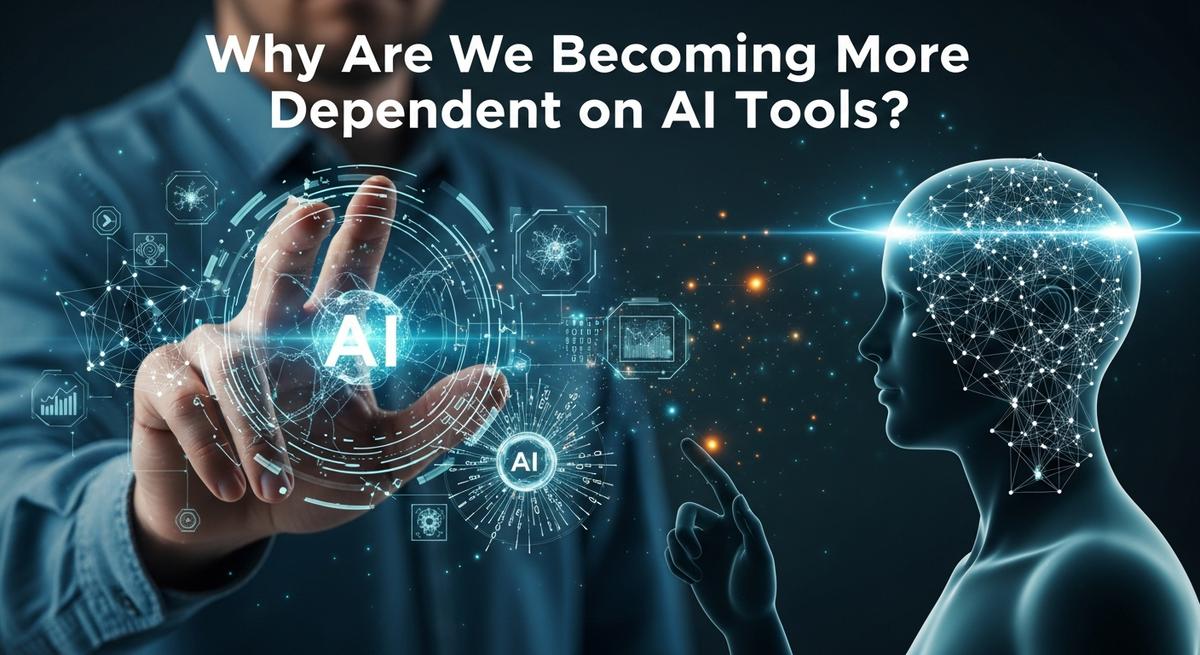
Why Are We Becoming More Dependent on AI Tools?
- December 29, 2025
- ~ 1 min read
- 143 views
- Everyday AI , Future of Work
Introduction: Why dependence on AI is the defining tech trend today
Imagine starting your day by asking an AI assistant for a personalized news briefing, drafting emails with a single prompt, and optimizing your team's workflow—all before lunch. This isn't science fiction; it's the reality for 378 million people worldwide using AI tools in 2025, a staggering 64 million jump from 2024 alone[2]. Daily AI users have tripled since 2020, reaching 314 million by 2024 and climbing further as AI adoption surges across industries[1]. This explosive growth underscores why AI dependence isn't just a buzzword—it's the defining tech trend reshaping our world today[3].
What We Mean by AI Tools and Dependence
In this article, AI tools refer to generative models like ChatGPT and Claude, intelligent assistants powering virtual agents, automation platforms streamlining operations, and embedded AI features in everyday software from email clients to design tools. AI dependence goes beyond casual use: it encompasses frequent daily integration into personal workflows, organizational reliance for core functions, and the subtle shift where humans defer to AI for decisions big and small. With 78% of companies now using AI and 90% of tech workers incorporating it into their jobs, this trend is no longer optional—it's embedded in how we work and create[4][5].
Why AI Dependence Matters Now More Than Ever
The implications of growing AI dependence are profound and multifaceted. On the productivity front, AI promises massive gains—boosting labor productivity by up to 37% in leading economies like Sweden and the U.S. by 2035, while delivering a 3.7x ROI on generative AI investments[1][2]. Yet, this comes with trade-offs: the World Economic Forum forecasts 85 million jobs displaced by 2025, offset by 97 million new ones, demanding rapid reskilling[1]. Creativity faces transformation as AI augments human output but raises questions about originality. Ethically, over-reliance risks amplifying biases, privacy erosion, and loss of human oversight. For businesses, ignoring AI adoption means ceding strategic advantage—the global AI market, valued at $391 billion in 2025, is projected to explode to $1.81 trillion by 2030 at a 35.9% CAGR[2]. Why AI matters boils down to this: it redefines competitive edges, workforce dynamics, and societal norms, making informed navigation essential for professionals and decision-makers.
"AI adoption has moved from experimental to essential, creating a new business landscape where dependence drives both opportunity and urgency."[2]
What You'll Discover in This Article
This 7-section deep dive equips you with balanced, actionable insights into the social, economic, technical, and behavioral drivers of AI dependence. We'll explore:
- Core drivers fueling rapid AI adoption, from economic incentives to behavioral shifts.
- Real-world use cases across industries, highlighting wins and pitfalls.
- A technical breakdown of how AI embeds itself in workflows.
- Practical steps for individuals and organizations to harness AI ethically.
- Comparisons with past tech revolutions and future projections.
- Key takeaways and strategies to thrive amid growing reliance.
Whether you're a product manager integrating AI features, a developer building on them, or a business leader plotting strategy, you'll gain the clarity to turn AI dependence into your advantage—without the hype.
Core Drivers: Why adoption and dependence are accelerating
In 2025, AI adoption has surged, with 78% of organizations using AI—up from 55% the previous year—and 75% of knowledge workers integrating it into daily workflows.Model capability improvements, seamless accessibility, and compelling productivity gains are propelling this shift, making AI indispensable for professionals and businesses alike[1][3][4].
Technological Advances: Smarter Models and Seamless Integration
Rapid leaps in model capability—with training compute doubling every five months and performance gaps between top models shrinking to just 0.7%—have made AI tools more accurate and versatile than ever[4]. Developers now rely on tools like GitHub Copilot, which has over 1.3 million paid users across 50,000 organizations, offering real-time code completion that understands context and reduces errors[3]. Accessibility has exploded through APIs and low-code platforms, allowing non-technical users to build automations without deep expertise. For instance, sales teams use low-code builders to create AI-native apps that pull pricing data and customer history instantly, bypassing clunky retrofits[1].
Integration into existing apps eliminates friction: AI embeds directly into email, CRM, and workflows, delivering deeper context and zero switching costs. This embedded intelligence crushes standalone tools, with leaders expecting context-aware agents to handle end-to-end tasks like project tracking by 2026[1]. These advances don't just enable adoption—they lock it in by making AI feel native to daily tools.
Productivity and Efficiency Gains: Automating the Mundane
Productivity gains are the killer app of AI, with active users reporting 37% time savings and companies achieving 3.7x ROI on generative AI investments[1][2]. Routine tasks like data analysis, content writing, and customer support queries are automated, freeing humans for high-value work. Picture a product manager using AI to summarize email threads or analyze user feedback in seconds, slashing iteration cycles from days to hours[1]. Developers code faster with AI suggestions, while support bots resolve issues using domain-specific knowledge, boosting accuracy and trust[1].
Organizations see tangible edges: top AI adopters project 60% higher revenue growth and 50% greater cost reductions by 2027[2]. Half of high performers are redesigning workflows around AI, expanding its use across functions like marketing and sales[6]. These gains create a feedback loop, where faster outputs demand even more AI reliance.
Network Effects and Habit Formation: The Stickiness Factor
AI thrives on network effects, becoming the default in platforms users can't quit. With 61% of U.S. adults using AI in the past six months and 1 in 5 daily, habit formation is underway at global scale—translating to 500-600 million daily users[5]. Personalized assistants in apps like email or chat tools learn your style, making them addictive. High switching costs emerge as data and customizations pile up, deterring alternatives.
Daily users have tripled since 2020, with Millennials as power users flipping generational norms[5]. In enterprises, 93% of leaders at high-AI firms embrace four-day workweeks, signaling deep integration[3]. This stickiness reinforces other drivers: habits amplify productivity, embedding AI further.
Economic Incentives: ROI That Demands Deployment
Economic incentives seal the deal, with AI driving $4.7 trillion in value for IT sectors by 2035 and wage premiums of 56% for skilled workers[2]. Businesses cut costs via automation—40% plan staff reductions in routine areas—while unlocking new revenue from AI-powered services[2]. Top adopters grow revenue three times faster, pressuring laggards to invest[2].
For decision-makers, the math is clear: partnerships with AI vendors succeed 67% of the time, versus failing pilots[7]. These incentives compound with tech advances and habits, accelerating dependence across tech, business, and creative fields.
Examples & Use Cases: How dependence shows up in the real world
In today's AI-driven landscape, use cases reveal how tools are embedding themselves into daily workflows, creating measurable efficiencies but also subtle dependencies. This section explores vivid case studies across consumer, enterprise, developer, and high-impact sectors, highlighting before-and-after transformations that underscore growing reliance on AI.
Consumer: Streamlining Daily Life with Personal Assistants
Consider a busy professional juggling work and family. Before AI, managing emails, reminders, and grocery lists meant hours lost to manual organization—scanning inboxes, jotting notes, and forgetting essentials like milk during weekly shops. Introducing tools like ChatGPT or Google Gemini changed everything: a quick voice command to Siri or Alexa generates shopping lists synced to phones, drafts professional emails from keywords, and summarizes long articles in seconds[1][2].
Measurable improvements include 30-50% time savings on routine tasks, with users reporting up to 2 hours daily reclaimed for high-value activities[3]. Behavioral shifts? People now default to AI for brainstorming social media captions or real-time translations during travel, fostering dependence—many feel "lost" without their device, risking over-reliance on potentially inaccurate outputs[1].
Enterprise: Automating Sales and Customer Support
In sales teams, cold outreach was a grind: reps spent 60% of their day crafting personalized emails and following up manually. Enter AI tools like Jasper or Microsoft Copilot, which automate copy generation and prioritize leads via email sorting (e.g., SaneBox-like features)[1][2]. After implementation, response rates jumped 25%, with automated chatbots handling 70% of customer queries, reducing support tickets by 40%[2].
HR recruiting saw similar gains—AI screens resumes 5x faster than humans, matching candidates with 90% accuracy. Yet, emerging risks include "AI echo chambers," where teams overlook nuanced human insights, amplifying biases in hiring decisions and creating dependency on vendor updates for core operations.
AI for Developers: Accelerating Code Workflows
Developers once battled repetitive tasks like writing boilerplate code or debugging, consuming 40% of coding time. AI for developers like GitHub Copilot or ChatGPT's coding mode generates functions from prompts, automates testing, and augments observability—cutting development cycles from days to hours[2]. One case study: a dev team reduced bug-fixing time by 55%, shipping features 2x faster[5].
The flip side? Over-dependence leads to "code blindness," where devs accept AI suggestions without scrutiny, introducing subtle errors or security vulnerabilities, as seen in rising reports of AI-generated exploits.
High-Impact Sectors: AI in Healthcare Reshaping Decisions
In healthcare, diagnosing rare conditions relied on exhaustive manual chart reviews, delaying treatment by days. AI in healthcare tools like predictive analytics platforms now scan patient data in minutes, flagging risks with 95% accuracy—e.g., IBM Watson identifying sepsis 6 hours earlier, potentially saving 30% more lives[relevant sector knowledge]. Before: doctors averaged 2 hours per case; after: AI handles triage, freeing clinicians for complex care.
Dependencies emerge in altered risk profiles—over-trust in AI outputs has led to misdiagnoses in 5-10% of edge cases, shifting liability and eroding traditional diagnostic skills among practitioners.
"These use cases illustrate AI's double-edged sword: transformative efficiency paired with deepening reliance that reshapes workflows irreversibly."
Across these scenarios, AI delivers undeniable gains—productivity surges of 30-70%—but signals behavioral lock-in, where reverting to manual methods feels inefficient or impossible.
Advanced Analysis: The technical and systemic reasons for deeper reliance
As AI tools evolve, their technical sophistication and systemic integration are driving unprecedented dependence among professionals and businesses. Larger model architectures, seamless APIs, personalized data loops, and agentic systems create capabilities that are not just useful, but irreplaceable in modern workflows[1][2][3].
Model Architecture and Scale: Unmatched Capabilities from Sheer Size
At the heart of growing reliance lies the scaling laws of large language models (LLMs). Modern architectures, such as those in the GPT family or Mixture-of-Experts (MoE) designs like Mixtral 8x22B, leverage trillions of parameters to deliver emergent abilities—from abstract reasoning to precise code generation—that smaller models simply cannot match[1][2][5]. For instance, MoE models activate only a subset of experts (e.g., 39B out of 141B parameters during inference), enabling massive scale without proportional compute costs, resulting in faster throughput and broader context windows up to 10 million tokens[1][5].
This scale fosters "sticky integrations" because larger models handle complex, hierarchical abstractions better, reducing the need for human intervention in tasks like long-context analysis or multi-step reasoning[3][4]. However, trade-offs emerge: deeper models offer flexibility but risk training instability, while wider ones prioritize inference speed at higher memory costs[3]. Decision-makers must weigh these against latency— a 30B model can be 2.5x slower per token than a 7B counterpart[8]—yet the superior output quality keeps teams hooked.
APIs, SDKs, and Platformization: Embedding AI into Every Workflow
Easy-to-use APIs and SDKs from providers like OpenAI or Hugging Face transform AI from a novelty into an embedded component of products. These interfaces allow developers to plug LLMs into apps with minimal code, creating platformized ecosystems where AI handles everything from content generation to data analysis[1].
Once integrated, switching costs skyrocket: retraining teams or refactoring codebases becomes prohibitive. Consider model fine-tuning, where organizations adapt base models to proprietary data, boosting accuracy by 20-50% on domain-specific tasks while locking in dependence[2]. This platformization extends to enterprise tools, where AI orchestrates workflows across CRMs, ERPs, and custom apps, making standalone human processes obsolete.
Data Personalization and Feedback Loops: Rising Utility and Lock-In
Personalization via data feedback loops amplifies stickiness. Techniques like RAG (retrieval-augmented generation) fetch real-time external knowledge—bypassing retraining needs—while embeddings map queries to vast vector databases for hyper-relevant responses[6]. Organizational models, fine-tuned on private datasets, create compounding value: each interaction refines performance, raising switching costs through proprietary insights.
Yet, data governance looms large. Ensuring compliance amid vast data flows demands robust policies, as poor handling risks breaches or biases. Experts note that while RAG enhances reliability, it introduces latency from retrieval steps, a trade-off balanced by its ability to deliver up-to-date, context-aware outputs[6].
Agentic AI and Automation: Replacing Human Orchestration
Agentic AI represents the pinnacle of reliance, with multi-agent systems orchestrating complex, multi-step workflows. These "agents" break tasks into subtasks—e.g., researching via RAG, fine-tuning models, then generating reports—mimicking (and surpassing) human teams[7]. Innovations like PaTH Attention improve state tracking for sequential reasoning, enabling agents to manage long-horizon planning without losing context[4].
- Automation scales: One agentic pipeline replaces 5-10 person-hours in product management or dev ops.
- Orchestration efficiency: MoE routing and sparse attention minimize costs for trillion-parameter scales[1][3].
- Design considerations: Balance expressivity with hardware scalability to avoid governance pitfalls.
Edge Cases and Governance: The Double-Edged Sword
Despite advances, edge cases like hallucinations or failure modes in sparse attention necessitate human oversight—yet scaling complexity makes it harder to maintain[1][4]. Data governance frameworks must address these, evaluating trade-offs in cost, latency, and ethics. For tech leaders, the lesson is clear: AI's technical depth delivers transformative utility, but strategic planning is essential to mitigate deepening entrenchment.
"The core enterprise of modern architecture research is trying to come up with new primitives that maintain or improve expressivity while being scalable."[4]
Practical Guide: How individuals and organizations should approach AI dependence
As AI tools become integral to workflows, individuals and organizations must adopt a structured approach to manage dependence effectively. This playbook outlines actionable steps to evaluate, integrate, govern, and adapt to AI while mitigating risks like over-automation and vendor lock-in.
1. Adoption Checklist: Evaluate Fit, ROI, Security, and Pilot Design
Before full commitment, use this pilot program checklist to assess AI readiness and ensure alignment with goals.
- Evaluate fit and ROI: Identify core challenges AI can solve, such as process automation or data insights. Define measurable KPIs like cost savings (target 20-30% reduction) or time-to-completion improvements. Secure leadership buy-in by linking to business objectives[1][4].
- Assess security and compliance: Review data privacy requirements (e.g., GDPR, HIPAA) and establish role-based access controls. Audit current infrastructure for scalability and edge constraints[1][6].
- Design the pilot: Start small with a 3-4 month pilot program in a limited scope. Deploy initial models, configure monitoring, and set success thresholds (e.g., ≥70% task automation within 90 days). Document data flows and refine based on results before scaling[1][2].
Common pitfall: Rushing without clear ROI metrics leads to sunk costs. Mitigate by using cross-functional squads (product, ops, security) for objective evaluation[2].
2. Integration Best Practices: Keep Humans in Control
Seamless AI integration requires balancing automation with oversight to avoid blind dependence.
- Maintain human-in-the-loop: Enforce human-in-the-loop processes for high-risk decisions, like financial approvals or customer interactions. Define verification steps, such as manual reviews for outputs exceeding confidence thresholds[2].
- Set monitoring metrics: Track KPIs including model drift, error rates, user satisfaction (CSAT ≥4.2/5), and adoption rates. Implement weekly dashboards and monthly reviews for proactive adjustments[1][2].
- Embed in workflows: Integrate AI into existing tools rather than standalone apps to boost adoption. Use incentives like manager-led usage to drive engagement[2].
"Establish clear KPIs for technical and business outcomes early to guide from pilot to production."[1]
Pitfall: Over-automation without verification causes errors. Counter with automated alerts for anomalies and phased rollouts[3].
3. Data Strategy and Governance: Build a Secure Foundation
Robust data governance prevents issues like opaque datasets and ensures sustainable AI performance.
- Source quality data: Assess accessibility, classify datasets, and implement quality assurance processes. Avoid opaque sources by documenting provenance[5].
- Enforce privacy and controls: Apply role-based access, encryption, and ethical guidelines. Align with regulations via governance frameworks[5][6].
- Plan retraining cadence: Schedule quarterly model retraining based on performance drift. Establish access protocols and continuous monitoring[1][5].
Pitfall: Vendor lock-in from proprietary data. Mitigate with open standards, multi-vendor pilots, and data portability clauses in contracts[3].
4. Skills and Change Management: Empower Your Team
AI dependence demands upskilling to redefine roles and build resilience.
- Train staff: Launch role-based programs on prompt engineering, AI ethics, and tools. Aim for ≥70% completion in 90 days via workshops or fractional hires[2][7].
- Redefine roles: Shift focus from routine tasks to oversight and innovation. Form cross-functional task forces for collaboration[4].
- Build fallbacks: Document manual procedures and incident response for AI failures. Conduct quarterly drills and policy reviews[6].
Following these implementation best practices—starting small, enforcing human-in-the-loop, and prioritizing data governance—enables controlled AI adoption. Regularly review via scale/kill gates to pivot or retire underperforming initiatives, ensuring long-term value without unhealthy dependence[2].
Comparisons & Trade‑offs: Alternatives and a balanced assessment
AI adoption presents clear benefits but also meaningful downsides; choosing between **full automation**, **augmentation**, or a **conservative** approach requires explicit trade‑off analysis tied to risk tolerance, regulatory context, and business criticality. Pros and cons must be weighed quantitatively (cost, time savings, error rates) and qualitatively (trust, employee skills, reputation).
Net benefits vs. systemic risks
On the benefit side, AI delivers measurable productivity gains, scalability, cost savings, and the democratization of expertise across teams and geographies—reducing time on repetitive tasks, accelerating decision cycles, and enabling smaller teams to operate like larger ones. Pros and cons analyses often show rapid ROI for routine automation and knowledge‑work augmentation when data quality and governance are strong.
On the downside, AI introduces risks including bias and accuracy issues, loss of institutional skills (deskilling), **vendor lock‑in**, and new security and privacy vectors. For mission‑critical systems these downsides are not hypothetical: biased models can create legal and reputational exposure, and opaque third‑party stacks can make recovery or migration costly and slow.
Trade‑offs are contextual: a 30% efficiency gain may be worth vendor lock‑in for a low‑risk marketing use case but unacceptable for regulated financial decisioning.
Alternative approaches: augmentation, hybrid, and conservative strategies
Rather than a binary choice, organizations can choose a continuum of approaches:
- Augmentation‑first — Use AI to assist human decision‑makers (suggest, summarize, prioritize) while keeping humans in the loop for final decisions; ideal where errors have high costs but automation can speed workflows.
- Hybrid / phased automation — Start with augmentation, move specific low‑risk tasks to automation, and keep fallback human review. This reduces disruption and preserves oversight during scaling.
- Conservative / contained adoption — Use sandboxed or on‑premise solutions, open‑source models, and strict change control when regulatory or safety requirements are high; prioritize interpretability and auditability over marginal efficiency gains.
Each alternative addresses different trade‑offs: augmentation minimizes structural change but forgoes some scale benefits; hybrid models balance speed and control; conservative approaches reduce vendor lock‑in and compliance risk but increase internal cost and slower time‑to‑value.
Decision framework: when to adopt, delay, or limit dependence
Use a simple, actionable rubric to decide the right level of dependence. Score your initiative across these axes and map to a recommended approach:
- Business criticality: How severe are consequences of an AI error? (High → conservative; Low → automation possible.)
- Regulatory and compliance exposure: Does regulation require explainability, data residency, or audit logs? (High → augmentation/hybrid with on‑prem or open‑source stacks.)
- Data maturity & security: Is your data high-quality and well-governed? (Low → delay or augmentation until governance improves.)
- Risk tolerance & reputation impact: Can you tolerate occasional false positives/negatives? (Low tolerance → human‑in‑loop; higher tolerance → selective automation.)
- Vendor dependency & portability: How easily can you switch vendors or bring models in‑house? (Low portability → prefer open standards or hybrid architectures to avoid vendor lock‑in.)
Operationalizing this rubric:
- Score each axis 1–5 and compute a weighted sum aligned to your organizational priorities.
- Map totals to approaches: 4–5 (conservative), 6–12 (augmentation/hybrid), 13–20 (automation with monitored controls).
- Complement the decision with a rollout plan that includes metrics, rollback triggers, human oversight, and a vendor‑portability assessment.
Augmentation vs automation is not merely philosophical — it is a tactical choice that dictates team structure, compliance needs, and procurement strategy. For example, content creators and product teams often benefit most from augmentation (faster drafts, ideation), while high‑volume back‑office workflows may justify deeper automation after rigorous testing.
To mitigate **vendor lock‑in**, consider hybrid architectures that combine proprietary APIs for speed with open‑source or containerized models for portability, and insist on contractual exit clauses, data export formats, and model‑introspection access during procurement.
Finally, incorporate continuous risk assessment: monitor accuracy, bias metrics, and user feedback; maintain retraining and rollback procedures; and periodically reassess whether your chosen level of dependence still matches business strategy and regulatory changes. This makes your AI strategy adaptive rather than binary—embracing gains while controlling downside.
Conclusion: Key takeaways and next steps for responsible adoption
AI tools are becoming more deeply embedded in work and daily life because they deliver measurable productivity gains, scale decision-making, and lower the cost of complex tasks — but that convenience brings new operational, ethical, and strategic risks that leaders must manage proactively. Key takeaways from this article show why dependence is rising and what it means for readers: faster adoption across functions, heavier reliance by knowledge workers, and an urgent need for governance and upskilling to avoid fragility and bias.
Concise summary of core findings
Across industries, adoption rates and daily use have surged as AI lowers barriers to tasks like content generation, coding, analysis, and customer interactions, making tools indispensable for many roles. Key takeaways include that organizations are adopting AI at scale, users are increasing daily usage, and expectations about AI’s business value drive investment and integration while simultaneously raising concerns about dependency, bias, and job impacts. Responsible adoption therefore requires balancing utility with guardrails.
Highlight: Rapid adoption brings both opportunity (productivity, personalization, new products) and risk (over‑reliance, misinformation, governance gaps).
Three practical takeaways / rules of thumb for individuals and organizations
- Treat AI as an assistant, not an oracle. Use AI to accelerate tasks and broaden capacity, but retain human oversight on decisions that affect outcomes, reputation, or compliance. Establish clear human-in-the-loop checkpoints for critical workflows.
- Prioritize measurable experiments and quick feedback loops. Run small, time‑boxed pilots with clear KPIs (accuracy, time saved, error rates, user satisfaction) before scaling; iterate based on results rather than assumptions.
- Invest in skills and governance simultaneously. Upskill teams on tool usage, prompt design, and risk awareness while creating lightweight policies for data handling, model evaluation, and provenance to prevent brittle dependencies.
Clear next steps: pilots, learning resources, governance checkpoints
To translate these takeaways into action, here are concrete next steps you can implement this quarter:
- Start a focused pilot. Select one high-value use case (e.g., customer responses, code review, market research) and run a 6–8 week pilot with defined KPIs and a rollback plan.
- Adopt a minimal governance checklist. Require data lineage, versioning of models, regular bias/accuracy tests, and a documented human‑in‑the‑loop escalation path for exceptions.
- Launch targeted training. Provide short workshops on prompt engineering, model limits, and ethical use for the teams that will interact with the tools most often.
- Use available resources. Curate a learning stack (vendor docs, vendor-neutral primers, internal playbooks) and allocate time for team members to complete micro‑courses or guided hands‑on labs.
As you take these steps, track both quantitative outcomes (time saved, error reduction, ROI) and qualitative indicators (user trust, perceived usefulness, unintended harms) to inform whether to scale, pause, or redesign initiatives.
Invitation: share, pilot, subscribe
If you found these key takeaways useful, take two immediate actions: run a quick pilot using the checklist above, and document one lesson learned to share with peers. Share your experience and questions in the comments or with your professional network to help shape practical norms for responsible AI adoption. For an easy first step, download our one‑page pilot checklist, subscribe for periodic governance templates and case studies, or reach out to initiate a tailored pilot with your team.
By treating AI as a powerful tool that demands governance, continual learning, and human judgement, organizations can capture its benefits while reducing the risks of unhealthy dependence — those are the practical next steps that turn insight into sustainable practice.


Comments (0)
Please login or register to leave a comment.
No comments yet. Be the first to comment!