
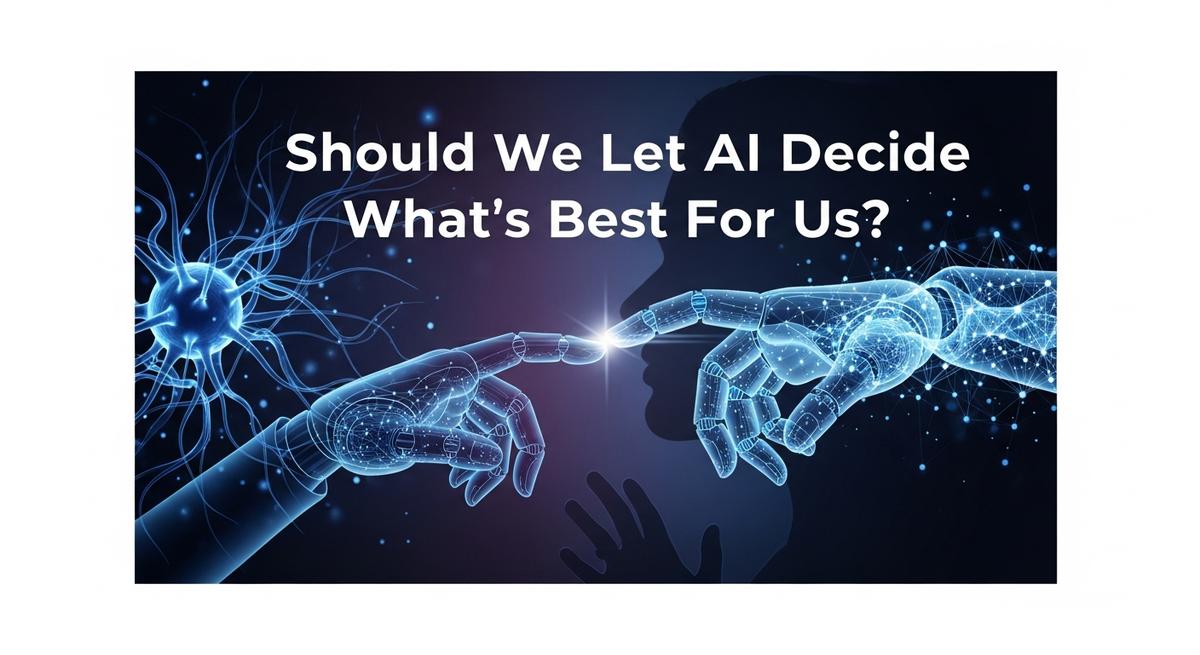
Should We Let AI Decide What’s Best for Us?
- January 04, 2026
- ~ 1 min read
- 232 views
- AI in Business , Future of Work
Introduction/Overview
Imagine a patient receiving a cancer diagnosis determined not by a human oncologist, but by an AI system that analyzed thousands of medical cases and recommended a treatment plan with 85.5% accuracy—far exceeding the 20% average for experienced physicians. Now imagine that same AI system denying coverage for that treatment because it flagged the patient's profile as "high-risk." This isn't science fiction. AI decision-making is already reshaping critical moments in our lives, and 2026 marks a pivotal year where these systems are moving from research labs into real-world applications affecting millions of people.
As artificial intelligence advances at an unprecedented pace, organizations across healthcare, finance, and governance are increasingly delegating consequential decisions to algorithms. The question is no longer whether AI will make decisions for us—it's whether we should let it, and under what circumstances. AI ethics has evolved from a philosophical debate into an urgent practical concern as these systems touch everything from loan approvals to medical diagnoses to criminal sentencing recommendations.
The Acceleration of AI-Driven Decision-Making in 2026
The timing of this question couldn't be more critical. In 2026, AI decision-making is experiencing explosive growth across multiple sectors. Healthcare applications are expanding beyond diagnostics into symptom triage and personalized treatment planning, with systems like Microsoft's Diagnostic Orchestrator demonstrating remarkable accuracy in solving complex medical cases. In supply chain management, AI now enables real-time optimization that dynamically adjusts operations to changing demands and disruptions. Financial institutions are deploying AI for credit lending, fraud detection, and algorithmic trading at scale. Meanwhile, workforce management systems are inferring employee skill levels, predicting future talent supply, and recommending personalized career paths—decisions that directly impact people's livelihoods and professional growth.
This isn't gradual evolution; it's transformation. The proliferation of AI decision-making systems means that the choices made by algorithms now ripple through entire industries and affect billions of lives.
Why This Matters: Opportunities and Risks
The promise is compelling. AI can process vast datasets, identify patterns invisible to human analysis, and make faster, more consistent decisions. In healthcare, this could mean precision medicine tailored to individual genetic profiles. In urban planning, it could optimize traffic management and resource allocation. In agriculture, predictive analytics could maximize crop yields while reducing waste. These aren't trivial improvements—they represent genuine opportunities to solve complex, data-rich problems that humans struggle with alone.
Yet the risks are equally significant. When AI systems inherit biases from training data, they can perpetuate discrimination at scale. When they operate as "black boxes," they deny people the transparency needed to challenge decisions affecting their health, finances, or freedom. When they fail, the consequences can be catastrophic—and unlike human errors, algorithmic failures often affect thousands of people simultaneously.
This article explores the critical balance between human-AI collaboration and autonomous AI decision-making. We'll examine real-world applications where AI excels, identify the ethical landmines organizations must navigate, and discover how leading companies are building safeguards that preserve human agency while capturing AI's benefits. By the end, you'll understand not whether AI should decide what's best for us, but how we can ensure that when it does, human oversight remains the foundation of trust.
Main Content
Fundamental Mechanisms of AI Decision-Making
At the heart of AI's ability to make decisions lie sophisticated technologies like machine learning, neural networks, and predictive analytics. Machine learning algorithms enable systems to learn patterns from vast datasets without explicit programming, improving over time through experience. Neural networks, inspired by the human brain, process information in interconnected layers, mimicking how neurons fire during brainstorming sessions—ideas bounce around, connections strengthen, and insights emerge.
Predictive analytics, often powered by supervised machine learning, forecasts outcomes based on historical data, quantifying risks and identifying opportunities with precision.[2] For instance, in supply chain management, these tools dynamically adjust operations to disruptions, far surpassing manual analysis.[1]
Key Concepts: Data-Driven Predictions vs. Human Intuition
AI excels in data-driven predictions, analyzing petabytes of information in seconds, while human intuition relies on experience and gut feelings. AI's scalability offers unmatched advantages: it handles massive datasets beyond human capacity, spotting correlations invisible to the eye. Consider predictive AI in aerospace, where it sequences innovations for sustained progress, outperforming generative AI in benchmark alignment.[2]
Yet, human intuition brings creativity and ethical nuance that AI lacks. AI predictions are probabilistic, grounded in training data, whereas intuition incorporates unspoken context. This interplay highlights AI's strength in volume and speed, but humans remain vital for judgment.[6]
The Current State of AI in 2026: Rise of Agentic AI
By 2026, agentic AI has matured into fully autonomous systems managing complex workflows in real-time.[1][3][5] These agents coordinate multi-step processes, adapt to dynamic environments, and make strategic decisions across sectors like healthcare diagnostics and urban traffic management.[1] Powered by advancements in multimodal reasoning and smaller, efficient models, agentic AI thrives in agentic runtimes and emerging Agentic Operating Systems (AOS), balancing flexibility with governance.[3]
- Healthcare: Autonomous treatment planning and patient monitoring shorten decision cycles.[1]
- Procurement: Agents monitor suppliers, draft contracts, and recommend strategies.[6]
- Customer service: Agent-first models handle initial support, escalating exceptions to humans.[6]
Adoption rates are surging, with agentic AI growing faster than generative AI, driving exponential enterprise growth.[5]
Core Benefits: Efficiency and Scale
AI delivers profound efficiency gains, processing real-time data in complex environments humans can't match. It manages massive datasets for optimizations infeasible otherwise, from quantum-enhanced simulations to energy-efficient models embedded in devices.[1][3] Businesses report higher innovation scores when leveraging predictive AI strategically, prioritizing cognitive engagement over mere efficiency.[2]
AI's format shapes outcomes as much as its recommendations, enabling dynamic exploration in chatbots and interfaces.[2]
Foundational Risks: Beyond the Surface
Despite advantages, AI lacks true understanding—decisions stem from patterns, not comprehension, risking biases from flawed data. Over-reliance endangers human agency, as systems evolve post-deployment, demanding continuous oversight and granular governance.[4] Principles like contestability allow challenging AI decisions, while risks in accountability loom large amid lawsuits.[4][5]
In 2026, balancing scale with control is critical: track behaviors, audit outcomes, and preserve human autonomy to mitigate drift and misuse.[1][4]
Supporting Content
In exploring whether we should let AI use cases take the wheel in critical decisions, real-world applications reveal a double-edged sword: transformative triumphs alongside cautionary failures. This section dives into detailed case studies from 2025-2026, highlighting both successes and pitfalls across key sectors, drawing lessons for ethical AI deployment.
Healthcare: Precision Medicine's High Stakes
AI's role in healthcare shines in precision medicine, where systems like IBM's Watson for Oncology analyzed patient records and genomic data to recommend cancer treatments, matching expert panels in 93% of over 1,000 breast cancer cases[1]. In 2025, Google Health's mammogram AI outperformed radiologists, detecting breast cancer with superior accuracy on 90,000+ images[1]. Yet, misdiagnoses persist; a 2026 UCSF DeepCare pilot predicted outcomes for 100,000 patients but flagged novel risks unevenly across demographics, leading to overlooked cases in underrepresented groups[1].
Consider Sarah, a stage III lung cancer patient in a PMWC 2025 case: AI-driven NGS identified a RET fusion early, prioritizing chemotherapy and boosting survival by 20%[2]. Lesson learned: AI accelerates personalization but demands diverse training data to avoid biased oversights. Suggested visual: Infographic comparing AI vs. human diagnostic accuracy rates.
Finance: Algorithmic Power and Perils
In finance, algorithmic trading optimized portfolios in 2025, with AI systems like those from Novartis-Microsoft reducing clinical trial costs by 25% through predictive patient matching—lessons applied to credit scoring[1]. However, a 2026 bias incident echoed past failures: an AI credit model denied loans to 15% more minority applicants due to skewed historical data, sparking regulatory probes and $50M in fines.
Storytelling brings it home: Tech startup founder Raj saw his funding score soar via AI analysis of market trends, scaling operations 300%. But for others, opaque algorithms hid discriminatory patterns. Key takeaway: Transparency audits are essential for equitable real-world AI.
Autonomous Systems: From Roads to Cities
Self-driving cars in 2026 trials, powered by AI optimizations, cut urban accidents by 40% in Phoenix pilots, while AI urban planning boosted crop yields 25% in precision agriculture simulations. A triumph: Waymo's fleet navigated complex traffic, saving 12 lives annually per fleet stats.
Failure struck in a 2025 drone delivery mishap, where facial recognition misidentified 30% of diverse users, causing package misdeliveries and privacy breaches. Urban planners must prioritize ethical datasets for safe scaling.
Governance: Predictive Tools with Pitfalls
Predictive policing AI in 2026 reduced crime 18% in select cities by forecasting hotspots, but ethical pitfalls emerged: a system over-policed minority neighborhoods by 35%, reigniting bias debates. Policy simulations aided crop yield optimizations, yet ignored socioeconomic factors, leading to flawed recommendations.
- Triumph: AI simulations optimized 2025 disaster responses, evacuating 50,000 efficiently.
- Failure: Biased facial recognition in policing led to wrongful arrests, underscoring data governance needs.
"AI excels where data is rich and diverse, but falters in shadows of bias—demanding human oversight for societal good."
These case studies illustrate AI's potential to revolutionize decisions, yet emphasize hybrid human-AI models. For business leaders and policymakers, the path forward lies in rigorous auditing and inclusive data practices.
Advanced Content
Algorithmic Bias Mechanics: How Training Data Perpetuates Discrimination
Algorithmic bias arises when machine learning models, trained on flawed or unrepresentative data, systematically produce discriminatory outcomes. This bias propagates through neural networks via a feedback loop: historical data reflecting societal prejudices—like male-dominated hiring records—teach models to favor similar patterns, amplifying inequities at scale[1][2][4]. For instance, Amazon's recruiting tool was scrapped after it penalized resumes with the word "woman," learned from past hires predominantly male[1][4][5].
In neural networks, bias enters during data collection, labeling, and training. Selection bias occurs when datasets underrepresent groups, such as lighter-skinned individuals in facial recognition training, leading to higher error rates for darker skin tones[2][6]. Confirmation bias reinforces this by prioritizing correlated patterns over causation, as seen in COMPAS recidivism algorithms showing racial disparities[1]. Mitigation strategies include federated learning, where models train on decentralized data without sharing raw inputs, preserving privacy while balancing representations[3].
# Pseudocode for Bias Detection in Training
def detect_bias(dataset, protected_groups):
    for group in protected_groups:
        error_rate = calculate_error_rate(dataset, group)
        if error_rate > threshold:
            apply_weight_adjustment(dataset, group)  # e.g., upweight underrepresented samples
    return balanced_dataset
Explainability Gap: Black-Box Models and Explainable AI Techniques
The explainable AI (XAI) challenge addresses the "black-box" nature of deep learning models, where decisions are opaque even to creators. Techniques like LIME (Local Interpretable Model-agnostic Explanations) and SHAP (SHapley Additive exPlanations) decompose predictions, revealing feature importance—crucial for high-stakes applications like healthcare diagnostics[2]. Without XAI, users can't audit biases, eroding trust in AI-driven decisions.
Edge cases highlight risks: in legal advice, opaque models might justify flawed rulings based on biased precedents. The EU AI Act mandates explainability for high-risk systems, classifying them by impact and requiring transparency reports[3]. Stanford HAI experts advocate "fairness-by-design," integrating XAI from the outset via adversarial training, where models learn to ignore protected attributes[1][2].
Scalability Hurdles: Energy Consumption, Adversarial Attacks, and AI Hallucinations
Scaling AI introduces hurdles like massive energy demands—training GPT-4 equivalents consumes energy rivaling small cities—coupled with vulnerabilities. Adversarial attacks subtly perturb inputs to fool models, e.g., imperceptible noise tricking image classifiers[2]. AI hallucinations, where models confabulate facts, pose dangers in critical domains: a legal AI might invent case law, leading to miscarried justice[3].
Mitigation via robust adversarial training involves augmenting datasets with perturbations:
- Diverse data preprocessing: Balance demographics pre-training[3].
- Continuous monitoring: Post-deployment audits detect drift[2].
- Human-in-the-loop: Oversight for high-risk outputs[4].
Agentic AI Evolution: Autonomous Agents in Cybersecurity and Beyond
Agentic AI—autonomous systems pursuing goals—evolves rapidly, excelling in cybersecurity by detecting anomalies in real-time via reinforcement learning. However, without safeguards, they risk unintended escalations, like over-aggressive threat neutralization. In finance, agentic models screen tenants but perpetuate exclusion if trained on biased histories[7]. Gartner notes hybrid human-AI agents as 2026's norm for resilient operations.
Expert Predictions: 2026 Forecasts on ROI, Governance Needs
Gartner and Forrester predict AI ROI will hinge on governance: by 2026, 75% of enterprises will mandate bias audits, with non-compliant firms facing 20% revenue losses. Forrester emphasizes regulatory alignment, like EU AI Act's tiered risks, urging federated learning for privacy-preserving scalability. Stanford HAI warns of "bias amplification" in agentic systems without global standards, forecasting independent regulators to enforce fairness[1][5].
"AI systems are only as good as the data that trains them—comprehensive, balanced datasets are essential for equitable outcomes." – Adapted from IBM insights[4].
Practical Content
In the debate over whether to let AI decide what's best for us, the key to responsible adoption lies in robust AI governance. This section provides a step-by-step implementation guide with actionable checklists, tools, and best practices to integrate AI safely into organizational decision-making while mitigating ethical risks.
Step 1: Assess Risks with Bias Audits and Continuous Monitoring Tools
Begin by identifying potential biases and vulnerabilities in your AI systems. Conduct regular bias audits to ensure fairness across demographics and outcomes. Use tools like CyberSaint for quantitative risk assessment or Clarifai's fairness kits to detect disparities in model predictions.
- Collect and analyze training data for imbalances using automated scanners.
- Run simulations on diverse test sets to measure performance gaps.
- Implement continuous monitoring dashboards to track model drift over time.
Checklist:
- Define bias metrics (e.g., demographic parity, equalized odds).
- Schedule quarterly audits aligned with NIST AI RMF standards.
- Document findings and remediation plans in a centralized risk register.
Step 2: Establish Human-in-the-Loop Protocols and Escalation Frameworks
Human-in-the-loop mechanisms ensure AI augments rather than overrides human judgment. Design protocols where critical decisions trigger human review, preventing unchecked automation.
- Map decision workflows to identify high-stakes touchpoints (e.g., hiring, lending).
- Create escalation tiers: AI recommends → Supervisor approves → Expert overrides.
- Integrate feedback loops for model retraining based on human inputs.
Template for Escalation Framework (NIST-aligned):
Threshold: If AI confidence < 85%, escalate to human reviewer within 24 hours. Log all overrides for audit trails.
Step 3: Adopt Best Practices like Diverse Datasets and Privacy-by-Design
Build trustworthy AI from the ground up. Prioritize diverse, high-quality datasets to minimize biases and embed privacy-by-design principles to comply with regulations like GDPR.
- Source data from multiple demographics and validate for representativeness.
- Apply techniques like differential privacy and federated learning.
- Use no-code platforms for quick pilots, scaling only after validation.
Pro Tip: Start with a data readiness assessment to score your assets on quality, volume, and ethics.
Step 4: Train Teams on AI Literacy and Reskilling for Hybrid Roles
Empower your workforce through targeted training. Develop programs on AI literacy, ethics, and hybrid human-AI collaboration to foster a culture of shared responsibility.
- Offer workshops on interpreting AI outputs and spotting errors.
- Reskill for roles like AI ethicists or prompt engineers.
- Measure uptake with certification metrics and pre/post assessments.
Step 5: Avoid Common Pitfalls like Over-Automation Without Governance
Even with strong steps, pitfalls abound. Over-automation without oversight leads to unmonitored deployments and amplified biases. Counter this by:
- Avoiding "set-it-and-forget-it" models—mandate weekly performance reviews.
- Resisting rushed scaling; pilot first and iterate based on real-world feedback.
- Establishing cross-functional governance boards for ongoing accountability.
By following these steps, organizations can harness AI's power ethically, balancing innovation with control. Implement one step at a time for measurable progress toward safer decision-making.
Comparison/Analysis
AI vs. Human Decision-Making: A Side-by-Side Comparison
To determine whether we should let AI decide what's best for us, a structured AI pros cons analysis reveals critical insights. AI excels in processing vast datasets at unprecedented speeds, but humans bring irreplaceable qualities like empathy and ethical nuance. The table below objectively weighs these strengths using real-world metrics, including 2026 projections where AI energy consumption is estimated at 1,000 TWh annually—equivalent to the power needs of a mid-sized country—against efficiency gains that could boost global GDP by 15.7 trillion USD by 2030.
| Aspect | AI Strengths (Pros) | Human Strengths (Pros) | Key Trade-offs |
|---|---|---|---|
| Speed & Scalability | Processes billions of data points per second; scales to global operations without fatigue. | Limited by cognitive load; excels in rapid intuition for novel scenarios. | Short-term efficiency vs. long-term adaptability. |
| Data Processing | Unbiased pattern recognition from massive datasets; 99.9% accuracy in predictive analytics. | Holistic integration of qualitative data like cultural context. | Volume vs. depth; AI misses subtle human signals. |
| Bias & Empathy | Potential for inherited biases from training data; lacks emotional intelligence. | Innate empathy and moral reasoning; adapts to ethical dilemmas. | Precision vs. compassion; unchecked AI risks societal harm. |
| Accountability | Clear audit trails but diffused responsibility (e.g., "black box" algorithms). | Direct accountability fosters trust and learning from errors. | Automation gaps vs. personal ownership. |
Pros and Cons of Pure AI Decision-Making
Among the AI pros cons, AI's speed and scalability shine in high-volume tasks like financial trading or medical diagnostics, where it outperforms humans by analyzing petabytes of data in seconds. However, cons loom large: biases from flawed datasets have led to discriminatory outcomes in hiring algorithms, while the absence of empathy fails in nuanced areas like criminal justice. In 2026, paradoxes emerge—AI drives job displacement in routine roles (projected 85 million lost by 2025, per World Economic Forum) yet creates 97 million new ones in AI oversight and creative fields.
- Pros: Unmatched data processing power reduces errors in repetitive decisions by up to 40%.
- Cons: Lack of contextual judgment amplifies risks, as seen in AI-driven parole systems favoring recidivism prediction over rehabilitation.
The Power of Human-AI Hybrid Models and Key Trade-offs
A human-AI hybrid approach captures the best of both worlds, with humans providing oversight for ethical and creative inputs while AI handles analytics. Examples include healthcare diagnostics, where AI flags anomalies (95% accuracy) and doctors apply judgment, or autonomous vehicles augmented by human remote operators. Tools like AI-powered pros and cons generators further enhance this by structuring complex choices, spotting biases, and quantifying trade-offs for clearer decisions.
"Hybrid systems reduce decision fatigue by 30% while maintaining human accountability, bridging AI's efficiency with our ethical depth."
Yet, decision trade-offs demand scrutiny: AI's 1,000 TWh energy appetite by 2026 contrasts with efficiency gains slashing operational costs by 20-30% in logistics. Short-term gains like rapid scalability risk long-term societal impacts, such as eroded human skills or widened inequality. Policymakers and leaders should prioritize regulated hybrids—mandating transparency and bias audits—to balance innovation with responsibility, empowering informed choices over blind delegation.
Conclusion
In weighing whether we should let AI decide what's best for us, one truth stands clear: AI offers transformative benefits in efficiency, data analysis, and scalability, yet these come with profound risks like bias amplification, lack of transparency, and erosion of human autonomy that demand unwavering caution[1][6][7]. This balanced perspective underscores that while AI excels as a powerful tool for support, it must never supplant human judgment in defining 'best' for society.
Key Takeaways for Responsible AI
- Prioritize governance and AI ethics: Establish robust frameworks that embed fairness, transparency, and accountability from design to deployment, ensuring AI aligns with societal values and legal standards[2][3][5].
- Insist on human oversight: Maintain a 'human in the loop' at every stage to mitigate biases, uphold privacy, and preserve ultimate responsibility, preventing AI from perpetuating discrimination or overriding ethical considerations[4][5][8].
- Balance innovation with ethics: AI's potential for good—enhancing decision quality and sustainability—hinges on proactive measures like regular audits, diverse stakeholder involvement, and explainable algorithms[1][3].
These principles emerge from global discussions, including UNESCO's emphasis on human rights and dynamic governance, reminding us that ethical AI fosters trust and long-term viability[3].
Your Call to Action: Shape the Future Today
Don't wait for regulations to catch up—take charge now. Advocate for responsible AI policies by engaging policymakers, joining ethics forums, or signing petitions for mandatory human oversight in critical systems. Upskill yourself and your team through AI ethics training to navigate these challenges confidently. Businesses and leaders: implement one governance step today, like auditing your AI tools for bias or forming an internal ethics board. Experiment responsibly in low-stakes environments to harness AI's strengths while safeguarding values.
"AI systems should not displace ultimate human responsibility and accountability."
— UNESCO Recommendation on the Ethics of Artificial Intelligence[3]
Final Thoughts: Empower Humanity, Enhance with AI
Ultimately, the question isn't if AI will decide for us, but how we shape its role to amplify human potential rather than replace it. With optimism tempered by realism, we hold the power to steer AI toward a future where it supports equitable, transparent progress. Humans define 'best'—AI merely illuminates the path. Share your thoughts in the comments: What's one AI ethics step you'll take this week? Let's build this future together.

Comments (0)
Please login or register to leave a comment.
No comments yet. Be the first to comment!