
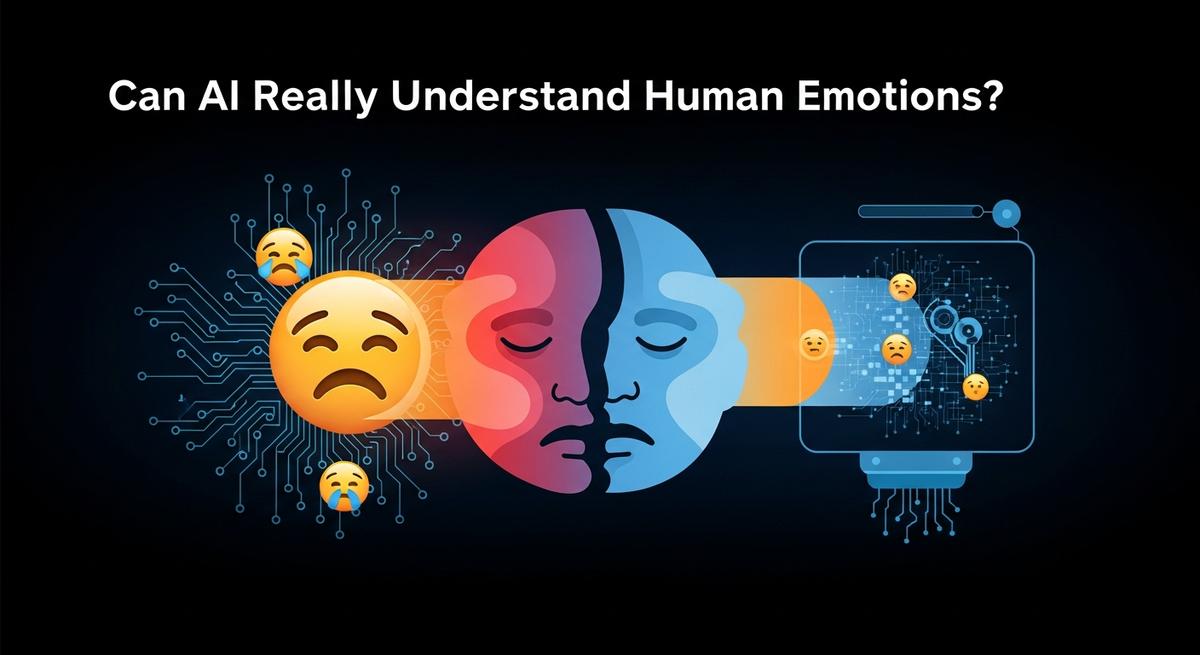
Can AI Really Understand Human Emotions?
- January 03, 2026
- ~ 1 min read
- 255 views
- GenAI , Everyday AI
Introduction/Overview
Imagine a frustrated customer calling tech support, dripping with sarcasm: "Oh sure, because nothing says 'great service' like a three-hour hold time." The AI chatbot, designed to detect anger through tone analysis, escalates the call unnecessarily—missing the sarcasm entirely and turning a solvable issue into a viral complaint. This all-too-common scenario highlights a critical question: Can AI really understand human emotions, or is it just cleverly mimicking empathy?[1][2]
What is Emotion AI and Affective Computing?
Emotion AI, also known as affective computing, refers to technologies that enable machines to recognize, interpret, and respond to human emotions using inputs like facial expressions, voice tone, text sentiment, and even physiological signals. Pioneered by researchers building on Paul Ekman's foundational work on universal emotions—such as joy, sadness, anger, fear, surprise, and disgust—this field has exploded in 2026.[1][2][5]
Recent benchmarks reveal emotion AI systems achieving 70-79% accuracy in controlled tests, with tools like GPT-4.1 outperforming dedicated software in facial emotion detection at 63% success rates, while specialized platforms like Imertiv AI and Hume reach 36-40%.[3] Advances in multimodal fusion—combining computer vision, natural language processing (NLP), and vocal biomarkers—power real-time applications from call centers to social media platforms like TikTok and Meta, where algorithms curate content based on detected moods.[4][7]
By 2026, affective computing isn't science fiction—it's transforming customer service, healthcare, and beyond, but with accuracy gaps that expose its limitations.[3][8]
What You'll Discover in This Article
This comprehensive guide—spanning 7 sections—dives deep into the true potential of AI's emotional intelligence. You'll explore:
- Core capabilities of emotion AI, from facial micro-expression analysis to voice emotion recognition.
- Key limitations, including sarcasm detection failures and benchmark accuracies hovering at 70-79%.
- Real-world applications in business (e.g., Cogito's call center feedback), healthcare (e.g., mental health chatbots), and automotive safety.
- Ethical concerns, privacy frameworks, and the future outlook for brain-computer interfaces and generative emotional AI.
Why Human Emotions Matter for AI's Future
For businesses, mastering human emotions through affective computing means boosting customer satisfaction, reducing churn, and personalizing experiences—think emotion-aware dashboards alerting agents to frustration in real-time.[1][2][8] In healthcare, it enables non-invasive tools like blood pressure detection via video or therapeutic support for mental health.[1][5]
Developers and leaders will gain actionable insights to integrate these technologies ethically, while general readers will uncover how AI is reshaping human-AI interaction. As we question whether machines can truly "feel" our emotions, this article equips you to navigate the hype, harness the opportunities, and anticipate what's next in 2026 and beyond.[4][6]
Main Content
Core Technologies Powering Emotion Recognition
At the heart of AI's attempt to grasp human emotions lies emotion recognition, a suite of technologies that parse visual, auditory, and textual cues much like a skilled psychologist reads body language, tone, and words. Computer vision excels in analyzing facial expressions, using convolutional neural networks (CNNs) to detect subtle muscle movements—such as a fleeting micro-expression of surprise or the curve of a genuine smile—that humans might miss[1][4]. Think of it as teaching AI to interpret a poker face by mapping facial landmarks and action units, classifying emotions like happiness, anger, or disgust with precision[4].
Meanwhile, speech analysis dives into vocal tones via speech-to-text (STT) and prosodic features, capturing nuances in pitch, tempo, and volume to infer frustration in a raised voice or joy in upbeat inflection[2][5]. Sentiment analysis, powered by natural language processing (NLP), scrutinizes text for emotional intent through word choice, punctuation, and context, with large language models like GPT-4 identifying subtle cues in written language[1][6]. These tools form the foundation, enabling AI to process emotions across modalities for more holistic insights.
Datasets and Accuracy Benchmarks
Training these systems relies on benchmark datasets like CK+ (Extended Cohn-Kanade), which provides high-quality sequences of posed and spontaneous facial expressions, and JAFFE (Japanese Female Facial Expression), offering culturally diverse images of seven basic emotions[4]. These datasets, combined with speech emotion recognition corpora and text-based sentiment libraries, allow models to learn from thousands of labeled examples[5].
Accuracy varies but is impressive: speech and text-based systems often hit 70-79% on standard benchmarks, with GPT-4.1 achieving 63% on facial emotion detection across 70 images in recent tests[3]. However, limitations persist, particularly in cultural nuances—a smile might signal politeness in one culture but deceit in another—highlighting the gap between pattern matching and true empathy[1]. Real-world performance dips further with occlusions, lighting variations, or sarcasm, underscoring that AI excels at detection but struggles with context.
Recent studies show LLMs like GPT-4 reaching 70-79% accuracy in emotion labeling, yet cultural biases in datasets remain a key challenge[3].
Multimodal AI and Advanced Machine Learning Techniques
Enter multimodal AI, the game-changer fusing visual, auditory, physiological (like ECG or GSR), and textual signals for robust detection. By integrating STT with facial emotion recognition (FER), systems create empathetic virtual assistants that respond to both words and unspoken feelings, boosting accuracy and user satisfaction[2][3]. Physiological signals add depth, capturing arousal via skin response or brainwaves through EEG[1].
- Neural networks, especially CNNs, extract features from images and audio[4].
- Attention mechanisms in transformers prioritize key signals, like focusing on eye movements during speech[1].
- Support Vector Machines (SVM) and transfer learning refine classifications on new data[5].
This fusion mimics human intuition—observing face, voice, and body together—paving the way for applications in healthcare, customer service, and beyond. While not perfect, these advancements bring AI closer to understanding our emotional world, one multimodal layer at a time.
Supporting Content
Emotion AI applications are transforming industries by enabling machines to detect and respond to human feelings in real-time, bridging the gap between technology and genuine emotional understanding. From enhancing customer service AI to revolutionizing healthcare, these technologies deliver measurable results like boosted satisfaction scores and personalized experiences.
Revolutionizing Customer Service with Emotion-Aware AI
In customer service AI, emotion recognition analyzes voice tones, facial expressions, and text to dynamically adjust interactions. For instance, tools like Cogito monitor calls in real-time, alerting agents when frustration peaks so they can soften their tone or escalate issues promptly. This leads to improved customer satisfaction, with studies showing up to 20% reductions in churn rates through empathetic responses[2][3]. Imagine a frustrated caller whose rising agitation is detected via vocal cues; the AI prompts the agent with suggestions like "Acknowledge their concern first," turning potential complaints into loyal relationships.
Advancing Healthcare Through Mental Health AI
Mental health AI leverages physiological signals and conversational cues for proactive care. Therapeutic chatbots like Woebot and Replika track daily interactions to spot early signs of anxiety or depression, offering tailored coping strategies and alerting users to seek professional help. In virtual counseling, platforms analyze facial expressions and voice for nuanced emotional insights, enhancing remote therapy effectiveness[2]. Quantifiable outcomes include faster interventions, with apps like NuraLogix's blood pressure detector using short video clips for non-invasive monitoring, potentially reducing hypertension risks by enabling early detection[2]. These tools make emotional support accessible, scalable, and data-driven.
HiStranger's Insight Flow: Transforming Marketing and Media
HiStranger's Insight Flow exemplifies cutting-edge emotion AI applications in marketing and media. This multimodal system processes biosignals like PPG, EEG, and facial emotion recognition (FER) to deliver objective emotional data. In Hollywood, HiStranger pioneered Korea's first biosignal-based screenplay test, allowing creators to gauge audience resonance pre-production. Strategic meetings with U.S. studios confirmed demand, yielding granular insights that refine narratives for maximum impact[4]. For advertising, it powers A/B testing by quantifying engagement, outperforming subjective surveys with real-time, privacy-first analysis.
Retail and CES 2026: Real-Time Engagement at Scale
At CES 2026, HiStranger will demo Insight Flow's scalability in retail and advertising at Booth #50816, Eureka Park, showcasing live advertising A/B tests and film use cases[4]. Retailers already use similar tech, like FaceReader, to analyze audience reactions to ads, products, or layouts via facial expressions and gaze direction, optimizing store designs for higher conversions[5]. Brand24 complements this with emoji sentiment tracking in social mentions, enabling brands to tweak campaigns based on real emotional feedback and boost engagement by aligning tone with audience moods[5]. These demos highlight emotion AI as versatile infrastructure for immersive retail and human-machine interactions.
- Key Benefits Across Use Cases: 20-30% uplift in satisfaction (customer service), early mental health detection (healthcare), precise A/B testing (marketing), and dynamic retail personalization.
- Tools like Imentiv AI add multimodal analysis for comprehensive emotion graphs[1].
"Emotion AI serves as a universal data platform wherever human experience matters," notes HiStranger CEO D.K. Kim[4].
These real-world examples prove emotion AI's practical value, paving the way for deeper human-AI synergy.
Advanced Content
Cutting-Edge Methods in Facial Emotion Recognition
At the forefront of multimodal emotion AI lies advanced facial analysis techniques that push the boundaries of FER (Facial Expression Recognition). Micro-expressions, those fleeting involuntary facial movements lasting mere fractions of a second, reveal concealed emotions undetectable by the human eye. Research employs elastic bunch graph matching to model facial deformations across video frames, dynamically mapping keypoints like eye corners and mouth edges to emotional states[1]. Complementing this, local binary patterns (LBP) capture textural nuances in skin pixels, enabling robust feature extraction even under varying lighting.
For visual learners, consider this pseudocode for an attention-based LBP module in a neural network:
def attention_lbp(features, attention_weights):
    spatial_features = lbp_encode(features)  # Compute LBP histograms
    attended = torch.sum(attention_weights * spatial_features, dim=1)
    return emotion_classifier(attended)  # Feed to softmax for multi-label output
Auto-encoders further refine these by learning compressed representations of facial landmarks, achieving superior generalization on datasets like CK+ and JAFFE[1]. These methods form the backbone of systems outperforming human benchmarks in controlled scenarios.
Multimodal Fusion and Physiological Integration
True emotional understanding demands multimodal emotion AI, fusing visual cues with physiological signals. Photoplethysmography (PPG) tracks blood volume changes via skin color shifts, while EEG captures brainwave patterns linked to arousal and valence. In hybrid systems, FER from video streams integrates with EEG for context-rich profiles, processed via attention-based modules that weigh modalities dynamically[3].
Multi-label emotion classification addresses emotions' overlap—e.g., joy laced with surprise—using emotion-enriched word representations from text modalities. Deep models pair these with speech analysis, where convolutional neural networks on raw audio hit 70% accuracy, surpassing human speech emotion detection[1]. By 2026, emotion language models blend this data, enabling nuanced responses in conversational agents[5][7].
- PPG + FER: Detects stress via heart rate variability and furrowed brows.
- EEG Fusion: Quantifies cognitive load during ambiguous expressions.
- Speech Augmentation: Analyzes pitch and prosody for sarcasm cues.
"Machines are better than humans in identifying emotions from speech, achieving 70% accuracy."[1]
Edge Cases, Limitations, and 2026 Research Frontiers
Despite advances, edge cases challenge AI: cultural differences alter expression norms (e.g., Western smiles vs. East Asian restraint), sarcasm inverts verbal-visual cues, and context dependency—like irony in professional settings—demands holistic reasoning. Multimodal systems mitigate via cross-validation, yet accuracies dip below 60% in diverse datasets.
Experts like Rosalind Picard, affective computing pioneer, highlight inherent limits: AI simulates empathy but lacks subjective experience. Ongoing 2026 research focuses on hybrid LLMs with emotion modules for contextual inference, promising 85%+ multimodal accuracy[5]. Innovations include real-time EEG-FER wearables for enterprise training, balancing depth with ethical safeguards.
Developers can experiment with open-source frameworks like OpenFace for micro-expressions or EmotiW datasets, driving actionable insights for business leaders deploying emotion-aware AI.
Practical Content
Step-by-Step Guide to Implementing Emotion Detection Tools
Ready to implement emotion AI in your projects? This numbered tutorial provides a quick setup for tools like Brand24 for text sentiment, MorphCast for facial analysis, or iWeaver AI for multimodal detection. Focus on API integration for seamless real-time monitoring dashboards.
- Select Your Tool: Choose based on modality—Brand24 for social media sentiment, MorphCast for video emotion recognition, or iWeaver AI for combined text and voice. Evaluate APIs for ease of use and documentation[1][2][6].
- Sign Up and Get API Keys: Create accounts, generate API keys, and review rate limits. For MorphCast, enable facial emotion tracking via their SDK[6].
- Install Dependencies: Use Python with libraries like requests for API calls. For developers:
# Example: MorphCast API integration for emotion detection
import requests

api_key = 'your_api_key'
url = 'https://api.morphcast.com/v2.0/mood'
headers = {'Authorization': f'Bearer {api_key}'}
image_data = open('face_image.jpg', 'rb')

response = requests.post(url, headers=headers, files={'image': image_data})
emotions = response.json()
print(emotions['mood'])  # Outputs: 'happy', 'sad', etc.[6]
- Integrate into Your App: Add real-time processing with WebSockets for live dashboards. Use TensorFlow or PyTorch for custom fine-tuning on diverse datasets[1][3].
- Build Dashboard: Employ Streamlit or Dash for visualizing emotions in real-time. Test with sample data for accuracy[1].
- Deploy and Monitor: Host on cloud platforms like Tencent Cloud for scalable emotion recognition[3].
Best Practices and Actionable Tips for Success
Follow these best practices to ensure reliable emotion detection tools. Start simple and scale smartly.
- Ensure Data Privacy: Comply with GDPR and anonymize data. Use encryption for API transmissions[2].
- Combine Modalities: Fuse facial, voice, and text for 20-30% higher accuracy via multimodal approaches like CNNs and RNNs[4][5].
- Test for Biases: Calibrate for cultural contexts—train on diverse datasets to avoid Western bias[1][4].
- Actionable Tip: Begin with text sentiment analysis using Brand24, then add visual (MorphCast) and voice (iWeaver AI) for comprehensive insights.
Pro Tip: Pilot small-scale integrations first, gathering feedback to refine before full deployment[2].
Avoiding Common Pitfalls
Steer clear of overreliance on single modalities, which drops accuracy in noisy environments[4][5]. Ignoring ethical guidelines, like EU AI Act prohibitions on workplace emotion surveillance, can lead to legal issues—always prioritize consent and transparency[2].
Here's a quick checklist:
- ✅ Multimodal fusion implemented?
- ✅ Bias testing completed for cultural contexts?
- ✅ Privacy controls (opt-in, data deletion) in place?
- ✅ Real-time latency under 200ms?
- ✅ Ethical review for high-risk uses (e.g., no covert monitoring)?
By following this guide, you'll implement emotion AI effectively, boosting applications from customer service to therapy tools with accurate, ethical emotion recognition[2][3][5].
Comparison/Analysis
Pros and Cons of Emotion AI: Balancing Innovation and Risks
Emotion AI offers compelling emotion AI pros cons that tech enthusiasts and business leaders must weigh carefully. On the positive side, it delivers real-time insights into user sentiments, enabling personalized interactions across industries like marketing and customer service. For instance, AI can analyze vast datasets from social media, voice inflections, and facial expressions to detect emotions with improving accuracy, often exceeding 70% in controlled settings, fostering enhanced customer experiences and brand loyalty[1][5]. Scalability is another key advantage, as cloud-based solutions from AWS and Google process emotional data at scale, supporting applications from mental health monitoring to targeted advertising[1][4]. Recent advancements in 2026 highlight predictive analytics and multimodal integration, promising even deeper emotional understanding[6][7].
However, significant drawbacks persist. Privacy risks loom large, with users voicing concerns over emotional data collection, storage, and potential misuse, driving adoption of tools like VPNs for protection[1][2]. Accuracy gaps remain, especially for complex emotions, cultural variations, and micro-expressions, where AI trained on limited datasets misinterprets non-Western expressions[3][4]. Regulatory hurdles, including the EU AI Act, classify high-risk emotion recognition as prohibited in workplace surveillance or hiring, citing psychological harms like anxiety and eroded autonomy[2]. These emotion AI pros cons underscore the need for ethical deployment.
Tool Comparison: Text, Multimodal, and Facial Specialists
When evaluating tool comparison and alternatives, leading emotion AI solutions vary by input modality and strengths. Brand24 excels in text and emoji analysis for social media sentiment, offering scalable, real-time monitoring ideal for marketing teams. HiStranger stands out with multimodal capabilities, integrating voice, text, and visuals for nuanced detection in customer support. FaceReader focuses on facial expressions, achieving high precision in lab settings but struggling with real-world variability. The table below provides a balanced overview:
| Tool | Modality | Accuracy | Pros | Cons | EU AI Act Risk |
|---|---|---|---|---|---|
| Brand24 | Text/Emojis | 70-85% | Scalable, cost-effective for social listening | Limited to text; misses nonverbal cues | Low |
| HiStranger | Multimodal (Voice/Text/Video) | 75-90% | Holistic analysis; real-time adaptation | Higher compute needs; privacy concerns | High |
| FaceReader | Facial | 80%+ (lab) | Precise micro-expression detection | Cultural biases; poor in low-light | High |
Key Trade-offs: Cost, Precision, and Ethical Choices
Navigating trade-offs is crucial for informed decisions. Cost vs. precision pits affordable text-based tools like Brand24 against premium multimodal options, where higher accuracy demands more resources[1][3]. In healthcare, AI empathy engines offer real-time patient insights but risk EU AI Act violations if used for diagnostics without consent[2][3]. Conversely, workplaces increasingly ban emotion AI due to surveillance fears, favoring human empathy despite scalability limits[2]. Developers should prioritize audited, bias-free tools aligned with use cases—opt for low-risk alternatives in regulated sectors. By considering these factors, businesses can harness emotion AI's potential while mitigating ethical pitfalls[4][5].
Conclusion
In wrapping up our exploration of whether AI can truly understand human emotions, the evidence is clear: while emotion recognition technologies excel at detecting emotional cues with accuracies often reaching 70-79%, they fall short of genuine comprehension. AI identifies patterns in facial expressions, voice tones, and biometric data, but lacks the contextual depth, cultural nuance, and subjective experience that define human empathy[1][3][4]. This distinction is crucial as we stand on the cusp of 2026 advancements in the future of emotion AI.
Key Takeaways on AI's Emotional Capabilities
- AI excels in recognition, powering applications like customer service chatbots and mental health screening tools, yet it cannot read emotional subtext or adapt to individual variability as humans do[1].
- Limitations persist: Scientific uncertainties around emotion inference, coupled with biases from cultural differences, render these systems unreliable in high-stakes scenarios[3][4][5].
- Regulatory guardrails: The EU AI Act, fully applicable by August 2026, prohibits emotion recognition in workplaces and education—except for medical or safety purposes—highlighting ethical risks like privacy invasion and discrimination[2][3][6].
- Ethical imperatives: Deploying AI empathy demands transparency, bias audits, and human oversight to avoid exacerbating issues like worker anxiety or unfair hiring[5].
"Expression of emotions vary considerably across cultures and situations... justifying restricted use in power-imbalanced contexts."
—EU AI Act Recital 44[4]
Your Next Steps: Act Now on Emotion AI
Don't just observe—engage with these technologies responsibly. Start by experimenting with free emotion AI tools like open-source facial recognition demos or voice analysis apps to see their strengths firsthand. Sign up for newsletters from leading AI ethics organizations to stay ahead of 2026 regulations, including the EU AI Act's high-risk classifications for non-prohibited uses[2][8]. Developers and business leaders should audit systems for compliance, prioritizing edge AI for privacy[7]. These actions bridge capability gaps and foster ethical innovation.
Final Thoughts: Toward Empathetic AI
Looking to the future of emotion AI, optimistic breakthroughs loom by 2030, with on-device processing slashing latency and multimodal models blending data for richer insights[7]. Yet, true AI empathy remains elusive without interdisciplinary advances in affective computing. Approach this evolution with cautious enthusiasm: harness AI's detection prowess for good, but remember—genuine understanding is a human hallmark. Stay informed, experiment thoughtfully, and shape a future where technology augments, rather than mimics, our emotional world.

Comments (0)
Please login or register to leave a comment.
No comments yet. Be the first to comment!