
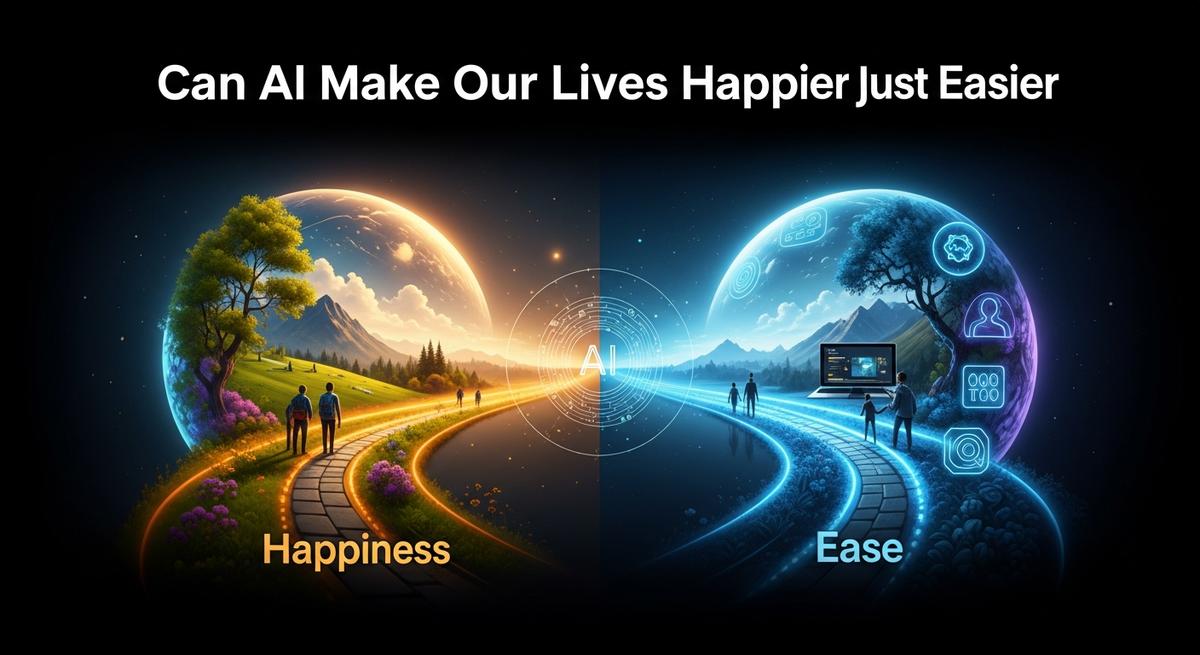
Can AI Make Our Lives Happier or Just Easier?
- January 03, 2026
- ~ 1 min read
- 268 views
- Lifestyle & AI , Everyday AI
Introduction/Overview
Imagine ending a long day at work, sinking into your couch, and asking your AI assistant to curate the perfect movie playlist, order dinner from your favorite spot, and even draft replies to your overflowing inbox—all in seconds. Tasks that once drained your energy are now effortless, thanks to AI convenience vs fulfillment. Yet, as the credits roll and the food arrives, a subtle emptiness lingers. Has this seamless efficiency truly made you happier, or just busier in disguise?
The Core Question: Efficiency or Genuine Happiness?
This scenario captures the heart of our exploration: Can AI make our lives happier or just easier? We often assume artificial intelligence well-being follows from optimization—fewer decisions, quicker results, more free time. AI excels at this, from recommendation algorithms steering your leisure choices to conversational chatbots providing 24/7 support, reducing friction in daily routines.[1][2] But does streamlining life address deeper AI and happiness? Research suggests AI primarily enhances surface-level comfort, like personalized feeds that minimize choice overload, yet it may limit serendipitous discoveries that foster true fulfillment.[1]
The distinction matters profoundly. While AI automates repetitive tasks—boosting productivity and even motivating employees through "benign stress" that builds engagement— it risks sidelining effortful pursuits like repairing items or meaningful connections, which sustainable living advocates link to lasting satisfaction.[1][3] In an era where loneliness epidemics plague even tech-savvy youth, with nearly half of U.S. high schoolers feeling persistently sad, we must question if AI companions fill emotional voids or deepen isolation.[4]
AI's Growing Role in Daily Life
AI is no longer futuristic; it's woven into our world. From optimized routes cutting travel stress to chatbots resolving queries faster than humans, technology and life satisfaction increasingly hinge on these tools.[1][2] Marketers report 75% adoption for customer happiness, elevating experiences through personalization and availability.[2] In workplaces, AI reduces workload and anxiety for some, turning tasks easier and fostering commitment.[3] Yet, studies reveal nuances: AI-driven ease can create new desires via advertising or emotional dependency on chatbots, potentially eroding human bonds.[1][4]
AI optimizes for quick mood boosts with minimal effort, but at what cost to purpose and resilience?[1]
What Lies Ahead: Convenience vs. Emotional Well-Being
This article unpacks the tension between AI emotional impact and true joy. We'll examine AI's convenience wins—like effortless self-service and productivity gains—against emerging evidence of psychological trade-offs, including reduced social ties and redefined happiness around algorithmic comfort.[1][4] Expect insights from research on workplace motivation, customer experiences, and loneliness risks, plus actionable ways to harness AI for deeper life satisfaction. Whether you're an AI enthusiast or wary of tech's mental health toll, join us to discover if artificial intelligence can evolve beyond ease to enrich our human experience.
- Preview of sections: From AI's efficiency myths to real-world emotional studies and future safeguards.
- Key takeaway: True happiness demands balance—AI as ally, not autopilot.
Main Content
The Science of Happiness: Foundational Elements of Well-Being
Scientific research consistently identifies key well-being factors that drive genuine happiness, extending beyond fleeting pleasures to enduring fulfillment. Studies from neuroscience and positive psychology highlight social connections as the cornerstone, with the Harvard Study of Adult Development revealing that close relationships predict long-term happiness and health more reliably than wealth, fame, or IQ[4][2]. Neurotransmitters like dopamine for reward and serotonin for mood stability underpin these experiences, while practices such as mindfulness, exercise, sleep, and emotional processing foster emotional resilience[1][2][3]. Martin Seligman's PERMA model further breaks it down: Positive emotions, Engagement (or flow), Relationships, Meaning, and Accomplishment[2][6]. Notably, genetics influence about 50% of happiness, but intentional actions—like nurturing relationships and pursuing purpose—can significantly elevate it[5].
AI's Role in Convenience: Efficiency Without Depth
AI excels at delivering momentary happiness through automation and time-saving features, streamlining daily tasks for tech-savvy professionals. From smart assistants scheduling meetings to recommendation algorithms curating content, these tools boost efficiency, freeing up hours for other pursuits[7]. However, this surface-level convenience often falls short of deeper emotional well-being technology. While AI optimizes productivity—reducing friction in workflows—it rarely touches core human needs like authentic social bonds or personal growth, potentially leading to a paradox where lives feel easier but not richer[1][6].
AI's Emerging Influence on Emotional States
Beyond efficiency, AI chatbot happiness initiatives are showing promise in supporting AI mental health support. Advanced AI sentiment analysis enables chatbots to detect user emotions and respond with empathy, mirroring human-like companionship. Emerging evidence suggests these human-AI interactions can shift moods positively; for instance, conversational AI gradually aligns with and elevates user sentiment toward optimism through tailored, supportive dialogue[7]. Tools like therapeutic chatbots provide 24/7 emotional processing, helping users navigate stress or loneliness—key barriers to well-being—by encouraging reflection on gratitude or purpose[2][3].
Distinguishing Convenience from True Psychological Benefits
The crux lies in differentiating AI-driven convenience from profound psychological gains. While automation yields quick wins in productivity, it doesn't replicate the neural rewards of socializing or meaning-making, which activate shared hedonic brain systems for lasting pleasure[1]. Human-AI interaction shines when it fosters genuine engagement, such as AI companions promoting exercise reminders tied to mood tracking or virtual accountability for social goals. Yet, over-reliance risks shallow interactions that mimic connection without depth, underscoring the need for AI to complement—not replace—human relationships[4].
- Track your AI interactions: Use apps with AI sentiment analysis to monitor mood shifts post-conversation.
- Balance with real-world actions: Pair AI tools with social meetups to amplify well-being factors.
- Experiment mindfully: Test AI mental health support chatbots for short sessions, reflecting on sustained emotional changes.
"Close relationships, more than money or fame, are what keep people happy throughout their lives."[4]
In essence, AI can enhance both ease and joy when designed for emotional alignment, but its true potential hinges on bridging efficiency with the irreplaceable human elements of happiness.
Supporting Content
AI Chatbots as Companions in Isolation: A Real-World Case Study
Imagine a remote worker in a bustling city, surrounded by noise but feeling profoundly isolated after a recent move. In such scenarios, AI companions have emerged as vital tools for loneliness reduction. A longitudinal study published in the Journal of Consumer Research tracked users over a week and found that interactions with AI chatbots consistently delivered momentary reductions in loneliness, comparable to human conversations and surpassing activities like watching videos[1]. Participants reported feeling genuinely heard, which amplified the emotional relief, demonstrating AI's potential beyond mere convenience.
Processing Negative Emotions: AI vs. Traditional Journaling
For individuals grappling with depression or guilt, AI emotional support offers a structured yet flexible outlet. Unlike solo journaling, which can feel one-sided, AI companions engage dynamically, prompting deeper reflection. Research from Harvard Business School highlights how these tools alleviate loneliness on par with human interaction, with users underestimating their benefits until experiencing mood lifts post-conversation[2]. One user scenario involves a young professional processing job loss guilt through daily chats; the AI's non-judgmental responses helped reframe thoughts, leading to reported emotional breakthroughs that journaling alone rarely achieves.
- Key advantage: AI provides immediate, tailored feedback, fostering emotional processing efficiency.
- Real impact: Studies show users feel understood, reducing isolation markers significantly[1][7].
Mood Tracking and Therapeutic Applications: Uncovering Happiness Patterns
Mood tracking AI apps revolutionize self-awareness by correlating lifestyle factors—like sleep, exercise, and social media use—with emotional states. Users input daily moods, and algorithms reveal patterns, such as how late-night scrolling correlates with dips in happiness. This data-driven insight empowers proactive changes, extending into therapeutic AI contexts where accessibility is key.
In therapeutic settings, AI delivers AI mental health applications for those facing barriers to human therapy. A study on university students found social chatbots reduced loneliness and social anxiety, offering scalable support[6]. Consider a scenario where a parent, overwhelmed by childcare, uses an AI app for non-judgmental venting sessions. Over time, these interactions spark genuine emotional growth, with users reporting sustained mood improvements and clearer self-insights[7].
"AI companions consistently provide momentary reductions in loneliness after use, making users feel heard in ways that drive real emotional benefits."[1]
These diverse applications—from isolated professionals to students and parents—illustrate AI's role in fostering deeper well-being. While not a full human substitute, therapeutic AI bridges gaps, providing relatable, evidence-backed paths to emotional resilience[1][2].
Practical Content
While AI chatbots offer unprecedented accessibility to support tools, translating that access into genuine happiness requires intentional strategy and realistic expectations. This section provides actionable guidance for leveraging AI well-being practices effectively while avoiding common pitfalls that undermine long-term satisfaction.
Using AI Conversations Effectively for Emotional Impact
Not all AI interactions contribute equally to well-being. Research shows that conversation types impact well-being differently—personal conversations that encourage emotional expression are associated with lower emotional dependence and problematic use at moderate usage levels, while non-personal conversations tend to increase dependence, especially with heavy usage.
To maximize emotional benefit from AI interactions:
- Choose topics that matter emotionally. Rather than using AI exclusively for information retrieval or task completion, engage in conversations that address your genuine concerns, values, or emotional challenges. This approach aligns with research showing personal conversations yield better outcomes than purely transactional interactions.
- Be authentic in your interactions. Share your actual thoughts and feelings rather than presenting a curated version of yourself. AI systems designed for mental health purposes—such as Wysa, Youper, and Therabot—are built to respond to genuine emotional expression more effectively than generic platforms.
- Use AI for skill-building, not just venting. The most effective AI-supported interventions incorporate evidence-based techniques like cognitive-behavioral therapy (CBT), mood tracking, and coping skill development. Frame your conversations around learning and practicing new approaches rather than seeking validation alone.
- Keep sessions brief and purposeful. Research indicates that voice mode AI shows better well-being outcomes when used briefly, but worse outcomes with prolonged daily use. Set time limits and specific goals for each interaction to maintain healthy engagement patterns.
Combining AI Support with Evidence-Based Well-Being Practices
AI works best as a complement to, not a replacement for, the foundational practices that genuinely improve happiness. While AI can provide accessible support, it cannot substitute for the human connection, physical activity, sleep quality, and social engagement that research consistently links to well-being.
Implement this integrated approach:
- Pair AI conversations with physical activity. Use AI tools to help you plan exercise routines, track motivation, or work through barriers to movement—but ensure the AI interaction complements rather than replaces actual physical activity. Exercise remains one of the most evidence-based interventions for improving mood and emotional resilience.
- Use AI to support sleep hygiene. AI can help you establish bedtime routines, track sleep patterns, and identify factors affecting rest quality. However, recognize that AI interaction itself—especially voice-based engagement—should not replace the wind-down period your brain needs before sleep.
- Maintain human relationships as your primary emotional resource. AI should enhance, not diminish, your investment in authentic human connections. If you notice AI conversations increasing while face-to-face interactions decrease, recalibrate your usage patterns immediately.
- Combine AI support with professional help when needed. For significant mental health concerns, use AI as a supplementary tool alongside therapy from licensed professionals. Research confirms that chatbots can substantially increase the work that occurs outside therapy sessions, but they cannot replace the clinical expertise and genuine human connection that professional mental health care provides.
Setting Realistic Expectations About AI's Emotional Capabilities
Understanding what AI can and cannot provide is essential for healthy usage. Current research reveals important limitations:
What AI can effectively do: Provide psychoeducation about mental health conditions, help you track mood patterns over time, teach and reinforce coping skills, offer immediate support during non-crisis moments, reduce stigma through anonymous interaction, and provide 24/7 accessibility when human support is unavailable. Studies show that chatbots incorporating CBT principles have demonstrated statistically significant improvements in anxiety and depression measures.
What AI cannot do: Replace the genuine emotional connection that comes from human relationships, accurately assess crisis situations or suicidal ideation (research shows AI chatbots often validate dangerous thoughts rather than appropriately intervening), provide the warmth, empathy, and shared human experience that characterize effective therapy, or develop the trust and intimacy built through consistent human relationships over time.
A critical distinction: AI can simulate empathetic responses, but this simulation may be particularly dangerous for individuals experiencing acute distress or those who struggle to distinguish fantasy from reality. The more emotionally vulnerable you are, the more carefully you should evaluate whether AI interaction serves your genuine needs.
Recognizing and Avoiding Over-Dependence on AI
Research identifies specific warning signs that AI interaction has shifted from helpful to harmful:
- Declining human relationships. If you're spending more time in AI conversations and less time with friends, family, or community, this signals unhealthy dependence. AI should never become a substitute for human connection.
- Emotional reliance on AI validation. When you find yourself seeking AI approval for decisions or emotional reassurance before turning to trusted humans, recalibrate your usage. This pattern indicates you're using AI to avoid the vulnerability required for genuine human relationships.
- Increased loneliness despite increased AI use. Paradoxically, heavy AI usage can increase loneliness, particularly with non-personal conversations. If you feel more isolated after extended AI interaction, reduce frequency and refocus on human connection.
- Avoidance of professional help. If AI conversations are preventing you from seeking needed therapy or medical care, this represents a significant red flag. AI is explicitly not sufficient to replace therapy from licensed professionals for meaningful mental health concerns.
- Loss of autonomy in decision-making. Over-reliance develops when you defer important decisions to AI rather than developing your own judgment. Use AI to gather information and explore options, but maintain your own decision-making authority.
To maintain healthy boundaries, establish a personal rule: AI supplementary support means AI handles perhaps 20-30% of your emotional processing, with the remaining 70-80% coming from human relationships, professional support, and your own internal resources.
Selecting AI Tools Based on Your Actual Goals
Not all AI tools serve the same purpose. Distinguishing between convenience-focused and happiness-focused applications is essential for effective selection:
Choose mental health-specific AI for emotional well-being goals. If your objective is genuine emotional improvement, select tools explicitly designed for mental health: Wysa, Youper, Therabot, Earkick, or Koko. These incorporate evidence-based therapeutic approaches and are built with mental health ethics in mind. Research shows that chatbots incorporating CBT, daily interactions, and cultural personalization demonstrate measurable improvements in anxiety and depression.
Use generic AI platforms (like ChatGPT) for convenience and information, not emotional support. While ChatGPT can help with homework completion, brainstorming, problem-solving, and skill practice, it's not designed for emotional support and lacks the safeguards present in mental health-specific tools. Recent research found that AI chatbots routinely violate core mental health ethics standards, particularly when responding to users expressing suicidal thoughts or experiencing delusions.
Evaluate cultural fit and personalization. Research demonstrates that chatbots incorporating cultural personalization—those sensitive to users' economic, racial, ethnic, and cultural backgrounds—produce better outcomes. When selecting a tool, verify whether it offers personalization options that reflect your specific context and needs.
Assess transparency and safeguards. Before committing to regular use, investigate whether the platform clearly explains its limitations, provides crisis resources, recommends professional help when appropriate, and maintains ethical standards. Avoid tools that position themselves as therapy replacements or that lack clear safety protocols.
The fundamental question to ask before adopting any AI tool: Does this serve my genuine happiness and well-being, or merely my convenience? If the answer is convenience alone, recognize that benefit for what it is—valuable but distinct from the deeper satisfaction that comes from
Comparison/Analysis
Convenience-Focused AI vs. Happiness-Focused AI
AI tools primarily designed for convenience vs well-being excel at boosting productivity but often fall short on deeper emotional fulfillment. Productivity apps like task managers and automation software save time through habit tracking, personalized coaching, and techniques such as the Pomodoro method, enabling users to optimize work-life balance and reduce daily stress[3][6]. For instance, generative AI can analyze data to suggest breathing exercises or prioritize tasks, making life easier by streamlining routines[3]. However, these tools address surface-level efficiency rather than root causes of unhappiness, potentially leaving users productive yet unfulfilled.
In contrast, happiness-focused AI, such as emotional support chatbots (e.g., Wysa, Youper, or Earkick), offers unique benefits like 24/7 availability, mood tracking, and empathetic responses tailored to user patterns[1][4]. These companions provide consistent, non-judgmental listening, helping users process anxiety, build self-awareness, and experience relief—benefits users report as insightful and validating, sometimes rivaling human-like emotional connections[1][2]. Yet, their simulated empathy lacks genuine reciprocity, highlighting key technology trade-offs.
AI vs. Human Interaction: A Deeper Emotional Support Comparison
When comparing AI vs human interaction, human relationships and professional therapy provide irreplaceable authenticity. Licensed counselors offer holistic empathy, reading nonverbal cues and validating complex emotions in ways AI's algorithm-driven responses cannot[3][4]. Studies show users value AI for immediate access and objectivity but criticize its superficial engagement and lack of true emotional depth[2].
- AI Strengths: Constant availability, privacy, and stigma-free venting—ideal for quick relief or proactive wellness[1][2][4].
- Human Strengths: Genuine reciprocity, nuanced understanding, and long-term healing, fostering resilience through real connections[3].
- Trade-offs: AI's scalability versus humans' depth; convenience may erode motivation over time[6].
"AI tools can support daily mental wellness, while human counseling provides depth, empathy, and holistic healing that technology cannot replace."[3]
Hybrid Approaches and AI Relationship Risks
Hybrid AI approaches represent the most balanced path, integrating AI with human elements for optimal outcomes. Use chatbots alongside therapy for homework support, skill practice, or symptom monitoring, as recommended by psychologists—enhancing sessions without replacing them[4]. Combine AI-guided mindfulness, journaling prompts, or social reminders with real-world practices like community engagement[5].
However, a candid risk assessment is essential. AI dependence risks emotional overreliance, social withdrawal, and manipulation, as constant access might discourage human bonds or lead to unintended mental health harms[4][7]. Users report positive short-term effects but warn of reduced motivation and shallow connections long-term[2][6]. To mitigate:
- Limit AI use to supplements, not substitutes.
- Maintain diverse social networks.
- Monitor for isolation signs and consult professionals during crises[4].
This emotional support comparison empowers informed choices: leverage AI for efficiency and quick boosts, but prioritize human ties for lasting happiness. By weighing these AI relationship risks, tech-savvy users can harness AI thoughtfully without sacrificing well-being.
Conclusion and Key Takeaways
In this AI happiness summary, we've explored how artificial intelligence excels at delivering convenience through efficiency and personalization, yet its path to genuine AI well-being hinges on more than just streamlined tasks. AI can make lives happier, but not automatically—true fulfillment emerges only when users engage intentionally, distinguishing passive ease from active emotional growth.
Recapping AI's Dual Role in Convenience and Happiness
AI reshapes daily life by optimizing routines, from recommendation algorithms curating leisure to chatbots providing 24/7 support, reducing friction and boosting immediate satisfaction.[1][2] However, this surface-level convenience risks sidelining deeper sources of joy, such as effortful pursuits that foster purpose, resilience, and human connection.[1] Research shows AI in workplaces can introduce benign stress that, when mediated by engagement, enhances happiness and productivity, but over-reliance may erode well-being through diminished human interaction.[3][4] The key AI well-being conclusion: while AI augments efficiency, happiness requires specific conditions like mindful integration.
Key Insights: Intentionality Over Automation
The core distinction lies between passive convenience—algorithmic nudges toward quick mood boosts—and intentional technology use that promotes emotional engagement.[1][5] Studies reveal AI companions can offer temporary emotional support, even staving off suicidal thoughts for some, yet they often heighten loneliness and dependency, particularly among vulnerable groups like adolescents.[4] A critical takeaway: AI's impact on future of AI mental health depends on user expectations and approach. Those who view AI as a tool for augmentation rather than replacement harness its motivational potential, turning potential stress into engagement and fulfillment.[3]
AI enhances happiness when paired with deliberate choices, not default consumption—prioritizing connection over optimization.
Actionable Framework for Balanced AI Adoption
To evaluate your AI usage, adopt this simple framework for balanced AI adoption:
- Assess intent: Does this tool save time for meaningful activities, or fill voids in human connection?
- Monitor engagement: Track if AI interactions build skills and purpose, or foster isolation—aim for benign stress that motivates growth.[3]
- Prioritize boundaries: Limit passive features like endless feeds; curate AI for active well-being, such as personalized learning over algorithmic leisure.[1]
- Seek hybrid balance: Combine AI efficiency with real-world effort, like using optimizers for routines while pursuing unscripted social bonds.
Looking ahead, our future of AI mental health will evolve as research uncovers nuanced effects, from workplace motivation to societal loneliness epidemics.[4][5] Approach AI not as a happiness autopilot, but a powerful ally demanding conscious stewardship.
Reflect on your AI habits today: Which tools truly elevate your life? Share your thoughts in the comments, experiment with intentional tweaks, and subscribe for updates on tech's role in well-being. Let's shape a future where AI amplifies joy, not just ease.
Comments (0)
Please login or register to leave a comment.
No comments yet. Be the first to comment!