
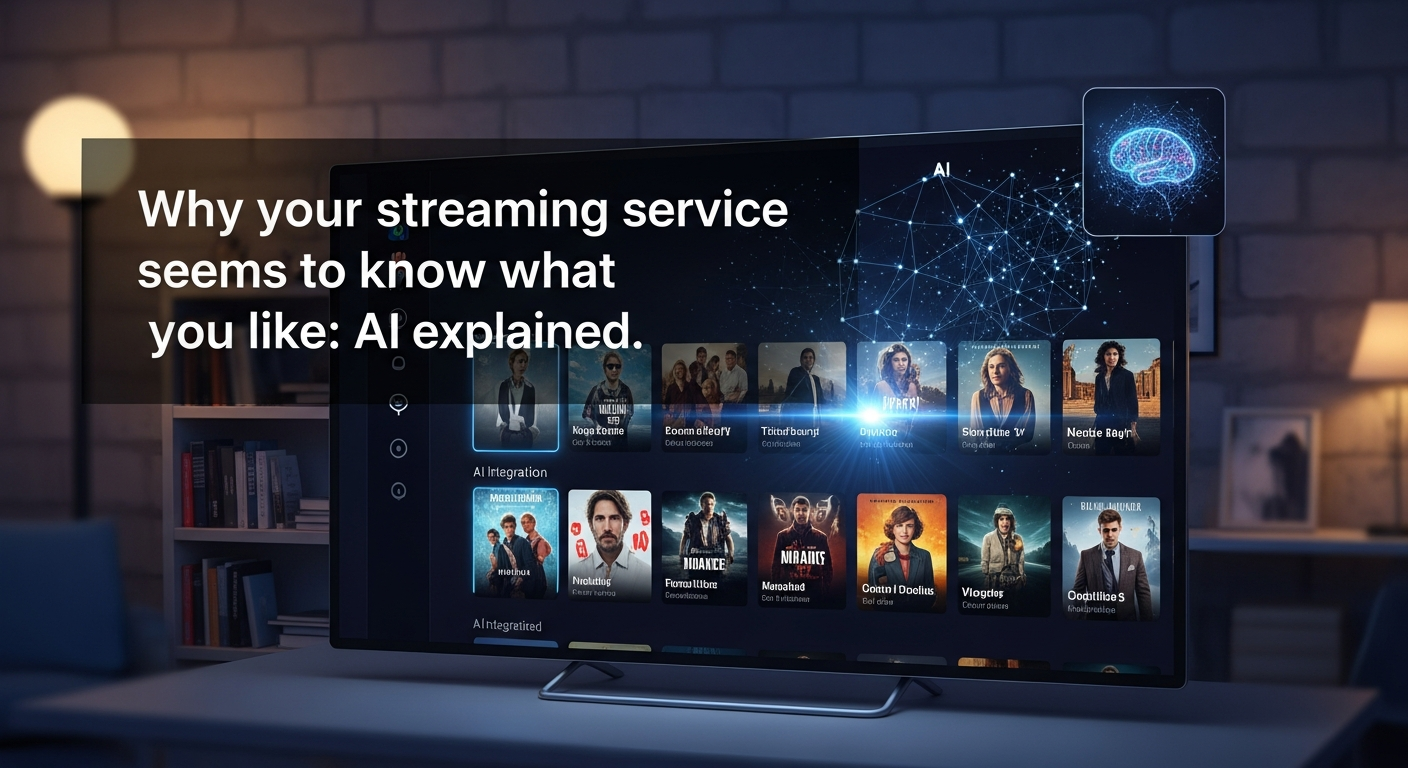
Why your streaming service seems to know what you like: AI explained
- November 20, 2025
- ~ 1 min read
- 150 views
- Everyday AI , Lifestyle & AI
Introduction to AI in Streaming Services
Have you ever wondered how your favorite streaming service seems to know exactly what you like to watch? It's not magic, but rather the power of Artificial Intelligence (AI) at work. In fact, a surprising 75% of viewers on popular streaming platforms watch content that is recommended to them by the service's algorithm. This is a testament to the effectiveness of AI in providing personalized recommendations that enhance the user experience.
What is AI and How is it Used in Streaming Services?
AI is a broad term that refers to the development of computer systems that can perform tasks that would typically require human intelligence, such as learning, problem-solving, and decision-making. In the context of streaming services, AI is used to analyze vast amounts of data about user behavior, including viewing history, search queries, and ratings. This data is then used to build complex models that can predict what a user is likely to enjoy watching, and provide personalized recommendations accordingly.
The use of AI in streaming services has revolutionized the way we consume content. Gone are the days of scrolling through endless lists of movies and TV shows, trying to find something that catches our eye. With AI-powered recommendations, we can discover new content that we may not have found otherwise, and enjoy a more tailored user experience. As personalization becomes increasingly important in the world of streaming, AI is playing a vital role in helping services stand out from the competition and retain users.
The Importance of Personalization in User Experience
Personalization is key to providing a great user experience in streaming services. When users feel like the content is tailored to their interests, they are more likely to engage with the service and continue using it. AI helps streaming services achieve this by analyzing user behavior and providing recommendations that are relevant and timely. This not only enhances the user experience but also increases user loyalty and retention.
What to Expect from this Article
In this article, we will delve deeper into the world of AI in streaming services, exploring the different ways in which it is used to provide personalized recommendations and enhance the user experience. We will cover topics such as the types of AI algorithms used in streaming services, the importance of data quality in AI-powered recommendations, and the future of AI in the streaming industry. By the end of this article, you will have a better understanding of how AI is revolutionizing the way we consume content, and what this means for the future of streaming services.
Some of the key points we will cover include:
- The different types of AI algorithms used in streaming services
- The importance of data quality in AI-powered recommendations
- The role of AI in enhancing the user experience
- The future of AI in the streaming industry
Whether you're a streaming enthusiast or just curious about the technology behind your favorite streaming service, this article will provide you with a comprehensive overview of the role of AI in streaming services and what it means for the future of entertainment.
The Basics of AI-Powered Recommendations
When you log into your favorite streaming service, you're often greeted with a curated list of shows and movies that seem to know exactly what you like. But have you ever wondered how these recommendations are made? The answer lies in the power of Artificial Intelligence (AI) and its ability to analyze vast amounts of data. In this section, we'll delve into the core concepts of AI-powered recommendations, exploring the different types of filtering that make these suggestions possible.
Collaborative Filtering: The Power of Community
Collaborative filtering is a type of algorithm that relies on the behavior of other users to make recommendations. The idea is simple: if you like a particular show, and other users with similar tastes also like that show, then you're likely to enjoy other shows that those users have liked. This approach is often compared to asking a friend for a recommendation, as it's based on the collective opinions of a community. For example, if you've watched and enjoyed a particular TV series, the algorithm will look for other users who have also watched and liked that series, and then suggest other shows that those users have enjoyed.
This approach is particularly effective because it takes into account the complexities of human taste and preference. By analyzing the behavior of many users, collaborative filtering can identify patterns and relationships that might not be immediately apparent. However, it does require a large amount of user data to be effective, which can be a challenge for smaller streaming services.
Content-Based Filtering: The Devil is in the Details
In contrast to collaborative filtering, content-based filtering focuses on the attributes of the content itself, rather than the behavior of other users. This approach uses metadata such as genres, directors, and actors to make recommendations. For example, if you've watched a lot of action movies starring a particular actor, the algorithm will suggest other action movies starring that same actor. This approach is often used in combination with collaborative filtering to create a more comprehensive recommendation system.
Content-based filtering is particularly useful for users who have very specific tastes or preferences. By analyzing the attributes of the content, the algorithm can identify other shows or movies that match those preferences, even if they're not necessarily popular with other users. However, this approach can be limited by the quality and accuracy of the metadata, which can be time-consuming and expensive to collect and maintain.
Hybrid Approaches and the Role of Data
In reality, most streaming services use a hybrid approach that combines elements of both collaborative filtering and content-based filtering. This approach allows the algorithm to take into account both the behavior of other users and the attributes of the content itself, creating a more nuanced and accurate recommendation system. However, this approach also requires large amounts of data collection and processing, which can be a challenge for streaming services.
The quality and accuracy of the recommendations are directly related to the quality and accuracy of the data collection process. The more data the algorithm has to work with, the better it can understand the preferences and behavior of the users. This is why streaming services often ask users to rate or review the content they've watched, as this provides valuable feedback that can be used to improve the recommendation system. By leveraging the power of AI and data collection, streaming services can create a personalized and engaging experience for their users, keeping them coming back for more.
The key to creating effective AI-powered recommendations is to strike a balance between collaborative filtering, content-based filtering, and hybrid approaches. By combining these different techniques and leveraging the power of data collection, streaming services can create a recommendation system that is both accurate and engaging.
Real-World Examples of AI in Streaming
The use of Artificial Intelligence (AI) in streaming services is not just a theoretical concept, but a practical reality that has been successfully implemented by several major players in the industry. In this section, we will explore some real-world examples of how Netflix, Spotify, and Amazon Prime Video are utilizing AI to enhance the user experience and increase user engagement.
Netflix's Personalized Recommendations
Netflix is a pioneer in the use of AI for content recommendation. The company's algorithm takes into account a user's viewing history, search queries, and ratings to provide personalized recommendations. This approach has been highly successful, with over 80% of Netflix users reporting that they watch content recommended by the algorithm. According to Netflix, their AI-powered recommendation engine is responsible for over 75% of user engagement on the platform. This is a testament to the power of AI in driving user engagement and retention.
Spotify's Discover Weekly Feature
Spotify's Discover Weekly feature is another example of AI in action. This feature uses natural language processing and collaborative filtering to create a personalized playlist for each user. The playlist is updated every Monday and features a unique set of songs that are likely to appeal to the user's tastes. According to Spotify, Discover Weekly has been a huge success, with over 40 million users engaging with the feature every week. This has not only increased user engagement but also helped Spotify to differentiate itself from other music streaming services.
Amazon Prime Video's AI-Powered Recommendations
Amazon Prime Video also uses AI to provide personalized recommendations to its users. The company's algorithm takes into account a user's viewing history, search queries, and ratings to recommend TV shows and movies. Amazon Prime Video also uses AI to optimize its content catalog, ensuring that users have access to a wide range of content that is relevant to their interests. According to Amazon, their AI-powered recommendation engine has increased user engagement by over 20%, with users reporting higher satisfaction rates with the content they watch.
In addition to these examples, other streaming services are also using AI to enhance the user experience. Some of the key benefits of AI in streaming include:
- Personalized recommendations that increase user engagement and retention
- Improved content discovery, making it easier for users to find new TV shows and movies
- Enhanced user experience, with AI-powered features such as voice control and natural language processing
The use of AI in streaming is not just about recommending content, it's about creating a personalized experience that meets the unique needs and preferences of each user. By leveraging AI, streaming services can increase user engagement, drive retention, and ultimately deliver a better experience for their users.
Advanced AI Concepts in Streaming Services
The application of Artificial Intelligence (AI) in streaming services has revolutionized the way content is recommended to users. At the heart of these recommendation systems lie advanced AI concepts, including Natural Language Processing (NLP) and deep learning models. In this section, we will delve into the technical aspects of these concepts and explore their role in enhancing the user experience.
NLP in Recommendation Systems
NLP plays a crucial role in analyzing user feedback, such as reviews and ratings, to improve the accuracy of content recommendations. By leveraging sentiment analysis and topic modeling, NLP algorithms can identify patterns and trends in user preferences, enabling streaming services to suggest content that is more likely to resonate with their audience. For instance, a study by Netflix found that incorporating NLP into their recommendation system resulted in a significant increase in user engagement and satisfaction.
Deep Learning Models for Content Analysis
Deep learning models, such as convolutional neural networks (CNNs) and recurrent neural networks (RNNs), are used to analyze audio-visual content and extract relevant features. These features can include visual and audio cues, such as genre, tone, and style, which are then used to recommend content to users. For example, a deep learning model can analyze a user's watching history and identify patterns in their preferences, such as a fondness for action movies or romantic comedies.
In addition to content analysis, deep learning models can also be used to address edge cases and challenges in AI implementation. For instance, edge cases such as cold start problems, where a new user or item is introduced to the system, can be mitigated using deep learning models that can learn to adapt to new data and make predictions based on limited information.
Future Developments and Advancements
As AI technology continues to evolve, we can expect to see significant advancements in the field of streaming services. One area of research is the development of more sophisticated model training techniques, such as transfer learning and meta-learning, which can enable models to learn from multiple tasks and adapt to new environments. Additionally, the integration of edge AI and explainable AI can provide more transparency and accountability in recommendation systems, enabling users to understand why certain content is being recommended to them.
Some potential future developments in AI-powered streaming services include:
- Personalized content creation, where AI algorithms can generate content tailored to individual users' preferences
- Improved content discovery, where AI-powered search engines can help users find new and relevant content
- Enhanced user experience, where AI-powered chatbots and virtual assistants can provide personalized support and recommendations
In conclusion, the application of advanced AI concepts, including NLP and deep learning, has revolutionized the streaming industry. As AI technology continues to evolve, we can expect to see significant advancements in the field, enabling streaming services to provide more personalized and engaging experiences for their users. By understanding the technical aspects of AI in streaming services, we can better appreciate the complexity and sophistication of these systems and look forward to the exciting developments that the future holds.
The future of streaming services will be shaped by the continued advancement of AI technology, enabling more personalized, interactive, and immersive experiences for users.
Implementing AI in Your Own Streaming Service
As we've explored the capabilities of Artificial Intelligence in streaming services, it's natural to wonder how to harness this power for your own platform. Implementing AI recommendations can significantly enhance user experience, increase engagement, and set your service apart from competitors. In this section, we'll provide a step-by-step guide to integrating AI recommendations, discussing data requirements, popular AI frameworks, and best practices for model evaluation.
Step-by-Step Guide to Integration
To start, you'll need to collect and preprocess your data. This involves gathering user interaction data, such as watch history, ratings, and search queries. Data quality is crucial for training accurate models, so ensure your data is clean, complete, and well-structured. Next, you'll need to select a suitable AI framework and choose a recommendation algorithm that aligns with your service's goals. Popular options include collaborative filtering, content-based filtering, and hybrid approaches.
Once you've selected your algorithm, you can begin training your model. This process involves feeding your preprocessed data into the algorithm and adjusting parameters to optimize performance. Continuous model evaluation is essential to ensure your recommendations remain accurate and relevant. You can use metrics such as precision, recall, and F1 score to assess your model's performance and make data-driven decisions for improvement.
Data Requirements and Preprocessing
Before diving into model training, it's essential to understand the data requirements for AI-powered recommendations. Your dataset should include a diverse range of user interactions, as well as metadata about your content, such as genres, directors, and release dates. Data preprocessing involves transforming your raw data into a format suitable for model training. This may include handling missing values, normalization, and feature scaling.
A well-structured dataset can significantly impact the accuracy of your recommendations. Consider using data preprocessing techniques such as tokenization, stemming, and lemmatization to extract relevant features from your text data. Additionally, you can use dimensionality reduction techniques, such as PCA or t-SNE, to reduce the complexity of your dataset and improve model performance.
Popular AI Frameworks and Tools
Fortunately, there are many AI frameworks and tools available to support the implementation of AI-powered recommendations. Popular options include TensorFlow, PyTorch, and Scikit-learn, which offer a range of algorithms and tools for model development and deployment. You can also leverage cloud-based services, such as Amazon SageMaker or Google Cloud AI Platform, to streamline your workflow and reduce infrastructure costs.
When selecting an AI framework, consider factors such as scalability, flexibility, and community support. You should also evaluate the ease of integration with your existing infrastructure and the level of expertise required to implement and maintain the framework. By choosing the right tools and frameworks, you can accelerate your development process and focus on delivering high-quality recommendations to your users.
To overcome common challenges and optimize performance, consider the following best practices:
- Continuously collect and update your dataset to ensure your recommendations remain relevant and accurate.
- Monitor your model's performance using metrics such as precision, recall, and F1 score, and adjust your algorithm and parameters as needed.
- Leverage model evaluation techniques, such as cross-validation and walk-forward optimization, to assess your model's performance and prevent overfitting.
- Use ensemble methods to combine the predictions of multiple models and improve overall performance.
By following these guidelines and best practices, you can successfully implement AI-powered recommendations in your streaming service, enhancing user experience and driving business growth.
Comparison of AI-Powered Streaming Services
The world of streaming services has become increasingly competitive, with numerous platforms vying for users' attention. One key factor that sets these services apart is their use of Artificial Intelligence (AI) to power their recommendation systems. In this section, we'll delve into a comparison of the AI-powered streaming services, highlighting their pros and cons, and exploring the implications for user privacy and content diversity.
Recommendation Algorithms: A Comparative Analysis
Major streaming services like Netflix, Hulu, and Amazon Prime Video employ different recommendation algorithms to suggest content to their users. Netflix, for instance, uses a collaborative filtering approach, which analyzes the viewing habits of similar users to recommend content. Hulu, on the other hand, relies on a content-based filtering approach, which recommends content based on the attributes of the content itself, such as genre or director. Amazon Prime Video uses a hybrid approach, combining collaborative filtering with content-based filtering to provide personalized recommendations.
A comparison of these approaches reveals that each has its strengths and weaknesses. Collaborative filtering can lead to echo chambers, where users are only recommended content that is similar to what they've already watched. Content-based filtering, on the other hand, can result in over-recommendation of certain genres or types of content. The hybrid approach used by Amazon Prime Video offers a more balanced approach, but can be computationally intensive and require large amounts of user data.
User Privacy and Data Security Considerations
As streaming services collect and analyze vast amounts of user data to power their recommendation systems, user privacy becomes a significant concern. Users may be uncomfortable with the idea of their viewing habits being tracked and analyzed, and may worry about the potential for data breaches or unauthorized use of their personal data. To mitigate these concerns, streaming services must prioritize data security and transparency, providing users with clear information about how their data is being used and protected.
Some streaming services, such as Netflix, have implemented measures to protect user privacy, such as anonymizing user data and using secure encryption to protect user information. However, other services may not be as proactive, and users must be vigilant in protecting their own data by reviewing privacy policies and adjusting their account settings accordingly.
Impact on Content Diversity and Discovery
The use of AI-powered recommendation systems can have a significant impact on content diversity and discovery. On the one hand, these systems can help users discover new content that they may not have found otherwise, by recommending titles that are similar to their existing viewing habits. On the other hand, the algorithmic bias inherent in these systems can lead to a homogenization of content, where users are only recommended content that is similar to what they've already watched.
To promote content diversity and discovery, streaming services must balance their recommendation algorithms with human curation and editorial judgment. This can involve highlighting independent or niche content, featuring diverse creators and voices, and providing users with tools to discover new content outside of their usual viewing habits. By striking this balance, streaming services can create a more vibrant and diverse content ecosystem that benefits both users and creators.
- Netflix's use of collaborative filtering can lead to echo chambers, but also allows for personalized recommendations.
- Hulu's content-based filtering approach can result in over-recommendation of certain genres, but also provides users with a clear understanding of why they're being recommended certain content.
- Amazon Prime Video's hybrid approach offers a balanced approach, but requires large amounts of user data and can be computationally intensive.
The use of AI-powered recommendation systems in streaming services is a double-edged sword. While these systems can provide users with personalized recommendations and help them discover new content, they also raise significant concerns about user privacy and data security. As the streaming landscape continues to evolve, it's essential for services to prioritize transparency, diversity, and user control in their recommendation algorithms.
Conclusion and Future of AI in Streaming
In conclusion, the integration of Artificial Intelligence (AI) in streaming services has revolutionized the way we consume media, offering personalized recommendations, enhanced user experiences, and streamlined content creation. Throughout this article, we have explored the significance of AI in streaming, from its role in predictive analytics to its application in content generation. The key takeaways from our discussion include the ability of AI to analyze user behavior, adapt to preferences, and improve overall engagement.
Reflection on the Current State and Future Potential of AI
As we reflect on the current state of AI in streaming, it is evident that we are merely scratching the surface of its potential. The future of AI in streaming holds much promise, with potential advancements in areas such as natural language processing, computer vision, and edge computing. These developments are expected to further enhance the streaming experience, enabling more accurate recommendations, improved content discovery, and seamless playback. However, the path forward is not without challenges, including concerns over data privacy, algorithmic bias, and the need for continuous learning and adaptation.
Call to Action for Further Exploration
As we move forward in this era of AI-driven streaming, it is essential to stay informed and engaged. We encourage readers to take a call to action, exploring the many resources available for learning more about AI and its applications in streaming. Whether you are a developer looking to implement AI in your own projects or simply a curious viewer interested in staying updated on the latest developments, there has never been a more exciting time to be a part of the streaming revolution. By embracing AI and its potential, we can unlock new possibilities for entertainment, education, and connection, ultimately shaping the future of streaming and beyond.
Some potential next steps for further exploration include:
- Delving into the world of machine learning and its applications in streaming
- Staying updated on the latest AI-powered streaming services and their innovative features
- Exploring the intersection of AI and virtual reality in streaming, and the potential for immersive experiences
In conclusion, the significance of AI in streaming services cannot be overstated. As we look to the future of AI, it is clear that its impact will only continue to grow, shaping the way we interact with media and each other. We hope that this article has provided valuable insights and inspiration, encouraging readers to embark on their own journey of discovery and exploration in the exciting realm of AI-driven streaming.


Comments (0)
Please login or register to leave a comment.
No comments yet. Be the first to comment!