
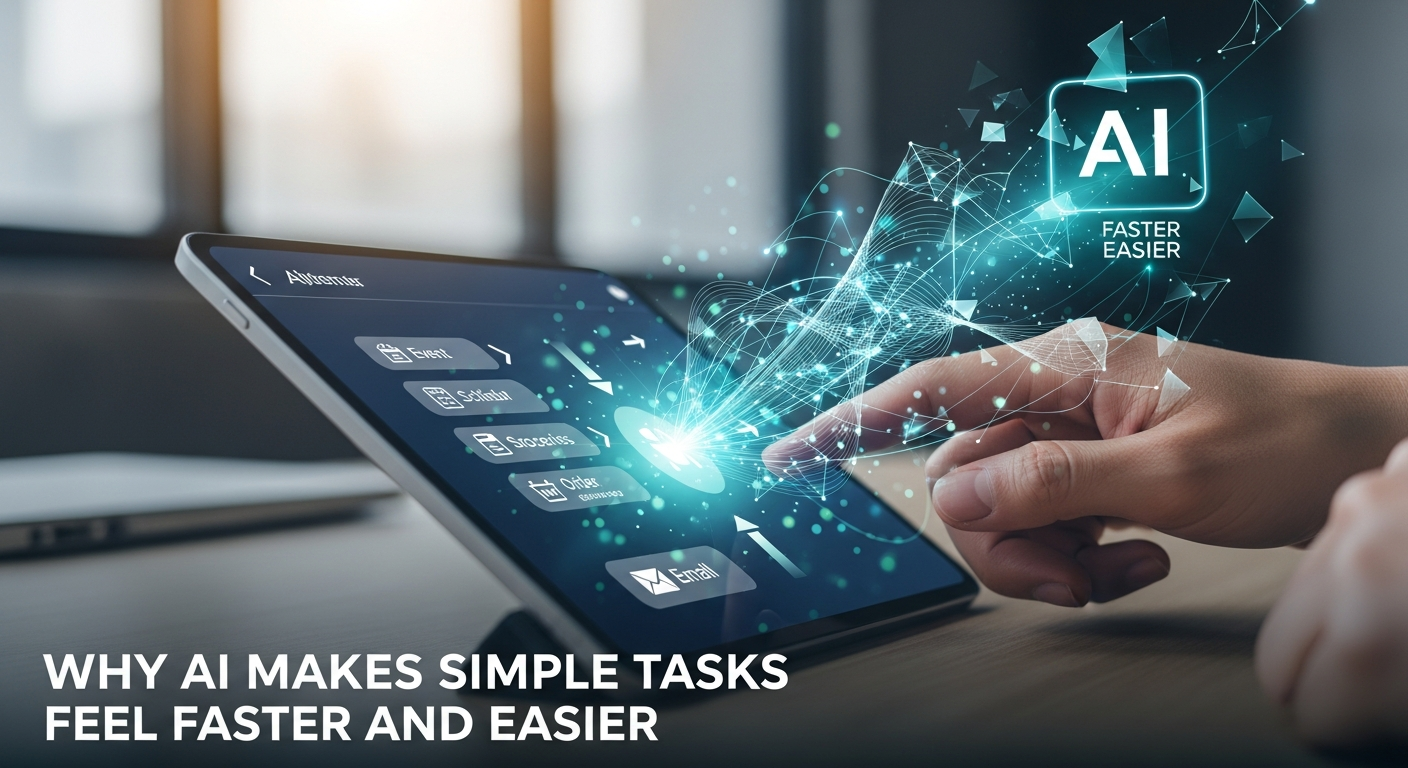
Why AI Makes Simple Tasks Feel Faster and Easier
- November 21, 2025
- ~ 1 min read
- 137 views
- Everyday AI , Lifestyle & AI
Introduction to AI-Driven Task Simplification
Imagine being able to save up to 2 hours a day by automating routine tasks, thanks to the power of Artificial Intelligence (AI). This is not a distant dream, but a reality that many individuals and organizations are already experiencing. AI has revolutionized the way we approach task management, making it faster, easier, and more efficient. In this article, we will delve into the world of AI-driven task simplification and explore its benefits, applications, and impact on our daily lives and work.
The Importance of Simplifying Tasks
In today's fast-paced world, productivity is key to success. By simplifying tasks, we can free up more time to focus on high-priority activities, leading to increased efficiency and better outcomes. Whether it's managing personal finances, organizing work projects, or simply keeping up with household chores, task simplification can have a significant impact on our overall well-being and stress levels. With the help of AI, we can automate repetitive tasks, reduce errors, and make informed decisions, ultimately leading to a more streamlined and organized life.
Preview of the Article's Content
In the following sections, we will explore the various ways in which AI is transforming task management. We will discuss the benefits of AI-driven task simplification, including increased efficiency, reduced costs, and enhanced decision-making capabilities. We will also examine the different applications of AI in task simplification, such as virtual assistants, automation tools, and machine learning algorithms. Additionally, we will provide actionable tips and insights on how to implement AI-driven task simplification in your daily life and work, and highlight the key takeaways from our discussion. Whether you're a busy professional, a student, or simply someone looking to optimize your daily routine, this article will provide you with a comprehensive understanding of the power of AI in simplifying tasks and improving overall efficiency.
Some of the key topics we will cover include:
- The benefits of AI-driven task simplification
- The applications of AI in task management
- Implementing AI-driven task simplification in daily life and work
- The future of AI in task management and its potential impact on society
How AI Simplifies Tasks
The integration of AI algorithms into various tasks has revolutionized the way we approach and complete them. At its core, AI simplifies tasks by automating repetitive and mundane processes, allowing individuals to focus on more complex and creative aspects of their work. One of the key drivers behind this simplification is machine learning, a subset of AI that enables systems to learn from data and improve their performance over time.
Understanding AI Algorithms and Machine Learning
Machine learning plays a pivotal role in enhancing the capabilities of AI systems. By analyzing vast amounts of data, machine learning algorithms can identify patterns, make predictions, and optimize processes. This capability is crucial for task automation, as it allows AI systems to adapt to new situations and improve their performance without requiring manual intervention. For instance, natural language processing algorithms can learn to recognize and respond to voice commands, making it easier for individuals to interact with devices and access information.
Examples of AI-Powered Tools
There are numerous examples of AI-powered tools that simplify tasks. Virtual assistants like Siri, Google Assistant, and Alexa use AI algorithms to perform tasks such as setting reminders, sending messages, and making calls. Additionally, project management tools like Trello and Asana utilize machine learning to automate task assignments, track progress, and predict deadlines. Other examples include automation software like Zapier and IFTTT, which enable users to create custom workflows and automate repetitive tasks.
Some of the benefits of using AI for task simplification include:
- Increased productivity: By automating repetitive tasks, individuals can focus on more complex and creative aspects of their work.
- Reduced errors: AI algorithms can perform tasks with a high degree of accuracy, reducing the likelihood of errors and mistakes.
- Improved efficiency: Machine learning can optimize processes and workflows, enabling individuals to complete tasks faster and more efficiently.
Benefits and Future Directions
The benefits of using AI for task simplification are numerous, and the technology is continually evolving. As AI algorithms and machine learning continue to improve, we can expect to see even more innovative applications of AI in various industries. Automation will play a key role in this evolution, enabling businesses and individuals to streamline processes, reduce costs, and improve productivity. By embracing AI and its potential to simplify tasks, we can unlock new levels of efficiency, creativity, and innovation.
The future of work will be shaped by the intersection of human and artificial intelligence. By leveraging the strengths of both, we can create a more efficient, productive, and innovative world.
Real-World Applications of AI in Task Simplification
The integration of Artificial Intelligence (AI) in various industries has led to significant simplification of tasks, enhancing efficiency and productivity. Case studies from companies like Amazon, Google, and Microsoft demonstrate the successful implementation of AI in simplifying tasks. For instance, Amazon's use of AI-powered chatbots has streamlined customer service, allowing for faster response times and improved customer satisfaction.
Industry Applications of AI-Powered Tools
AI-powered tools are being used in various sectors, including customer service, marketing, and healthcare. In customer service, AI-powered chatbots are used to handle routine inquiries, freeing up human representatives to focus on more complex issues. In marketing, AI is used to analyze customer data and create personalized campaigns, leading to increased engagement and conversion rates. In healthcare, AI is used to analyze medical images and diagnose diseases, enabling doctors to make more accurate diagnoses and develop effective treatment plans.
Some examples of AI-powered tools include:
- Virtual assistants like Siri and Alexa, which use natural language processing to perform tasks and provide information
- Marketing automation platforms like Marketo and Pardot, which use AI to personalize and optimize marketing campaigns
- Medical imaging analysis tools like Google's LYNA (Lymph Node Assistant), which uses AI to detect breast cancer
The Impact of AI on Job Roles and the Future of Work
The increasing use of AI in task simplification has raised concerns about the impact on job roles and the future of work. While AI may automate some tasks, it is unlikely to replace human workers entirely. Instead, AI will augment human capabilities, enabling workers to focus on more complex and creative tasks. According to a report by the World Economic Forum, by 2022, 75 million jobs may be displaced by automation, but 133 million new roles may emerge that are more adapted to the new division of labor between humans, machines, and algorithms.
However, it is essential to address the challenges faced by companies implementing AI for task simplification. These challenges include:
- Data quality and availability: AI requires high-quality and relevant data to function effectively
- Algorithmic bias: AI systems can perpetuate existing biases if they are trained on biased data
- Job displacement: The automation of tasks may lead to job displacement, particularly for low-skilled workers
Despite these challenges, the benefits of AI in task simplification are undeniable. Industry applications of AI have the potential to transform various sectors, leading to increased efficiency, productivity, and innovation. As AI continues to evolve, it is essential to prioritize the development of human-centered AI systems that augment human capabilities and create new opportunities for workers.
The future of work will be characterized by the collaboration between humans and machines, and it is essential to develop strategies that prepare workers for this new reality.
Advanced Concepts in AI-Driven Task Simplification
The integration of advanced AI algorithms has revolutionized the way tasks are simplified, making them faster and more efficient. At the core of this simplification are neural networks and deep learning techniques, which enable machines to learn from data and improve their performance over time. These technologies have been instrumental in developing sophisticated applications such as natural language processing, which allows for more intuitive human-computer interactions.
Technical Details and Challenges
One of the key challenges in AI-driven task simplification is handling edge cases, which are unusual or unexpected scenarios that the AI system may not have been trained to handle. Developers must carefully design and train their AI models to recognize and adapt to these edge cases, ensuring that the system remains robust and reliable. This involves continuous learning and updating of the AI models to incorporate new data and scenarios, thereby improving their ability to simplify tasks effectively.
To address these challenges, researchers and developers are exploring new advanced AI algorithms that can better handle complexity and uncertainty. For example, techniques such as reinforcement learning allow AI systems to learn from trial and error, enabling them to adapt to new situations and improve their performance over time. Additionally, the use of explainable AI is becoming increasingly important, as it provides insights into how AI systems make decisions, thereby building trust and transparency in AI-driven task simplification.
Expert Insights and Future Directions
According to expert insights, the future of AI-driven task simplification holds much promise. As AI technologies continue to evolve, we can expect to see even more sophisticated applications of AI in task simplification, including AI-assisted decision-making. This will enable individuals and organizations to make more informed decisions, faster and with greater accuracy. Moreover, the integration of AI with other technologies such as the Internet of Things (IoT) and blockchain will further enhance the potential of AI to simplify tasks and improve productivity.
However, as we move forward, it is essential to consider the ethical implications of relying heavily on AI for task simplification. There are concerns about job displacement, bias in AI decision-making, and the potential for AI systems to perpetuate existing inequalities. To address these concerns, it is crucial to develop and implement ethical AI frameworks that prioritize transparency, accountability, and fairness. By doing so, we can ensure that the benefits of AI-driven task simplification are equitably distributed and that the technology is used for the betterment of society as a whole.
Sophisticated Applications and Ethical Considerations
Some of the sophisticated applications of AI in task simplification include:
- AI-assisted writing tools that can help with content creation and editing
- Virtual assistants that can manage schedules and reminders
- AI-powered project management tools that can help with task allocation and tracking
When implementing these applications, it is essential to consider the ethical implications and ensure that they are aligned with human values and principles. This includes being transparent about how AI systems work, ensuring that they are fair and unbiased, and providing mechanisms for accountability and feedback. By prioritizing ethics in AI-driven task simplification, we can create a future where technology enhances human capabilities without compromising our values and well-being.
The future of AI-driven task simplification is not just about making tasks faster and easier; it's about creating a more equitable, transparent, and accountable world where technology serves humanity.
Implementing AI for Task Simplification: A Practical Guide
As we explore the potential of AI in simplifying tasks, it's essential to have a clear understanding of how to implement these tools effectively. In this section, we'll provide a step-by-step implementation guide to help you integrate AI into your workflow, making tasks faster and easier to manage. Whether you're a business owner or an individual looking to streamline your daily tasks, this guide will walk you through the process of adopting AI for task simplification.
Step-by-Step Guide to Implementing AI Tools
To get started with AI-powered task simplification, follow these steps:
- Identify the tasks you want to simplify: Make a list of tasks that take up a significant amount of your time or are repetitive in nature. Focus on tasks that have a high potential for automation, such as data entry, email management, or bookkeeping.
- Research AI tools: Look for AI-powered tools that can help you simplify the tasks you've identified. Some popular options include virtual assistants, project management software, and automation platforms.
- Choose the right tool: Select the tool that best fits your needs and budget. Consider factors such as ease of use, scalability, and customer support.
- Set up and configure the tool: Once you've chosen a tool, set it up and configure it to meet your specific needs. This may involve integrating it with other software or systems you use.
- Test and refine: Test the tool to ensure it's working as expected, and refine its settings as needed to optimize its performance.
Best Practices for Integrating AI into Existing Workflows
To ensure a smooth integration of AI into your existing workflows, follow these best practices:
- Start small: Begin with a small pilot project to test the waters and refine your approach before scaling up.
- Communicate with your team: Keep your team informed about the changes you're making and provide training on how to use the new tools.
- Monitor and evaluate: Continuously monitor the performance of the AI tool and evaluate its impact on your workflow.
- Be flexible: Be prepared to make adjustments as needed to ensure the tool is working effectively and efficiently.
Common Pitfalls to Avoid and Actionable Tips
When adopting AI for task simplification, there are several common pitfalls to avoid. These include over-reliance on automation, lack of transparency, and inadequate training. To overcome these challenges, follow these actionable tips:
By following these tips and avoiding common pitfalls, you can maximize the benefits of AI in task management and create a more efficient and productive workflow.
Some additional tips to keep in mind include:
- Regularly review and update your AI tools to ensure they remain effective and efficient.
- Provide ongoing training and support to your team to ensure they're comfortable using the new tools.
- Continuously monitor the performance of the AI tool and make adjustments as needed to optimize its performance.
By following this implementation guide and adhering to best practices, you can successfully integrate AI into your workflow and start enjoying the benefits of simplified tasks. Remember to stay flexible, be open to learning, and continuously evaluate and refine your approach to ensure you're getting the most out of your AI-powered tools. With these actionable tips and a clear understanding of how to implement AI for task simplification, you'll be well on your way to creating a more efficient and productive workflow.
Comparing AI Solutions for Task Simplification
As AI technology continues to evolve, numerous AI-powered tools have emerged to simplify various tasks. In this section, we will delve into a comparison of different AI solutions, discussing their pros and cons, and analyzing the trade-offs between them. This will enable readers to make informed decisions when selecting the most suitable AI tool for their specific needs.
Evaluating AI-Powered Tools
Several AI-powered tools are available for task simplification, including virtual assistants, automation software, and machine learning platforms. Each tool has its unique features, advantages, and limitations. For instance, virtual assistants like Siri, Google Assistant, and Alexa excel in voice-activated tasks, while automation software like Zapier and IFTTT specialize in streamlining workflows. Machine learning platforms, on the other hand, offer advanced predictive analytics and data processing capabilities.
A key aspect of evaluating these tools is considering their user interface and experience. Some tools, like virtual assistants, are designed for ease of use and provide a seamless user experience. Others, like machine learning platforms, may require more technical expertise and have a steeper learning curve. When selecting an AI tool, it is essential to consider the level of technical proficiency required and the potential impact on productivity.
Analyzing Trade-Offs and Making a Decision
When comparing AI solutions, it is crucial to analyze the trade-offs between different tools. For example, a tool with advanced features may come at a higher cost, while a more affordable option may have limited functionality. Cost vs. functionality is a common trade-off, and readers must weigh the importance of each factor based on their specific needs. Other trade-offs include security vs. convenience and customizability vs. ease of use.
To make an informed decision, readers should consider the following criteria:
- Specific task requirements: What tasks do you want to simplify, and what features are essential for achieving this goal?
- Technical expertise: What level of technical proficiency do you possess, and what kind of support does the tool offer?
- Budget: What is your budget for the AI tool, and what are the total costs of ownership?
- Scalability: Will the tool grow with your needs, or will it become outdated quickly?
By carefully evaluating these factors and considering the pros and cons of each AI solution, readers can select the most suitable tool for their specific needs and simplify tasks more efficiently.
In conclusion, comparing AI solutions for task simplification requires a thorough analysis of their features, advantages, and limitations. By understanding the trade-offs between different tools and considering specific needs, readers can make informed decisions and harness the power of AI to simplify tasks and boost productivity. In the next section, we will explore the future of AI in task simplification and its potential impact on various industries.
Conclusion: Harnessing AI for Simplified Task Management
In summary, this article has explored the profound impact of Artificial Intelligence (AI) on simplifying tasks, making them feel faster and easier. From automating repetitive tasks to enhancing decision-making processes, AI has revolutionized the way we manage our daily tasks. The integration of AI in task management has not only increased efficiency but also reduced the likelihood of human error, leading to more accurate and reliable outcomes.
Final Thoughts on AI's Potential
As we reflect on the final thoughts regarding the potential of AI in simplifying tasks, it's clear that the future of task management is closely tied to the advancements in AI technology. Future developments are expected to bring even more sophisticated AI solutions, capable of handling complex tasks with ease and precision. However, it's also important to acknowledge the potential challenges that may arise, such as ensuring the transparency and accountability of AI-driven decision-making processes. Despite these challenges, the benefits of AI in task simplification are undeniable, and it's essential to continue exploring and investing in AI solutions to unlock their full potential.
Embracing the Future of Task Management
The call-to-action for readers is to start exploring AI solutions for their specific task management needs. Whether it's automating routine tasks, enhancing productivity, or gaining valuable insights from data analysis, AI has the potential to transform the way we work and live. By embracing AI and its capabilities, individuals and organizations can streamline their workflows, reduce costs, and improve overall performance. As we move forward in this era of technological advancements, it's crucial to stay informed and adapt to the changing landscape of task management, leveraging AI to simplify tasks and unlock new opportunities for growth and success.
Some key areas to consider when exploring AI solutions include:
- Task automation and workflow optimization
- Decision-making and predictive analytics
- Natural Language Processing (NLP) and virtual assistants
In conclusion, the integration of AI in task management has the potential to revolutionize the way we work and live. By understanding the benefits and challenges of AI, and by taking the first step towards exploring AI solutions, readers can harness the power of AI to simplify tasks, increase productivity, and achieve their goals. As we continue to navigate the ever-evolving landscape of technology and AI, one thing is certain – the future of task management is brighter, faster, and more efficient than ever before.
Start your journey today, and discover the transformative power of AI in simplifying tasks and unlocking new opportunities for success.

Comments (0)
Please login or register to leave a comment.
No comments yet. Be the first to comment!