
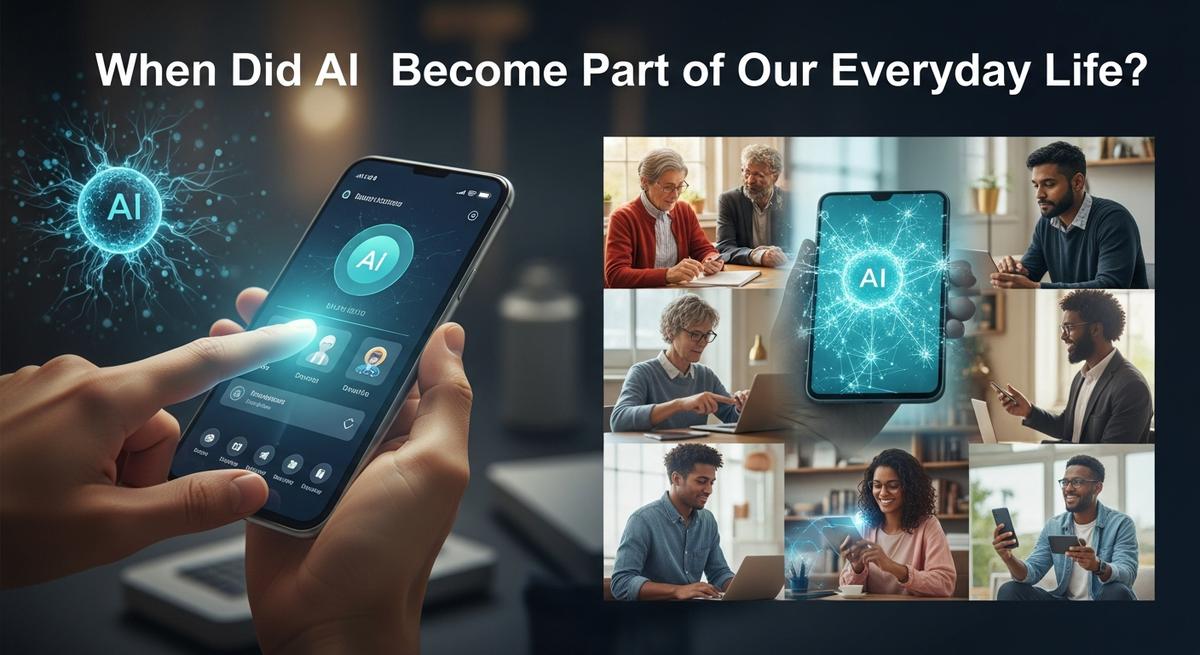
When Did AI Become Part of Our Everyday Life?
- December 26, 2025
- ~ 1 min read
- 132 views
- Everyday AI , Lifestyle & AI
Introduction/Overview
Imagine starting your day with a simple "Good morning" to your voice assistant, which instantly adjusts the thermostat, brews your coffee, and reads out your personalized news briefing while your robotic vacuum quietly maps the floor for cleaning. This seamless orchestration of tasks isn't science fiction—it's AI in everyday life, powering everything from Netflix recommendations that know you better than your friends to spam filters that shield your inbox and GPS apps that reroute you around traffic in real-time[1][2][5].
The Unseen AI Revolution in Your Routine
What was once confined to labs and Hollywood dreams has become indispensable. Artificial Intelligence (AI) refers to computer systems designed to perform tasks that typically require human intelligence, such as recognizing speech, making decisions, or predicting outcomes. Today, it's embedded in virtual assistants like Siri, Alexa, and Google Assistant, which use natural language processing to understand your slang-filled commands and adapt to your habits[1][4][5]. From facial recognition unlocking your phone to AI-powered fraud detection safeguarding your bank account, these technologies quietly enhance efficiency, security, and convenience without a second thought[3][5].
Consider your morning commute: Real-time navigation apps analyze vast datasets from millions of users to predict delays and suggest optimal routes[1][5]. At work, chatbots handle customer queries 24/7, while personalized e-commerce recommendations boost your shopping experience based on past behavior[1][3]. Even your fitness tracker uses AI to analyze patterns and suggest workouts tailored to your goals. This invisible integration marks a profound shift—AI is no longer a novelty but a necessity shaping how we live, work, and connect[2][6].
Roots of AI: From Theory to Reality
The story of AI history begins in the 1940s and 1950s, when visionaries like Alan Turing posed the question, "Can machines think?" His Turing Test laid the philosophical groundwork, while early programs like the 1956 Dartmouth Conference birthed AI as a formal field. Decades of "AI winters"—periods of hype followed by setbacks—preceded breakthroughs in machine learning and neural networks, fueled by exploding data and computing power.
- 1940s-1950s: Conceptual foundations with Turing's ideas and first neural network models.
- 1960s-1980s: Expert systems and initial applications in chess and diagnostics.
- 1990s-2000s: Rise of machine learning, enabling pattern recognition in spam filters and recommendations.
These milestones transformed abstract concepts into practical tools, paving the way for today's AI integration[6].
What Lies Ahead: Your Guide to AI's Tipping Point
In this article, we'll trace the fascinating journey of AI in everyday life across seven sections—from its theoretical origins to the smartphone era and beyond. Discover key milestones like voice assistants' rise, the explosion of recommendation engines, and the dawn of autonomous vehicles. Understanding this evolution isn't just historical trivia; it equips you to navigate AI's future impact on jobs, ethics, and innovation. Whether you're a tech enthusiast, business leader, or student, you'll uncover the exact tipping point when AI slipped from labs into your pocket—and why it matters now more than ever[6][7].
"AI is increasingly embedded in everyday life. From healthcare to transportation, AI is rapidly moving from the lab to daily life." – Stanford HAI AI Index Report[6]
Main Content
1940s-1950s: The Foundations of AI with Turing and the Dartmouth Conference
The AI timeline begins in the 1940s with Alan Turing's groundbreaking work on the Bombe machine, which cracked Nazi Enigma codes during World War II. Building on Polish cryptanalysts' earlier efforts, Turing mechanized code-breaking by inventing the Bombe in collaboration with Gordon Welchman. Operational by August 1940, it tested millions of rotor configurations rapidly, saving countless lives and laying early groundwork for machine intelligence[1][2][3].
In 1950, Turing proposed the famous Turing Test, a benchmark for machine intelligence where a computer must convincingly imitate human conversation to fool a judge. This idea shifted focus from mere computation to human-like thinking[4][6]. The decade culminated in 1956 at the Dartmouth Conference, where John McCarthy coined "artificial intelligence," marking AI's official birth as a field and sparking optimistic research into thinking machines[7].
1960s: Early Chatbots, Robots, and Neural Networks
The 1960s saw AI leap from theory to prototypes. Joseph Weizenbaum's ELIZA (1966), an early chatbot, simulated a psychotherapist by pattern-matching user inputs, demonstrating how simple rules could mimic conversation and foreshadowing modern virtual assistants.
Shakey the Robot at Stanford Research Institute became the first mobile robot to reason about its actions, using cameras and planning algorithms to navigate rooms—proving AI could interact with the physical world. Meanwhile, the first neural networks (computer systems inspired by the human brain's interconnected neurons) emerged, with Frank Rosenblatt's Perceptron learning to recognize patterns, hinting at AI's learning potential.
1970s-1980s: AI Winters and the Rise of Expert Systems
Overhyped promises led to the first AI winters in the 1970s, periods of slashed funding due to unmet expectations. Yet, progress continued with expert systems—AI programs encoding human expertise for specific tasks, like medical diagnosis.
The 1980s brought resurgence via backpropagation, an algorithm training neural networks by adjusting connections based on errors. This revived interest in learning systems, though another winter hit by decade's end amid economic pressures.
1990s-2000s: Milestones in Gaming and Voice Tech
IBM's Deep Blue defeated chess champion Garry Kasparov in 1997, showcasing AI's brute-force search prowess in strategic games. Microsoft integrated speech recognition into Windows, enabling voice commands on personal computers.
Early personal assistants like IBM's ViaVoice paved the way, blending natural language processing with everyday computing and hinting at consumer adoption.
2010s: Deep Learning and AI Enters Homes
The 2010s exploded with deep learning, advanced neural networks powered by big data and GPUs, enabling breakthroughs in image, speech, and language recognition. Apple's Siri launched in 2011 on iPhones, answering questions and setting reminders via voice—AI's first mass-market foothold.
Amazon's Alexa (2014) turned smart speakers into home hubs for music, shopping, and control, embedding AI seamlessly into daily routines. These innovations marked AI's transition from labs to living rooms, setting the stage for ubiquity today.
- Key Takeaway: From Turing's code-breaking to voice-activated homes, AI's path shows steady evolution toward everyday integration.
- Explore further: How deep learning fueled this shift in our next sections.
Supporting Content
Consumer Tech: Voice Assistants and Smart Home Robots
AI's entry into everyday homes began accelerating in the early 2000s, making chores and queries effortless. The Roomba robot, launched in 2002 by iRobot, was the first autonomous vacuum cleaner to bring AI-powered navigation into living rooms worldwide. Using sensors to avoid obstacles, detect dirt, and map rooms, Roomba transformed cleaning from a tedious task into a set-it-and-forget-it convenience. By 2010, its impact was so profound that it earned induction into the Robot Hall of Fame at Carnegie Mellon University. Imagine coming home to spotless floors without lifting a finger—millions did just that, with over 30 million units sold to date.
Fast-forward to 2011, when Apple introduced Siri AI on the iPhone 4S, the first widely accessible voice-activated assistant capable of natural language processing. Users could ask for directions, set reminders, or send texts hands-free, sparking a revolution in mobile interaction. Then, in 2014, Amazon's Alexa integration via the Echo speaker took it further, embedding AI into homes for controlling lights, playing music, and even reordering groceries. "Alexa, turn off the lights" became a household phrase, with Alexa now powering devices in over 100 million homes. A user shared, "Siri and Alexa have become my daily sidekicks—planning my commute while Roomba handles the floors."[1][2][3]
Entertainment: Personalized Streaming and Smart Features
In entertainment, AI curates experiences tailored just for you. Netflix's recommendation engine, powered by machine learning since the mid-2000s, analyzes viewing habits to suggest shows with uncanny accuracy—responsible for 80% of what users watch. Picture binge-watching your next favorite series without endless scrolling; that's AI at work, predicting preferences from billions of data points.
Spotify takes it to audio with dynamic playlists like Discover Weekly, launched in 2015, which feels eerily personal by matching songs to your tastes using collaborative filtering. Meanwhile, facial recognition in photo apps like Google Photos (since 2015) auto-tags family members, saving hours of manual sorting. These features make entertainment seamless, turning passive consumption into an intuitive delight.[1][4]
Workplace and Transportation: Invisible AI Boosts Productivity
At work, AI has been a quiet powerhouse since the 2000s. Spam filters in email clients like Gmail use AI to block 99.9% of junk mail, learning from user feedback to evolve. Autocorrect and Google search autocomplete predict your intent in real-time, slashing typing errors and search times—features refined over decades for billions of daily interactions.
In transportation, GPS apps like Waze and Google Maps employ AI for traffic prediction and dynamic routing, factoring in accidents and congestion for optimal paths. Early autonomous features in Tesla's Autopilot (2014 onward) preview self-driving futures, while adaptive cruise control is now standard. A commuter noted, "AI navigation saves me 20 minutes daily—it's like having a personal chauffeur."[1][2]
- Key Takeaway: From Siri AI queries to Netflix recommendations, these tools show AI's mass adoption since 2002.
- Stats highlight reach: 4.2 billion voice assistant users globally by 2024.
- Pro Tip: Enable Alexa integration with Roomba for voice-activated cleaning.
"AI isn't futuristic—it's the Roomba vacuuming while Alexa dims the lights." – Tech Enthusiast Review[1]
Advanced Content
Foundational Neural Networks: Perceptron and Backpropagation
In 1958, Frank Rosenblatt introduced the perceptron at Cornell Aeronautical Laboratory, marking the birth of modern neural networks[1][2][3]. This pioneering algorithm mimicked biological neurons, enabling machines to learn patterns from examples rather than rigid programming. The perceptron used simple arithmetic—addition, multiplication, and comparison—to adjust weights based on errors, making it feasible on 1950s hardware like the IBM 704[1][6]. However, limitations exposed by Marvin Minsky and Seymour Papert in 1969, such as inability to solve non-linear problems like XOR, led to the first AI winter[3][7].
The revival came in 1986 with backpropagation, popularized by Geoffrey Hinton, David Rumelhart, and Ronald Williams. This technique propagated errors backward through multi-layer neural networks, training hidden layers via gradient descent. Imagine a chain of decision-makers: each layer refines predictions by learning from the next one's mistakes, unlocking complex pattern recognition. Yet, compute shortages and funding cuts triggered another AI winter in the late 1980s and 1990s[3].
AlexNet's 2012 Breakthrough: Igniting Deep Learning
Alex Krizhevsky's AlexNet in 2012 shattered barriers at the ImageNet competition, slashing error rates in image recognition from 25% to 15%[2]. Powered by convolutional neural networks (CNNs) and trained on GPUs, it stacked layers to detect edges, shapes, and objects hierarchically—like a brain's visual cortex. This enabled everyday tech like facial recognition in smartphones and photo tagging on social media. Post-2010, surging GPU power and big data datasets overcame prior computational hurdles, scaling AI from labs to devices[2].
"Modern day artificial neural networks that underpin familiar AI like ChatGPT and DALL-E are software versions of the Perceptron, except with substantially more layers, nodes and connections."[2]
Transformer Revolution and GPT Models: Language Mastery
Entering the 2020s, GPT models from OpenAI harnessed the transformers architecture, introduced in 2017 by Vaswani et al. Transformers process sequences in parallel using self-attention mechanisms: each word "attends" to others via weighted connections, capturing context without recurrence. Simplified analogy: like a spotlight scanning a sentence to weigh relationships, enabling chatbots to generate human-like responses.
- Self-attention: Computes relevance scores across inputs simultaneously, scaling to billions of parameters.
- Positional encoding: Embeds sequence order, vital for coherent text.
- Decoder stacks: Refine predictions autoregressively, powering tools like GPT-3 (2020) and GPT-4.
These fueled seamless integration into daily life—virtual assistants, content generation, and translation apps.
Navigating AI Winters and Scaling with Big Data and GPUs
AI endured two winters: post-perceptron hype (1970s) due to linear limits, and post-backpropagation (1990s) from compute scarcity[1][3]. Revival hinged on big data floods from the internet and NVIDIA GPUs accelerating matrix operations 100x[2]. Expert Geoffrey Hinton notes this "virtuous cycle" of data, compute, and algorithms propelled multimodal AI—fusing text, images, and video.
Forward-looking: Expect edge AI on devices, processing data privately without clouds, and hybrid models blending symbolic reasoning with neural nets for robust everyday ubiquity.
Practical Content
AI has woven itself into our daily routines through voice assistants, smartphone cameras, and smart home AI, making it essential to harness these tools effectively. This section provides a hands-on guide to audit, customize, and optimize AI in your life with AI best practices for efficiency, privacy, and ethical use[1][2][3].
Step 1: Audit Your Devices – Uncover Hidden AI Features
Start by identifying AI daily use in your gadgets to appreciate its seamless integration. Most modern devices already leverage AI without you noticing.
- Check your smartphone: Open settings for Face ID or facial recognition (e.g., Apple's Face ID uses machine learning to map your face in 3D)[4]. Test your camera app—AI enhances photos with scene detection and portrait mode.
- Inspect apps: Review voice assistants like Siri, Alexa, or Google Assistant. Say "Hey Siri, what can you do?" to list features like reminders and smart home control[1][6].
- Scan smart devices: Look at thermostats (e.g., Nest learns your routine for energy savings), robot vacuums (map your home autonomously), or fridges (track inventory and suggest recipes)[2][3][5].
Actionable checklist: List 5 AI-powered apps/devices you use daily and note one new feature to try today.
Step 2: Customize Settings – Optimize for Privacy and Efficiency
Personalize your AI tools to match your needs while prioritizing privacy tips. Voice assistants learn from interactions, so fine-tune them for better performance[1][7].
- Enable and train voice assistants: On iOS, go to Settings > Siri & Search; teach it your name, routines, and shortcuts (e.g., "Good morning" routine for weather and lights). For Alexa, use the app to create custom skills[6].
- Integrate smart home AI: Link devices via apps like Google Home or Amazon Echo. Set routines: "Alexa, bedtime" dims lights, adjusts thermostat, and locks doors[2][6].
- Apply privacy settings: Disable unnecessary data sharing—review microphone access, delete voice history in Siri/Alexa apps, and enable two-factor authentication[3].
Experiment: Spend 10 minutes training your assistant with 3-5 voice commands to handle daily tasks like grocery lists or fitness reminders.
Step 3: Adopt Best Practices – Ethical Use and Maintenance
Maximize benefits with AI best practices: Update software regularly for new features, like improved natural language processing in assistants[1][7].
- Enable auto-updates on all devices to access AI enhancements, such as better obstacle avoidance in robot vacuums[5].
- Use AI ethically: Cross-check recommendations (e.g., health insights from wearables) with professionals[3].
- Integrate multi-device ecosystems: Connect your phone, watch, and home hub for automated routines, like smart alarms that wake you in light sleep phases[3].
Avoid Common Pitfalls: Stay Aware and Balanced
While AI boosts convenience, watch for over-reliance—balance with manual habits to maintain skills. Protect against data privacy tips by using incognito modes and reviewing permissions. Be mindful of biases in recommendations; diversify inputs for fairer outputs[1][3].
"AI-powered devices learn from your patterns to optimize comfort and efficiency, but user control ensures ethical integration."[6]
Implement these steps today to make AI daily use a powerful ally. Your hands-on experiments will reveal how deeply AI enhances everyday life.
Comparison/Analysis
To understand when AI adoption truly permeated everyday life, a comparative analysis of its evolution reveals key eras, trade-offs, and alternatives. This section weighs the AI pros cons across phases, contrasts rule-based systems with machine learning, and examines pivotal tools like Siri vs Alexa, highlighting how convenience clashes with AI ethics.
Eras of AI Integration: Pros, Cons, and Tipping Points
Before 2010, AI was largely experimental, confined to labs and enterprises. Pros included groundbreaking innovation in fields like expert systems, fostering foundational research. However, cons were stark: limited access due to bulky hardware, exorbitant costs (often millions for custom setups), and minimal scalability, restricting it to niche applications[1][3].
The 2010s marked a consumer boom, propelled by smartphone proliferation—over 3.5 billion devices by 2020—and cloud computing. Pros shone through affordability (voice assistants free on devices) and scalability, enabling AI adoption in navigation, recommendations, and photography. Yet, cons emerged prominently: surging privacy concerns, as data collection fueled personalization but sparked scandals like Cambridge Analytica[2][4]. This era's tipping point? The 2011 iPhone 4S launch with Siri, democratizing AI.
Alternatives: Rule-Based Systems vs. Machine Learning in Daily Apps
Early AI relied on rule-based systems—predefined "if-then" logic coded by experts—ideal for deterministic tasks like basic chatbots or calculators. They offer transparency, speed, and low data needs but falter in complexity, lacking adaptability and scalability for real-world variability[1][3][5].
In contrast, machine learning learns patterns from vast datasets, powering dynamic apps like Netflix recommendations or spam filters. It excels in predictive tasks, evolving with data for superior accuracy in ambiguous scenarios, though it demands massive training data and can be opaque ("black box" decisions)[2][4][5].
| Aspect | Rule-Based Systems | Machine Learning |
|---|---|---|
| Approach | Human-coded rules (if-then) | Data-driven pattern learning[1][5] |
| Pros | Transparent, fast, cost-efficient for simple tasks | Adaptable, handles complexity, improves over time[2][3] |
| Cons | Brittle, doesn't scale, no learning | Data-hungry, potential bias, less explainable[4][5] |
| Daily Apps Example | Basic calculators, simple diagnostics | Voice assistants, image recognition |
Hybrid approaches now blend both, marrying precision with adaptability for optimal daily use[1][7].
Trade-Offs and Siri vs. Alexa: Convenience Meets Ethical Risks
Consider Siri vs Alexa: Launched in 2011, Siri pioneered voice AI on iOS, emphasizing on-device processing for privacy. Alexa (2014) scaled via Echo devices, integrating smart homes but aggregating vast cloud data—highlighting trade-offs in convenience versus privacy[2]. Both leverage machine learning for natural language, yet raise AI ethics issues like biased recommendations (e.g., gender stereotypes in responses).
- Convenience: Instant queries save time, boosting productivity—Siri handles 3 billion daily requests.
- Ethical Risks: Bias from skewed training data perpetuates inequalities; privacy erosion via constant listening[3][8].
"Machine learning outperforms rule-based AI in dynamic environments, but at the cost of interpretability and ethical oversight."—Synthesized from industry analyses[2][5]
Future trade-offs loom with AI regulation: balancing innovation (e.g., EU AI Act mandates) against hype. Reality check—AI enhances life but demands vigilant AI ethics to mitigate risks. Businesses and users should prioritize transparent models, fostering sustainable AI adoption.
Conclusion
From the theoretical foundations laid in the 1950s with Alan Turing's groundbreaking Turing Test and John McCarthy's coining of Artificial Intelligence at the 1956 Dartmouth Conference, to the explosive integration of everyday AI in the 2010s, AI has transformed from a distant dream into an indispensable part of modern life[1][2][3][5]. This journey through decades of innovation—spanning neural networks in the late 1950s, AI winters in the 1970s and 1980s, chess triumphs like Deep Blue in 1997, and the neural network resurgence that powered Siri in 2011 and Alexa in 2014—culminates in today's seamless AI ubiquity, where virtual assistants, recommendation engines, and autonomous systems shape our daily routines[1][3][5].
Key AI Takeaways: The 2010s Turning Point
- 1950s-1980s: AI emerged as theory and early experiments, with milestones like the Perceptron (1957), ELIZA chatbot (1964), and expert systems, but faced "AI winters" due to overhyped expectations and limited computing power[1][2][4][5].
- 1990s-2000s: Breakthroughs in machine learning, such as Deep Blue's chess victory (1997) and Stanford's autonomous vehicle win (2005), laid groundwork for practical applications[1][3].
- 2010s Ubiquity: The real shift to everyday AI happened around 2011 with Apple's Siri, followed by Amazon's Alexa (2014) and widespread adoption of voice assistants, facial recognition, and streaming recommendations—making AI invisible yet essential[2][3].
These AI takeaways highlight how exponential advances in data, computing power, and algorithms turned speculative research into tools we can't live without, from smartphone predictions to smart home automation[3][5].
Embracing the AI Future: Your Next Steps
As we stand on the brink of an even more profound AI future, where generative models like GPT-3 (2020) and beyond enable creative collaboration, the question isn't if AI will evolve further, but how it will redefine human potential. Will AI enhance creativity, solve global challenges, or raise ethical dilemmas around privacy and bias? The power to shape this future lies in informed action today.
AI didn't just become part of everyday life—it redefined it. Now, it's your turn to lead the next chapter.
Start experimenting with everyday AI tools like ChatGPT for productivity boosts or voice assistants for hands-free efficiency. Stay informed on AI ethics by following reputable sources, and consider downloading a free AI app today—such as a smart planner or image generator—to experience the magic firsthand. For deeper insights into emerging trends, subscribe to our newsletter for exclusive updates on the AI future, milestone recaps, and practical guides. Join thousands of tech enthusiasts, business pros, and students already equipped for an AI-driven world—what will you create next?
Comments (0)
Please login or register to leave a comment.
No comments yet. Be the first to comment!