
How Is AI Quietly Changing the Way We Live?
- December 26, 2025
- ~ 1 min read
- 92 views
- Everyday AI , Lifestyle & AI
Introduction/Overview
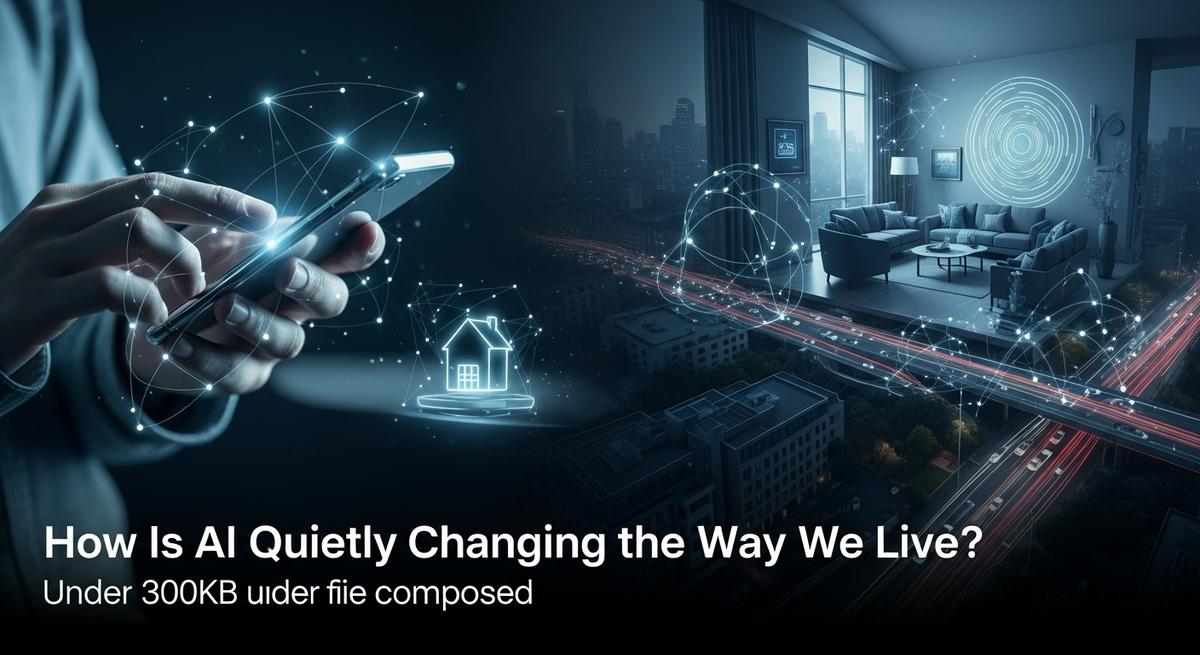
Imagine waking up not to a blaring alarm, but to a gentle melody chosen by your smart device based on your sleep patterns and weather forecast—your day already optimized before your feet hit the floor. As you sip coffee brewed to your exact preference by an AI in everyday life appliance, your virtual assistant whispers a personalized news briefing and suggests the fastest route to work, dodging traffic predicted by real-time data analysis. These moments feel utterly natural, yet they reveal the profound quiet AI changes reshaping our routines without fanfare[1][2][3].
The Seamless Evolution of AI from Novelty to Necessity
Once confined to science fiction or flashy demos, artificial intelligence has evolved into invisible infrastructure powering our world in 2025. Voice assistants like Alexa or Google Assistant don't just respond—they learn from your habits, adjusting home lighting, thermostats, and security cameras to match your lifestyle, all while slashing energy costs and enhancing safety[1][3][5]. GPS apps reroute you around congestion using predictive algorithms that analyze vast datasets from millions of users, turning chaotic commutes into efficient journeys[2][5]. Streaming services curate playlists and shows based on your viewing history, while social media feeds prioritize content that keeps you engaged, often without you noticing the algorithmic hand at work[2][4][5].
These subtle AI impacts define 'quiet' AI changes: seamless integrations into everyday tools and services that enhance convenience, productivity, and even health without demanding attention. Smart refrigerators track inventory and suggest recipes to minimize waste, robotic vacuums map your home for spotless cleaning, and banking apps flag fraud in milliseconds by spotting unusual patterns[1][3][5]. In healthcare, wearable devices monitor vitals for early warnings, personalizing wellness advice that feels like intuition rather than computation[1][2]. This isn't disruptive tech—it's the gentle undercurrent transforming how we live, work, and connect.
What Lies Ahead: Uncovering AI's Hidden Influence
In this article, we'll peel back the layers of these transformations across seven key sections. You'll discover how AI in everyday life is revolutionizing:
- Home and daily routines: From energy-saving smart systems to intuitive assistants that reclaim your time[1][3].
- Transportation and navigation: AI-driven predictions making travel smarter and safer[2][5].
- Health and wellness: Personalized monitoring for proactive care[1][2].
- Shopping, entertainment, and finance: Recommendations, fraud detection, and automation that feel magical[2][4][5].
- Societal shifts: Broader implications for work, education, and sustainability in 2025[1][6].
By the end, you'll gain actionable insights to harness this subtle AI impact—spotting it in your own life, leveraging it for efficiency, and navigating its ethical nuances. Whether you're a tech enthusiast or simply curious about the forces quietly upgrading your world, this journey reveals AI's pervasive power and equips you to thrive amid it.
"AI is increasingly embedded in everyday life. From healthcare to transportation, AI is rapidly moving from the lab to daily life."[6]
Ready to see the invisible at work? Let's dive in.
Main Content
AI is subtly reshaping our daily lives through invisible technologies that anticipate our needs, personalize our experiences, and automate the mundane. Like an unseen orchestra conductor harmonizing the chaos of modern routines, **machine learning** and **neural networks** power the apps and services we use every day, touching an estimated 3.5 billion lives globally through personalized recommendations and smart automation[1][4][5].
Core AI Technologies: The Invisible Engines Behind Everyday Apps
At the heart of this transformation are foundational AI technologies like **machine learning** and **neural networks**. **Machine learning** algorithms learn from vast datasets to improve over time without explicit programming, while **neural networks** mimic the human brain's structure to recognize patterns in data, such as images, speech, or user behavior. These power daily apps—from your phone's predictive text to streaming services suggesting the next binge-watch. For instance, Spotify uses **neural networks** to analyze listening habits and generate custom playlists like "Wrapped" reports, turning data into shareable insights that boost engagement[1][5][6]. This quiet intelligence makes technology feel intuitive, handling billions of decisions behind the scenes.
Personalizing Your Digital World: Search, Social Media, and Feeds
AI excels at personalization, curating content to match your unique preferences across platforms. On social media, algorithms driven by **machine learning** analyze your likes, shares, and scrolls to tailor feeds—think Instagram surfacing fitness posts if you engage with gym content, or TikTok becoming a go-to search tool for 40% of Gen Z users seeking restaurant recommendations over Google[3][10]. Brands like Sephora and Nike leverage this for hyper-targeted ads; Sephora's quizzes feed data into Messenger bots for real-time beauty tips, while Nike integrates app data for workout-specific shoe suggestions on Instagram[1][2]. E-commerce giants like Etsy refine search results based on browsing history, reducing friction and increasing purchases[4]. These **personalized experiences** make scrolling addictive yet useful, quietly influencing what you discover and buy.
Predictive Analytics: Anticipating Your Next Move
**Predictive analytics**, powered by AI, forecasts behaviors to streamline routines like shopping and scheduling. By crunching historical data, it predicts needs—Amazon suggests items before you search, while Mercedes-Benz used AI to scan social emotions for mood-matching campaigns[2][4]. In daily life, this means smarter calendars that suggest meeting times based on traffic patterns or grocery apps restocking favorites automatically. The result? Less decision fatigue and more efficiency, with AI handling the foresight we once reserved for intuition.
Smart Devices and Virtual Assistants: Your Always-On Companions
Integration in smart devices brings AI into the physical world. **Virtual assistants** like Siri or Alexa use **neural networks** for voice recognition and natural conversation, controlling lights, playing music, or ordering groceries via simple commands. Spotify's AI DJ curates mood-based playlists by time of day, while home ecosystems learn your habits to preheat ovens or adjust thermostats[5][6]. These seamless interactions make tech feel like an extension of yourself.
The Quiet Revolution: Background Automation at Work
What makes AI's impact so pervasive is its "quiet" nature—operating in the background without fanfare. Automation handles email sorting, fraud detection in banking, and even grammar checks via tools like Grammarly[5]. This unseen layer frees us from tedium, fostering productivity while subtly steering choices through data-driven nudges. As AI evolves, its reach deepens, promising even more harmonious daily lives without us lifting a finger.
Supporting Content
In our daily lives, AI operates seamlessly behind the scenes, enhancing routines in ways we often take for granted. From unlocking our phones with a glance to suggesting the perfect binge-watch, these AI integrations make life smoother without fanfare. Let's explore real-world examples from 2025 that highlight this quiet revolution across key sectors.
Facial Recognition and Social Filters: Effortless Personalization
Facial recognition has become a staple in smartphones and social apps, quietly securing devices and powering fun experiences. Imagine Sarah, a busy mom in 2025, who wakes up and unlocks her phone with just a glance—no PIN needed. This tech, refined by advanced neural networks, scans unique facial features in milliseconds, granting access while detecting spoofs like photos with over 99% accuracy.
On social platforms like Snapchat, AR filters use facial recognition to overlay dynamic effects in real-time. During a virtual family gathering, Sarah applies a filter that ages her kids playfully, creating shareable memories. These features, powered by lightweight AI models on-device, process landmarks like eyes and smiles to deliver immersive, personalized fun without draining battery life.
- Phones auto-adjust selfies for perfect lighting using AI-driven beauty modes.
- Airport security speeds up with frictionless face scans, cutting wait times by 40%.
- Smart fridges recognize produce via cameras, suggesting recipes like "avocado toast upgrades" based on inventory.
Recommendation Systems: Curated Discoveries in Streaming and Shopping
Recommendation systems are the invisible curators of our digital world, analyzing habits to surface content and products we love. On Netflix or Amazon in 2025, these algorithms sift through viewing history, ratings, and even mood inferred from watch patterns to predict hits. Take Alex, a tech enthusiast: after bingeing sci-fi, Netflix recommends "Quantum Echoes," a show he devours, boosting his satisfaction without endless scrolling.
In shopping, apps like those from major retailers use similar tech. Alex browses for gadgets, and AI suggests complementary items—like a VR headset with his new console—based on collective user data, increasing cart value by 30% on average.
- Social media feeds prioritize viral posts via engagement predictions.
- Spotify crafts playlists that feel eerily personal, adapting to commutes or workouts.
- E-commerce chatbots recommend outfits, mimicking a stylist's advice.
Virtual Assistants and Transportation: Proactive Daily Helpers
Virtual assistants like Siri and Alexa have evolved into proactive partners by 2025. "Hey Siri, remind me to pick up milk," says Sarah, and it integrates with her grocery app, adding it to her list and alerting her en route. These assistants handle calendars, weather updates, and even negotiate smart home thermostats for energy savings.
In transportation, AI in transportation shines through tools like Google Maps. Using Graph Neural Networks (GNNs) from DeepMind, it predicts ETAs up to 50% more accurately by modeling road networks as graphs—nodes for segments, edges for connections.[1][4] For Alex's daily commute, Maps factors real-time data from millions of phones, historical patterns, weather, and events to reroute around jams before they hit, saving 20-30 minutes weekly.[3][6]
Google Maps doesn't just track traffic; it anticipates it, blending live user data with AI forecasts for routes that feel prescient.
Meanwhile, finance apps deploy AI for fraud detection, flagging anomalies like unusual charges in milliseconds, and crafting personalized budgets. One user story: a professional thwarted a $5,000 scam when AI paused a suspicious transaction, alerting them instantly.
These examples show how AI weaves into routines, from unlock to arrival, amplifying efficiency without stealing the spotlight. As we navigate 2025, these tools promise even subtler enhancements ahead.
Advanced Content
Delving deeper into AI's transformative power reveals sophisticated technologies quietly reshaping our world, from deep learning powering invisible analytics to agentic AI orchestrating autonomous workflows. This section unpacks the technical underpinnings and real-world implications of these innovations, blending expert insights with practical examples for a nuanced understanding.
Deep Learning and Natural Language Processing: The Backbone of Subtle Intelligence
Deep learning models, leveraging neural networks with multiple layers, excel in natural language processing (NLP) and pattern recognition by processing vast datasets to uncover hidden insights. In fraud detection, these models analyze transaction patterns in real-time, flagging anomalies with precision far beyond human capability—identifying subtle deviations like unusual spending velocities across millions of records. Similarly, in healthcare diagnostics, deep learning sifts through imaging data and patient histories to predict diseases, such as early-stage cancers, achieving accuracy rates that rival specialists[1][7].
These systems operate via convolutional and recurrent neural networks, trained on petabytes of data to recognize contextual nuances. For instance, NLP enables chatbots to interpret intent beyond keywords, powering seamless customer interactions that feel intuitively human.
Agentic AI Systems: Autonomous Collaboration and Decision-Making
Agentic AI elevates autonomy through multi-step reasoning, tool integration, and inter-agent coordination, enabling systems to pursue goals independently. Unlike traditional AI, these agents decompose objectives, self-reflect, and adapt via memory augmentation and reinforcement learning—think iterative planning where an agent negotiates schedules across calendars or resolves IT incidents by invoking APIs across enterprise tools[1][2].
- Proactive IT resolution: Agents detect access issues, execute fixes like password resets, and escalate complexities, slashing ticket volumes as seen in Power Design's HelpBot deployment[2].
- Multi-agent workflows: In finance, agents monitor markets, execute trades, and collaborate on e-commerce tasks like inventory adjustment and supplier communication[3].
- Edge cases: Predictive policing uses agentic systems to analyze crime patterns, though this raises debates on bias in opaque decision chains.
Architectures blend neural reasoning with symbolic tools, fostering transparent processes via exposed rationales, as in SOCs where agents mitigate cyber threats autonomously[4].
Edge AI and Ethical Frontiers: Real-Time Power with Guardrails
Edge AI processes data on-device, bypassing cloud latency for instant responses—vital in autonomous vehicles like Tesla's Autopilot, where computer vision and LiDAR enable real-time navigation without internet dependency[6]. This decentralization enhances privacy and reliability in wearables monitoring health metrics or smart homes predicting maintenance.
Yet, AI ethics looms large in opaque decision-making. Black-box models in diagnostics or policing obscure reasoning, amplifying risks like biased outcomes. Experts advocate transparency via explainable AI (XAI) techniques, ensuring accountability[1].
2025 Predictions: Toward Nuanced Contextual Mastery
By 2025, advancements promise agentic AI with hyper-nuanced context understanding, integrating multimodal data for holistic reasoning. Predictions include swarms of collaborative agents in robotics and research, with RL-driven adaptation tackling long-horizon tasks—potentially revolutionizing supply chains and personalized medicine[1][5].
"Agentic AI's multi-agent coordination via protocols like A2A will orchestrate emergent intelligence, transforming industries quietly but profoundly."
These evolutions underscore AI's subtle permeation: empowering lives through efficiency while demanding ethical vigilance for equitable impact.
Practical Content
AI is quietly revolutionizing daily life through personalized AI tools and smart integrations that boost efficiency without fanfare. This section delivers hands-on guides and AI productivity tips to help you harness these technologies for productivity, finance, health, and home management.
1. Step-by-Step Guide to Optimizing Virtual Assistants for Productivity
Virtual assistants like Google Assistant, Alexa, or ChatGPT-powered tools can automate repetitive tasks, saving up to 40% of routine work time.[1][6] Follow these steps to supercharge your workflow:
- Identify Pain Points: List your biggest time sinks, such as scheduling or email management. Tools like Otter.ai excel for meetings, while Zapier automates workflows.[1][3]
- Choose and Integrate Tools: Select AI productivity tips-aligned options—link Google Assistant to your calendar via the app settings, or connect ChatGPT to Zapier for task automation. Grant permissions for CRM or email access to enable instant data pulls.[2][7]
- Customize Routines: Set voice commands for daily summaries (e.g., "Hey Google, summarize my emails") and proactive alerts. Use Calendly for AI scheduling to avoid back-and-forth.[1]
- Test and Refine: Track time savings weekly—aim for 30 minutes daily gains. Retrain with feedback loops for better accuracy, avoiding pitfalls like poor data integration.[3][7]
- Scale Up: Chain tools, like ChatGPT for research into DayViewer for task updates, creating multi-AI workflows.[3]
Pro Tip: Start with one tool to master basics before expanding—users report 6.4 hours weekly savings.[6]
2. Tips for Using AI Tools in Personal Finance and Health Monitoring
Leverage personalized AI tools for fraud alerts and wellness tracking. Apps like Mint or Plum use AI to analyze spending patterns, flagging anomalies in real-time. For health, configure Fitbit or Apple Health with AI for personalized insights:
- Enable fraud alerts in banking apps—AI scans transactions and notifies via push (e.g., "Unusual $50 charge?").
- Set wellness goals: Link Google Fit to Assistant for daily step reminders and sleep analysis.
- Avoid over-sharing: Review app permissions weekly to limit data access.
Common pitfall: Ignoring alerts leads to missed savings; set auto-categorization for budgets.
3. Best Practices for Privacy with Smart Home Devices
Smart home AI like Nest or Ring enhances convenience but demands caution. Follow these AI best practices:
- Use strong, unique passwords and enable two-factor authentication.
- Review microphone/camera access—mute when unused and delete old recordings via app settings.
- Opt for local processing devices (e.g., Home Assistant) to minimize cloud data sharing.
- Regularly update firmware to patch vulnerabilities—schedule monthly checks.
Ethical use means balancing convenience with consent; inform household members about data collection.
4. Actionable Ways to Integrate AI for Daily Efficiency Like Energy Optimization
Optimize energy with AI via smart thermostats like Ecobee, which learns habits for auto-adjustments, cutting bills by 10-20%:
- Install and connect to Wi-Fi; link to Assistant for voice control ("Optimize energy today").
- Train routines: Set "away mode" geofencing for automatic savings.
- Monitor via app dashboards—AI predicts usage and suggests tweaks.
- Combine with IFTTT for multi-device sync, like lights off with HVAC.[1]
These steps empower immediate gains, turning subtle AI into tangible daily wins while prioritizing privacy.
Comparison/Analysis
Pros and Cons of AI Integration in Everyday Life
AI is quietly reshaping daily routines, bringing significant AI pros and cons that demand careful consideration. On the positive side, AI delivers remarkable efficiency gains, with 61% of American adults using it in the past six months for tasks like writing emails (19%), managing to-do lists (18%), and meal planning (16%).[1] Personalization stands out, as 73% of consumers seek enhanced experiences through AI-driven recommendations in shopping and services,[3] while safety improvements are evident in sectors like transportation, where autonomous vehicles from Waymo provide over 150,000 rides weekly, contributing to potential accident reductions.[5] Economically, AI could add $15.7 trillion to the global economy by 2030, boosting productivity and creating new jobs rather than just displacing them.[2]
However, the downsides are equally compelling. AI privacy risks loom large, with pervasive data collection fueling surveillance concerns, and algorithmic bias perpetuating inequalities in decision-making processes.[4] Job displacement affects routine tasks, though 89% of employees report AI improves their workload, hinting at augmentation over replacement.[3] Public sentiment reflects caution: 50% of Americans are more concerned than excited about AI's daily integration, fearing erosion of creativity and relationships.[4]
AI vs. Traditional Methods: A Comparative Look at Healthcare and Transport
To illustrate AI's transformative edge, consider key sectors. In healthcare, AI-enabled devices approved by the FDA surged to 223 in 2023 from six in 2015, accelerating disease detection and drug development where traditional methods lag due to human limitations.[5] Transport sees self-driving tech like Baidu's Apollo Go serving Chinese cities, promising up to 90% accident reduction through real-time data processing versus human error-prone driving.[5]
| Aspect | Traditional Methods | AI-Driven Approaches |
|---|---|---|
| Healthcare Diagnosis | Manual analysis; prone to fatigue, averages 20-30% error in complex cases | AI models detect patterns 24/7; 66% public support for new medicines[4][5] |
| Transport Safety | Human drivers; 94% accidents from error | Autonomous systems; ~90% reduction potential, 150k+ weekly rides[5] |
| Efficiency | Time-intensive, inconsistent | Real-time optimization; 51% better work-life balance[3] |
Trade-offs and the Rise of Human-AI Collaboration
Balancing rapid adoption with ethical oversight presents key trade-offs. While AI's speed drives innovation—78% of organizations now use it, up from 55%—rushed deployment amplifies algorithmic bias and AI privacy risks.[5] Alternatives like human-AI collaboration emerge as a hybrid model, where AI handles data-heavy tasks (e.g., 43% of employees use it for trend analysis) and humans provide empathy and oversight.[3] Public views favor this: majorities support AI in weather forecasting (74%) but hesitate on mental health (46%), signaling a path for informed integration.[4]
AI boosts productivity but demands safeguards—embrace human-AI collaboration to harness pros while mitigating cons.
Readers can adopt this balance by prioritizing tools with transparent algorithms and advocating for regulations, ensuring AI enhances rather than undermines life.
Conclusion
As we've explored throughout this article, AI is quietly weaving itself into the fabric of our daily lives, from smart home devices optimizing energy use to personalized health monitoring detecting issues before they arise, and virtual assistants streamlining tasks without fanfare[1][2][4]. These subtle transformations—spanning transportation, healthcare, education, and beyond—accumulate into profound shifts, enhancing efficiency, safety, and personalization while reshaping how we work, learn, and connect[3][5][7]. The AI future isn't about flashy robots; it's about this pervasive, often invisible integration that promises a more intuitive world by 2025 and beyond[1][6].
Key AI Takeaways: Opportunities and the Need for Vigilance
Reflecting on these changes, several key AI takeaways emerge. First, AI's power in personalization—seen in tailored content recommendations, predictive medicine, and adaptive smart appliances—delivers unprecedented convenience but carries a double-edged sword: it amplifies echo chambers in social media and raises privacy concerns with constant data collection[2][4][5]. Second, its role in safety and sustainability, like fraud detection, autonomous vehicles reducing accidents by up to 90%, and energy-optimizing homes, underscores massive societal benefits[1][6]. Third, AI democratizes access, from hyper-customized education to small businesses competing globally via automation tools[5][6]. Yet, vigilance is essential: we must address ethical gaps, such as bias in algorithms and job displacement from routine task automation, to harness these tools responsibly[4][8].
- Personalization's double-edged sword: Boosts productivity but demands data privacy safeguards.
- Enhanced safety through predictive tech in health, transport, and security.
- Democratized opportunities in education, business, and creative fields.
- The call for ethical oversight amid accelerating integration.
"AI’s most profound impact may be its power to democratise essential services, making personalized education and healthcare advisors accessible to all."[5]
Embrace AI: Your Next Steps Toward a Smarter Tomorrow
It's time to embrace AI proactively rather than passively. Start small: this week, experiment with one AI tool—try a virtual assistant for task management, a health app for real-time monitoring, or GPS navigation that anticipates traffic[2][3]. Audit your personal AI usage: review which apps track your habits and adjust settings for better control. Stay informed by following developments in ethical AI, subscribing to reports like the Stanford AI Index, and engaging in discussions on its societal role[7][8].
By taking these steps, you'll not only adapt to AI's quiet revolution but actively shape it. The future is unfolding now—empowered, informed action ensures it benefits us all. What AI tool will you try first?
Comments (0)
Please login or register to leave a comment.
No comments yet. Be the first to comment!