
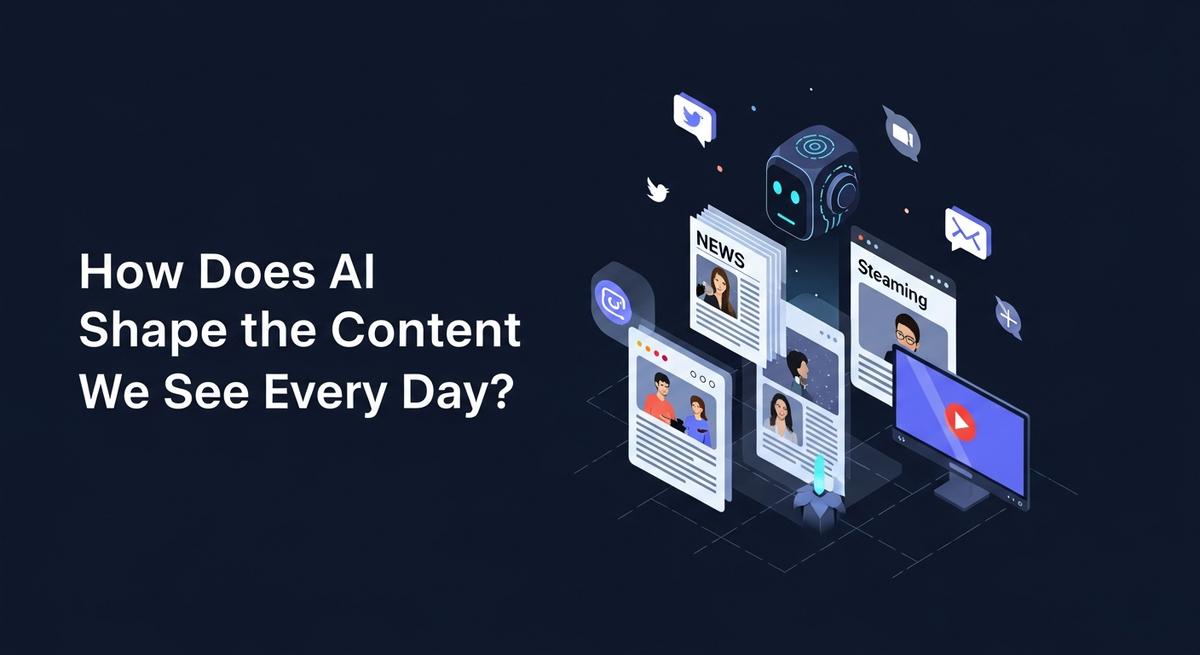
How Does AI Shape the Content We See Every Day?
- December 31, 2025
- ~ 1 min read
- 203 views
- Everyday AI , Lifestyle & AI
Introduction/Overview
Imagine starting your day with a cup of coffee in hand, grabbing your phone to scroll through your social media feed. Suddenly, a video of that hiking trail you mentioned last week pops up, followed by an ad for the exact running shoes you've been eyeing, and a news article tailored to your interest in sustainable tech. It feels serendipitous, doesn't it? But behind this seamless experience lies the invisible hand of AI content shaping, powered by sophisticated recommendation algorithms and personalized feeds that curate every piece of content you see.[1][2]
The Evolution of AI in Content Curation
AI has come a long way from its early days of simple spam filters and basic search rankings. Today, in 2025, it's a powerhouse driving the AI content shaping revolution. What began as rule-based systems has evolved into advanced machine learning models that analyze vast datasets—including your past clicks, dwell time, location, and even device preferences—to predict and prioritize content in real-time.[2][4] The AI marketing market alone is valued at $47.32 billion this year, projected to double by 2028, underscoring its explosive growth and integration into daily digital life.[1] Recommendation algorithms, the core engines of this transformation, don't just filter; they learn from billions of interactions to surface hyper-relevant material, making your feed feel uniquely yours.[3][5]
These personalized feeds are fueled by personalization engines that process behavioral data, creating dynamic user profiles. For instance, 92% of businesses now leverage AI-driven personalization, boosting customer engagement through tailored recommendations that increase click-through rates and loyalty.[3] This shift from generic broadcasts to individualized streams has redefined how platforms like Instagram, TikTok, and YouTube deliver content, often without users realizing the depth of influence.
What You'll Discover in This Guide
In this comprehensive article, we'll demystify the mechanisms behind AI content shaping. You'll explore:
- How recommendation algorithms work under the hood, from collaborative filtering to neural networks.
- Real-world examples of personalized feeds in action across social media, streaming services, and e-commerce.
- The broader implications, including filter bubbles, privacy concerns, and ethical dilemmas.
- Practical tips for content creators and marketers to harness or counter these forces.
- Future trends shaping the next wave of AI-driven content experiences.
By the end, you'll have a clear roadmap to navigate—and even optimize—your digital world.
Why AI's Role in Your Daily Feed Matters Now
73% of business leaders agree that AI will fundamentally reshape personalization strategies, delivering value-driven content at scale.[3][8]
AI doesn't just entertain; it subtly molds opinions, behaviors, and even worldviews by amplifying certain narratives while burying others. With 88% of marketers using AI daily to enhance content speed and relevance, the stakes are high—personalization boosts sales by up to 38% and fosters loyalty, but it also risks creating echo chambers.[1][3] Understanding recommendation algorithms and personalized feeds empowers you to break free from algorithmic biases, make informed choices, and as a creator or marketer, craft content that thrives in this AI-dominated landscape. It's time to peek behind the curtain.[2][5]
Main Content
Breaking Down Recommendation Systems: The Core of Your Feed
At the heart of AI-shaped content are recommendation systems, sophisticated algorithms that curate what you see on platforms like YouTube, TikTok, and Instagram. These systems primarily use three approaches: collaborative filtering, content-based filtering, and hybrid models. Think of collaborative filtering as a social matchmaker—it analyzes patterns from similar users, suggesting content like "people who watched this also enjoyed that."[1][3][6] For instance, if users with tastes like yours binge-watch sci-fi thrillers, the system pushes those your way, uncovering hidden gems through collective behavior.
Content-based filtering, on the other hand, acts like a personal stylist focusing on item traits. It matches content to your past likes by examining attributes such as genre, keywords, or actors—if you love action movies with explosive plots, it recommends similar ones based on those features, without needing data from others.[1][2][5] Hybrid models combine both for superior accuracy, tackling issues like the "cold start" problem for new items by blending user similarities with content profiles.[4][5] This powerhouse trio processes billions of data points daily, powering feeds that feel eerily intuitive.
Personalization Engines: Crafting Your Unique Experience
Personalization engines elevate this by collecting vast user data—behavior (clicks, views, dwell time), demographics, and interactions—and adapting in real-time.[2][7] Imagine AI as your personal DJ, scanning your listening history, mood signals from session length, and even device context to spin the perfect playlist on Spotify.[3] These engines build feature vectors from centralized data warehouses, feeding them into machine learning models like neural networks for predictive magic.[2] The result? Content that evolves with you, from tailored Instagram Reels to YouTube suggestions that hook you instantly.
Generative AI: Automating Creativity at Scale
Enter generative AI, which doesn't just recommend—it creates. Platforms use it to auto-generate summaries, eye-catching thumbnails, and even content variants customized to your profile.[8] For example, TikTok might tweak video captions or previews based on your past engagement, while news apps produce bite-sized recaps. This scales personalization exponentially, handling the flood of user-generated content without human intervention.
The Power of User Engagement Loops and Massive Scale
These systems thrive on user engagement loops, where your likes, shares, and scrolls reinforce AI decisions, creating self-improving cycles—but also potential echo chambers.[2] High engagement signals "more of this," narrowing your feed into familiar territory, which boosts platform retention yet limits discovery. At scale, YouTube and TikTok crunch billions of interactions via real-time data pipelines, with the AI recommendation systems market projected to grow rapidly as adoption surges—recent studies show hybrid models boosting precision by integrating explicit and implicit data.[5]
- Empower yourself: Diversify by exploring "For You" alternatives or resetting algorithms periodically.
- Content creators: Optimize with rich metadata to shine in content-based filters.
- Marketers: Leverage these loops for targeted campaigns that ride engagement waves.
"Recommendation engines filter the universe of content into a personalized shortlist, saying, 'You might like these next.'"[1]
By understanding these interconnected mechanisms, you demystify the black box, gaining control over the content that shapes your daily digital life.
Supporting Content
AI's influence on everyday content is most evident in real-world applications across social media, streaming, news, e-commerce, and creator tools. These platforms use sophisticated algorithms to personalize feeds, predict viral trends, and automate workflows, shaping what billions see daily.
Social Media: TikTok's For You Page and Instagram Reels
The TikTok For You Page exemplifies AI's power in viral content prediction. Powered by machine learning, it analyzes user interactions like watch time, likes, shares, comments, and even skips to curate a hyper-personalized feed.[1][2][3] For instance, if you engage with cooking videos, the algorithm refines recommendations toward vegan recipes, creating an addictive loop where users spend an average of 95 minutes daily scrolling.[5] A user persona like Sarah, a busy mom, once saw generic family tips; post-AI training via "Not Interested" taps, her feed now floods with quick toddler hacks, boosting retention.
Similarly, Instagram Reels employs AI to mirror this, prioritizing short-form videos based on past views and hashtags, turning casual scrolls into discovery engines for trends.
Visual suggestion: Insert a screenshot of a personalized TikTok For You Page feed showing tailored recipe videos.
Streaming and News: Netflix, YouTube, and Personalized Feeds
Streaming giants like Netflix and YouTube rely on Netflix recommendations and YouTube algorithms for the bulk of engagement—driving 80% of views through AI that factors in watch history, pauses, and rewatches.[1] Netflix's system suggests binges based on subtle cues, transforming a viewer's evening from random browsing to tailored marathons.
In news, Google News and Facebook prioritize stories via past clicks, ensuring timely, relevant headlines. Consider Mark, a tech enthusiast: pre-AI, he sifted generic feeds; now, algorithms surface breaking AI news, keeping him informed without effort.
These systems weigh signals like completion rates heavily, ensuring fresh, engaging content.[4]
E-commerce and Creator Tools: Amazon and AI Boosters
Amazon's product suggestions use AI to analyze browsing and purchase history, subtly shaping shopping habits—often accounting for 35% of sales through "customers also bought" predictions.
- Before AI: Generic listings overwhelm users.
- After AI: Personalized carousels lead to impulse buys, like recommending running gear after fitness video views.
For creators, AI thumbnails and captions are game-changers. Stats show 80% of creators integrate AI into workflows for optimized visuals and hooks, skyrocketing visibility on YouTube and TikTok.[1][3] Tools auto-generate eye-catching thumbnails predicting click-through rates, while caption generators incorporate trending hashtags.
TikTok's algorithm assigns prediction scores to videos, amplifying top performers to wider audiences based on initial engagement.[3]
Visual suggestion: Include side-by-side screenshots of AI-generated vs. manual thumbnails, highlighting engagement spikes.
These examples reveal AI's dual role: enhancing discovery for users while empowering creators and businesses. By understanding these mechanics, you can train your feeds—try "Refresh your For You feed" on TikTok or curating watchlists on Netflix for better personalization.[1]
Advanced Content
In the realm of AI-driven content, advanced content represents the pinnacle of sophistication where neural networks, transformers, and cutting-edge algorithms process vast datasets to curate hyper-personalized experiences. This section dives deep into the technical underpinnings powering your daily feeds, from recommendation engines to generative adaptations, revealing how these systems shape what you see with unprecedented precision[1][2][3].
Machine Learning Models Powering Recommendations
At the core of modern recommendation systems lie sophisticated machine learning models like neural networks, transformers, and reinforcement learning. Transformers, with their multi-head self-attention mechanisms, excel at capturing relationships across sequential data, such as a user's browsing history or video watch patterns, enabling platforms to predict the next engaging item[2][6][7]. For instance, recurrent neural networks (RNNs) and transformers process session-based interactions, embedding item IDs into vectors that feed into deeper layers for accurate predictions[3].
Consider this simplified pseudocode for a transformer-based recommender:
# Pseudocode for Transformer Sequence Layer in Recommendations
def transformer_recommendation(user_sequence):
    embeddings = embed_items(user_sequence)  # Embed item IDs
    attention_output = multi_head_attention(embeddings)  # Self-attention
    sequence_repr = feed_forward(attention_output)  # Final representation
    predictions = softmax(sequence_repr @ item_embeddings.T)
    return top_k(predictions)
Reinforcement learning further refines these models in real-time, optimizing for long-term engagement by treating recommendations as actions in a reward-based environment[1]. Hybrid systems combine these with matrix factorization for superior accuracy[1][2].
Data Pipelines and Edge Cases in AI Content Shaping
These models thrive on massive data pipelines handling petabytes of user interactions via real-time processing. Frameworks like NVIDIA's HugeCTR scale embedding tables across terabytes, maximizing GPU utilization for training on multimodal data—text, images, and video[3]. Deep learning recommender systems outperform traditional methods by leveraging this scale, though they demand extensive computational resources[2].
Yet, challenges persist in edge cases. Bias amplification occurs when algorithms reinforce existing prejudices in training data, skewing feeds toward popular or demographically similar content[4]. The cold-start problem hampers new users or items lacking interaction history, while adversarial attacks—subtle manipulations—can poison recommendations[1]. Addressing these requires hybrid models and federated learning for privacy-preserving adaptations[1][4].
"Deep neural networks outperform traditional algorithms by identifying non-linear relationships, but ethical challenges like bias amplification demand vigilant oversight," notes Amazon research on recommendation engines[2].
Generative AI, Expert Insights, and Future Multimodal Horizons
Expert insights highlight generative AI like GPT models, built on transformers, which dynamically adapt content—rewriting headlines or generating summaries tailored to user context[6]. These enable real-time personalization beyond static recommendations.
Looking ahead, multimodal AI—integrating text, video, and audio—promises holistic shaping of experiences. Graph neural networks (GNNs) and context-aware systems will map complex user-item graphs, while neuro-symbolic AI enhances interpretability[1][4]. For content creators and marketers, understanding these trends means leveraging tools like two-tower models for efficient candidate generation in multi-stage pipelines[5].
- Adopt transformers for sequential personalization to boost engagement.
- Mitigate bias amplification with diverse datasets and audits.
- Explore multimodal AI for cross-domain recommendations, like video-to-text suggestions.
By grasping these advanced content mechanics, readers gain the edge to navigate and innovate in an AI-curated world.
Practical Content
Take control of your daily content experience with these AI personalization tips and recommendation hacks. Whether you're a casual user tired of repetitive feeds or a creator optimizing your workflow, these step-by-step guides empower you to reset algorithms, curate better content, and blend human creativity with AI tools effectively.
1. Step-by-Step: Reset Algorithms on YouTube, TikTok, and Instagram
Resetting your algorithm reset is like hitting refresh on your digital world. Start fresh to break free from outdated suggestions and introduce variety. Here's how:
- TikTok: Open the app, tap your Profile (bottom right), then the three lines (top right) to access Settings and Privacy. Under Content Preferences, select Refresh Your For You Feed and confirm. Your feed will act like new, broadening content based on fresh interactions[1].
- Instagram: Go to your Profile, tap Settings and Activity, scroll to Content Preferences, and hit Reset Suggested Content. For ongoing tweaks, tap three dots on unwanted posts and select Not Interested[1][5].
- YouTube: Navigate to Settings > History & Privacy and tap Clear Watch History. Diversify by watching varied videos and using incognito mode to explore without influencing your main feed[4].
Pro tip: Clear history weekly and engage with new topics to train the algorithm mindfully.
2. Actionable Strategies: Curate and Engage Mindfully
Avoid filter bubbles by diversifying your digital diet. Use these recommendation hacks daily:
- Switch to incognito or private browsing on apps like YouTube or TikTok to test neutral feeds without history bias.
- Curate follows: Unfollow or mute 10-20 accounts weekly; ask: Does this spark joy or growth? On TikTok, use the nuclear option to unfollow all and restart selectively[2].
- Engage intentionally: Like, comment, and share diverse content. Block keywords in settings (e.g., Instagram's ad preferences) to filter noise[2][3].
"Think of it as reorganizing your pantry—clear space for fresh discoveries and mental clarity."[1]
3. Best Practices for Creators: Hybrid Human-AI Workflows
Creators, supercharge your output with creator workflows that harness AI without losing your voice. Focus on efficiency:
- Thumbnails & SEO: Use tools like Canva's Magic Studio or Midjourney for eye-catching thumbnails, then optimize titles with Ahrefs or SEMrush for AI personalization tips.
- AI-Assisted Captioning: Generate drafts with ChatGPT or Jasper, then infuse personal flair—trends show 30% faster production with hybrid approaches.
- Personalize at scale: Segment audiences via YouTube Analytics and tailor content hooks based on recommendation data.
Checklist for Success:
- AI for ideation/drafts ✓
- Human edit for authenticity ✓
- A/B test with platform insights ✓
4. Tools Overview: Audit and Tweak Recommendations
Empower yourself with browser extensions like News Feed Eradicator (Chrome) to limit endless scrolling, or Enhance YouTube to filter suggestions. Apps like Control Alt Achieve audit feeds, while Freedom blocks distracting sites. Install, scan your history, and tweak for balanced viewing.
5. Avoid Pitfalls: Break Free from Filter Bubbles
Over-reliance on AI creates echo chambers—spot filter bubbles when feeds feel eerily uniform. Counter by rotating platforms, seeking offline inspiration, and questioning suggestions. Balance is key: Use AI as a tool, not a crutch, for richer content discovery.
Implement these today for feeds that inspire, not confine. Your empowered scroll starts now!
Conclusion
As we've explored throughout this article, AI content is no longer a distant future concept—it's actively shaping what you see, read, and watch every single day. From Netflix's algorithm that influences approximately 80% of what users watch to Amazon's recommendation engine that drives roughly 35% of sales, artificial intelligence has become the invisible curator of our digital lives. The mechanisms are sophisticated yet purposeful: collaborative filtering, predictive analytics, and natural language processing work in concert to deliver content that feels eerily tailored to your preferences.
But understanding how AI personalizes your content consumption is only half the battle. The real power lies in recognizing that while these systems are designed to influence your choices, you're not entirely passive in this equation. The AI content future belongs to informed users who understand the mechanics at play and take deliberate steps to shape their own digital experience.
Key Takeaways to Remember
- AI learns from your behavior—Every click, pause, search, and purchase feeds algorithms that predict what you'll want next. Your data is the currency that powers personalization.
- Personalization drives engagement and revenue—Brands using AI personalization report significant improvements in conversion rates and customer lifetime value. Calm increased daily usage by 3.4% through personalized recommendations, while Netflix saves $1 billion annually in customer retention through optimized content curation.
- You have more agency than you think—By auditing your feeds, diversifying your content sources, and consciously seeking out different perspectives, you can influence what algorithms recommend to you.
- Emerging trends demand awareness—Hyper-personalization, predictive offers, and AI-driven video personalization are becoming standard practice. Staying informed about these trends helps you navigate them more intentionally.
- Ethics and transparency matter—As AI becomes more sophisticated, questions about data privacy, algorithmic bias, and consent deserve your attention and advocacy.
Your Call to Action: Take Control of Your Digital Diet
The insights in this article aren't meant to alarm you—they're meant to empower you. Audit your feed today by asking yourself critical questions: What patterns do you notice in your recommendations? Are you seeing diverse viewpoints or trapped in an echo chamber? Which platforms are you spending the most time on, and why?
Beyond auditing, consider these actionable steps:
- Deliberately search for and follow creators and sources outside your usual preferences
- Review your privacy settings and data permissions on major platforms
- Engage critically with recommendations rather than passively accepting them
- Support platforms and creators who prioritize transparency about their algorithms
- Stay informed about AI ethics discussions and industry developments
Looking Ahead: An Optimistic Vision for 2025 and Beyond
The AI content future doesn't have to be one where algorithms control us. Instead, it can be a future where informed users leverage AI's benefits while maintaining agency over their digital consumption. As we move deeper into 2025, expect to see continued evolution in AI monetization, more sophisticated personalization techniques, and—hopefully—greater emphasis on algorithmic transparency and user control.
The brands and platforms that will thrive are those that balance personalization with respect for user autonomy. They understand that true engagement comes from delivering value, not just maximizing screen time. Whether you're a content creator, marketer, or casual social media user, the message is clear: AI is reshaping how we consume content, but you're not powerless in that transformation.
Start today. Audit your feed. Diversify your sources. Engage critically. The content you see tomorrow is shaped by the choices you make today—and that's a power worth exercising.
Comments (0)
Please login or register to leave a comment.
No comments yet. Be the first to comment!