
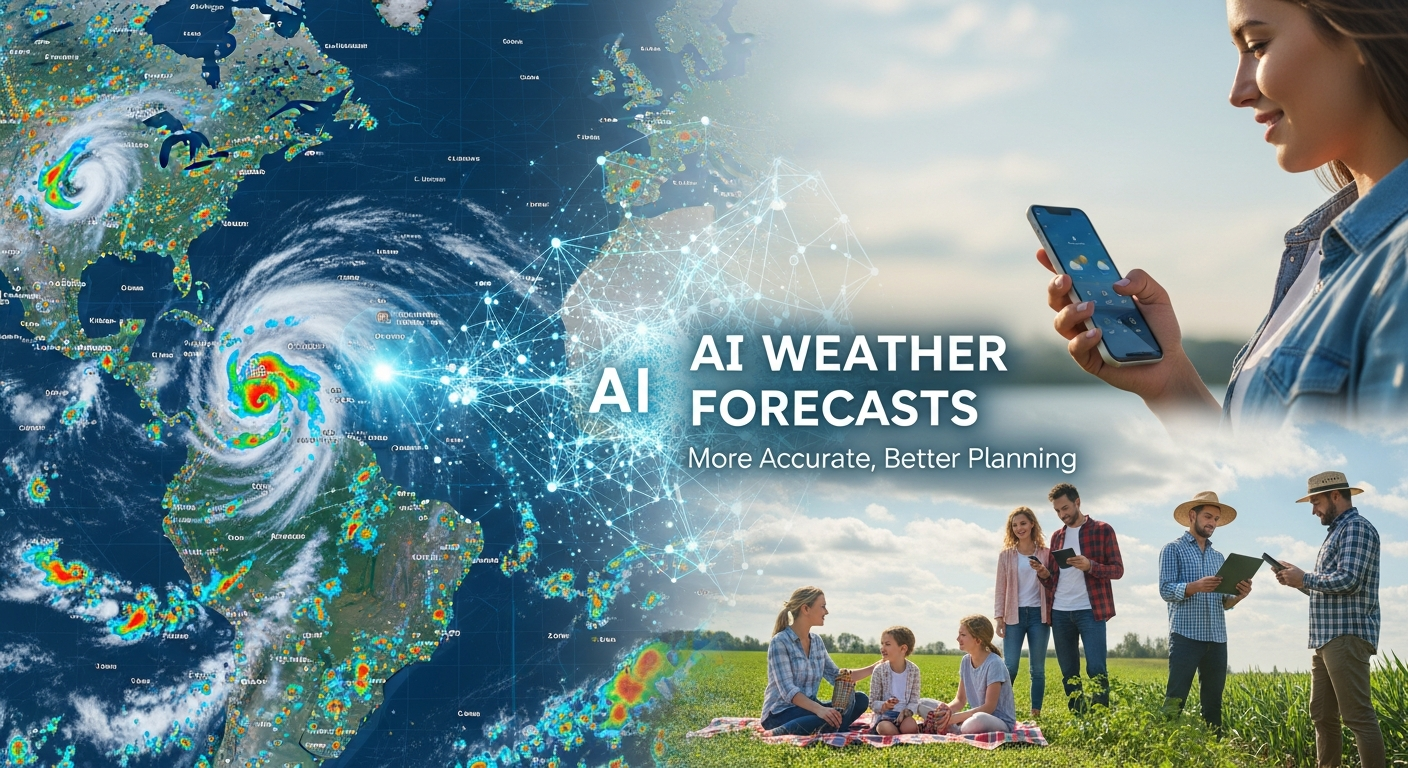
How AI is making weather forecasts more accurate and helping people plan their daily lives.
- November 20, 2025
- ~ 1 min read
- 105 views
- Everyday AI , Lifestyle & AI
Introduction/Overview
The Unpredictable Dance of Daily Life and Weather
Ever planned a weekend hike only for an unexpected downpour to ruin your meticulously laid plans? Or perhaps you left your umbrella at home, only to be caught unprepared in a sudden afternoon shower during your commute? For generations, weather has been an undeniable, often frustrating, influencer of our daily decisions. From choosing an outfit and planning a family outing to scheduling outdoor work or even anticipating traffic patterns, the sky's mood dictates much of our rhythm. Traditional weather forecasting, while a cornerstone of meteorology, has historically grappled with the sheer complexity and vastness of atmospheric data, often leading to generalized predictions that lacked the precision we craved for our hyper-local, real-time needs.
A New Era of Precision: The AI Revolution in Forecasting
Imagine a world where such uncertainties are dramatically minimized, where you can plan your day with near-perfect confidence in the weather conditions. That world is rapidly becoming a reality, thanks to the groundbreaking power of Artificial Intelligence. The intersection of advanced computing, sophisticated machine learning algorithms, and massive datasets is ushering in an AI revolution in meteorology, fundamentally transforming how we understand and predict atmospheric conditions. This isn't just about incremental improvements; AI weather forecasting is delivering unprecedented accuracy and predictive power that was once unimaginable, moving us beyond simple probabilities to highly detailed, dynamic models.
Unlocking Smarter Planning with AI-Powered Insights
This article will delve deep into the transformative impact of AI on weather forecasting, exploring not just the technological advancements that lead to more accurate weather predictions, but also the direct, tangible benefits these improvements bring to your daily life planning. You'll discover how cutting-edge weather technology, powered by AI, is making our forecasts sharper, more localized, and significantly more reliable than ever before. From optimizing your commute and deciding what to wear, to scheduling outdoor activities and making critical business decisions, you'll learn how AI is empowering you to plan your days with greater confidence, less stress, and an unprecedented level of foresight. Get ready to rethink everything you thought you knew about the weather.
Main Content - Core AI Mechanisms
The Shift from Traditional to AI-Augmented Forecasting
For decades, the backbone of weather forecasting has been **numerical weather prediction** (NWP). These sophisticated models rely on a vast network of supercomputers solving complex physics equations that describe atmospheric processes – fluid dynamics, thermodynamics, and radiation. While incredibly powerful, NWP models operate within certain limitations: they require enormous computational resources, often make simplifying assumptions about the atmosphere, and struggle with high-resolution prediction of localized, short-term phenomena due to their grid-based nature.
This is where AI steps in, marking a fundamental shift. Rather than replacing NWP entirely, AI often works in tandem, augmenting existing models by refining their outputs, correcting systematic biases, or generating higher-resolution forecasts. Increasingly, advanced **AI algorithms** are also emerging as standalone forecasting systems, capable of interpreting atmospheric behavior in ways purely physics-based models cannot, bridging the gap between theoretical understanding and real-world complexity.
Harnessing the Deluge: AI's Data Processing Prowess
Modern meteorology generates an unimaginable torrent of information every second. Think of the raw data flowing from countless sources: high-resolution satellite imagery (visible, infrared, microwave), ground-based radar systems (tracking precipitation and wind velocity), an ever-expanding network of ground sensors, weather balloons, ocean buoys, and even emerging data streams from Internet of Things (IoT) devices like smart thermometers. Traditional NWP models are challenged to effectively ingest and synthesize *all* this disparate data simultaneously. They are designed for specific types of input and can be overwhelmed by the sheer volume and variety.
This is where AI truly shines. Advanced **weather data analysis** techniques powered by AI can process and interpret these gargantuan, diverse datasets with unparalleled efficiency. AI doesn't just look at one data point; it identifies intricate, non-linear correlations and patterns across seemingly unrelated data sources – something human meteorologists or conventional models might easily miss. This ability to make sense of 'data overload' is critical for improving forecast accuracy.
Learning from the Atmosphere: Machine Learning and Deep Learning
At the heart of AI's revolution in meteorology are techniques like **machine learning in weather** and deep learning. Imagine trying to teach a computer to recognize a specific type of cloud formation. Instead of programming explicit rules for every possible variation, you show it millions of images of different clouds, labeled correctly. Over time, the computer learns to identify the common features and patterns itself. This is analogous to how AI learns from atmospheric data.
Specifically, **neural networks meteorology** simulates the human brain's interconnected neurons. Input layers receive raw data (e.g., temperature, pressure, humidity, wind speed from various locations). Hidden layers process this information, extracting increasingly abstract features, much like your brain processes visual information from simple lines to complex shapes. Finally, output layers generate a prediction, such as the likelihood of rain, specific temperatures, or severe weather events.
Deep learning forecasts take this a step further, utilizing neural networks with many hidden layers. This multi-layered structure allows for the extraction of highly nuanced and hierarchical patterns from raw atmospheric data, from microscale turbulences to large-scale climate oscillations. These models are constantly learning. Trained on vast historical datasets of past weather conditions, observed outcomes, and previous forecasts, they continuously adjust their internal parameters. When a forecast deviates from reality, the model learns from that error, refining its internal logic to make more precise predictions in the future. This iterative process of learning and refinement allows AI to adapt to the dynamic and often chaotic nature of our atmosphere, leading to forecasts that are not just accurate, but also remarkably timely and responsive to rapidly changing conditions. This continuous learning loop is key to AI's superior predictive power.
Supporting Content - Real-World Applications and Benefits
The theoretical advancements of AI in weather forecasting truly shine when we look at their tangible impact on our daily lives and broader economic systems. AI isn't just making numbers more accurate; it's translating complex data into actionable insights that help individuals and industries thrive.
Hyper-Local Precision for Daily Life
One of the most remarkable breakthroughs powered by AI is the rise of hyper-local weather forecasting. Traditional weather models often provide regional predictions, which can be sufficient for general planning but fall short when specific conditions dictate our immediate actions. AI, however, excels at processing vast datasets from an ever-growing network of sensors, personal devices, and micro-weather stations. This allows it to predict phenomena at an unprecedented scale, often down to a specific street or neighborhood.
Imagine planning your commute and knowing with high certainty that it will rain precisely on your route in the next 15 minutes, allowing you to grab an umbrella or choose an alternative path. Or perhaps you're planning an outdoor activity; AI can tell you the exact window of sunshine before a localized shower hits. This level of granular detail was previously unimaginable, fundamentally changing how we approach everything from hanging laundry to scheduling a children's playdate.
Enhancing Severe Weather Prediction and Preparedness
Beyond daily conveniences, AI is proving to be a game-changer in safeguarding lives and property by significantly improving severe weather warnings AI capabilities. For events like hurricanes, tornadoes, and flash floods, early and accurate warnings are paramount. AI systems analyze satellite imagery, radar data, atmospheric pressure changes, and historical storm patterns at speeds and scales impossible for human meteorologists alone.
This allows for more precise tracking of storm paths, better prediction of intensity, and identification of specific areas at highest risk. The result? More targeted and earlier alerts, providing critical extra hours or even days for effective evacuations, robust disaster preparedness measures, and the deployment of emergency services. This precision doesn't just reduce property damage; it directly contributes to saving lives.
Economic Resonances: Agriculture, Energy, and Logistics
The positive ramifications of AI-enhanced forecasts extend far into various economic sectors, showcasing the profound economic impact of weather. In agriculture, for instance, farmers rely heavily on precise weather data. AI in agriculture helps optimize planting and harvesting schedules, determines ideal irrigation timing, and informs the best windows for applying pesticides or fertilizers. Knowing the exact likelihood of rain before a costly chemical application can prevent significant waste and crop loss.
Similarly, the energy sector leverages AI to predict demand spikes during heatwaves or cold snaps, optimizing power generation and distribution. Renewable energy sources like solar and wind farms use AI-powered forecasts to predict output fluctuations, integrating them more seamlessly into the grid. In logistics and transportation, AI helps companies reroute delivery trucks or adjust shipping schedules to avoid severe storms, ensuring timely deliveries, reducing fuel consumption, and enhancing the safety of personnel and cargo.
Personalized Planning through Smart Weather Applications
Finally, AI integration into modern smart weather apps has revolutionized how individuals receive and interpret weather information for their specific needs. These applications go far beyond simply displaying temperature and precipitation. By combining real-time weather data with a user's location, calendar, activity preferences, and even wearable data, AI provides highly personalized advice.
For a runner, a smart app might suggest the optimal time to run to avoid peak humidity or strong winds. For a gardener, it could recommend when to water based on soil moisture and upcoming rainfall. A drone pilot might receive alerts about ideal flying conditions or warnings about impending gusts. These AI-driven tools go beyond merely reporting the weather; they actively interpret it in the context of your unique lifestyle, making daily planning more efficient, safer, and tailored than ever before.
Advanced Content - Deep Dive into AI Techniques
For those eager to peer under the hood, AI's transformation of weather forecasting isn't magic; it's a sophisticated blend of algorithms and computational prowess. This section demystifies key AI methodologies driving this revolution, explaining how intelligent systems meticulously analyze and predict our dynamic atmosphere.
Neural Networks: Processing Spatial and Temporal Data
At the core of AI weather innovations are specialized neural network architectures. Convolutional Neural Networks (CNNs) excel at discerning spatial patterns, much like image recognition. In meteorology, CNN weather models process satellite imagery and radar data, identifying cloud formations, storm structures, and atmospheric fronts. They learn to spot developing hurricanes or localized heavy rainfall by analyzing visual "signatures," acting as the AI's eyes on the skies.
Complementing CNNs are Recurrent Neural Networks (RNNs), adept at understanding sequential, time-dependent data. Weather is inherently a time-series problem. RNNs, particularly Long Short-Term Memory (LSTMs), learn intricate temporal dependencies—how pressure changes, temperature fluctuations, or wind patterns evolve. This enables precise RNN forecasting, allowing AI to grasp both the "what" (spatial patterns) and the "how" (temporal evolution) of weather phenomena.
Intelligent Data Fusion and Probabilistic Outcomes
One of AI's most profound contributions is its mastery of data assimilation weather—integrating vast, disparate datasets into a coherent, real-time atmospheric picture. AI models seamlessly fuse information from satellites, ground sensors, radar, ocean buoys, and even citizen science. Unlike traditional methods, AI algorithms identify biases, correct errors, and intelligently weigh diverse sources, creating a remarkably detailed and consistent initial state for forecasts. This holistic view is critical for highly precise predictions.
Furthermore, AI significantly enhances how we address forecast uncertainty. Instead of a single deterministic prediction, AI models generate probabilistic forecasts. They can convey, for example, "There's an 80% chance of rain between 2 PM and 4 PM, with a 30% chance of heavy thunderstorms." By learning the distribution of possible outcomes, AI offers users a better sense of confidence levels and potential scenarios, providing truly actionable insights for daily planning.
Computational Demands and the Quest for Explainability
Running these sophisticated AI weather models demands immense computational power. Training and executing deep neural networks on petabytes of global weather data necessitate robust high-performance computing weather infrastructure. This includes powerful supercomputers, scalable cloud platforms, and specialized hardware like GPUs (Graphics Processing Units), efficient for parallel processing. Advancements in these technologies directly fuel progress in AI-driven weather forecasting accuracy.
Despite their power, AI models present challenges, notably the 'black box' problem. While highly accurate, understanding *why* a particular prediction was made can be difficult. This lack of transparency can hinder trust and comprehensive interpretation. Thus, a vital research area focuses on explainable AI meteorology (XAI). Scientists develop techniques to illuminate AI's decision-making, making models more interpretable, trustworthy, and ultimately more useful to human experts.
Practical Content - Leveraging Better Forecasts
Artificial Intelligence has revolutionized how we predict weather, moving from broad generalizations to hyper-localized, highly accurate forecasts. But what good is this advanced technology if you don't know how to harness its power? This section provides actionable advice, transforming you from a passive weather observer into an active planner, ready to optimize your daily life and professional endeavors with the help of AI.
Selecting and Understanding AI-Powered Forecasts
The first step to leveraging better forecasts is knowing where to find them. Not all weather apps are created equal, and many now boast AI integration. To identify the best AI weather apps, look for platforms that:
- Utilize Advanced Models: They should explicitly mention leveraging machine learning, deep learning, or ensemble modeling for improved accuracy.
- Offer Hyperlocal Data: AI excels at microclimates. Seek apps providing street-level or neighborhood-specific forecasts.
- Provide Granular Timelines: Look for hourly or even minute-by-minute predictions, especially for precipitation.
- Include Predictive Analytics: Some advanced apps can predict the impact of weather, not just the weather itself.
Popular choices often include apps like Tomorrow.io (formerly ClimaCell), Carrot Weather, and Google's integrated weather services, which increasingly draw on sophisticated AI models. Once you've chosen an app, the next crucial step is mastering forecast interpretation tips. AI-generated data often includes metrics beyond a simple temperature and rain icon. For instance:
- Probability Percentages: A "60% chance of rain" doesn't mean it will rain over 60% of the area. It means there's a 60% likelihood of rain occurring at your specific location during the forecast period. Use this to gauge risk.
- Confidence Intervals: Some advanced apps might show a temperature range (e.g., 20-25°C) instead of a single number, indicating the model's certainty. A wider range suggests more uncertainty.
- "Feels Like" Temperature: AI models often calculate wind chill and heat index more precisely, giving you a better sense of actual comfort than just the ambient temperature.
Understanding these nuances allows for much more informed decision-making than traditional forecasts ever permitted. Don't just see the forecast, understand its implications.
Integrating Advanced Forecasts into Your Daily Routine
With precise, AI-driven weather insights at your fingertips, you can practice truly smart planning weather integration into your personal schedule. This isn't just about grabbing an umbrella; it's about optimizing every aspect of your day:
- Commuting: Check minute-by-minute rain forecasts to time your walk to the bus stop or leave earlier to avoid peak traffic during a sudden downpour. AI can predict icy patches on specific routes.
- Outdoor Activities: Planning a run or a garden party? Pinpoint the exact wind conditions, humidity, and clear skies window for optimal enjoyment and safety.
- Travel: Before a road trip, monitor potential severe weather along your route hours or even days ahead, allowing for timely route adjustments or departure changes. For flights, stay updated on airport conditions for potential delays.
- Home Management: Use temperature predictions to program your smart thermostat, ensuring energy efficiency. Anticipate frost warnings to protect delicate plants, or heavy winds to secure outdoor furniture.
The key is to proactively adjust your plans based on the more granular and reliable information AI provides, transforming passive consumption into active planning.
Leveraging AI Weather Insights for Business Advantage
Small businesses and professionals can gain a significant competitive edge by integrating business weather insights from AI forecasts into their operations. This is truly actionable weather advice that directly impacts the bottom line:
- Retail & Hospitality: Predict foot traffic based on temperature and precipitation. A sudden cold snap might boost hot coffee sales; a sunny weekend could mean more patio diners. Adjust staffing and inventory accordingly.
- Event Planning: For outdoor events, AI provides critical data for contingency planning. Knowing the precise timing of potential rain or wind allows for better setup schedules, equipment protection, and communication with attendees.
- Logistics & Delivery: Optimize delivery routes and schedules to avoid severe weather zones, reducing delays, fuel consumption, and accident risks. For perishable goods, knowing precise temperatures is crucial.
- Construction & Agriculture: Schedule outdoor work or planting/harvesting based on accurate windows of favorable weather, minimizing risks and maximizing efficiency.
Integrating these insights can lead to improved efficiency, reduced waste, and enhanced customer satisfaction.
Empowering the Network: Your Role in Enhanced Forecasting
While AI models do the heavy lifting, they thrive on data. You can play a vital role in enhancing forecast accuracy for your community. Many weather apps and meteorological organizations now encourage citizen science. If you own a personal weather station, consider connecting it to global networks. The data from your backyard can feed into vast AI models, providing hyper-local ground truth that refines predictions for your immediate area and beyond. This collaborative approach means every data point contributes to a more accurate and resilient forecasting system for everyone.
Comparison/Analysis - AI vs. Traditional and Future Outlook
AI vs. Traditional NWP: A Nuanced Duel
For decades, weather forecasting has relied heavily on Numerical Weather Prediction (NWP) models. These are complex, physics-based simulations that solve intricate mathematical equations representing atmospheric processes. Traditional NWP excels at providing a foundational understanding of large-scale weather phenomena, offering robust and physically consistent forecasts. However, NWP models are incredibly computationally intensive, requiring supercomputers to process vast datasets and complex equations. This often leads to trade-offs in resolution, making it challenging to predict highly localized or rapidly evolving weather events with precision.
Enter AI. In the ongoing AI vs NWP comparison, AI models demonstrate exceptional strengths in processing speed and pattern recognition. By analyzing massive historical and real-time datasets, AI can identify subtle relationships and emerging patterns that might be missed by traditional methods. This allows for rapid assimilation of new data and the generation of forecasts with unparalleled speed, often excelling in hyper-local applications like nowcasting for specific neighborhoods or even city blocks. While AI may not possess the inherent physical understanding of NWP, its ability to learn from past errors and adapt makes it a formidable tool for refining predictions, especially in complex urban environments or during rapidly changing conditions.
The Synergy: Hybrid Models and Ethical Horizons
The prevailing sentiment in modern meteorology is not about one technology replacing the other, but rather a powerful synergy. The future lies in hybrid weather models, which combine the foundational physics of NWP with the data-driven intelligence of AI. AI can take the output of NWP models and refine it, correct biases, or downscale it to provide ultra-high-resolution forecasts for specific areas. Conversely, NWP can provide crucial physical constraints and initial conditions that prevent AI models from generating unrealistic predictions. This symbiotic relationship leverages the best of both worlds, leading to significantly more accurate and detailed forecasts.
However, the rapid advancement of AI in weather forecasting also brings important ethical AI weather considerations to the forefront. A primary concern is data bias. If the training data used for AI models disproportionately represents certain geographical areas or demographic groups, the forecasts might be less accurate or even biased for underrepresented regions. Ensuring equitable access to these advanced forecasting capabilities is crucial, preventing a digital divide in weather preparedness. Furthermore, the "black box" nature of some AI models, where it's difficult to understand *why* a particular prediction was made, raises questions about transparency and accountability. Responsible deployment requires addressing these biases and ensuring accessibility and explainability.
Gazing into the Crystal Ball: The Future and Unsolved Mysteries
The future of meteorology is incredibly exciting, with AI poised to unlock unprecedented levels of precision and utility. Imagine ultra-high-resolution global models that provide minute-by-minute forecasts for every square meter on Earth. Emerging trends include the potential for quantum computing weather simulations, which could handle atmospheric complexities currently beyond our reach, leading to truly revolutionary breakthroughs in long-range forecasting. Edge AI will enable local weather sensors to process data and provide real-time, hyper-localized alerts directly at the source, drastically reducing latency. Seamless integration with smart city infrastructure will allow weather data to automatically optimize traffic flow, energy grids, and even public transportation schedules, making daily life significantly more efficient.
Despite these advancements, it's vital to acknowledge the existing weather forecasting limitations and ongoing challenges. AI, while powerful, learns from historical data. Predicting truly unprecedented weather events – those with no historical analog – remains a significant hurdle. Furthermore, ensuring consistent, high-quality data input globally is an immense logistical challenge. Human expert oversight will always be indispensable for interpreting complex forecasts, especially in high-stakes situations, and for continuously improving both NWP and AI models. The human element, with its intuition and capacity for critical analysis, remains the ultimate arbiter in safeguarding lives and livelihoods against the whims of the weather.
Conclusion - Summary and Call to Action
AI's Transformative Role in Weather Forecasting
Throughout this article, we've journeyed through the remarkable ways Artificial Intelligence is fundamentally reshaping the landscape of weather forecasting. From processing vast datasets with unparalleled speed to identifying subtle atmospheric patterns invisible to traditional methods, AI is not just augmenting, but revolutionizing how we understand and predict the weather. This innovation brings dual AI weather benefits: significantly enhanced accuracy and profound practical utility for everyone. We've seen how machine learning models, neural networks, and deep learning algorithms are improving everything from short-term predictions to long-range climate models, making forecasts more reliable and localized than ever before.
Empowering Daily Life and Future Planning
The impact of AI-driven weather insights extends far beyond mere scientific advancement; it directly translates into tangible improvements in our daily lives. With more precise forecasts, individuals can make better-informed decisions, whether it's choosing the right attire for the day, planning outdoor activities, commuting safely, or even scheduling significant events. This shift from guesswork to informed choice fosters a greater sense of preparedness and reduces the uncertainty that often accompanies unpredictable weather. The positive weather tech impact means fewer surprises and more opportunities to optimize our routines, conserve resources, and protect ourselves and our property from adverse conditions. It's about building a more resilient daily life, one forecast at a time.
Embrace the Future of Intelligent Weather
The evolution of AI in meteorology is an ongoing journey, and its potential continues to expand. We encourage you to actively engage with this exciting technological advancement. Explore the latest AI-powered weather applications and platforms available on your devices; you might be surprised by their precision and features. Stay curious, stay informed about new breakthroughs, and share your experiences with how improved forecasts have helped you. Your feedback contributes to the continuous development of these vital tools. This proactive call to action weather is crucial for harnessing the full potential of these innovations.
Ultimately, AI is paving the way for a future where weather is less of an obstacle and more of a predictable element within our control. The future of planning is undoubtedly intertwined with these intelligent systems, promising a world where communities are more resilient, individuals are better prepared, and our relationship with the natural world is managed with unprecedented insight and foresight. The future of weather forecasting is intelligent, and it's here to stay, creating a more predictable and resilient world for us all.
Comments (0)
Please login or register to leave a comment.
No comments yet. Be the first to comment!