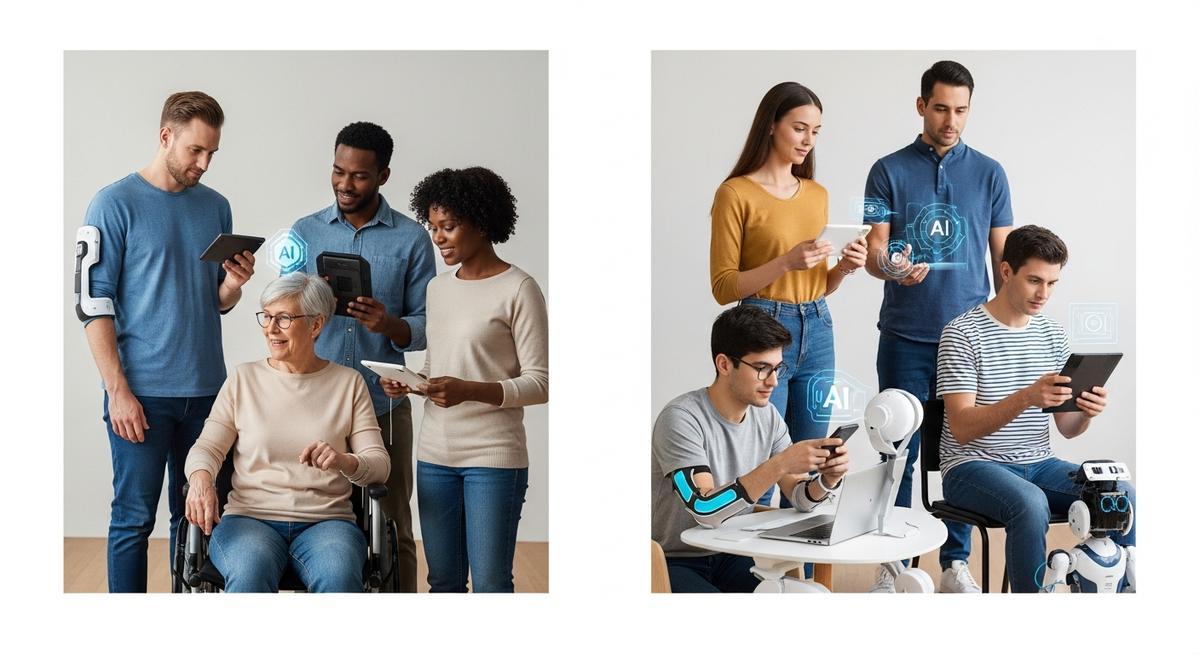
How AI is helping people with disabilities live fuller lives
- November 22, 2025
- ~ 1 min read
- 166 views
- Everyday AI , AI & Healthcare , Lifestyle & AI
Introduction/Overview
Imagine a world where a person with a visual impairment can navigate unfamiliar environments independently, or a student with learning disabilities receives personalized support tailored precisely to their needs—all made possible through the power of AI for disabilities. This is no longer a distant vision but a present reality, as artificial intelligence is revolutionizing the landscape of assistive technology and dramatically enhancing accessibility.
Over the past decade, traditional tools designed to aid people with disabilities—such as static hearing aids or basic screen readers—have evolved into intelligent, adaptive solutions that learn and respond to individual needs. These AI-driven technologies are breaking barriers that once limited independence, offering new opportunities for communication, mobility, education, and employment. The shift from conventional assistive devices to smart, context-aware systems marks a transformative moment in disability support, empowering millions worldwide to live fuller, more autonomous lives.
At the same time, society’s focus on accessibility and inclusion has gained unprecedented momentum. With over one billion people globally living with some form of disability, there is a growing recognition that technology must serve everyone equitably. AI holds immense promise to bridge gaps in access, but it also presents challenges such as bias and exclusion if not carefully designed and implemented. This dual potential underscores the importance of ongoing innovation combined with ethical responsibility.
What to Expect in This Article
In the sections that follow, we will explore the latest advancements in AI technologies specifically tailored to support people with disabilities. From AI-powered prosthetics and vision assistance apps to intelligent learning platforms and accessibility auditing tools, we will highlight real-world applications that are reshaping lives.
Moreover, this article will address the critical issues surrounding AI implementation, including the need for inclusive design, mitigation of algorithmic bias, and the role of diverse stakeholder collaboration. Our goal is to provide a comprehensive understanding of how AI is both a catalyst for greater independence and a field requiring careful stewardship to ensure equitable benefits.
Whether you are a technology enthusiast, a disability advocate, an educator, or a caregiver, you will find actionable insights and inspiring examples that demonstrate how AI is helping people with disabilities overcome challenges and thrive in everyday life.
Join us as we delve into the transformative intersection of artificial intelligence and disability support, illuminating a path toward a more accessible and inclusive future.
Main Content
Artificial intelligence (AI) is transforming the way people with disabilities interact with the world, offering new levels of independence, communication, and participation in everyday life. From helping individuals express themselves to supporting mobility and learning, AI-powered tools are making a real difference in daily living.
AI-Driven Communication Aids
For people with speech or language impairments, AI communication aids are revolutionizing how they connect with others. These tools use advanced algorithms to interpret speech patterns, predict words, and even translate gestures into spoken language. For example, some AAC (Augmentative and Alternative Communication) devices now use AI to learn a user’s communication habits, making suggestions faster and more accurate over time. This means individuals can communicate more naturally and efficiently, reducing frustration and increasing their ability to participate in conversations. Platforms like Proloquo2Go and AI-powered gesture-to-speech apps allow users to express themselves using pictures, text, or even body movements, making communication accessible to a wider range of people.
“AI is making mainstream technologies we use every day better all the time. With some deliberate work, AAC technologies used by people who have limited speech can also be made better by AI.”
Smart Mobility Solutions
Smart mobility is another area where AI is having a major impact. AI-powered prosthetics and wheelchairs are designed to adapt to a user’s movements and environment, providing greater control and safety. For instance, AI can help a prosthetic limb learn a person’s walking style, adjusting in real time for smoother movement. Similarly, smart wheelchairs use sensors and AI to navigate obstacles, avoid collisions, and respond to voice or gesture commands. These innovations give users more freedom to move around independently, whether at home, at work, or in public spaces.
Visual and Auditory Assistance Technologies
AI is also enhancing visual assistance and auditory support for people with sensory impairments. Smart glasses and apps use AI to describe surroundings, read text aloud, or identify faces and objects. For those with hearing loss, AI-powered hearing aids can filter background noise, recognize speech patterns, and even translate spoken language in real time. These tools help users stay connected to their environment and participate more fully in social and professional settings.
Cognitive and Learning Support Tools
For individuals with cognitive or learning challenges, AI offers personalized cognitive support through adaptive learning platforms and memory aids. These tools can adjust content difficulty, provide reminders, and offer real-time feedback to help users learn at their own pace. AI-driven apps can also assist with organization, planning, and daily routines, making it easier for people to manage tasks and achieve their goals.
By integrating AI into assistive technologies, we are not just improving accessibility—we are empowering people with disabilities to live fuller, more independent lives.
Examples and Use Cases
AI-Powered Smart Glasses for the Visually Impaired
One of the most transformative applications of AI in assistive technology is the development of smart glasses designed for people with visual impairments. Devices like the Envision PRO Smart Glasses use advanced artificial intelligence to convert visual information into audible descriptions, enabling users to recognize objects, read text, and identify faces in real time. Equipped with an integrated camera and built-in speakers, these glasses provide spoken feedback that helps users navigate their environment independently.
For example, the Envision glasses offer features such as Instant Text reading, scene description, and even the ability to call a remote assistant for help. Users have reported a significant increase in confidence and autonomy, as these glasses allow them to perform everyday tasks—like reading menus or identifying currency—without assistance. As one user shared, “The glasses have opened up a new world for me, allowing me to engage with my surroundings in ways I never thought possible.”
Similarly, Meta Ray-Ban Smart Glasses integrate AI assistants with apps like “Be My Eyes,” providing hands-free, real-time assistance from sighted volunteers. This combination of AI and human support creates a seamless experience that enhances both safety and social interaction for visually impaired individuals.
Voice Recognition Tools for People with Speech Disabilities
Voice recognition technology powered by AI has revolutionized communication for individuals with speech disabilities. Modern AI-driven speech recognition systems can understand and transcribe speech patterns that differ from typical speech, including those affected by conditions such as cerebral palsy, stroke, or ALS.
These tools enable users to control devices, compose messages, and interact with digital assistants more naturally and efficiently. For instance, customized voice recognition software can learn a user’s unique speech patterns over time, improving accuracy and reducing frustration. This technology empowers people with speech impairments to participate more fully in social, educational, and professional settings.
One caregiver noted, “Since using AI voice recognition, my client can express themselves more clearly and quickly, which has made a huge difference in their independence and self-esteem.” These advances are making communication more accessible and less isolating for many.
Brain-Computer Interfaces for Paralysis Recovery
Brain-computer interfaces (BCIs) represent a cutting-edge AI application that offers hope for individuals with paralysis. BCIs use AI algorithms to decode neural signals directly from the brain, translating thoughts into commands that control external devices such as robotic limbs, computers, or wheelchairs.
In rehabilitation scenarios, BCIs enable users to regain functional movement or communicate despite severe motor impairments. For example, patients with spinal cord injuries have successfully operated robotic arms or computer cursors using only their brain activity, bypassing damaged nerves.
AI enhances the interpretation of complex brain signals, making the interface more responsive and intuitive. As one patient described, “Using the brain-computer interface felt like reclaiming control over my body — it’s truly life-changing.” This technology not only aids physical recovery but also improves psychological well-being by restoring a sense of agency.
AI-Driven Navigation for Mobility-Impaired Individuals
Navigation can be a major challenge for people with mobility impairments, especially in unfamiliar or crowded environments. AI navigation systems integrated into wearable devices or smartphones are helping to overcome these barriers by providing real-time guidance tailored to individual needs.
These AI-powered solutions use sensors, GPS, and machine learning to map accessible routes, avoid obstacles, and alert users to hazards. For example, some apps can recommend wheelchair-friendly paths, detect changes in terrain, and provide voice instructions to ensure safe travel.
One user with limited mobility shared, “The AI navigation app gives me confidence to explore new places without worrying about barriers or getting lost.” By enhancing spatial awareness and autonomy, AI navigation tools significantly improve the daily lives of mobility-impaired individuals.
Advanced Concepts and Deep Dive
AI Algorithms Powering Assistive Devices
AI algorithms form the backbone of modern assistive technologies by processing vast amounts of user data to deliver personalized and adaptive support. These algorithms leverage machine learning models that continuously analyze behavioral patterns, environmental inputs, and physiological signals to predict user intentions and optimize device responsiveness. For example, prosthetic limbs equipped with sensors and cameras use AI to interpret muscle signals and user movements, enabling more natural and precise control. Similarly, speech recognition systems apply deep learning to decode non-standard speech patterns, improving communication for individuals with speech impairments.
Key techniques include predictive modeling, where the AI anticipates user needs based on historical data, and reinforcement learning, where devices learn optimal responses through repeated interactions. This adaptability allows assistive devices to evolve with the user, accommodating changes in abilities or preferences over time, thereby enhancing autonomy and quality of life.
Exploration of Brain-Computer Interfaces and Neural Implants
At the forefront of assistive technology are brain-computer interfaces (BCIs) and neural implants, which establish direct communication pathways between the brain and external devices. These systems decode neural signals to enable control of prosthetics, wheelchairs, or communication aids without muscular movement.
Neural implants consist of microelectrodes implanted in specific brain regions to record electrical activity associated with motor commands or sensory perception. Advanced signal processing algorithms then translate these neural patterns into actionable commands. For example, a user with paralysis can control a robotic arm or a computer cursor purely through thought. Recent research focuses on improving the biocompatibility and signal fidelity of implants to ensure long-term functionality and reduce immune response.
Moreover, closed-loop BCIs are emerging, which not only read brain signals but also provide sensory feedback to the nervous system, enabling more intuitive and precise control. This integration of neuroscience and AI promises transformative possibilities for restoring lost functions and enhancing human-machine symbiosis.
Ethical Considerations and Privacy Concerns
While AI-driven assistive technologies offer tremendous benefits, they also raise critical ethical considerations and privacy challenges. The collection and processing of sensitive personal data—ranging from physiological signals to behavioral patterns—necessitate stringent data protection measures to prevent misuse or unauthorized access.
Bias in AI algorithms is another significant concern, as training data that lack diversity can lead to systems that perform poorly or unfairly for certain groups of users, exacerbating existing inequalities. Ensuring inclusivity requires active involvement of people with disabilities in the design, development, and testing phases to create equitable solutions.
Transparency and explainability of AI decisions are essential to build trust, especially in assistive contexts where errors can have serious consequences. Regulatory frameworks like the European AI Act aim to address these issues by establishing standards for safety, accountability, and user rights.
"Ethical AI development must prioritize user autonomy, data privacy, and inclusivity to truly empower people with disabilities."
Emerging Trends: Generative AI, Predictive Analytics, and Adaptive Learning
Emerging technologies such as generative AI are expanding the horizons of assistive solutions. Generative AI models can create personalized content, such as adaptive learning materials, accessible interfaces, and real-time language translation, tailored to individual cognitive and sensory needs. For instance, these models can generate simplified texts or alternative formats that improve comprehension for users with learning disabilities.
Predictive analytics further enhance assistive devices by forecasting user needs and environmental changes, enabling proactive adjustments. Adaptive learning systems continuously refine their responses based on user feedback and performance, ensuring that assistance remains aligned with evolving abilities.
Integration of these advanced AI capabilities with existing assistive ecosystems promises more holistic and seamless support, fostering greater independence and social inclusion. Ongoing research is also exploring multimodal AI systems that combine vision, speech, and neural data to create richer, context-aware interactions.
Implementation Guide and Best Practices
Integrating artificial intelligence into the lives of people with disabilities can be transformative, but it requires thoughtful planning and ongoing support. This section offers a practical, step-by-step approach to help caregivers, educators, and individuals select, implement, and optimize AI tools for maximum benefit.
Step-by-Step Guide to Selecting the Right AI Tools
- Assess Individual Needs: Begin by identifying the specific challenges and goals of the user. Consider mobility, communication, learning, or daily living needs. For example, someone with visual impairments may benefit from AI-powered navigation apps, while a person with speech difficulties might need advanced speech-to-text solutions.
- Research Available Options: Explore reputable AI tools designed for accessibility, such as Envision for visual assistance, Evelity for navigation, or conversational agents for communication support. Look for tools with positive user reviews and strong privacy policies.
- Test Before Committing: Whenever possible, trial the tool in a real-world setting. Many platforms offer free or limited versions. This helps ensure the technology fits the user’s lifestyle and preferences.
- Ensure Compatibility: Check that the AI tool works with existing devices and software. Compatibility is crucial for seamless integration and long-term use.
Best Practices for Integrating AI into Daily Routines
- Start with simple tasks, like using AI for reminders or voice-controlled smart home devices, before moving to more complex applications.
- Customize settings to match the user’s abilities and preferences. Many AI tools allow for personalization, such as adjusting speech speed or interface contrast.
- Encourage regular use to build confidence and familiarity. Consistency helps users get the most out of the technology.
- Stay updated on new features and updates. AI tools often improve over time, offering new functionalities that can further enhance independence.
Tips for Caregivers and Educators Supporting Users
Supporting someone using AI tools requires patience, encouragement, and ongoing learning. Caregiver tips include:
- Provide hands-on training and be available for troubleshooting.
- Encourage open communication about what’s working and what isn’t.
- Stay informed about best practices and new tools through professional networks and resources.
Empowering users to take ownership of their AI tools fosters independence and confidence.
Common Pitfalls to Avoid and Troubleshooting Advice
Be aware of potential challenges, such as technical glitches, privacy concerns, or over-reliance on technology. Always have a backup plan in place. If a tool isn’t working as expected, check for updates, consult user forums, or contact customer support. Remember, AI implementation is an ongoing process—regularly reassess needs and adjust strategies as necessary.
Comparison and Analysis
AI Device Comparison: Popular Assistive Technologies
Artificial intelligence has revolutionized assistive technology, offering a diverse range of devices tailored to different disabilities. Among the most prominent are AI-powered screen readers and text-to-speech (TTS) systems like Microsoft’s Seeing AI and Speechify, which provide real-time audio descriptions for people with visual impairments. Wearable devices such as Meta’s Ray-Ban Smart Glasses with Live AI feature offer hands-free, continuous scene interpretation, enabling users to interact naturally with their environment. For individuals with speech or mobility challenges, AI-enhanced voice recognition and predictive text tools improve communication and productivity. Meanwhile, innovative tools like Speakaboo allow users to ask specific questions before capturing images, delivering focused scene descriptions that enhance usability for blind users.
Each device serves unique needs, with some excelling in portability and natural interaction (e.g., smart glasses), while others offer comprehensive text interpretation and document reading (e.g., screen readers). This diversity ensures a broad spectrum of solutions but also requires careful consideration regarding individual requirements and contexts.
Pros and Cons of Various AI Assistive Technologies
- Screen Readers and Text-to-Speech Tools: These technologies provide essential access to written content and digital interfaces. Pros include wide compatibility with devices and extensive language support. However, they may struggle with complex layouts or poorly tagged content, and their effectiveness depends on software updates and user training.
- AI-Powered Wearables: Devices like Meta Ray-Ban glasses offer real-time, hands-free interaction and environmental awareness. Their strengths lie in convenience and immediacy, but they often come with higher costs and battery life limitations. Privacy concerns and the need for continuous internet connectivity can also be drawbacks.
- Predictive Text and Voice Recognition: These tools significantly enhance communication for users with speech or motor impairments by reducing effort and increasing accuracy. While highly effective, they sometimes require customization to individual speech patterns and may have challenges with accents or background noise.
Trade-offs: Cost, Functionality, and Accessibility
When choosing AI assistive technologies, users often face trade-offs between cost, functionality, and accessibility. High-end wearables provide sophisticated features like live scene analysis and natural voice interaction but can be prohibitively expensive for many users and may require technical support. Conversely, software-based solutions such as screen readers and text-to-speech applications are generally more affordable and widely accessible but may lack the immediacy or contextual awareness of wearables.
Ease of use is another critical factor. Devices with intuitive interfaces and minimal setup foster greater adoption, especially among users with cognitive disabilities. However, more advanced AI systems may demand a learning curve or ongoing calibration, which can be a barrier for some.
Alternative Solutions and Their Limitations
Beyond AI-powered devices, traditional assistive technologies like manual Braille displays, magnifiers, or non-AI-based speech-generating devices remain relevant. These alternatives often have the advantage of simplicity, reliability, and lower cost. However, they typically lack the adaptability and personalization that AI offers, such as real-time language translation, contextual understanding, and predictive assistance.
Moreover, many alternative solutions do not scale well with complex environments or diverse user needs. For example, static Braille displays cannot provide dynamic scene descriptions or environmental feedback, limiting independence in unfamiliar settings. Similarly, manual communication aids may not support rapid or natural interaction, affecting social inclusion.
In summary, the landscape of AI device comparison reveals a spectrum of options, each with distinct pros and cons. Understanding the trade-offs between cost, functionality, and accessibility is essential for selecting the most appropriate assistive technology. While alternative solutions continue to serve important roles, AI-powered tools increasingly offer personalized, efficient, and empowering experiences for people with disabilities.
Conclusion and Key Takeaways
Summary of AI’s Impact on Disability Support
Throughout this article, we’ve explored the transformative ways in which artificial intelligence is helping people with disabilities live fuller, more independent lives. From AI empowerment in communication and mobility to personalized learning and healthcare solutions, the benefits are both wide-ranging and deeply meaningful. AI-powered tools such as speech recognition, real-time transcription, adaptive interfaces, and smart assistive devices are breaking down barriers that have long limited access to education, employment, and everyday activities.
Key takeaways include:
- AI is making digital and physical environments more accessible for people with visual, hearing, cognitive, and mobility impairments.
- Personalized AI solutions, like adaptive learning platforms and voice-activated assistants, are enabling greater independence and self-determination.
- AI-driven healthcare and monitoring tools are improving safety, early intervention, and quality of life for individuals with disabilities.
- While the potential is immense, it’s crucial to address risks such as privacy, transparency, and equitable access to ensure that AI truly serves everyone.
The Transformative Potential of AI
The integration of AI into assistive technology is not just about convenience—it’s about empowerment. When designed inclusively, AI can unlock new opportunities, foster greater social participation, and support the unique needs of each individual. The stories and examples shared here illustrate how AI is not just a tool, but a partner in the journey toward greater accessibility and inclusion.
“Accessible technology is best created by, with, and for disabled users themselves.”
This principle reminds us that the most impactful AI solutions are those developed with input from the disability community, ensuring that innovations truly meet real-world needs.
Call to Action and Next Steps
As readers, you have the power to be part of this positive change. Whether you’re an individual with a disability, a caregiver, an educator, or an advocate, there are meaningful steps you can take:
- Explore and try out AI-powered assistive tools that could enhance independence or accessibility in your life or the lives of others.
- Share this article and other resources with your network to raise awareness about the benefits and challenges of AI for people with disabilities.
- Advocate for accessibility advocacy in your community, workplace, or school by supporting inclusive design and equitable access to technology.
By embracing AI and championing accessibility, we can all contribute to a future where technology empowers everyone to live their fullest lives. Let’s continue to learn, share, and act—because every step forward is a step toward a more inclusive world.
Comments (0)
Please login or register to leave a comment.
No comments yet. Be the first to comment!