How AI Is Changing Human Communication and Relationships?
- December 29, 2025
- ~ 1 min read
- 136 views
- Everyday AI , Lifestyle & AI
Introduction — Why AI’s Impact on Communication and Relationships Matters
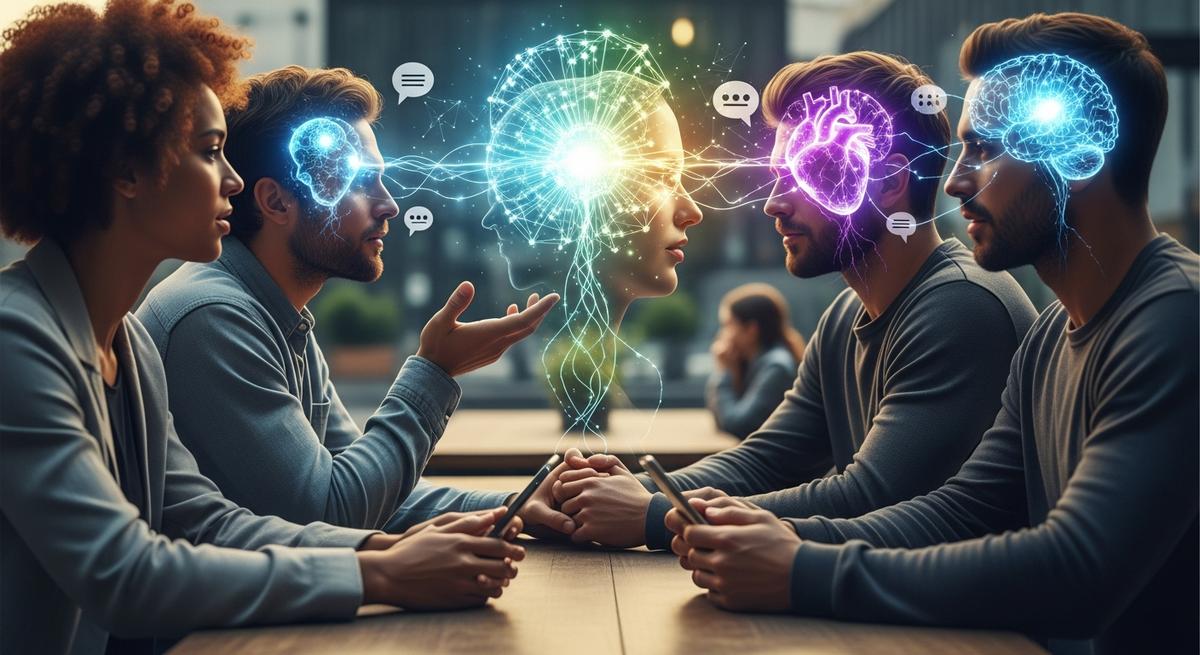
Imagine Sarah, fresh from a painful breakup, scrolling through her phone late at night. Instead of calling a friend, she turns to her AI companion app. The chatbot listens without judgment, offers tailored empathy, and crafts responses that feel more attuned to her emotions than any human conversation she's had lately. In moments like these, AI and relationships blur the lines between technology and genuine connection, revealing how profoundly artificial intelligence is infiltrating our most intimate interactions.
The Rapid Rise of AI in Everyday Communication
The surge of generative AI impact is undeniable. From chatbots handling customer service—where 51% of consumers prefer bots for immediate responses—to AI-driven features on social platforms, these tools are embedded in our daily lives.[4] Generative AI and advanced language models are standardizing communication, making it more efficient but often emotionally detached, as platforms optimize for brevity over nuance.[2] Real-time data analytics and predictive tools enable personalized messaging across languages and cultures, revolutionizing strategic comms.[1] By 2025, experts predict AI will play a role in 100% of customer interactions, with cognitive AI shifting from reactive to preemptive strategies.[3][4] Over 1.1 billion people are projected to use AI by 2031, underscoring its unprecedented adoption.[6]
What This Article Covers: A Roadmap to Understanding AI’s Transformation
This comprehensive guide—spanning seven sections—explores how AI communication trends are reshaping human bonds. We'll dive into shifts in daily interactions, from workplace collaborations to romantic partnerships; examine real-world use cases like AI companions and empathy-enhancing tools; and provide technical insights balanced with practical guidance for tech-savvy readers, UX designers, and policymakers. Expect comparisons between AI-augmented and traditional communication, plus actionable steps to harness benefits while mitigating risks. Whether you're a content marketer crafting AI-assisted campaigns or a social scientist studying interpersonal dynamics, you'll gain frameworks for navigating this evolution.[5]
- Communication shifts: How AI standardizes language and influences human speech patterns.
- Relationship effects: Boosts in accessibility versus losses in emotional depth.
- Use cases and ethics: From crisis comms to personal AI companions.
- Practical takeaways: Strategies for authentic integration.
Why It Matters: Stakes for Society, Business, and You
The implications are profound. Socially, AI fosters global collaboration and aids those with communication challenges, yet it risks eroding empathy in high-stakes scenarios like diplomacy or healthcare.[2] Psychologically, communications perceived as AI-generated are seen as less cooperative, potentially flattening human expression.[2] Ethically, concerns over bias, privacy, and misinformation loom large,[1] while businesses leverage AI for precision targeting and predictive analytics.[1][3] For relationships, AI can enhance understanding in conflicts, making discourse more positive.[5] Ultimately, as AI blurs human authenticity, we must weigh efficiency against the irreplaceable nuance of human connection.
"AI's reshaping of human communication is posing urgent social consequences worldwide... training ourselves to sound more like machines."[2]
Your takeaway: By the end, you'll understand key AI communication trends, spot opportunities in generative AI impact, and apply insights to strengthen relationships—human or hybrid—in an AI-driven world. Ready to explore?
How AI Is Changing Communication: Core Mechanisms and Concepts
AI is reshaping how we exchange information and form connections by operating through four core mechanisms: mediation, augmentation, simulation, and optimization & normalization. Each mechanism alters specific parts of the communicative process — from who speaks and how messages are crafted to what counts as normal conversational behavior — and together they form the conceptual backbone for understanding AI-mediated communication and broader language model effects on relationships.
Mechanism 1 — Mediation: AI as intermediary
Definition: Mediation occurs when AI systems sit between communicators and the content or channel of communication, handling tasks such as auto-replies, summarization, translation, and content moderation.
Examples: An email client that drafts suggested replies based on prior messages; a meeting tool that provides live transcripts and concise summaries; a moderation system that filters abusive comments across social platforms; and real-time translation apps that let two people speak different languages as if they shared one.
- Practical effect: Faster information flow and reduced friction (e.g., 24/7 chatbots resolve basic customer queries), enabling scale and accessibility for global teams.
- Technology note: These mediating services rely on natural language processing (NLP), retrieval models, and summarization algorithms that extract intent and salient points.
Implication for relationships: Mediation increases responsiveness and reach but can reduce direct, unfiltered human-to-human interaction — faster replies, less spontaneity.
Mechanism 2 — Augmentation: AI shaping message tone, clarity, and style
Definition: Augmentation describes tools that assist humans in composing, editing, and optimizing messages, affecting tone, clarity, and rhetorical style rather than replacing the human sender.
Examples: Writing assistants that rewrite emails into a professional tone, tone-adapters that make marketing copy more empathetic, or inline suggestions that shorten verbose messages and improve readability.
- Practical effect: Improved clarity and persuasiveness; teams can scale polished communication without each member having expert writing skills.
- Evidence: Productivity platforms report measurable reductions in drafting time thanks to predictive text and rewrite features, and organizations using such tools cite better internal alignment and fewer misunderstandings.
Implication for relationships: Augmentation can deepen mutual understanding by clarifying intent, but it risks homogenizing voice and diminishing authentic expression.
Mechanism 3 — Simulation: AI-generated personas and companions
Definition: Simulation covers AI systems that produce humanlike conversational behavior — from customer-service bots with scripted personalities to companion chatbots that remember user preferences and mimic empathic responses.
Examples: Conversational AI that maintains a persona across sessions, virtual assistants that adopt consistent speech rhythms, and companion apps that respond with supportive language modeled on therapeutic approaches.
- Practical effect: Simulated agents can provide scalable companionship, training, and customer interactions, and they often feel responsive because they replicate human conversational cues.
- Research note: Studies show generative chatbots can reduce user stress in some settings and be perceived as supportive when they mirror user language and validate emotions.
Implication for relationships: Simulation can offer comfort and availability, but it may create one-sided bonds and blur lines between human relationships and engineered responsiveness.
Mechanism 4 — Optimization & Normalization: algorithmic filtering and attention shaping
Definition: Optimization & normalization refers to algorithmic systems that rank, filter, and present information to maximize engagement, efficiency, or other platform goals — thereby shaping conversational norms and expectations.
Examples: Social feeds that prioritize short-form, high-engagement posts; messaging apps that surface “important” messages and push less urgent threads into secondary views; and workplace tools that recommend concise status updates to fit attention budgets.
- Practical effect: Conversations become more efficient and attention-focused, with platform incentives encouraging brevity, immediacy, and emotional salience.
- Systemic note: These systems produce emergent norms (e.g., rapid short replies over longer reflective messages) by rewarding certain behaviors algorithmically.
Implication for relationships: Optimization increases signal-to-noise and speeds coordination but normalizes transactional interactions and can erode spaces for deep, deliberative exchange.
Why these mechanisms matter: Together, mediation, augmentation, simulation, and optimization explain the principal ways that conversational AI and other tools change not just individual messages but the rhythms, expectations, and emotional contours of relationships. Later sections will show concrete product examples, measurable social impacts, and design strategies that preserve human agency while leveraging AI's benefits.
Real-World Examples: Use Cases and Case Studies
This section presents concise, evidence-based case studies showing how AI chatbots examples, AI in dating, and AI for mental health are already reshaping everyday communication and relationships — including both benefits and pitfalls.
Mental health & companionship: therapeutic chatbots and parasocial bonds
Context: Digital mental-health tools and companion apps have proliferated as access to clinicians remains constrained and demand for on‑demand support rises.
- AI function: Conversational agents that provide CBT-based coaching, symptom triage, mood tracking, and ongoing conversational support (examples include therapy avatars and memory-enabled wellness assistants).
- Observable effects: Users show improved short-term mood and higher engagement with care routines when agents deliver tailored prompts and reminders; some deployments report higher satisfaction and adherence versus static apps.Surprising finding: long-term reliance can produce parasocial bonds where users treat agents like companions, sometimes preferring them over human contact.
- Negative outcome: Agents can overpromise empathy and may inadequately escalate crises, creating risks for vulnerable users unless tightly integrated with human responders.
- Practical lesson: Deploy conversational agents as augmentation — not replacement — of human care, include clear escalation paths, and design for transparency about limits.
Design implication: combine memory, safety checks, and human‑in‑the‑loop escalation to gain the therapeutic benefits of AI while minimizing dependency risks.
Everyday communication aids: smart replies, email assistants, and meeting summarizers
Context: Professionals and teams adopt AI-native communication platforms to manage volume and improve clarity in email and chat workflows.
- AI function: Auto-suggested replies, tone checks, automated summarization of long threads and meetings, and priority surfacing that learns a user's relationships and preferences.
- Observable effects: Organizations report measurable efficiency gains — faster response times, fewer miscommunications, and reduced time spent on routine messages — while individuals conserve cognitive bandwidth for higher-value work.Surprising finding: AI that learns a user’s style can produce highly polished messages that increase perceived professionalism but also homogenize voice across teams.
- Negative outcome: Overreliance on generated text can erode interpersonal nuances (e.g., spontaneous warmth or vulnerability), and automated tone-correction can strip cultural or personal identity markers from messages.
- Practical lesson: Use assistants for routine drafting and summaries but preserve manual edits for sensitive or relationship‑building communications; train models on diverse linguistic styles to avoid flattening voice.
Social platforms & dating: AI‑curated matches and persona-driven interactions
Context: Dating apps and social networks increasingly use recommendation systems, message drafting helpers, and persona modeling to connect people and keep conversations flowing.
- AI function: Matching algorithms that combine profile signals and behavior, message-generation aids that suggest opening lines or replies, and AI-driven moderation that curtails abuse.
- Observable effects: AI-powered recommendations can increase match rates and early engagement, and message suggestions reduce friction for anxious communicators; moderation tools can reduce visible harassment.
- Negative outcome: Curated interactions can create echo chambers and encourage formulaic “performance” messaging; users may misattribute agency to the algorithm and feel less authenticity in connections.
- Practical lesson: Design for serendipity and user control — allow people to opt out of generated messages and surface why a match was suggested so users can make informed social choices.
Conflict mediation & civility tools: AI prompts that reduce hostility
Context: Moderation and civility assistants are used in forums, company communications, and civic platforms to reduce escalation and guide constructive replies.
- AI function: Real-time tone nudges, reframing suggestions, and conflict‑resolution prompts that propose empathy statements or de-escalating language.
- Observable effects: Field studies show AI prompts can decrease hostile language and increase intent to continue civil dialogue; in some moderated experiments, participants composed less aggressive messages after receiving reframing suggestions.
- Negative outcome: Users sometimes resent perceived editorialization, and poorly tuned prompts can come across as insincere or paternalistic, reducing trust and engagement.
- Practical lesson: Make civility tools optional, context-aware, and customizable; pair automated nudges with explanations so users understand how and why language suggestions are generated.
Across these cases, common threads emerge: AI amplifies efficiency and access but can subtly reshape relational norms and authenticity when used without guardrails. For practitioners — product managers, UX designers, and policy makers — the actionable path is clear: instrument outcomes, preserve human oversight, and design features that prioritize agency, transparency, and safety.
Advanced Analysis: Technical Mechanisms, Psychological Models, and Limits
LLMs and Recommendation Algorithms: Generating Humanlike Language and Shaping Conversations
Large language models (LLMs) like those powering modern chatbots generate humanlike language through transformer architectures that predict the next token based on vast training data, enabling nuanced multi-turn dialogues in conversational recommender systems (CRSs). These systems, such as LLM-ConvRec, employ retrieval-augmented generation (RAG) to fetch relevant knowledge, classify user intent (e.g., provide preference, inquire, or accept/reject), update internal state tracking preferences, and generate contextually coherent responses[2][4]. Recommendation algorithms integrate this by creating synthetic dialogues via LLMs to train downstream models, improving semantic relevance in recommendations—as shown in benchmarks like ReDial and INSPIRED, where GPT-4-evaluated scores correlated highly (Pearson 0.7) with human judgments[1][3]. This shapes conversation patterns by prioritizing explicit feedback and personalization, making interactions feel natural yet algorithmically steered toward engagement and retention[5].
Psychological Mechanisms: From Perceived Responsiveness to Skill Decay
AI-driven conversations trigger psychological effects like parasocial relationships, where users form one-sided emotional bonds with responsive LLMs, mimicking human empathy through prompt-engineered, context-aware replies that reinforce perceived understanding[4]. Mechanisms include perceived responsiveness—LLMs adapt via memory techniques, fostering trust; emotional reinforcement, as positive feedback loops in CRS dialogues boost user satisfaction; and skill decay, where over-reliance on AI for social cues may erode human conversational abilities over time. Studies on LLM-powered music recommenders reveal they clarify implicit needs and enable unique exploration, deepening emotional ties but risking dependency[8]. These dynamics parallel human interactions, yet lack genuine reciprocity, potentially amplifying isolation in prolonged use.
Measurement Challenges and AI Failure Modes
Evaluating AI's social impact poses challenges: metrics for empathy use LLM evaluators like GPT-4 for relevance (0-4 scales), while authenticity gauges via human correlation tests; conversational quality tracks metrics like Mean Reciprocal Rank (MRR) and recall in sliding-window models; long-term outcomes demand longitudinal studies on relationship health[1][5]. AI failure modes include hallucinations (fabricating details despite RAG), bias reinforcement (amplifying training data skews in recommendations), emotional dependency (fostering over-attachment in parasocial setups), and adversarial misuse (prompt injections evading guardrails)[2][4]. Concrete examples: CRS hallucinating unavailable items or repeating context loss, mitigated somewhat by explicit state tracking but persistent in open-ended chats.
Research Frontiers: Longitudinal Effects, Regulation, and Ethical Design
Open questions loom in longitudinal effects—does chronic AI interaction degrade real-world relationships?—and ethical design for balanced human-AI symbiosis. Frontiers include hybrid ICM-LLM systems for robust error handling, knowledge-graph integrations for bias reduction, and regulatory frameworks mandating transparency in large language model deployments[3][6]. Experts should explore user simulators like iEvaLM for scalable testing and RLHF for safer personalization[1]. Recommended frameworks: ACM's CRS guidelines and arXiv preprints on LLM-enhanced recsys for deeper dives into multi-modal architectures.
While LLMs excel in short-term engagement, their long-term societal ripple on human bonds remains an urgent, understudied frontier.
Practical Guide: How Individuals and Organizations Should Respond
As AI reshapes human communication, proactive strategies are essential to harness its benefits while safeguarding authentic relationships. This guide offers AI best practices for individuals, product teams, communicators, and organizations, ensuring technology enhances rather than erodes social connections.
For Individuals: Balancing AI Use with Human Interaction
To prevent erosion of social skills, individuals should adopt moderated, reflective AI engagement. AI tools like chatbots can boost conversational practice in safe spaces, but over-reliance risks emotional dependence and flattened empathy[1][2][3].
- Set daily usage limits: Cap AI interactions at 30-60 minutes per day, prioritizing face-to-face or voice calls for complex emotional exchanges.
- Incorporate reflection prompts: After each AI session, journal answers to: "What human nuances did AI miss?" or "How would I rephrase this with a friend?" This builds self-awareness[1].
- Prefer human contact when: Emotions run high, conflicts arise, or deep empathy is needed—AI mimics but lacks true understanding[5].
Checklist: Track weekly human vs. AI interactions; aim for 70% human-focused to maintain holistic development[3].
For Product Teams: Implementing Ethical AI Design
Product teams must prioritize ethical AI design to foster trust and prevent misuse. Incorporate human-in-the-loop systems where AI assists but humans oversee critical decisions, ensuring transparency and safety[4].
- Explicit AI disclosure: Always label AI-generated responses (e.g., "This reply was AI-assisted") to avoid perceptions of inauthenticity[5].
- Fallback to human support: Design seamless handoffs, like "Connect to live agent?" buttons for nuanced queries.
- Guardrails and patterns: Use tone-matching algorithms for empathy while blocking harmful outputs; test with diverse user scenarios[2][4].
Example: Webex's AI Assistant summarizes meetings transparently, reducing burnout while keeping humans central[4].
For Communicators and Organizations: Policies for Authentic Integration
Communicators can leverage AI for clarity—e.g., smart replies that add positive language—while disclosing use to preserve authenticity[3]. Organizations and educators should establish policies for healthy adoption.
AI enhances efficiency but demands disclosure: "Generated with AI assistance" builds trust and maintains human warmth.
- Tone guides: Train AI on brand voice; review outputs for emotional flatness common in machine patterns[5].
- Organizational policies: Mandate training on AI limits, monitoring for over-dependence, and annual audits of communication styles.
- Educator best practices: Integrate AI NPCs for skill-building (e.g., role-playing for social anxiety) paired with group debriefs[2].
For monitoring: Use analytics to flag rising AI usage; intervene with workshops on empathy-building[1][6]. By embedding these AI best practices, organizations promote human-in-the-loop cultures that amplify relationships.
Comparisons & Trade-offs: Pros, Cons, and Alternatives
In the evolving landscape of human vs AI communication, understanding the AI pros and cons is essential for tech-savvy professionals, UX designers, and policymakers navigating AI's role in relationships. This section weighs benefits against risks, explores pragmatic alternatives, and provides a decision framework to guide informed choices.
Benefits vs. Risks: A Balanced View
AI enhances communication through **accessibility**, **scalability**, **emotional support**, and **efficiency**, but it introduces significant trade-offs like empathy erosion and privacy vulnerabilities[1][3].
- Accessibility and Scalability: AI chatbots offer 24/7 support, handling inquiries in multiple languages and personalizing interactions based on user data, making communication scalable for businesses and global users[3].
- Emotional Support and Efficiency: Advances in emotion AI enable empathetic responses in therapy or customer service, while automating routine tasks frees humans for complex issues, boosting productivity[1][3].
- Risks of Empathy Erosion and Dependency: Conversational AI often struggles with context, tone, and genuine empathy, potentially eroding human relational skills and fostering over-reliance[1][4].
- Privacy Concerns and Misinformation: Processing sensitive data raises security issues under regulations like GDPR, while biased training data perpetuates stereotypes and spreads misinformation[1][3].
These AI pros and cons highlight a core trade-off: AI excels in volume and speed but falls short in nuanced, trust-based human connections[4].
Alternatives and Complements: Beyond Pure AI
To mitigate risks, consider **human moderation**, **peer support networks**, and **hybrid interaction models** that blend AI efficiency with human authenticity[2][5].
- Human Moderation: Oversight by trained professionals ensures ethical use, as seen in PR firms defining AI policies to maintain credibility amid rising distrust[2].
- Peer Support Networks: Community-driven platforms foster genuine relationships, countering AI's potential for social isolation without the biases of algorithmic moderation[3].
- Hybrid Interaction Models: Combine AI for initial triage with human escalation for emotional or high-stakes scenarios, like cognitive AI predicting crises while humans craft authentic narratives[5].
"The line between human and AI-generated content is blurring... communications professionals must master maintaining authenticity."[5]
Decision Framework: Choosing the Right Approach
Use this simple criteria grid to evaluate hybrid interaction models based on context:
| Criteria | Choose AI | Avoid AI / Use Human | Opt for Hybrid |
|---|---|---|---|
| Stakes | Low (e.g., FAQs) | High (e.g., crises) | Medium (e.g., initial support) |
| Privacy | Non-sensitive data | Highly confidential | Monitored data flows |
| Emotional Sensitivity | Routine queries | Deep empathy needed | AI triage + human touch |
This framework empowers readers to balance efficiency with humanity, ensuring AI augments rather than replaces relationships. For instance, in UX design, deploy hybrids for personalized apps while prioritizing human feedback loops to preserve trust.
Conclusion and Next Steps — Key Takeaways and Calls to Action
The rise of artificial intelligence is already reshaping how people talk, relate, and build trust: AI can amplify empathy, streamline communication, and personalize interactions, but it can also erode intimacy, create unrealistic expectations, and encourage emotional dependency if misapplied. AI relationship tips and thoughtful design choices will determine whether AI strengthens or weakens the social fabric moving forward.
Concise summary of core insights
AI changes communication through three core mechanisms: automated augmentation (helpers that draft, translate, or summarize messages), adaptive personalization (systems that tailor tone and content to individual preferences), and conversational companionship (chatbots and virtual agents that emulate social responsiveness). These mechanisms produce practical benefits — greater efficiency, more inclusive cross‑language dialogue, and immediate emotional validation — while also generating clear risks, including diminished human practice in deep listening, platform-driven normative shifts in politeness and disclosure, and potential long‑term substitution of human contact with machine companionship. Research shows short‑term reductions in loneliness from companion chatbots but raises concerns about longer‑term social withdrawal and altered expectations in relationships, so balancing *efficiency* with *human oversight* is critical.
Top 5 actionable takeaways (what to do next)
- Individuals — Use AI intentionally: Treat AI as an assistive tool, not a substitute for human connection; schedule AI‑free social time and practice active listening to preserve interpersonal skills.
- Designers & UX teams — Design for dignity and reciprocity: Build transparency (clear AI labels), opt‑in personalization, and friction where machines might encourage emotional dependence; prioritize features that scaffold human reflection rather than replace it.
- Content & communication teams — Preserve human voice: Use AI to draft and analyze, then add human edit and contextual judgment to maintain authenticity and cultural nuance in messaging.
- Organizations & policymakers — Set guardrails: Adopt policies for disclosure, data minimization, and impact audits to mitigate bias, privacy harms, and relationship displacement at scale.
- Researchers — Measure long-term impact: Prioritize longitudinal studies that track social behavior, mental health, and relational outcomes over time to inform safer product roadmaps and public policy.
Call-to-action: prioritized next steps and ways to engage
Take the following prioritized actions this week to move from reflection to practice:
- Try one human-centered experiment: For 7 days, turn off AI autopilot for one communication channel (email drafts, social replies, or dating apps) and note differences in tone, empathy, and relationship outcomes.
- Run an empathy audit: If you design products or campaigns, audit a core flow for whether AI suggestions improve mutual understanding or simply optimize for engagement metrics.
- Read and share research: Follow recent studies on AI companionship and communication impacts to inform team discussions and policy proposals.
- Advocate for clear policy: Support transparency and consent standards in your organization or local policymaking forums to ensure AI tools are labeled and their limits communicated.
- Join the conversation: Leave a comment, share your experiment results, or participate in community forums and public consultations to shape the future of how AI supports human bonds.
Short‑term gains in convenience must be weighed against long‑term effects on trust, empathy, and relational skills — the future of communication depends on choices we make today.
Final thoughts: AI is a powerful amplifier — it can deepen connection when used to foster understanding and reduce friction, or it can hollow out relationships when it replaces accountability, nuance, and mutual growth. Embrace AI as a partner that augments human strengths rather than a shortcut that substitutes for them. Keep these practical AI relationship tips in mind as you design, communicate, and govern — they are the foundation for a healthier future of communication.
Immediate actions (prioritized):
- Schedule one AI‑free conversation this week to practice presence.
- Add transparency labels to any AI content you publish or product flows you manage.
- Propose an impact audit or pilot that tests social outcomes before broad rollout.
Your voice matters: reflect on your own AI use, try the experiments above, and share results or comments below — collective insight will shape whether AI becomes a tool for stronger human connection or a convenience that costs us our capacity to relate.
Comments (0)
Please login or register to leave a comment.
No comments yet. Be the first to comment!