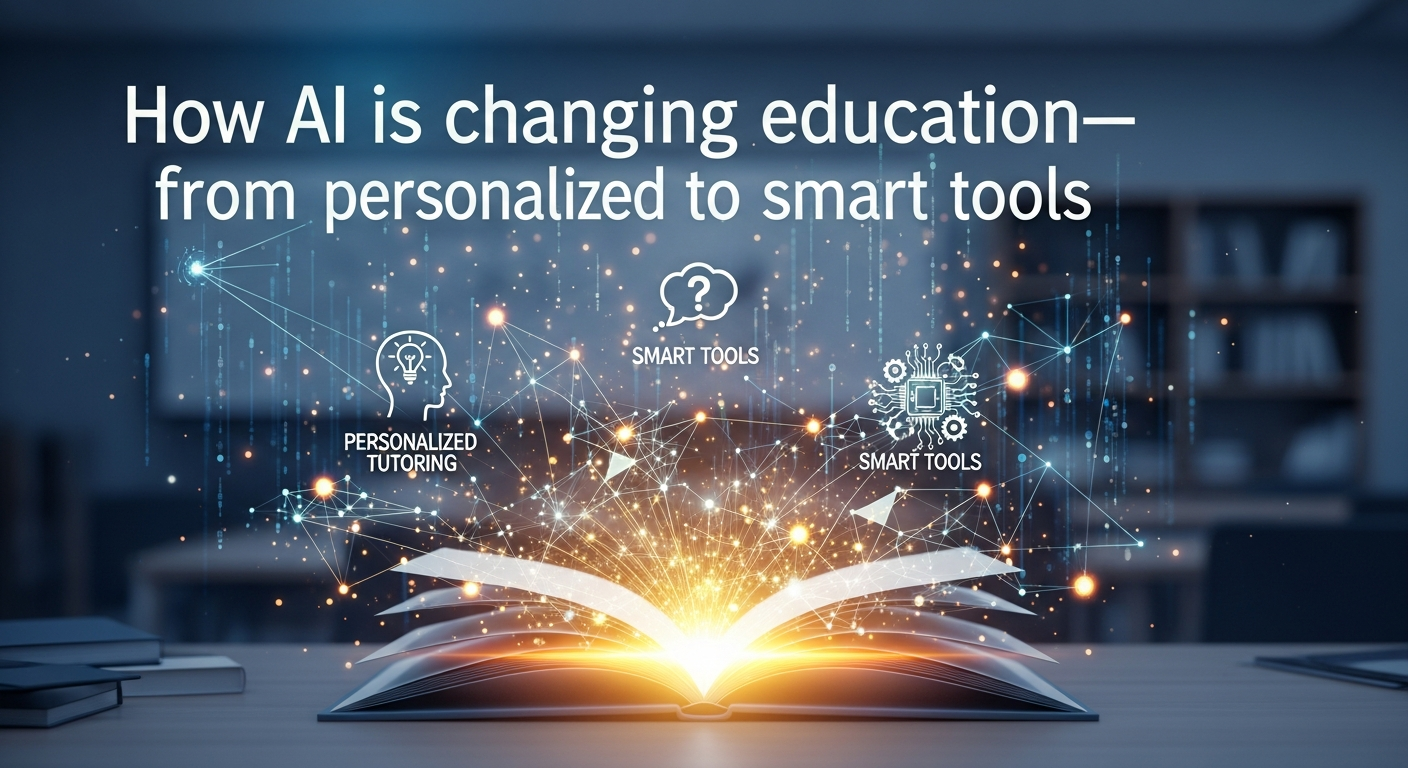
How AI is changing education—from personalized tutoring to smart tools
- November 21, 2025
- ~ 1 min read
- 144 views
- AI in Education
Introduction to AI in Education
The integration of Artificial Intelligence (AI) in education is revolutionizing the way we learn and teach, with AI in education becoming an increasingly vital component of the EdTech landscape. As we stand at the threshold of this technological shift, it's essential to understand the significance of AI's growing presence in education. The statistics are compelling: according to a report by McKinsey, the EdTech market is projected to reach $252 billion by 2026, with AI-powered solutions being a key driver of this growth. This surge in AI adoption is not merely a trend; it's a transformative force that's redefining the education sector.
The Current State of EdTech and AI
Today, personalized learning experiences are no longer a luxury but a necessity, as educators and policymakers recognize the importance of tailoring education to individual needs. AI-driven systems are at the forefront of this movement, enabling schools and institutions to offer customized learning paths that cater to diverse learning styles and abilities. The impact of AI on education extends beyond the classroom, influencing educational policies and informing data-driven decision-making. As AI continues to evolve, it's crucial for stakeholders to stay informed about the latest developments and their implications for the education sector.
Why AI Matters in Education
Understanding the impact of AI in education is vital for several reasons. Firstly, AI has the potential to address long-standing challenges in education, such as inequality and accessibility. By providing personalized learning experiences, AI can help bridge the gap between students from different socio-economic backgrounds. Secondly, AI can enhance the efficiency and effectiveness of educational institutions, streamlining administrative tasks and freeing up resources for more critical activities. Finally, AI can empower educators to focus on what matters most – teaching and mentoring – by automating routine tasks and providing actionable insights.
What to Expect from This Article
In this article, we will delve into the world of AI in education, exploring its applications, benefits, and challenges. We will examine the role of EdTech in shaping the future of education and discuss the potential of personalized learning to transform the way we learn. The topics we will cover include the current state of AI in education, the benefits and challenges of implementing AI-powered solutions, and the future of EdTech. Whether you're an educator, policymaker, or simply interested in the intersection of technology and education, this article aims to provide you with a comprehensive understanding of the impact of AI on education and the exciting possibilities that lie ahead.
Some of the key topics we will explore in this article include:
- The applications of AI in education, from intelligent tutoring systems to natural language processing
- The benefits of personalized learning, including improved student outcomes and increased engagement
- The challenges of implementing AI-powered solutions, including data privacy concerns and equity issues
The Role of AI in Personalized Tutoring
Personalized tutoring has long been recognized as an effective approach to education, as it allows students to receive tailored guidance and support that caters to their individual needs and learning styles. With the integration of Artificial Intelligence (AI), personalized learning has become even more effective, enabling educators to create customized learning plans that adapt to each student's pace, abilities, and knowledge gaps. In this section, we will delve into the concept of personalized tutoring, explore how AI algorithms can enhance it, and discuss the benefits and challenges of AI tutoring in education.
Customized Learning Plans with AI Algorithms
AI-driven algorithms play a crucial role in creating customized learning plans, as they can analyze vast amounts of data on individual students, including their learning history, strengths, weaknesses, and learning preferences. By processing this data, AI systems can identify knowledge gaps, predict learning outcomes, and recommend personalized learning pathways that are tailored to each student's needs. This approach enables educators to provide targeted support, ensuring that students receive the most effective instruction possible. Furthermore, AI algorithms can continuously assess student progress, adjusting the learning plan as needed to ensure that students stay on track and achieve their academic goals.
Examples of AI-Powered Tutoring Systems
Several AI-powered tutoring systems have been successfully implemented in educational settings, demonstrating the potential of adaptive education to improve learning outcomes. For example, AI-powered chatbots have been used to provide one-on-one support to students, offering real-time feedback and guidance on various subjects, including math, science, and language arts. Additionally, AI-driven learning platforms have been developed to provide personalized learning experiences, using machine learning algorithms to adapt to individual students' needs and abilities. These systems have shown promising results, with studies indicating that students who use AI-powered tutoring systems tend to perform better academically and exhibit increased motivation and engagement.
Some notable examples of AI-powered tutoring systems include:
- DreamBox Learning, an online math platform that uses AI to provide personalized math instruction
- Carnegie Learning, a learning platform that uses AI to provide real-time feedback and support to students
- IBM Watson Education, a suite of AI-powered tools that provide personalized learning recommendations and support
Challenges and Limitations of AI in Personalized Tutoring
While AI has the potential to revolutionize personalized tutoring, there are several challenges and limitations that must be addressed. One of the primary concerns is data privacy, as AI systems require access to sensitive student data to provide effective personalized learning experiences. Additionally, there is a risk of bias in AI algorithms, which can perpetuate existing inequalities and disparities in education. To mitigate these risks, educators and policymakers must prioritize transparency, accountability, and equity in the development and implementation of AI-powered tutoring systems. By doing so, we can ensure that AI is used to enhance personalized learning and improve educational outcomes for all students, regardless of their background or abilities.
The effective integration of AI in personalized tutoring has the potential to transform education, enabling educators to provide targeted support and guidance that caters to the unique needs and abilities of each student. As we move forward, it is essential that we prioritize the development of AI-powered tutoring systems that are transparent, equitable, and effective, and that we address the challenges and limitations associated with AI in education.
Smart Tools and Technologies in Education
The integration of AI in classrooms has given rise to a plethora of smart tools and technologies that are revolutionizing the educational landscape. These innovative solutions are designed to enhance student engagement, improve learning outcomes, and make education more accessible and effective. From intelligent tutoring systems to adaptive learning platforms, smart education tools are being increasingly adopted by schools and institutions worldwide.
Case Studies: Successful Integration of AI Tools
Several schools and institutions have successfully integrated AI-powered tools into their curriculum, yielding impressive results. For instance, a study by a leading educational research firm found that students who used AI-based math tutoring software showed a significant improvement in their test scores compared to those who did not. Similarly, a school in the United States implemented an AI-driven reading platform that helped struggling readers catch up with their peers, resulting in a substantial increase in student engagement and motivation. These case studies demonstrate the practical applications and benefits of educational technology in real-world settings.
Enhancing Student Engagement and Learning Outcomes
The use of AI in education has been shown to have a positive impact on student engagement and learning outcomes. By providing personalized learning experiences, AI-powered tools can help students stay motivated and focused, leading to better academic performance. Adaptive learning platforms, for example, use machine learning algorithms to adjust the difficulty level of course materials based on individual student needs, ensuring that each student is challenged but not overwhelmed. Additionally, intelligent tutoring systems can offer one-on-one support to students, providing real-time feedback and guidance that helps them overcome knowledge gaps and achieve their learning goals.
AI-Based Educational Resources and Platforms
There are numerous AI-based educational resources and platforms available that cater to diverse learning needs and styles. Some popular examples include:
- Online learning platforms that offer AI-powered course recommendations and personalized learning pathways
- AI-driven tutoring software that provides real-time feedback and assessment
- Intelligent virtual teaching assistants that help teachers with grading, feedback, and student support
- Adaptive learning platforms that adjust to individual student needs and abilities
The future of education is not about replacing human teachers with machines, but about using AI-powered tools to augment and support the teaching process, making it more effective, efficient, and enjoyable for both teachers and students.
In conclusion, the integration of smart tools and technologies in education has the potential to revolutionize the way we learn and teach. By providing personalized learning experiences, enhancing student engagement, and improving learning outcomes, AI in classrooms can help create a more effective, efficient, and enjoyable education system for all. As we move forward, it is essential to continue exploring the possibilities of educational technology and harnessing its power to transform the future of education.
Advanced AI Concepts in Education
The integration of Artificial Intelligence (AI) in education has led to the development of innovative technologies that are transforming the way we learn and teach. At the forefront of this revolution are advanced AI concepts such as machine learning and Natural Language Processing (NLP). These technologies have the potential to personalize learning, improve student outcomes, and enhance the overall educational experience. In this section, we will delve into the technical aspects of these concepts and explore their applications in educational settings.
Machine Learning and NLP in Education
Machine learning algorithms can be used to analyze vast amounts of data, identify patterns, and make predictions. In education, these algorithms can be applied to develop personalized learning systems that adapt to individual students' needs and abilities. For instance, machine learning can be used to create adaptive assessments that adjust their difficulty level based on a student's performance. Additionally, NLP can be used to develop intelligent tutoring systems that provide real-time feedback and support to students. These systems can analyze student responses, identify areas of difficulty, and offer targeted interventions to improve learning outcomes.
The application of NLP in education is particularly significant, as it enables the development of intelligent language processing systems that can understand and respond to natural language inputs. This technology has the potential to revolutionize the way we teach languages, with NLP-powered chatbots and virtual assistants providing personalized language instruction and feedback. Furthermore, NLP can be used to analyze large datasets of educational texts, identify knowledge gaps, and develop targeted interventions to improve student understanding.
Revolutionizing Special Needs Education
The potential of AI to revolutionize special needs education is vast. Machine learning and NLP can be used to develop personalized learning systems that cater to the unique needs of students with disabilities. For example, AI-powered systems can be used to create customized learning plans for students with autism, ADHD, or other learning disabilities. These systems can analyze student data, identify areas of strength and weakness, and provide targeted interventions to improve learning outcomes. Additionally, NLP can be used to develop assistive technologies that enable students with disabilities to communicate more effectively, such as speech-to-text systems or language translation software.
The application of AI in special needs education also raises important ethical considerations. For instance, there is a need to ensure that AI-powered systems are fair, transparent, and unbiased, and that they do not perpetuate existing inequalities or biases. Moreover, there is a need to consider the potential risks and challenges associated with the use of AI in special needs education, such as the potential for over-reliance on technology or the lack of human interaction.
AI in Educational Research and Policy-Making
AI is not only transforming educational practice but also shaping educational research and policy-making. Machine learning and NLP can be used to analyze large datasets of educational research, identify patterns and trends, and inform policy decisions. For example, AI-powered systems can be used to analyze data on student outcomes, identify areas of improvement, and develop targeted interventions to address these gaps. Additionally, NLP can be used to analyze educational policies, identify areas of ambiguity or inconsistency, and provide recommendations for improvement.
The use of AI in educational research and policy-making also raises important questions about AI ethics. For instance, there is a need to consider the potential biases and limitations of AI-powered systems, and to ensure that they are transparent, fair, and accountable. Moreover, there is a need to consider the potential risks and challenges associated with the use of AI in educational research and policy-making, such as the potential for over-reliance on technology or the lack of human judgment.
The integration of AI in education has the potential to transform the way we learn and teach. However, it is essential to consider the ethical implications of this technology and to ensure that it is used in a way that is fair, transparent, and accountable.
In conclusion, advanced AI concepts such as machine learning and NLP are transforming the educational landscape. These technologies have the potential to personalize learning, improve student outcomes, and enhance the overall educational experience. However, they also raise important ethical considerations and challenges, particularly in the context of special needs education and educational research and policy-making. As we move forward, it is essential to consider the potential risks and benefits of AI in education and to ensure that this technology is used in a way that is fair, transparent, and accountable.
- Ensure that AI-powered systems are fair, transparent, and unbiased
- Consider the potential risks and challenges associated with the use of AI in education
- Develop targeted interventions to address the unique needs of students with disabilities
- Use AI to analyze large datasets of educational research and inform policy decisions
- Consider the ethical implications of AI in education and ensure that it is used in a way that is accountable and transparent
Implementing AI in Educational Settings
As educators and institutions look to harness the power of Artificial Intelligence (AI) in their practices, a well-planned AI implementation strategy is crucial for success. This involves not only selecting the right AI-powered tools but also ensuring that educators are adequately trained to use them effectively. In this section, we will provide a step-by-step guide on how to implement AI in educational settings, discuss the importance of teacher training, and outline best practices for integrating AI into existing curriculum and teaching methods.
Step-by-Step Guide to Selecting and Implementing AI Educational Tools
The first step in implementing AI in educational settings is to identify the specific needs and goals of the institution. This could involve assessing the current curriculum and identifying areas where AI-powered tools could enhance the learning experience. Once the needs have been identified, the next step is to research and select the most suitable AI educational tools. This could involve reviewing case studies and seeking recommendations from other educators or institutions that have already implemented similar tools.
Some key considerations when selecting AI educational tools include:
- Alignment with learning objectives and outcomes
- Ease of use and user experience
- Integration with existing systems and infrastructure
- Cost and scalability
- Support and maintenance requirements
Training Educators to Effectively Use AI-Powered Tools
Once the AI educational tools have been selected, the next step is to provide educators with the necessary teacher training to use them effectively. This could involve workshops and professional development programs that focus on the technical aspects of the tools as well as how to integrate them into existing teaching methods. It is also important to provide ongoing support and resources to ensure that educators are able to troubleshoot any issues that may arise and continue to develop their skills over time.
Some best practices for training educators to use AI-powered tools include:
- Providing hands-on experience and practice with the tools
- Encouraging collaboration and peer-to-peer support
- Offering ongoing coaching and mentoring
- Encouraging feedback and evaluation to inform future training programs
Best Practices for Integrating AI into Existing Curriculum and Teaching Methods
When integrating AI into existing curriculum and teaching methods, it is essential to strike a balance between technology and traditional teaching practices. This could involve using AI-powered tools to enhance and support existing teaching methods rather than replacing them entirely. It is also important to ensure that the use of AI is aligned with the overall learning objectives and outcomes of the institution.
Some common pitfalls to avoid when implementing AI in education include:
- Over-reliance on technology at the expense of traditional teaching practices
- Failure to provide adequate training and support for educators
- Inadequate evaluation and assessment of the effectiveness of AI-powered tools
- Insufficient consideration of the ethical implications of AI in education
By following these best practices and avoiding common pitfalls, educators and institutions can ensure a successful AI implementation that enhances the learning experience and improves outcomes for students.
In conclusion, implementing AI in educational settings requires a well-planned strategy that takes into account the specific needs and goals of the institution. By providing educators with the necessary teacher training and support, and by integrating AI into existing curriculum and teaching methods in a way that is aligned with learning objectives and outcomes, institutions can harness the power of educational technology integration to enhance the learning experience and improve outcomes for students.
Comparing AI-Powered Educational Tools
The integration of Artificial Intelligence (AI) in education has led to the development of numerous AI-powered educational tools and platforms. Each of these solutions offers unique features, benefits, and drawbacks. In this section, we will delve into a comprehensive comparison of different AI-powered educational tools, discussing their pros and cons, cost-effectiveness, accessibility, and user experience. This analysis will help educators, policymakers, and individuals interested in EdTech make informed decisions about which tools best meet their needs.
Evaluating Popular AI-Powered Educational Tools
Several AI-powered educational tools have gained popularity in recent years, including AI-powered adaptive learning systems, intelligent tutoring systems, and virtual learning environments. These tools offer personalized learning experiences, real-time feedback, and automated grading, among other features. However, each tool has its strengths and weaknesses. For instance, adaptive learning systems like DreamBox and Curriculum Associates' i-Ready provide personalized math and reading instruction, but may require significant upfront costs and training for educators.
In contrast, intelligent tutoring systems like Carnegie Learning's MATHia and Reasoning Mind offer one-on-one support for students, but may lack the comprehensive curriculum coverage of other solutions. Virtual learning environments like Google Classroom and Canvas provide a platform for educators to create and manage online courses, but may require significant technical expertise to set up and maintain. It is essential to consider these factors when evaluating AI-powered educational tools, as they can significantly impact the effectiveness of the tool in a particular educational setting.
Cost-Effectiveness and Accessibility of AI-Powered Educational Tools
The cost-effectiveness and accessibility of AI-powered educational tools are critical factors to consider when evaluating these solutions. Some tools, like Khan Academy's AI-powered learning platform, offer free or low-cost access to high-quality educational content. Others, like AI-powered educational software from companies like McGraw-Hill and Pearson, may require significant investments in licensing fees, hardware, and training. Accessibility is also a crucial consideration, as some tools may not be compatible with certain devices or operating systems, or may not provide adequate support for students with disabilities.
To ensure that AI-powered educational tools are accessible to all students, educators and policymakers must consider the following factors:
- Licensing fees and costs associated with implementation and maintenance
- Hardware and software requirements for the tool
- Compatibility with different devices and operating systems
- Support for students with disabilities, including text-to-speech functionality and closed captions
Expert Opinions and User Reviews
When evaluating AI-powered educational tools, it is essential to consider feedback from users and experts in the field.
According to a recent report by the National Education Association, 71% of educators believe that AI-powered educational tools have the potential to improve student outcomes, but 61% also express concerns about the potential for bias in these tools.User reviews and expert opinions can provide valuable insights into the strengths and weaknesses of different AI-powered educational tools, helping educators and policymakers make informed decisions about which tools to implement.
In conclusion, comparing AI-powered educational tools requires a comprehensive evaluation of their pros and cons, cost-effectiveness, accessibility, and user experience. By considering these factors and incorporating feedback from users and experts, educators and policymakers can make informed decisions about which tools best meet their needs and provide high-quality educational experiences for all students. As the EdTech landscape continues to evolve, it is essential to stay up-to-date on the latest developments and advancements in AI-powered educational tools, and to continually evaluate and refine their implementation to ensure maximum effectiveness.
Conclusion and Future Directions
In conclusion, the integration of Artificial Intelligence (AI) in education has the potential to revolutionize the way we learn and teach. Throughout this article, we have explored the various ways in which AI is transforming the educational landscape, from personalized tutoring and intelligent adaptive learning systems to automated grading and virtual learning environments. We have seen how AI can help address long-standing educational challenges, such as the achievement gap and teacher workload, and provide new opportunities for inclusive and accessible education.
Reflection on the Potential of AI in Education
As we look to the future, it is clear that AI will play an increasingly important role in shaping the future of education. The potential of AI to transform education is vast, and its impact will be felt across all aspects of the educational system. From enhancing student outcomes to improving teacher productivity, AI has the potential to make a significant and lasting impact on the way we learn and teach. As EdTech innovation continues to evolve, we can expect to see even more sophisticated and effective AI-powered tools and systems being developed to support educational transformation.
Call to Action
So, what can educators, policymakers, and technologists do to harness the potential of AI in education? Firstly, it is essential to stay informed about the latest developments in AI and EdTech, and to be open to new ideas and innovations. Secondly, we need to work together to develop and implement effective AI-powered solutions that can help address the complex challenges facing education. Finally, we must ensure that AI is used in a way that is transparent, accountable, and equitable, and that its benefits are available to all. As we move forward, we must ask ourselves: what will be the impact of AI on the future of education, and how can we work together to ensure that its potential is realized?
As we consider the future of AI in education, we are reminded that the AI in education future is not just about technology, but about the potential to create a more just and equitable society. By working together to harness the power of AI, we can create a brighter future for all, and ensure that education continues to be a powerful tool for personal and societal transformation. The time to act is now, and we must be bold and visionary in our pursuit of EdTech innovation and educational transformation.
The future of education is not just about AI, but about the potential of AI to unlock human potential and create a better world for all.
Comments (0)
Please login or register to leave a comment.
No comments yet. Be the first to comment!