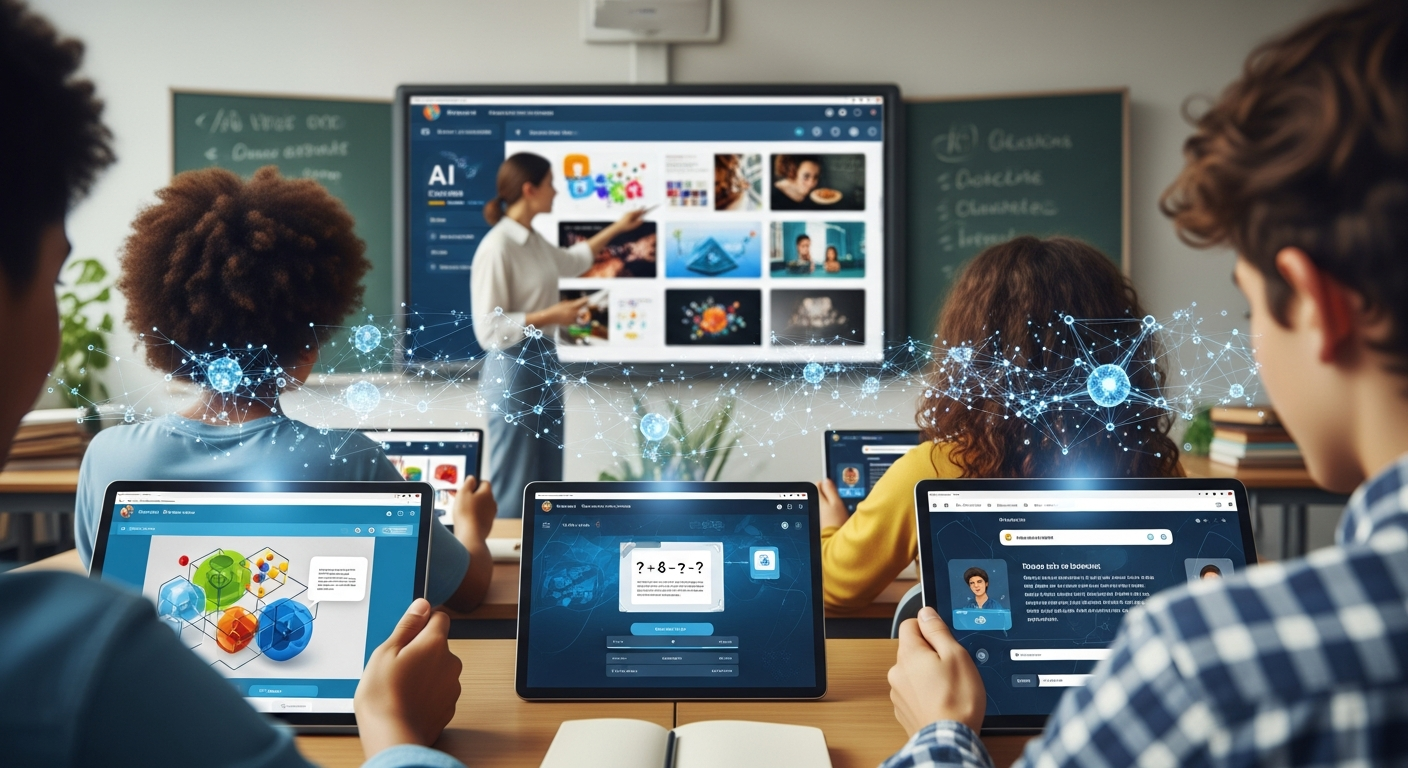
AI in education and how it personalizes lessons for each student.
- November 20, 2025
- ~ 1 min read
- 144 views
- AI in Education , GenAI , Everyday AI
Introduction: The Dawn of Personalized Learning with AI
For generations, the classroom has largely operated on a "one-size-fits-all" model. Students, with their unique learning styles, varying paces, and diverse interests, are often expected to navigate a standardized curriculum at a uniform speed. While educators tirelessly strive to meet individual needs, the sheer scale and complexity of a diverse classroom often lead to missed opportunities, leaving some students disengaged and others unchallenged. The inherent limitations of this traditional approach have long been a source of frustration, pushing the pedagogical community to dream of a more tailored, effective educational experience.
The concept of personalized learning isn't new; it's a long-held aspiration to create educational journeys that cater specifically to each student's strengths, weaknesses, and preferred methods. Historically, however, achieving true personalization was an insurmountable challenge. It demanded an impractical level of individual teacher attention, vast resources, and sophisticated data analysis capabilities that simply didn't exist. Educators knew the benefits—deeper understanding, greater engagement, and improved outcomes—but the practical implementation seemed perpetually out of reach.
Today, the landscape is dramatically shifting with the advent of Artificial Intelligence. AI in education is no longer a futuristic concept but a transformative force rapidly reshaping how we approach teaching and learning. It emerges as the ultimate game-changer, capable of moving personalized learning from a theoretical ideal to a practical, scalable reality. By leveraging powerful algorithms and data analytics, AI promises to make every lesson uniquely relevant, dynamically adapting to individual progress and preferences. This paradigm shift signals the dawn of a new era where education is truly student-centric, promising an adaptive education system that responds intuitively to individual needs.
In this article, we will delve into the profound ways AI is revolutionizing the classroom. We'll explore how cutting-edge educational technology powers individualized learning pathways, offers intelligent tutoring systems, and provides real-time feedback that fosters deeper understanding. Join us as we uncover the practical applications and immense potential of AI to unlock each student's full potential, charting a course for the exciting future of learning where every learner thrives.
Main Content: How AI Personalizes Lessons for Every Student
The true promise of Artificial Intelligence in education lies in its unparalleled ability to move beyond a one-size-fits-all approach, crafting bespoke learning journeys for each individual student. By harnessing sophisticated computational power, AI can analyze a vast array of student data to dynamically adjust the educational experience, making learning more effective, engaging, and relevant. Let's delve into the core mechanisms through which AI achieves this remarkable personalization.
Adaptive Learning Platforms: Your Personalized GPS for Knowledge
At the forefront of AI-powered personalization are adaptive learning platforms. These systems are akin to a highly intelligent personal tutor that constantly monitors a student's interaction with content, understanding, and progress. Using advanced machine learning in learning techniques, AI algorithms meticulously analyze data points such as correct/incorrect answers, time spent on tasks, areas of struggle, and mastery levels. Based on this real-time assessment, the platform can dynamically adjust the curriculum's pace, difficulty, and even the type of content presented. For instance, if a student grasps a concept quickly, the platform might offer more challenging material or move to the next topic faster. Conversely, if a student struggles, it can provide supplementary resources, present the concept in a different format (e.g., video instead of text), or offer additional practice problems until mastery is achieved. This ensures that every student is consistently challenged but never overwhelmed, optimizing their path to comprehension.
Intelligent Tutoring Systems (ITS): AI Mentors in Real-Time
Imagine having a dedicated tutor available 24/7, providing immediate, constructive feedback. That's the essence of intelligent tutoring systems (ITS). These AI-driven tools go beyond simple answer checking; they understand the student's problem-solving process, identify misconceptions, and offer hints or explanations tailored to the specific learning gap. Leveraging natural language processing (NLP), ITS can even engage in conversational dialogue, responding to student questions and guiding them through complex reasoning. This immediate, contextualized support mimics the best human tutors, providing personalized guidance precisely when and where a student needs it most. The result is a highly interactive and effective learning experience that accelerates understanding and builds confidence.
Smart Content Recommendation Engines: Tailoring Resources
Just as streaming services suggest movies based on your viewing history, AI employs sophisticated content recommendation engines in education. These engines analyze a student's past performance, expressed interests, learning style preferences, and even their emotional responses to different content types. Are they visual learners? Do they prefer hands-on activities? Do they engage more with gamified content? Based on these insights, AI can suggest relevant articles, videos, simulations, interactive exercises, or even entire courses that align with the student's unique profile and learning objectives. This personalized curation ensures that students are always presented with the most effective and engaging resources, fostering deeper engagement and a more enjoyable learning journey. It transforms passive consumption into active, self-directed exploration.
Predictive Analytics: Proactively Identifying Learning Needs
Perhaps one of the most powerful applications of AI in education is its ability to look into the future through predictive analytics in education. By processing vast datasets of student behaviors, attendance records, engagement patterns, and historical performance, AI algorithms can identify subtle trends and potential warning signs that might indicate a student is at risk of falling behind or disengaging. For example, a sudden drop in activity on an online platform or consistent struggles with a particular type of problem could trigger an alert. This proactive identification allows educators to intervene early with targeted support, resources, or communication, preventing potential academic difficulties before they escalate. Dynamic adaptation isn't just about reacting to current performance; it's also about anticipating future needs, ensuring that every student receives timely assistance to stay on track for success in their personalized education journey.
Supporting Content: Real-World Examples of AI-Driven Personalization
The promise of Artificial Intelligence transforming education is rapidly moving from theory to tangible practice. Across diverse educational settings and subjects, AI is proving instrumental in delivering truly personalized learning experiences. These AI education examples illustrate how innovative technologies are directly impacting students and educators, fostering engagement, improving outcomes, and addressing unique needs. Here, we delve into concrete personalized learning case studies that underscore the power of AI in action.
Adaptive Math Platforms for K-12 Students
In many K-12 classrooms, a one-size-fits-all approach to mathematics instruction can leave some students bored and others struggling to keep up. AI-powered adaptive learning platforms are revolutionizing this. Consider tools like DreamBox Learning or IXL, which utilize sophisticated algorithms to continuously assess a student's understanding and adjust the curriculum in real-time. If a student masters a concept quickly, the platform presents more challenging problems; if they falter, it provides targeted support, remedial exercises, and different instructional approaches until mastery is achieved. This personalized pathway ensures that every student is working at their optimal learning edge, leading to significant improvements in mathematical proficiency and greater student confidence.
AI Tutors for University STEM Subjects
University-level STEM subjects (Science, Technology, Engineering, Mathematics) often present complex challenges for students, with large class sizes making individualized instructor support difficult to access. AI-powered tutoring systems are stepping in to bridge this gap. Platforms such as Carnegie Learning's MATHia offer AI tutors that provide step-by-step guidance, immediate feedback on problem-solving attempts, and personalized practice problems. These systems don't just give answers; they help students understand the 'why' behind solutions, fostering deeper conceptual understanding and critical thinking skills. The benefit is clear: students receive on-demand, tailored assistance, reducing frustration and enabling them to tackle difficult concepts with greater success, ultimately improving retention rates in challenging courses.
Language Learning Apps with Tailored Exercises
Learning a new language is a deeply personal journey, often hampered by generic curricula that don't adapt to individual learning styles or prior knowledge. Language learning apps like Duolingo, Babbel, and Memrise leverage AI to create highly customized learning paths. By tracking a user's progress, identifying their specific areas of difficulty (e.g., certain grammar rules, vocabulary categories, or pronunciation challenges), the AI dynamically adjusts the exercises and repetition schedule. This intelligent adaptation ensures that students focus their efforts where it's most needed, reinforcing weak points and accelerating vocabulary acquisition and grammatical fluency. The result is a more engaging, effective, and efficient language learning experience, making these prominent ed-tech innovations.
AI Tools for Special Education Support
Identifying and supporting students with special learning needs can be a complex and resource-intensive endeavor. AI is emerging as a powerful ally in this critical area, offering significant breakthroughs in AI in special education. Tools are being developed that analyze student performance data, behavioral patterns, and even linguistic nuances to help educators identify potential learning difficulties, such as dyslexia or ADHD, much earlier than traditional methods. Furthermore, once identified, AI-driven platforms can then suggest or deliver highly individualized interventions, adaptive content, and assistive technologies tailored to a student's specific learning profile. This proactive and personalized support ensures that every student, regardless of their learning challenges, receives the appropriate resources to thrive academically and socially, embodying the true potential of adaptive learning tools.
Advanced Content: The Ethics, Challenges, and Future of AI in Education
Ethical Foundations: Data Privacy, Algorithmic Bias, and Equity
As AI becomes increasingly embedded in personalized learning ecosystems, a profound consideration of its ethical implications is paramount. At the forefront of this discussion is data privacy education and security. Educational AI systems process vast amounts of sensitive student data, ranging from academic performance and learning styles to behavioral patterns and even biometric information. Safeguarding this data is not merely a technical challenge but a critical ethical imperative. Regulations like the General Data Protection Regulation (GDPR) in Europe and the Family Educational Rights and Privacy Act (FERPA) in the United States provide legal frameworks, but their application to dynamic AI systems demands vigilance. Institutions must implement robust encryption, anonymization techniques, and strict access controls, coupled with transparent policies that inform students and parents about how their data is collected, used, and protected. The principle of data minimization—collecting only what is necessary—must be a guiding force in AI development for education.
Equally critical is addressing the potential for algorithmic bias to perpetuate or even amplify existing educational inequalities. AI models are trained on historical data, and if that data reflects societal biases or disparities in access and resources, the AI's recommendations and assessments can inadvertently disadvantage certain student groups. For instance, an AI tutor trained predominantly on data from affluent demographics might fail to recognize the unique learning challenges or cultural contexts of students from underserved communities. Mitigating this requires diverse, representative training datasets, rigorous auditing of algorithms for fairness, and a commitment to explainable AI (XAI) to understand *why* an AI makes specific decisions. Ensuring equitable access to these personalized AI tools, irrespective of socioeconomic status, is also a significant aspect of AI ethics in education, preventing a digital divide in the quality of instruction.
The Evolving Human-AI Partnership: Augmenting the Educator
A common misconception regarding AI in education is that it aims to replace human teachers. On the contrary, expert insights emphasize that the most effective integration of AI is through a symbiotic teacher-AI collaboration. AI excels at data analysis, identifying patterns, and delivering targeted content, thereby automating many of the administrative and diagnostic tasks that consume valuable teacher time. This frees educators to focus on their irreplaceable human roles: providing emotional support, fostering critical thinking, nurturing creativity, facilitating complex discussions, and addressing socio-emotional learning needs. AI can personalize curriculum delivery, but it cannot replicate the nuanced understanding of a child's emotional state, the motivational power of a human mentor, or the adaptive empathy required in real-time classroom interactions. The future of personalized learning lies not in AI teaching students, but in AI empowering teachers to teach better, creating a dynamic duo that enhances the learning experience beyond what either could achieve alone.
Future Trends and Overcoming Ed-Tech Challenges
Looking ahead, the future of AI learning promises even deeper levels of hyper-personalization. Emerging technologies such as VR/AR education are poised to create immersive, interactive learning environments tailored to individual paces and preferences. Imagine a student struggling with planetary motion able to 'walk' through a solar system simulation, or a history lesson brought to life through augmented reality overlays. Furthermore, advancements in emotional AI, which can interpret a student's facial expressions, tone of voice, or even physiological responses, could allow systems to adapt not just to cognitive understanding but also to emotional engagement and frustration levels, offering real-time encouragement or adjusting task difficulty accordingly. This represents a significant leap towards truly adaptive and empathetic learning companions.
However, the widespread adoption and equitable implementation of these advanced AI personalizations face significant ed-tech challenges. Key hurdles include:
- Infrastructure: Many educational institutions lack the robust, high-speed internet and computing infrastructure necessary to support advanced AI applications and VR/AR experiences.
- Cost: Developing, implementing, and maintaining sophisticated AI systems is expensive, posing a barrier for underfunded schools and districts.
- Teacher Training: Equipping educators with the skills and confidence to effectively integrate AI tools into their pedagogy, understand AI-generated insights, and manage ethical considerations requires comprehensive, ongoing professional development.
Overcoming these challenges will require concerted effort from policymakers, technology developers, and educational leaders, ensuring that the transformative potential of AI in personalized education is realized responsibly and equitably for all students.
Practical Content: Implementing AI for Personalized Learning
The vision of AI-powered personalized education is compelling, but translating that vision into reality requires a strategic, phased, and practical approach. This section provides a step-by-step framework for educators and institutions considering or actively engaged in implementing AI in schools, ensuring a smooth transition and maximum impact on student learning outcomes.
Assessing Needs for Impactful AI Personalization
Before diving into solutions, the foundational step is a thorough needs assessment. Identify specific pain points or opportunities within your current educational landscape where AI personalization can deliver the greatest value. Consider:
- Student Performance Gaps: Are there particular subjects or skill areas where a significant number of students struggle, or where advanced learners aren't sufficiently challenged?
- Teacher Workload: Can AI automate repetitive tasks like grading certain assignments, generating differentiated practice, or providing initial feedback, thereby freeing up teacher time for more direct student interaction?
- Engagement and Motivation: Are there cohorts of students who are disengaged, and could adaptive content or gamified learning pathways reignite their interest?
- Assessment & Feedback: Is your current system providing timely, actionable, and individualized feedback to students and teachers?
By pinpointing these areas, you can develop clear objectives and measurable outcomes for your AI initiatives, ensuring that technology serves a defined pedagogical purpose.
Selecting the Right AI-Powered Learning Tools
With needs assessed, the next critical step is choosing AI learning tools that align with your educational goals. The market is vast, so meticulous evaluation is key. Consider the following criteria:
- Pedagogical Alignment: Does the tool support your curriculum and teaching philosophies? Look for solutions that enhance, rather than dictate, learning.
- User-Friendliness: Both students and teachers should find the interface intuitive and easy to navigate. A steep learning curve can hinder adoption.
- Data Privacy and Security: This is paramount. Ensure the platform adheres to all relevant data protection regulations (e.g., FERPA, GDPR) and has robust security measures in place.
- Scalability and Interoperability: Can the tool grow with your institution? Does it integrate seamlessly with your existing learning management systems (LMS) and other essential software?
- Vendor Support and Training: What kind of onboarding, ongoing support, and professional development does the vendor offer?
- Cost-Effectiveness: Evaluate the return on investment, considering both direct costs and potential long-term benefits in student achievement and teacher efficiency.
Prioritize tools that offer adaptive learning pathways, intelligent tutoring, AI-powered assessment, or content recommendation engines that truly personalize the learning journey.
Phased Rollout: Implementing Pilot Programs
A successful ed-tech adoption strategy often involves a phased approach. Rather than a system-wide overhaul, begin with carefully designed pilot programs:
- Start Small: Select a manageable group – a single classroom, a specific grade level, or a particular subject area – to test the AI solution.
- Define Clear Objectives: What specific outcomes are you hoping to achieve during the pilot (e.g., improved math scores in a certain topic, increased student engagement in reading, reduced teacher time on differentiation)?
- Gather Feedback Systematically: Implement mechanisms for teachers, students, and administrators to provide ongoing feedback on the tool's effectiveness, ease of use, and areas for improvement.
- Analyze Data: Continuously monitor the data generated by the AI tool and compare it against your pilot objectives. Are students progressing as expected? Are teachers finding the insights useful?
- Iterate and Expand: Use insights from the pilot to refine implementation strategies, make adjustments to tool usage, and then consider a broader rollout based on proven success.
"Starting with a pilot program allows institutions to learn, adapt, and build confidence with AI technology without the pressure of an immediate, full-scale deployment."
Empowering Educators: Teacher Training and Professional Development for AI
The success of AI in education hinges significantly on educator buy-in and proficiency. Comprehensive teacher training AI programs are non-negotiable. These programs should:
- Focus on Pedagogy, Not Just Technology: Explain *how* AI supports teaching and learning, rather than just *what* the buttons do. Emphasize how AI can free up time for deeper interactions and more targeted support.
- Provide Hands-on Experience: Teachers need opportunities to interact with the AI tools as both a student and an instructor.
- Interpret AI Insights: Train educators on how to understand and act upon the data and recommendations generated by AI, integrating these insights into their instructional planning.
- Address Ethical Considerations: Discuss the responsible use of AI, data privacy, bias in algorithms, and maintaining the human element in education.
- Offer Ongoing Support: Establish communities of practice, peer mentoring, and accessible technical support to ensure teachers feel continuously supported in their AI journey.
Empowering teachers ensures that AI becomes a powerful assistant, amplifying their expertise rather than complicating their roles.
Ensuring Continuous Improvement: Data Governance and Feedback Loops
For AI personalization to be truly effective and sustainable, robust systems for data governance and continuous feedback are essential. This is where data governance education becomes critical:
- Establish Clear Data Policies: Develop transparent policies regarding what student data is collected, how it's stored, who has access, and how it's used. Communicate these policies clearly to parents, students, and staff.
- Prioritize Security: Implement stringent cybersecurity measures to protect sensitive student information from breaches and unauthorized access.
- Ethical AI Use: Continuously review AI algorithms and their impact to mitigate potential biases and ensure equitable outcomes for all students.
- Implement Feedback Mechanisms: Beyond initial pilots, create formal and informal channels for teachers, students, and parents to provide ongoing feedback about the AI tools and their impact. This includes regular surveys, focus groups, and open forums.
- Regular Evaluation and Iteration: Schedule periodic reviews of your AI strategies. Analyze performance data, incorporate feedback, and be prepared to adjust tools, training, or policies to reflect new insights and evolving needs.
By committing to these best practices AI education principles, institutions can foster a dynamic learning environment where AI continually adapts and improves, ensuring personalized education remains at the forefront of innovation.
Comparison & Analysis: AI Personalization vs. Traditional Approaches
As we delve deeper into the capabilities of Artificial Intelligence in shaping educational futures, it's crucial to place its strengths and weaknesses in direct comparison with established pedagogical methods. This section offers an objective analysis, highlighting where AI truly innovates and where traditional approaches, often supported by human intuition and interaction, maintain their irreplaceable value.
Differentiated Instruction vs. AI Personalization: Synergy and Distinction
For decades, educators have championed Differentiated Instruction (DI), a pedagogical framework where teachers tailor curriculum and instruction to meet the varied learning needs of students. DI is inherently human-centric, relying on a teacher's keen observation, experience, and deep understanding of their students to modify content, process, products, and learning environments. While effective, it is incredibly labor-intensive, often limited by class size, available resources, and the individual teacher's capacity.
Enter AI Personalization. The fundamental difference lies in scope and scale. While DI is a manual, human-driven process, AI-driven personalization leverages algorithms and data analytics to adapt learning paths automatically. It can instantaneously adjust content difficulty, recommend resources, provide targeted feedback, and even modify pacing based on real-time student performance data. The direct comparison often frames the debate as AI vs differentiated instruction, but a more progressive view sees them as complementary. AI can serve as a powerful assistant, automating the data collection and initial adaptation, freeing up teachers to focus on the higher-order tasks that AI currently cannot replicate: fostering critical thinking, emotional support, and complex social interactions. The synergy allows for personalization on a scale previously unimaginable for human educators alone.
The Evolving Landscape: Personalized Learning Pros and Cons
The advent of AI in education introduces a compelling set of advantages and challenges. Understanding these personalized learning pros cons is vital for informed implementation.
Pros of AI Personalization:
- Scalability and Efficiency: AI systems can personalize learning experiences for thousands, even millions of students simultaneously, something impossible with human teachers alone. This offers unprecedented scalability in education, optimizing resource allocation.
- Data-Driven Insights: AI continuously collects and analyzes student performance data, providing educators with granular, actionable insights into individual strengths, weaknesses, and learning patterns that would be arduous to track manually.
- 24/7 Accessibility: Learning platforms powered by AI are available anytime, anywhere, breaking down geographical and time barriers to education. Students can learn at their own pace, on their own schedule.
- Consistent Adaptation: AI's ability to adapt content, exercises, and feedback in real-time ensures that the learning experience is always optimized for the student's current needs, preventing boredom or frustration.
- Objective Feedback: AI can provide immediate, unbiased feedback on tasks, allowing students to understand and correct mistakes without delay.
Cons of AI Personalization:
- Cost and Infrastructure: Implementing robust AI platforms requires significant initial investment in technology, infrastructure, and ongoing maintenance, posing a barrier for underfunded institutions.
- Reliance on Technology: Over-reliance on AI can lead to technological dependence, where system failures or internet outages disrupt learning. There's also a risk of diminishing human interaction.
- Potential for 'Echo Chambers': If not carefully designed, AI algorithms might inadvertently narrow a student's exposure to diverse perspectives or learning styles, reinforcing existing biases or limiting creativity.
- The Digital Divide: Unequal access to necessary technology and reliable internet connectivity could exacerbate the digital divide, creating disparities in educational opportunities for students from different socioeconomic backgrounds.
- Lack of Human Empathy: AI, despite its sophistication, cannot fully replicate the nuanced emotional support, mentorship, and spontaneous creative thinking that a human teacher provides.
- Data Privacy Concerns: The extensive data collection inherent in AI personalization raises significant questions about student data privacy and security, requiring robust ethical guidelines.
Complementing and Coexisting: AI, Ed-Tech, and Human Expertise
The conversation around AI in education isn't about replacing teachers or abandoning proven methods; it's about enhancement. When considering ed-tech comparison, AI systems offer a significant leap beyond older solutions like static e-learning modules or one-size-fits-all digital textbooks. Unlike these predecessors, which merely digitized traditional content, AI actively interacts with the learner, making the experience truly dynamic and adaptive.
The true power lies in human-AI collaboration. AI should be viewed as an intelligent co-pilot for educators, handling the heavy lifting of data analysis, content delivery, and initial adaptation, thereby empowering teachers to elevate their role. Teachers can then focus on critical pedagogical tasks: fostering socio-emotional development, encouraging collaborative projects, facilitating complex discussions, and providing the invaluable human connection and mentorship that machines cannot replicate. The optimal mix involves AI providing personalized learning paths and instant feedback, while human instructors offer contextual understanding, foster creativity, address emotional needs, and ensure ethical oversight. This balanced approach allows for a truly holistic educational experience that leverages the best of both worlds.
Conclusion: The Personalized Classroom of Tomorrow
As we've explored throughout this article, the integration of Artificial Intelligence into education is not merely an enhancement but a fundamental shift towards a truly personalized learning experience. We've seen how AI can meticulously analyze individual student needs, learning styles, and progress, moving beyond the one-size-fits-all model to create tailored educational journeys. From adaptive learning platforms that adjust difficulty in real-time to AI tutors providing instant, targeted feedback, the potential for AI to unlock each student's unique capabilities is profound. This comprehensive personalized education summary underscores AI's capacity to foster deeper engagement, improve retention, and cultivate a genuine love for learning.
Embracing the AI Learning Future Responsibly
The benefits of this transformation are immense: improved academic outcomes, greater student autonomy, and a more equitable learning environment that addresses diverse needs, including those of students with learning disabilities. However, realizing the full potential of the AI learning future hinges on our commitment to responsible and ethical implementation. Issues such as data privacy, algorithmic bias, and the critical importance of maintaining human oversight remain paramount. Educators, policymakers, and developers must collaborate to ensure AI tools are transparent, fair, and designed to augment, not replace, the irreplaceable human element of teaching and mentorship. It's about empowering educators and students alike, creating a symbiotic relationship between human intelligence and artificial intelligence.
Shaping the Future of Education: A Call to Action
The landscape of learning is evolving rapidly, and AI stands at the forefront of this revolution. It promises a future where education is dynamic, responsive, and intrinsically motivated, preparing students not just for tests, but for life. This is not a distant dream but an emerging reality, and every educator, administrator, parent, and student has a role to play in shaping it. We urge you to explore these technologies, engage in thoughtful discussions, and advocate for ethical integration within your institutions. This is a vital call to action for the entire ed-tech community and beyond. Let's collectively embrace this transformative journey, ensuring that the future of education is inclusive, innovative, and truly personalized for every learner, building a generation ready to thrive in an ever-changing world.

Comments (0)
Please login or register to leave a comment.
No comments yet. Be the first to comment!