
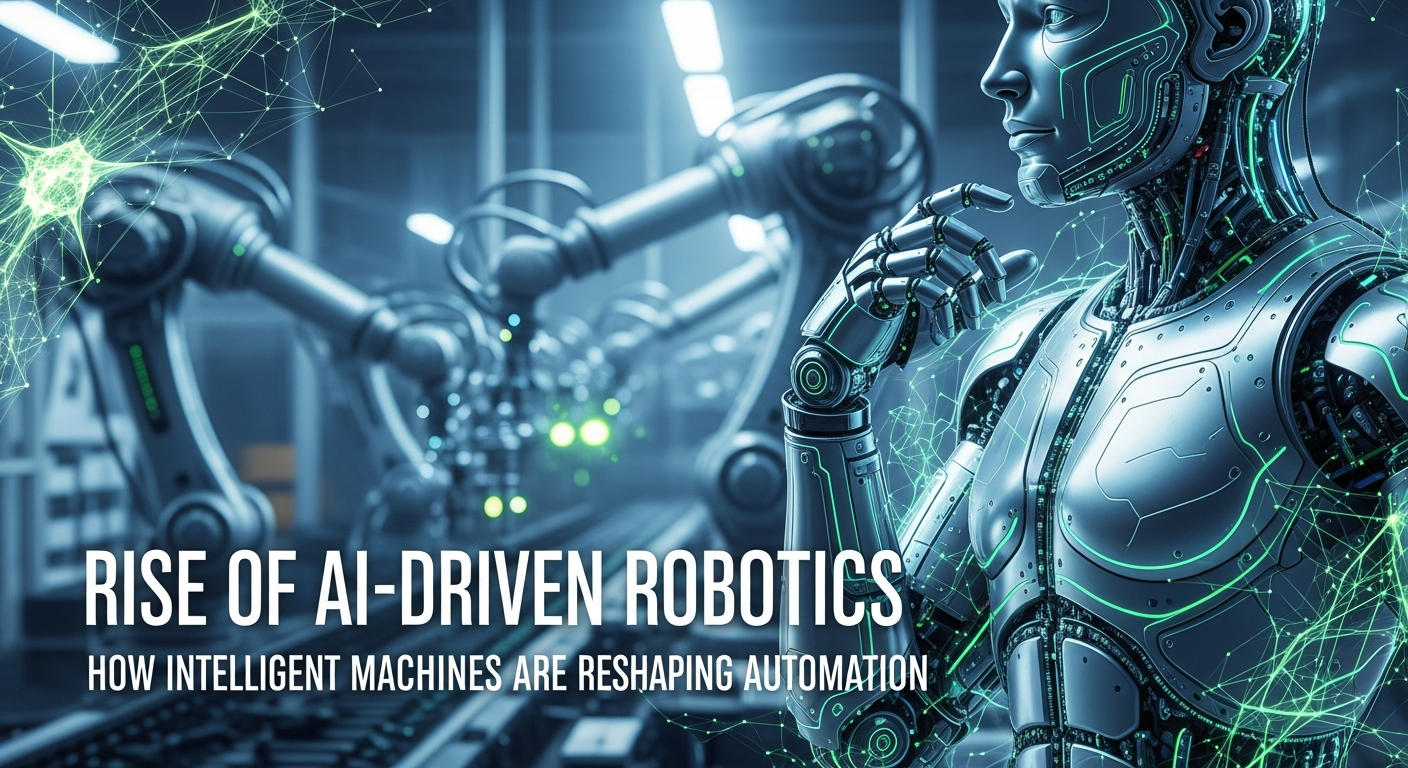
Rise of AI-Driven Robotics: How Intelligent Machines Are Reshaping Automation
- November 18, 2025
- ~ 1 min read
- 156 views
- AI Robotics
Introduction/Overview
The Dawn of a New Era: Beyond the Assembly Line
Imagine an industrial robot performing a complex welding task with unwavering precision, day in and day out. This image, common for decades, represents the pinnacle of traditional automation. These systems, often based on pre-programmed instructions and sensors, excel at repetitive, predictable tasks. However, they often falter when faced with deviations, unexpected obstacles, or situations requiring adaptive decision-making.
Consider a warehouse fulfillment center. Automated guided vehicles (AGVs) move goods along designated paths using fixed maps and sensors. While efficient for structured environments, they can become bottlenecks or even unsafe if the layout changes unexpectedly or if unforeseen objects enter their path. This highlights a key limitation of traditional automation: its reliance on rigid programming and fixed operational parameters.
Enter the era of AI-driven robotics. This is more than just attaching a camera or adding sensors to a traditional robot. It involves integrating sophisticated algorithms, often based on machine learning, computer vision, and natural language processing, directly into the robot's control system. These intelligent machines can perceive their environment in complex ways, learn from experience, adapt their behavior on the fly, and make decisions based on goals and context.
Why This Shift Matters: The Power of Intelligence in Motion
The integration of artificial intelligence is fundamentally transforming automation from a tool for simple task repetition to a dynamic partner capable of complex problem-solving. This shift is significant for several reasons:
- Enhanced Flexibility and Adaptability: AI allows robots to handle variations in tasks, environments, and objects much more effectively. A robot arm equipped with AI can learn to grasp a wide variety of objects it hasn't encountered before, adapting its grip and motion based on visual input and past successes.
- Improved Efficiency and Productivity: Intelligent machines can optimize workflows in real-time. They can identify bottlenecks, adjust processes, and work collaboratively with humans in shared spaces (cobots), leading to significant gains in output and resource utilization.
- Creation of New Capabilities: AI enables robots to perform tasks previously thought impossible or too complex for automation. Think about agricultural robots identifying and harvesting ripe produce, surgical robots assisting doctors with unprecedented precision, or inspection robots autonomously navigating and analyzing complex structures like wind turbines.
- Reduced Costs and Increased Safety: While the initial investment can be high, the long-term operational costs are often reduced through increased efficiency and reduced need for human intervention in hazardous environments. Furthermore, intelligent machines can potentially enhance safety by taking over dangerous tasks or providing better situational awareness.
The rise of AI-driven robotics isn't just an incremental improvement; it's a paradigm shift. It's moving us towards systems that are not just reactive but proactive, learning and evolving as they interact with the world. This capability unlocks entirely new possibilities across manufacturing, logistics, healthcare, agriculture, exploration, and countless other sectors.
What to Expect: Exploring the Future of Automation
This introductory section has set the stage by contrasting traditional automation with the intelligence brought by AI, highlighting the transformative potential of AI-driven robotics, and defining the key players like intelligent machines. In the subsequent sections of this article, we will delve deeper into:
- The Core Technologies: We'll break down the specific AI techniques (like machine learning, computer vision, and reinforcement learning) that power these intelligent systems.
- Key Applications Across Industries: We'll explore real-world examples of AI-driven robotics in action, from factories and warehouses to healthcare, agriculture, and beyond.
- Challenges and Considerations: No technological revolution is without hurdles. We'll discuss the technical, ethical, and societal challenges associated with the widespread adoption of these intelligent machines.
- The Human Factor: How are these advancements impacting the workforce? We'll examine the opportunities for collaboration and the skills needed for the future.
- Future Trends and Predictions: What does the horizon hold? We'll speculate on the next wave of innovation in AI-driven robotics.
Our goal throughout this exploration is to provide a comprehensive understanding of how artificial intelligence is not just enhancing, but fundamentally reshaping the landscape of automation, paving the way for a future where intelligent machines are ubiquitous partners in our world.
The Core of AI-Driven Robotics
Beyond Traditional Automation: Defining AI-Driven Robotics
While automation has been a cornerstone of industrial efficiency for decades, the advent of AI has ushered in a fundamentally new era: AI-driven robotics. Traditional automation relies on pre-programmed sequences, executing repetitive tasks with precision but little flexibility. Think of a robotic arm programmed to weld the same spot on every car chassis. Its movements are fixed, its responses predictable, and its inability to adapt to unforeseen variables is a significant limitation.
In stark contrast, AI-driven robots are imbued with the capacity to perceive, reason, and learn from their environment. They aren't just performing tasks; they are understanding contexts, making decisions, and optimizing their actions in real-time. This crucial distinction transforms robots from mere tools into truly adaptive and intelligent collaborators, capable of navigating complex, dynamic, and unpredictable scenarios previously beyond the reach of automated systems.
The Pillars of Robotic Intelligence: Key AI Technologies
The remarkable capabilities of modern robots are powered by a synergy of advanced AI technologies that grant them senses and cognitive functions. These core components are the building blocks of true robotic intelligence:
- Machine Learning (ML): At the heart of adaptive robotics is machine learning, which enables robots to learn from data, patterns, and experience without explicit programming. Through supervised, unsupervised, or reinforcement learning, robots can identify objects, predict outcomes, refine motor control, and even learn new skills. This allows them to self-optimize their performance over time, continually improving efficiency and accuracy.
- Computer Vision (CV): Giving robots the ability to "see," computer vision allows them to interpret visual information from cameras and sensors. This includes recognizing objects, understanding their spatial relationships, detecting anomalies, and navigating complex environments. CV is vital for tasks such as precision assembly, quality inspection, obstacle avoidance, and human-robot interaction.
- Natural Language Processing (NLP): NLP empowers robots to understand, interpret, and generate human language. This technology facilitates intuitive communication, allowing users to interact with robots through voice commands or text. NLP is crucial for collaborative robots in human-centric environments, service robots, and systems requiring complex instruction comprehension.
These sophisticated AI components don't operate in isolation; they integrate seamlessly to create a holistic intelligent system. For instance, a robot might use computer vision to identify a misplaced part, machine learning to determine the optimal gripping strategy, and NLP to inform a human operator about the situation – all in a coordinated, intelligent workflow.
From Simple Automation to Cognitive Automation
The journey from simple automation to AI-driven robotics marks a profound evolution in industrial and service applications. Early automation focused on mechanizing repetitive tasks, such as assembly lines or pick-and-place operations in controlled environments. While highly efficient, these systems lacked flexibility and could not handle variations or unexpected events.
Today, AI enables robots to perform tasks previously considered the exclusive domain of human cognition. Robots can now perform delicate surgery, drive autonomous vehicles, sort irregular packages, or even prepare gourmet meals. This transition represents a qualitative leap towards what is known as cognitive automation. Unlike traditional automation, cognitive automation refers to systems that can perceive, reason, learn, and problem-solve in dynamic, unstructured environments. This level of autonomy and intelligence is not merely an improvement on past systems; it is a fundamental redefinition of what automation can achieve, truly reshaping industries from manufacturing and healthcare to logistics and beyond.
Real-World Applications: Where AI Robots are Making an Impact
Artificial intelligence is rapidly transcending theoretical potential and embedding itself into practical applications, particularly within the domain of robotics. The synergy between AI and robotics is not just a technological trend; it's fundamentally reshaping workflows, boosting productivity, and enabling entirely new capabilities across diverse sectors. Understanding these **robotic applications** provides crucial insight into the tangible benefits and future trajectory of this powerful combination.
Manufacturing: Precision, Adaptability, and Predictive Power
The manufacturing floor has become one of the most prominent arenas for **AI automation examples**. Modern assembly lines are increasingly staffed by intelligent machines capable of far more than simple repetition. AI-driven **robotic applications** in manufacturing go beyond basic automation, offering unprecedented levels of precision, flexibility, and predictive insight.
- Advanced Assembly Lines: Robots equipped with vision systems and AI algorithms can now perform complex assembly tasks with high dexterity and adaptability. They can identify components, make fine adjustments based on real-time feedback, and even handle variations in part placement or material properties, significantly reducing errors and speeding up production.
- Intelligent Quality Control: AI-powered vision systems mounted on robotic arms or used in separate inspection stations can meticulously examine products for defects far more quickly and accurately than human inspectors. These systems learn from data, improving their detection capabilities over time, ensuring higher product standards and reducing waste.
- Predictive Maintenance: This is a critical **industry use case**. AI algorithms analyze data from sensors embedded in robotic machinery (vibration, temperature, power consumption) to predict potential failures before they occur. This allows manufacturers to schedule maintenance proactively, minimizing costly downtime and extending the lifespan of their equipment.
Healthcare: Precision Surgery, Care Assistance, and Streamlined Logistics
The healthcare sector is leveraging AI robotics to enhance precision, provide patient care, and manage complex logistics. These **autonomous robots** are contributing significantly to safer procedures, improved patient outcomes, and more efficient hospital operations.
- Minimally Invasive Surgery:** Systems like the da Vinci Surgical Robot allow surgeons to perform highly complex procedures with enhanced precision, flexibility, and control, often resulting in less pain, reduced blood loss, and faster recovery times for patients. AI assists by analyzing data and potentially guiding the surgeon's movements.
- Companion and Telehealth Robots:** These robots interact with patients, providing companionship, monitoring vital signs, reminding them to take medication, and even facilitating remote consultations with healthcare providers. They are particularly valuable in elderly care and managing chronic conditions.
- Automated Logistics:** Hospitals employ autonomous robots for transporting medications, laboratory samples, and linens between departments. These **AI automation examples** ensure timely delivery, reduce staff workload, minimize human error, and free up personnel for more critical patient care tasks.
Logistics and Warehousing: Efficiency and Autonomous Movement
Warehouses and logistics hubs worldwide are being revolutionized by the integration of AI and robotics, moving towards highly efficient, automated operations capable of handling complex tasks with minimal human intervention.
- Autonomous Mobile Robots (AMRs):** Unlike traditional Automated Guided Vehicles (AGVs), modern AMRs use AI to navigate dynamically through complex warehouse environments. They can autonomously pick items from shelves, transport goods to packing stations, and optimize their routes in real-time based on current warehouse activity and task priorities.
- AI-Powered Sorting Systems:** High-speed sorting systems utilize computer vision and machine learning to identify packages, read barcodes or labels, and direct them to the correct outbound conveyor or truck with remarkable speed and accuracy, processing thousands of items per hour without errors.
- Inventory Management:** AI algorithms analyze data from various sources (RFID, sensors, order history) to provide real-time inventory tracking, predict demand fluctuations, and optimize stock levels, ensuring efficient space utilization and reducing the risk of stockouts or overstocking.
Agriculture: Enhancing Monitoring, Harvesting, and Labor Efficiency
Agriculture, facing challenges like labor shortages and the need for sustainable practices, is turning to AI-driven robotics to optimize operations, from monitoring crops to harvesting produce.
- AI-Driven Drones:** Unmanned Aerial Vehicles (UAVs) equipped with multispectral and thermal cameras, coupled with AI analysis, provide farmers with detailed insights into crop health, soil conditions, irrigation needs, and pest infestations. This allows for precision farming, targeted interventions, and maximized yields.
- Harvesting and Weeding Robots:** These sophisticated robots use computer vision and AI to identify ripe fruits and vegetables, navigate precisely around them, and perform delicate harvesting tasks without damage. They can also identify and remove weeds, reducing the reliance on manual labor and chemical herbicides.
- Automated Monitoring:** Ground-based and aerial robots continuously monitor field conditions, collecting vast amounts of data that AI systems analyze to provide actionable recommendations on fertilization, watering schedules, and overall farm management strategies.
Customer Service: AI-Powered Interaction and Support
While perhaps not always physical robots, AI-powered chatbots and virtual assistants represent a significant **robotic applications** area focused on automating customer interactions. These systems handle inquiries, provide information, process orders, and offer support 24/7, available to a global customer base.
Though virtual assistants differ in form, they embody the core principle of integrating AI for task automation, improving response times, and enhancing customer satisfaction by providing instant, scalable support.
Deep Dive: The Technical Foundations
At the heart of the AI-driven robotics revolution lies a complex interplay of sophisticated technologies. Understanding how these technical foundations work is crucial to grasping the capabilities and limitations of modern intelligent machines. This section delves into the core AI and ML concepts that empower robots to learn, perceive, understand, and act autonomously.
Reinforcement Learning: Learning Through Interaction
Reinforcement Learning (RL) represents a paradigm shift from traditional programming, enabling robots to learn optimal behaviors through trial and error within their environment. Instead of being explicitly programmed for every scenario, the robot, often referred to as an agent, learns by performing actions and receiving feedback in the form of rewards or penalties.
The core objective of RL is to maximize cumulative rewards over time. This involves navigating complex state spaces – the different configurations or situations the robot can be in – and selecting actions that lead towards achieving a long-term goal. A key component is the policy, which dictates the agent's behavior at each state, mapping it to an action.
Popular RL algorithms like Q-learning and policy gradient methods allow robots to iteratively refine their machine learning models. For instance, a robot learning to grasp objects might receive a positive reward for successfully picking up an object and a negative reward for dropping it. Through countless simulations or real-world trials, it learns the most effective grasping strategies and movements, adapting its internal policy to improve performance.
Reinforcement Learning allows robots to adapt to unforeseen circumstances and optimize complex tasks through direct experience, making them more versatile than pre-programmed systems.
Computer Vision: Seeing and Understanding the World
For robots operating in the real world, computer vision is fundamental to perception. It equips machines with the ability to interpret visual data from cameras and sensors, much like human eyes and brains do. Advanced computer vision robotics techniques are essential for navigation, object recognition, manipulation, and scene understanding.
Key tasks include object detection, identifying and locating objects within an image; object segmentation, distinguishing object pixels from the background; and optical flow, measuring motion between frames. Techniques like convolutional neural networks (CNNs), a class of deep learning models particularly adept at processing grid-like data such as images, power these capabilities.
Robots use computer vision for tasks like Simultaneous Localization and Mapping (SLAM), where they build a map of an unknown environment while simultaneously keeping track of their location within it. Vision systems also enable robots to identify obstacles, recognize human gestures or facial expressions (for human-robot interaction), and precisely locate objects for manipulation, forming the basis of robust robotic perception.
Natural Language Processing: Bridging Human and Machine Communication
Effective human-robot collaboration often requires robots to understand and respond to natural language commands. Natural Language Processing (NLP) provides the tools for this interaction. By analyzing and interpreting human language, NLP allows robots to be commanded or queried using everyday speech, making them more intuitive and accessible.
NLP techniques involve tasks like tokenization (breaking text into words or phrases), parsing (analyzing sentence structure), and semantic understanding. Modern approaches often leverage large language models or specialized machine learning models trained on vast text datasets. These models can parse the intent behind a user's command, even if the phrasing is imperfect, and translate it into actionable instructions for the robot.
This capability is crucial for applications ranging from voice-controlled industrial robots receiving dynamic instructions on the factory floor to companion robots understanding nuanced requests from users. Integrating NLP enhances the usability and integration of robots into human-centric environments.
Sensor Fusion: Integrating Perceptions for Robustness
Real-world environments are complex and often ambiguous. Relying on a single sensor type, like a camera or a LiDAR scanner, can lead to incomplete or inaccurate information. Sensor fusion addresses this by intelligently combining data from multiple sensors – cameras, LiDAR, radar, tactile sensors, IMUs (Inertial Measurement Units) – to create a more comprehensive and reliable understanding of the surroundings.
The challenge lies in aligning data from different sensor modalities (which may have varying resolutions, noise characteristics, and fields of view) and fusing them meaningfully. This often involves sophisticated algorithms that weigh the reliability of different data sources and integrate them to estimate quantities like the robot's position (sensor fusion contributes significantly to accurate robotic perception) or the precise location and properties of objects.
The benefits are substantial: fused sensor data provides richer context, improves accuracy, enhances robustness to individual sensor failures, and enables capabilities beyond the reach of any single sensor. For example, LiDAR might provide range information, while a camera adds color and texture details; together, they offer a more detailed environmental model.
Edge Computing: Powering Real-Time Decisions
As robots become more intelligent and data-intensive, the sheer volume of information they generate or need to process presents challenges. Edge computing addresses this by shifting computation closer to the source – the robot itself – rather than relying solely on cloud servers. Running AI algorithms locally on the robot offers critical advantages.
First, it drastically reduces latency, enabling robots to make split-second decisions required for tasks like collision avoidance or rapid response to environmental changes. Second, it ensures operational continuity even when cloud connectivity is lost or bandwidth is limited. Third, it enhances data privacy by keeping sensitive operational data on the device.
Robots often employ specialized hardware like field-programmable gate arrays (FPGAs) or application-specific integrated circuits (ASICs) alongside powerful onboard processors to efficiently run complex AI models in real-time. This local processing capability is fundamental for achieving the responsiveness needed in dynamic and often unpredictable operational scenarios.
Implementing AI-Driven Automation: Practical Considerations
1. Assessing Needs: Identifying Suitable Tasks for AI-Driven Automation
Before embarking on an implementing AI robotics initiative, organizations must carefully assess their operational landscape to identify tasks suitable for automation. This foundational step requires evaluating factors such as task complexity, frequency, safety requirements, and human limitations. AI-driven automation excels in repetitive, high-precision tasks where human error rates can be problematic. Examples include assembly line operations, quality inspection, and data entry processes. Consider tasks with predictable patterns, high volume, or dangerous conditions where human involvement is either inefficient or unsafe. A thorough needs assessment will help prioritize automation opportunities that offer the greatest potential for efficiency gains and cost reduction.
2. Choosing the Right Hardware: Robot Types and Specifications
Effective robot selection is crucial for successful implementation. The hardware must align with the task requirements and operational environment. Consider the following robot types:
- Mobile robots: Ideal for tasks requiring movement, such as warehouse logistics, floor inspections, or material handling.
- Manipulator robots: Perfect for precise tasks involving object manipulation, assembly, or welding.
- Drones: Suitable for surveillance, inspection in hard-to-reach areas, or delivery applications.
When selecting hardware, evaluate specifications such as payload capacity, reach, speed, precision, power source, and environmental tolerance. Consider integration capabilities, maintenance requirements, and scalability. The chosen robot platform should complement the AI algorithms and work seamlessly within the operational workflow.
3. Selecting Appropriate Software and AI Platforms
The choice between AI automation software solutions significantly impacts implementation success. Organizations face two primary options: custom development or off-the-shelf platforms. Custom solutions offer maximum flexibility but require substantial expertise and resources. Off-the-shelf platforms provide faster deployment and established features but may lack specific functionality. Evaluate based on:
- Specific task requirements and complexity
- Integration capabilities with existing systems
- Scalability and future expansion potential
- Maintenance and update support
- Cost considerations and long-term value
Consider platforms with robust machine learning frameworks, intuitive APIs, and strong community support. The selected software should enable continuous learning and adaptation to changing operational conditions.
4. Data Requirements and Management for Training AI Models
AI-driven automation fundamentally relies on data. Insufficient or poor-quality data leads to underperforming systems. Establish a comprehensive data management strategy from the outset:
- Identify the types and quantities of data needed for model training
- Implement data collection mechanisms with appropriate sensors and tools
- Ensure data quality through validation, cleaning, and augmentation processes
- Establish secure data storage and management protocols
- Develop a strategy for ongoing data collection to support continuous improvement
Consider data privacy regulations and implement appropriate anonymization techniques where necessary. The volume, variety, and veracity of your data directly influence the performance and reliability of your AI-driven automation systems.
5. Integration with Existing Systems and Workflows
Seamless integration with current operational infrastructure is essential for maximizing value. This involves:
- Establishing clear communication protocols between the AI system and existing equipment
- Developing intuitive user interfaces for human-machine collaboration
- Mapping automation workflows with current business processes
- Testing integration points for reliability and performance
Address potential integration challenges proactively by conducting thorough compatibility assessments and planning for necessary system modifications. Consider middleware solutions that facilitate smoother data exchange between disparate systems.
6. Key Considerations: Cost, ROI, Safety, and Workforce Impact
Successful implementation requires balancing multiple critical factors:
- Cost considerations: Evaluate both initial investment and ongoing operational expenses, including maintenance, updates, and potential retraining costs.
- Return on investment: Develop a clear methodology for measuring and evaluating ROI beyond simple cost savings, considering factors like quality improvement, safety enhancements, and productivity gains.
- Safety protocols: Implement comprehensive safety measures, including fail-safes, emergency stop mechanisms, and collaborative robot designs that ensure human-robot interaction is safe.
- Workforce impact: Plan for reskilling and role evolution, focusing on how automation can augment human capabilities rather than simply replace them.
These considerations require strategic planning and cross-functional collaboration to ensure the implementation delivers sustainable value while addressing potential challenges proactively.
Comparison: AI-Driven Robotics vs. Traditional Automation
Flexibility vs. Rigidity: Adaptability of AI Systems
One of the most significant differentiators between modern AI-driven robotics and traditional automation lies in their inherent flexibility. Traditional automation, often implemented through systems like Programmable Logic Controllers (PLCs) controlling fixed robotic arms, excels in executing highly repetitive, predefined tasks with incredible speed and precision. These systems are masters of their specific domain but are fundamentally rigid. If the task changes slightly, even outside of minor parameter adjustments, the entire program may need rewriting or physical reconfiguration, which can be time-consuming and costly.
In stark contrast, AI-driven robotics offer a remarkable degree of adaptability. Machine learning algorithms allow robots to learn from experience, recognize patterns, and adjust their behavior based on changing conditions or environments. Computer vision enables them to identify and manipulate objects they haven't encountered before, and natural language processing facilitates interaction and reprogramming through human language. This inherent flexibility comparison makes AI-driven systems exceptionally suitable for environments with variable tasks, unpredictable inputs, or the need for continuous improvement without extensive downtime.
Complex Task Handling: Capabilities of Intelligent Machines
When it comes to handling complex tasks, the capabilities of traditional automation versus AI-driven robotics represent a different paradigm. Traditional automation systems are highly optimized for executing simple, well-understood, and repeatable procedures. They excel in assembly line tasks, precise material handling, and controlled manufacturing processes where the rules are clearly defined. However, they struggle significantly with ambiguity, unstructured environments, and tasks requiring contextual understanding or decision-making based on incomplete information.
AI-driven robotics, powered by sophisticated algorithms, can tackle far more complex challenges. They can perform intricate visual inspections, identify defects that might escape simpler systems, navigate dynamic workspaces, and even collaborate safely with human workers. AI enables robots to make contextual decisions, learn new skills through simulation or demonstration, and handle tasks that require a degree of cognitive processing – making them invaluable in sectors like advanced manufacturing, logistics, healthcare, and research where complexity is the norm rather than the exception.
Initial Investment and Cost Structure
The upfront cost presents a crucial trade-off point when comparing AI vs traditional automation. Traditional automation systems, while the technology itself can range widely in price, often benefit from mature markets, established suppliers, and potentially lower initial purchase prices compared to their AI-integrated counterparts, especially for simpler PLC-controlled machinery. The integration process is also typically well-understood and less complex.
AI-driven robotics systems, particularly those incorporating advanced machine learning models, sophisticated sensors (like high-resolution cameras and LiDAR), and powerful computing hardware (like GPUs), generally carry a higher initial investment. The cost includes not just the robot hardware but also the software development, data acquisition infrastructure, and often specialized expertise for setup and training. However, this investment can sometimes be offset by greater long-term flexibility and the ability to handle a wider range of tasks, potentially reducing the need for separate specialized equipment.
A relevant cost analysis must consider the Total Cost of Ownership (TCO), factoring in software development, integration complexity, data management, and potential return on investment through increased efficiency and capability.
Maintenance and Longevity: AI Systems vs. Traditional Equipment
Maintenance requirements and longevity also differ between these two approaches. Traditional automation equipment often relies on well-documented hardware and software components. Maintenance can be more straightforward, involving physical checks, sensor calibrations, and software patching. The longevity of these systems can be quite long, although they may eventually become obsolete if their specific control systems are no longer supported.
AI-driven robotics introduce new layers of complexity regarding maintenance. They require robust cybersecurity measures to protect against threats, ongoing data management and storage, and specialized skills for monitoring AI model performance and retraining. Software updates are frequent and essential for maintaining functionality and security. While the underlying hardware might still be durable, the software and data components necessitate continuous attention. However, the intelligence built-in might also lead to predictive maintenance capabilities, potentially increasing longevity through early detection of potential failures.
Human Factors: Skill Requirements, Job Displacement, and Collaboration
The human element is paramount in comparing these technologies. Traditional automation typically requires skilled engineers and technicians for programming, setup, calibration, and maintenance. While these skills remain valuable, the barrier to entry is generally lower than for managing complex AI systems. However, these systems often perform tasks that could displace human workers from repetitive physical jobs.
AI-driven robotics demand a workforce with advanced skills. Programmers, data scientists, AI specialists, and cybersecurity experts are needed to develop, train, manage, and secure these intelligent machines. This creates new job opportunities but necessitates significant investment in retraining and education. Furthermore, the rise of collaborative robots (cobots) designed to work alongside humans safely represents a potential path towards mitigating job displacement, focusing instead on augmenting human capabilities rather than fully replacing them. The implementation trade-offs here involve balancing the need for advanced skills against the potential impact on employment patterns.
Conclusion: The Future is Intelligent
The Transformative Power of AI-Driven Robotics
As we conclude our exploration of the rise of AI-driven robotics, it's clear that we are standing at the threshold of a profound technological revolution. The fusion of artificial intelligence and robotic systems is not merely an incremental improvement; it represents a fundamental shift towards machines possessing unprecedented levels of intelligence and adaptability. This synergy is rapidly moving beyond theoretical potential into practical reality, fundamentally reshaping the landscape of automation across manufacturing, logistics, healthcare, agriculture, and countless other sectors.
Key Takeaways: Benefits, Challenges, and Opportunities
Reflecting on our journey, several key points emerge crucial for understanding the current trajectory and future potential:
- Enhanced Efficiency and Capability: AI robotics deliver dramatic improvements in speed, precision, and the ability to perform complex, dynamic tasks previously thought impossible for machines. This drives significant gains in productivity and opens doors to entirely new applications.
- Addressing Challenges: While the benefits are substantial, the path forward involves navigating challenges related to cost, integration complexity, data security, and the development of robust AI models. These hurdles, however, are increasingly being overcome as the technology matures.
- The Promising Future: The future of automation is inextricably linked with the evolution of intelligent machines. We anticipate continued advancements leading to more autonomous, collaborative, and human-like interactions between robots and their environments.
Call to Action: Embrace the Intelligent Revolution
The emergence of AI-driven robotics presents significant opportunities for innovation and competitive advantage. Whether you are a technology professional, a business leader, or an enthusiast, now is the time to start exploring this field:
- Learn More: Dive into the latest research, case studies, and technological breakthroughs shaping the future of automation. Resources like technical journals, industry reports, and online courses offer valuable insights.
- Consider Implementation: If your organization or projects could benefit from automation, begin assessing the potential applications of intelligent robotics. Consider pilot projects or partnerships to explore the technology's fit and impact.
Final Thoughts: An Evolving Landscape
The journey of AI-driven robotics is just beginning. The ongoing evolution promises not only increased efficiency and capability but also profound societal shifts. As these intelligent machines become more integrated into our world, their impact will extend beyond the factory floor and laboratory, influencing how we live, work, and interact. Understanding, adapting to, and contributing to this AI robotics summary is essential for anyone looking to navigate the complexities and seize the opportunities of our intelligent future. The rise of intelligent machines is not a distant dream; it is the dynamic reality reshaping our present and illuminating our future.
Comments (0)
Please login or register to leave a comment.
No comments yet. Be the first to comment!