
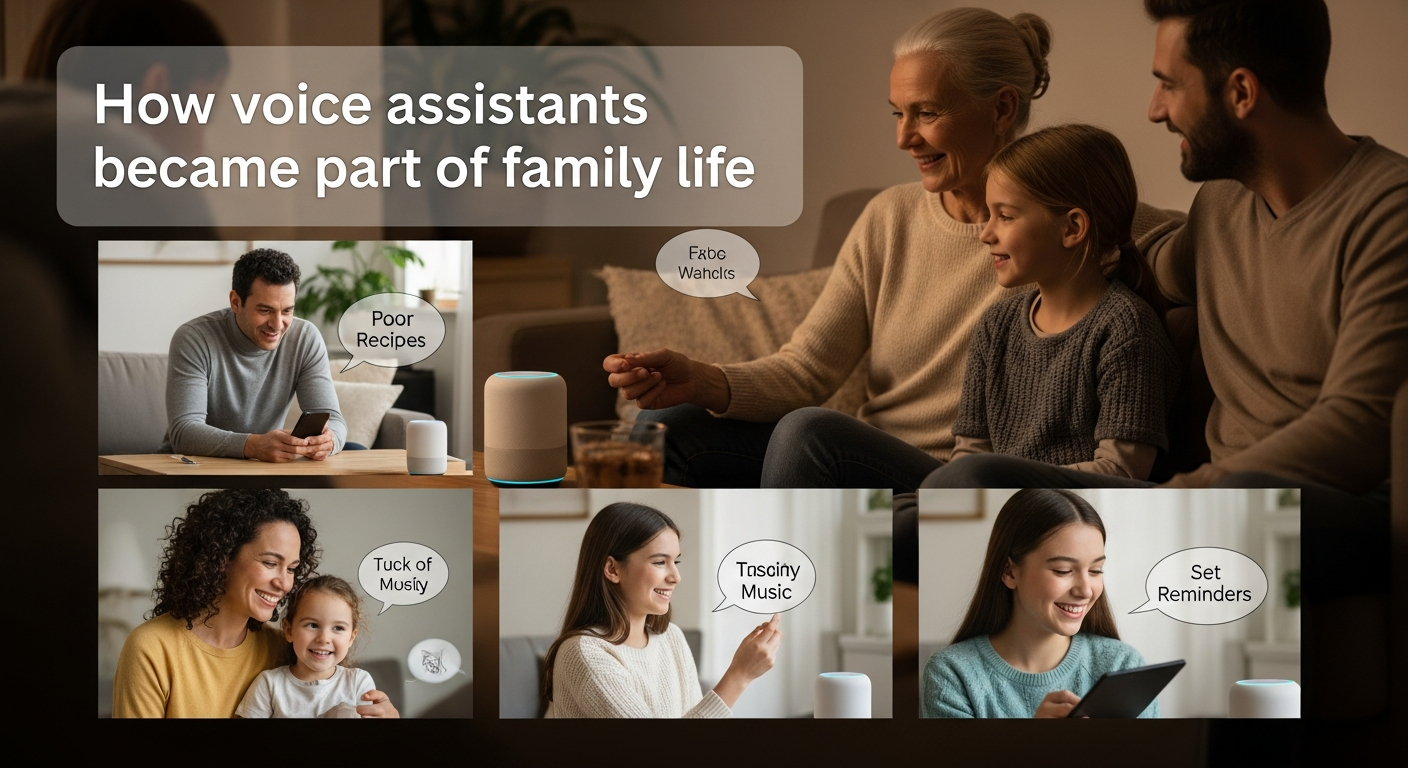
How voice assistants became part of family life
- November 20, 2025
- ~ 1 min read
- 149 views
- Lifestyle & AI , AI Agents
Introduction to Voice Assistants in Family Life
It's hard to imagine a time when voice assistants weren't a part of our daily lives. From setting reminders to playing our favorite music, these virtual helpers have become an integral part of our households. But have you ever stopped to think about how they've become such an essential part of family life? Let's take a step back and explore the journey of voice assistants and their impact on our daily routines.
A Brief History of Voice Assistants
The concept of voice assistants has been around for decades, but it wasn't until the launch of Siri by Apple in 2011 that they started gaining popularity. Since then, other tech giants like Amazon, Google, and Microsoft have joined the fray, introducing their own versions of voice assistants. Today, we have a plethora of options to choose from, including Alexa, Google Assistant, and Cortana, each with its unique features and capabilities.
According to a recent survey, over 50% of households in the United States have at least one voice assistant device, with the number expected to grow to over 75% by 2025. This staggering growth is a testament to the increasing popularity of voice assistants and their ability to make our lives easier.
Current Market Trends and Popularity
The technology trends surrounding voice assistants are constantly evolving, with new features and devices being launched regularly. One of the key drivers of this growth is the growing demand for smart home devices, which often come with integrated voice assistants. In fact, a report by Statista found that the global smart speaker market is expected to reach over 200 million units by 2023, with voice assistants being a key factor in this growth.
Some of the key statistics that highlight the popularity of voice assistants include:
- Over 100 million voice assistant devices were sold in 2020 alone
- 75% of voice assistant users use them to control their smart home devices
- 60% of voice assistant users use them to play music and podcasts
Importance of Understanding Voice Assistants' Role in Family Life
As voice assistants become more ubiquitous, it's essential to understand their impact on family life. From changing the way we interact with each other to influencing our daily routines, voice assistants are having a profound effect on our households. By understanding these changes, we can harness the power of voice assistants to create a more harmonious and efficient home environment.
As we delve deeper into the world of voice assistants, it's crucial to remember that they are not just devices, but an integral part of our daily lives, shaping the way we live, work, and interact with each other.
In the following sections, we'll explore the various aspects of voice assistants and their impact on family life, from their benefits and drawbacks to their potential to shape our future. So, let's get started on this journey to discover the exciting world of voice assistants and their role in shaping our daily lives.
How Voice Assistants Are Changing Family Life
Voice assistants have become an integral part of family life, revolutionizing the way families manage their daily routines, entertainment, and household chores. With their ability to understand and respond to voice commands, these devices have made it easier for families to stay organized, have fun, and enjoy quality time together. In this section, we'll explore the various ways voice assistants are changing family life, from managing daily schedules to assisting with household chores.
Managing Daily Schedules with Ease
Voice assistants have made it incredibly easy for families to manage their daily schedules. With smart home devices, families can set reminders, calendar events, and alarms using simple voice commands. For instance, a family can ask their voice assistant to remind them of an upcoming school event or a doctor's appointment. This feature has been particularly helpful for busy families who need to stay on top of their daily routines. By setting reminders and calendar events, families can ensure that everyone is on the same page and that important tasks are not forgotten.
In addition to setting reminders, voice assistants can also help families manage their daily schedules by providing traffic updates, weather forecasts, and news updates. This information can be particularly useful for families who need to plan their daily commute or outdoor activities. By staying informed, families can make the most of their time and avoid unnecessary delays or disruptions.
Enhancing Entertainment and Leisure Activities
Voice assistants have also had a significant impact on entertainment and leisure activities in family life. With the ability to play music, videos, and podcasts, voice assistants have become an essential part of family entertainment. Families can ask their voice assistant to play their favorite music or podcast, creating a fun and relaxing atmosphere in the home. Moreover, voice assistants can also help families discover new music, movies, and TV shows, making it easier for them to find something that everyone will enjoy.
Some voice assistants also come with features like multi-room audio, which allows families to play music in different rooms of the house. This feature has been particularly popular among families who enjoy hosting parties or gatherings. By playing music in different rooms, families can create a fun and lively atmosphere that their guests will love.
Assisting with Household Chores and Organization
Voice assistants have also made it easier for families to manage their household chores and organization. With the ability to control smart home devices, families can turn on lights, adjust the thermostat, and secure their homes using simple voice commands. This feature has been particularly helpful for families who want to create a safe and comfortable living environment. By controlling their smart home devices, families can ensure that their home is always warm, bright, and secure.
In addition to controlling smart home devices, voice assistants can also help families with household chores like grocery shopping and meal planning. Families can ask their voice assistant to add items to their grocery list or provide recipe suggestions based on the ingredients they have at home. This feature has been particularly helpful for busy families who need to plan their meals in advance. By using their voice assistant to plan their meals, families can save time and reduce food waste.
Overall, voice assistants have become an essential part of family life, making it easier for families to manage their daily routines, entertainment, and household chores. By providing a range of features and functionalities, voice assistants have helped families simplify their lives, reduce stress, and enjoy more quality time together. As family management becomes increasingly important, voice assistants are likely to play an even bigger role in helping families stay organized and connected.
- Set reminders and calendar events using voice commands
- Control smart home devices to create a safe and comfortable living environment
- Use voice assistants to discover new music, movies, and TV shows
- Ask voice assistants for recipe suggestions and meal planning ideas
- Use voice assistants to play music and videos in different rooms of the house
By integrating voice assistants into their daily routines, families can enjoy a more streamlined and organized life, with more time for the things that matter most.
Real-World Examples of Voice Assistants in Action
As voice assistants continue to evolve, they are becoming an integral part of family life, providing assistance and support in various aspects of daily living. From helping with homework and education to assisting individuals with disabilities, voice assistants are making a significant impact on the quality of life for many individuals. In this section, we will explore some real-world examples and case studies that demonstrate the versatility and utility of voice assistants.
Voice Assistants in Education: Enhancing Learning Experience
Voice assistants are being increasingly used in educational settings to enhance the learning experience for students. For instance, they can help students with their homework by providing definitions, calculations, and explanations. They can also assist students with research by providing relevant information and sources. Moreover, voice assistants can help students with disabilities, such as visual or hearing impairments, by providing audio descriptions, text-to-speech functionality, and other assistive technology features. Some examples of voice assistants being used in education include:
- Providing interactive lessons and quizzes to make learning more engaging and fun
- Offering personalized learning plans and recommendations based on individual student needs
- Assisting students with language learning by providing pronunciation guidance and conversation practice
Voice Assistants and Disability Support: Improving Accessibility
Voice assistants are also being used to support individuals with disabilities, providing them with greater independence and accessibility. For example, voice assistants can be used to control smart homes, allowing individuals with mobility impairments to adjust lighting, temperature, and entertainment systems with ease. They can also be used to provide critical support for individuals with cognitive or mental health disabilities, such as reminders, schedules, and emotional support. Some case studies have shown that voice assistants can have a significant impact on the quality of life for individuals with disabilities, providing them with greater autonomy and confidence.
Smart Homes and Voice Assistants: Seamless Integration
The integration of voice assistants with smart homes is another area where we are seeing significant benefits. With voice assistants, homeowners can control various aspects of their home, from lighting and temperature to security and entertainment systems. This seamless integration provides a convenient and intuitive way to manage the home, making it easier to relax and enjoy family time. Some examples of voice assistants being used in smart homes include:
- Controlling lighting and temperature to create a comfortable and cozy atmosphere
- Providing entertainment options, such as music and video streaming, with voice commands
- Enhancing home security with voice-controlled door locks, cameras, and alarm systems
In conclusion, voice assistants are having a significant impact on family life, providing assistance and support in various aspects of daily living. From education and disability support to smart home integration, the case studies and real-world examples demonstrate the versatility and utility of these technologies. As voice assistants continue to evolve, we can expect to see even more innovative applications and benefits in the future.
Advanced Features and Future Developments
The integration of voice assistants into family life has been a remarkable journey, with AI and machine learning algorithms playing a crucial role in their development. These algorithms enable voice assistants to learn and adapt to individual preferences, making them more efficient and effective over time. The technical aspects of voice recognition involve complex processes such as speech-to-text, natural language processing, and intent identification. As voice assistants continue to evolve, we can expect to see significant advancements in these areas, leading to even more seamless interactions between humans and devices.
Technical Aspects of Voice Recognition and AI
At the heart of voice assistants lies voice recognition technology, which uses sophisticated algorithms to identify and interpret spoken words. This process involves several stages, including audio signal processing, feature extraction, and pattern recognition. The use of deep learning techniques, such as convolutional neural networks and recurrent neural networks, has significantly improved the accuracy of voice recognition systems. Additionally, the integration of context-aware capabilities allows voice assistants to understand the nuances of human language, enabling more accurate and relevant responses.
The AI powering voice assistants is also being continually improved, with advancements in areas such as emotion detection and sentiment analysis. This enables voice assistants to better understand the emotional context of user interactions, allowing them to respond in a more empathetic and personalized manner. As AI continues to evolve, we can expect to see even more sophisticated capabilities, such as predictive analytics and proactive suggestions, which will further enhance the user experience.
Security and Privacy Concerns with Voice Assistants
As voice assistants become increasingly integrated into family life, concerns about data privacy and security have grown. The use of voice assistants raises important questions about who has access to user data, how it is stored and protected, and what measures are in place to prevent unauthorized access. Manufacturers have responded to these concerns by implementing robust security measures, such as encryption and secure authentication protocols. However, users must also take steps to protect their own data, such as regularly reviewing and updating their privacy settings and being cautious when using voice assistants in public areas.
Some of the key security and privacy concerns associated with voice assistants include:
- Unauthorized access to user data
- Data breaches and cyber attacks
- Privacy risks associated with third-party skills and integrations
- Potential for voice assistants to be used as a surveillance tool
Future Developments and Potential Advancements
Looking ahead, there are several potential advancements that could shape the future of voice assistants. Some of the most exciting developments include:
- Improved voice recognition accuracy, enabling voice assistants to better understand accents, dialects, and spoken languages
- Enhanced multi-language support, allowing voice assistants to communicate with users in their native language
- Increased integration with smart devices, enabling seamless control and automation of home systems and appliances
- Advancements in emotion detection and sentiment analysis, enabling voice assistants to better understand and respond to user emotions
The future of voice assistants is exciting and full of possibilities. As AI and machine learning continue to evolve, we can expect to see significant advancements in areas such as voice recognition, emotion detection, and proactive suggestions. By prioritizing data privacy and security, manufacturers and users can work together to ensure that voice assistants are a positive and empowering force in family life.
Implementing Voice Assistants in Your Home
As voice assistants become an integral part of family life, it's essential to know how to implement them effectively in your home. With numerous options available, choosing the right voice assistant for your needs can be a daunting task. In this section, we'll guide you through the process of selecting, setting up, and customizing your voice assistant to maximize its benefits.
Choosing the Right Voice Assistant for Your Needs
When selecting a voice assistant, consider the ecosystem you're already invested in. For example, if you're an Apple user, you might prefer Siri or HomePod. If you're an Android user, Google Assistant might be the better choice. It's crucial to think about the devices you already own and how they'll integrate with your new voice assistant. Make a list of the features that matter most to you, such as smart home control, music streaming, or news updates. This will help you narrow down your options and choose the voice assistant that best fits your lifestyle.
Setting Up and Customizing Your Voice Assistant
Once you've chosen your voice assistant, it's time to set it up. Follow the manufacturer's setup guide to get started. This usually involves downloading an app, creating an account, and connecting your device to your Wi-Fi network. After setup, you can begin customization to tailor your voice assistant to your preferences. This might include setting up voice commands, creating routines, or linking your calendar and contacts. Don't be afraid to experiment and try out different features to see what works best for you.
Tips for Maximizing the Benefits of Voice Assistants
To get the most out of your voice assistant, it's essential to use voice commands efficiently. Start by learning the basic commands, such as "what's the weather like today?" or "play some music." You can also explore third-party skills to expand your voice assistant's capabilities. For example, you can use skills to order food, book a ride, or control your smart home devices. Here are some additional tips to keep in mind:
- Be patient and don't get discouraged if you encounter any issues during setup or use.
- Use your voice assistant regularly to get accustomed to its features and capabilities.
- Explore the different features and skills available to find what works best for you and your family.
- Consider setting up a central hub or control center to manage all your smart devices and voice assistant.
By following these tips and being open to learning and experimentation, you can unlock the full potential of your voice assistant and make it an integral part of your family life.
Remember, the key to getting the most out of your voice assistant is to take the time to learn its features and capabilities. With practice and patience, you'll be using your voice assistant like a pro in no time. In the next section, we'll explore the impact of voice assistants on family life and how they're changing the way we interact with each other and our surroundings.
Comparing Voice Assistants: Which One is Right for You?
The market for voice assistants has become increasingly crowded, with major players like Amazon's Alexa, Google Assistant, and Apple's Siri vying for dominance. Each platform has its unique features, strengths, and weaknesses, making the choice of which one to use a daunting task for many consumers. In this section, we'll delve into a comprehensive comparison of these leading voice assistants, exploring their ecosystems, pros, and cons to help you make an informed decision.
Overview of Leading Voice Assistants
Alexa, Google Assistant, and Siri are the most widely used voice assistants today, each integrated into a broader ecosystem of devices and services. Alexa is deeply embedded in Amazon's smart home devices and shopping platform, while Google Assistant leverages Google's vast knowledge graph and integration with Android devices. Siri, on the other hand, is exclusive to Apple devices, offering a seamless experience across iPhones, iPads, and Macs. When considering which voice assistant to use, it's essential to think about the devices and services you already use and how they might integrate with your chosen assistant.
Pros and Cons of Each Platform
Each voice assistant has its advantages and disadvantages. Alexa, for example, excels in smart home control, with a wide range of compatible devices. However, its capabilities in answering general knowledge questions are not as robust as Google Assistant's. Google Assistant, on the other hand, offers superior search capabilities and multi-language support but may not be as polished in smart home automation as Alexa. Siri, while highly integrated with Apple devices, sometimes lags behind in terms of third-party app support and cross-platform compatibility. The choice between these voice assistants ultimately depends on your specific needs and preferences.
- Alexa: Strong in smart home control, wide device compatibility, but weaker in general knowledge queries.
- Google Assistant: Excellent in search and multi-language support, good smart home capabilities, but may require more setup for full functionality.
- Siri: Highly integrated with Apple devices, easy to use, but limited in smart home control and third-party app support compared to others.
Considerations for Choosing the Best Voice Assistant
When deciding which voice assistant is right for you, consider your current device ecosystem and the types of tasks you want to perform. If you're deeply invested in the Apple universe, Siri might be the most convenient choice. For those looking for robust smart home control, Alexa could be the way to go. Meanwhile, users who value search functionality and cross-platform compatibility might find Google Assistant to be the best fit.
Ultimately, the best voice assistant is one that seamlessly integrates into your daily life, making tasks easier and more convenient.By weighing the pros and cons of each platform and considering your specific needs, you can choose a voice assistant that enhances your family life and becomes an indispensable part of your daily routine.
In conclusion, the voice assistant comparison isn't just about Alexa vs. Google Assistant vs. Siri; it's about finding the right tool that fits your lifestyle and preferences. Whether you're looking for smart home automation, information on demand, or a seamless experience across your devices, there's a voice assistant out there for you. By doing your research and considering the unique features and ecosystems of each, you can make an informed decision that will bring convenience, entertainment, and connection to your family life.
Conclusion: The Future of Voice Assistants in Family Life
Summary of Key Points
In this article, we have explored the significant role that voice assistants have come to play in modern family life. From managing daily routines to providing entertainment and educational content, these devices have become an integral part of our homes. We have discussed how family technology has evolved over the years, with voice assistants being at the forefront of this evolution. The impact of voice assistants on family life has been profound, making it easier for families to stay connected, organized, and informed.
Final Thoughts on the Impact of Voice Assistants
As we look to the future, it is clear that voice assistant evolution will continue to shape the way we live and interact with each other. The potential benefits of voice assistants are vast, from improving home care for the elderly to enhancing the overall quality of life for families. However, it is also important to consider the ethical implications of relying on these devices, such as issues related to privacy and data security. As we move forward, it is essential that we prioritize responsible innovation and ensure that voice assistants are designed with the needs and well-being of families in mind.
Future Predictions and Potential Developments
So, what can we expect from the future of voice assistants in family life? Some potential developments include the integration of voice assistants with other family technology, such as smart home devices and wearables. We may also see the emergence of more advanced voice assistant evolution, such as devices that can learn and adapt to our habits and preferences over time. The possibilities are endless, and it will be exciting to see how voice assistants continue to evolve and improve in the years to come. As we look to the future, we encourage readers to embrace these technologies and explore their full potential. By doing so, we can unlock new opportunities for connection, convenience, and care, and create a brighter future for families around the world.
As you consider the role of voice assistants in your own family life, we encourage you to think critically about the potential benefits and challenges that these devices present. By staying informed and engaged, you can help shape the future of voice assistants and ensure that they continue to serve the needs of families for years to come.
The future of voice assistants is exciting and full of possibilities, and we are eager to see how they will continue to evolve and improve in the years to come.



Comments (0)
Please login or register to leave a comment.
No comments yet. Be the first to comment!