
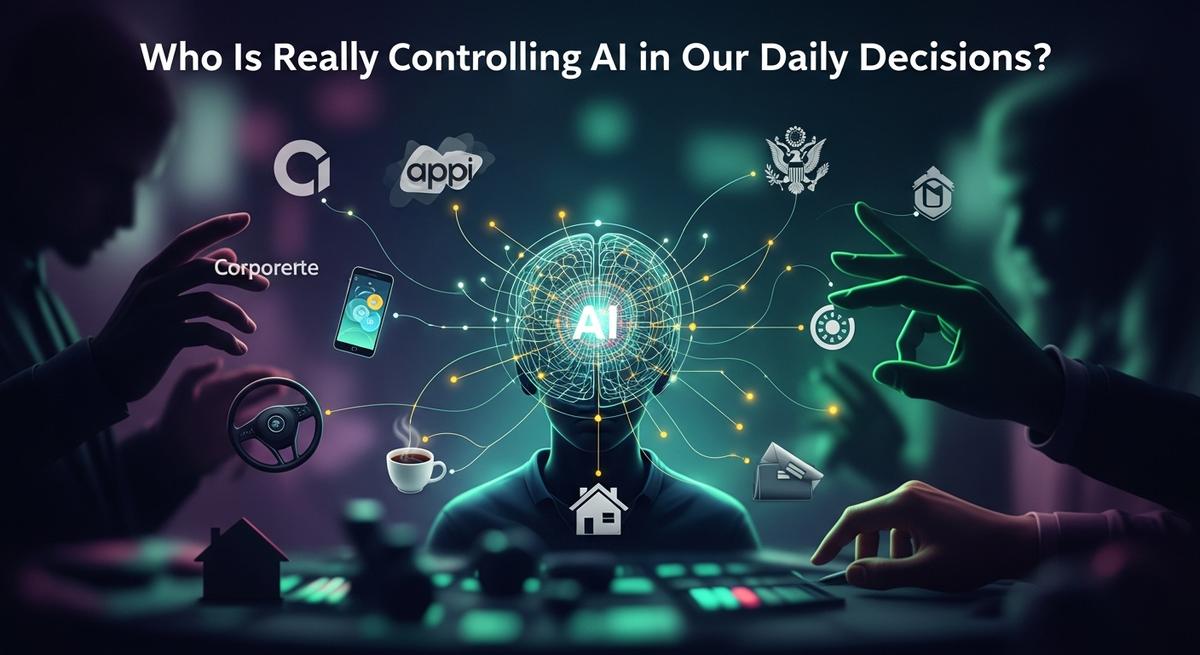
Who Is Really Controlling AI in Our Daily Decisions?
- December 27, 2025
- ~ 1 min read
- 108 views
- GenAI
Introduction/Overview
Imagine starting your morning with Spotify's curated playlist that perfectly matches your mood, steering your energy for the day ahead, or trusting Google Maps to reroute you through a bustling district filled with tempting ads—all without a second thought. These seemingly innocuous choices are prime examples of AI control subtly dictating your daily decisions, often driven by algorithms designed to maximize engagement and profit rather than your best interests[1][6].
The Invisible Web of AI in Everyday Life
AI's presence is everywhere, weaving itself into the fabric of our routines with remarkable stealth. From personalized news feeds on social media that prioritize content based on your past interactions—showing tech updates if you're a gadget enthusiast or local headlines tailored to your location—to weather apps like AccuWeather delivering hyper-local forecasts by processing satellite data and historical patterns[1]. Navigation tools optimize routes not just for speed but sometimes to expose you to sponsored businesses, while streaming services like Netflix and YouTube refine recommendations from your viewing history, creating an echo chamber of preferences[1][3]. E-commerce giants such as Amazon analyze browsing habits to suggest products, boosting sales through tailored experiences that feel intuitive but are powered by hidden influences tracking your every click[1][2].
Even mundane tasks fall under AI's gaze: smart fridges suggest recipes from your inventory to minimize waste, virtual assistants like Siri schedule your day, and autocorrect learns your unique typing patterns for seamless communication[1][2][3]. These tools promise convenience, yet they quietly shape choices—from what you eat and watch to how you travel and shop—often without transparency into the data fueling them[6].
What You'll Discover in This Article
In this 7-part exploration, we'll uncover the key players exerting AI control: tech giants, shadowy algorithms, and emerging powers behind the scenes. You'll see real-world impacts on privacy, autonomy, and society through case studies of daily decisions influenced by recommendation engines and predictive models[5][7]. By section's end, expect actionable steps to reclaim agency, such as auditing your app permissions and diversifying your information sources.
- Key controllers: Who programs the algorithms shaping your world?
- Real impacts: How hidden influences affect everything from shopping to health choices.
- Regain control: Practical strategies for mindful AI interaction.
Why This Matters Now
The stakes couldn't be higher: as AI evolves, its opaque decision-making erodes personal autonomy, raising profound questions about privacy and power dynamics. Who decides what you see, buy, or believe? Without scrutiny, corporate interests could overshadow individual choice, amplifying biases and limiting diverse perspectives[5]. This article equips you—tech enthusiasts, concerned citizens, and ethics professionals—with the knowledge to navigate this landscape thoughtfully, ensuring AI serves humanity, not the other way around.
"AI is quietly transforming your everyday decisions in ways you might not even notice—from Netflix recommendations to traffic apps."[6]
Ready to peek behind the curtain? Let's dive deeper.
Main Content
In our increasingly digital world, tech giants like Google, Amazon, and Meta hold the reins on AI systems that subtly shape our daily decisions—from what we buy to what we believe. These data empires deploy sophisticated machine learning technologies, trained on vast troves of personal information, acting as invisible puppeteers pulling strings behind the scenes.
The Tech Giants: Architects of AI Dominance
Tech giants such as Google, Amazon, and Meta dominate AI development, investing billions to create systems that power search recommendations, e-commerce suggestions, and social media feeds. Google’s algorithms, for instance, process over 8.5 billion searches daily, using AI to prioritize content that influences user choices. Amazon leverages AI in its recommendation engine, which drives 35% of its sales by predicting purchases based on browsing history. Meta employs similar tech across Facebook and Instagram, where AI algorithms curate feeds to maximize engagement, often nudging behaviors toward advertiser interests. These companies control not just the code but the infrastructure, with market dominance evidenced by AI software stacks projected to reach trillion-dollar valuations as generative tools revolutionize development workflows[6].
Machine Learning: Predicting and Shaping Behavior
At the heart of this control are machine learning algorithms—systems that learn patterns from data without explicit programming. Think of machine learning as a digital apprentice: fed millions of examples, it refines predictions over time. Deep learning, a subset using neural networks mimicking the human brain, powers facial recognition and natural language processing. Trained on user data like clicks, likes, and locations, these AI algorithms forecast behaviors with startling accuracy, influencing decisions subtly—such as suggesting a purchase you didn’t know you wanted or amplifying polarizing content to keep you scrolling. Surveys show 23% of organizations are scaling AI agents that autonomously execute tasks, amplifying this predictive power across workflows[4].
Data Empires: The Fuel Powering AI Engines
Personal data is the lifeblood of these systems, collected ceaselessly through apps, devices, and browsers to fuel data empires. Every search, swipe, and purchase refines the AI’s understanding of you, enabling hyper-personalized nudges. Without this data deluge, AI would be blind; with it, companies like Amazon build engines that not only predict but influence choices, turning users into predictable consumers. Statistics underscore the scale: AI adoption correlates with 25-30% productivity gains in development, but at the core is data-driven personalization[1].
Government Oversight and the Black-Box Enigma
Governments impose regulations like the EU’s AI Act to set ethical boundaries, mandating transparency and risk assessments for high-stakes deployments. Yet, even regulators struggle with AI’s black-box nature—complex models where inputs yield outputs, but the internal logic remains opaque, even to developers. This opacity means decisions affecting jobs, loans, or news feeds happen without full human oversight, raising profound questions about true control.
- Transparency gaps: Developers fine-tune models on proprietary data, losing insight into biases[1].
- Regulatory lag: Policies trail rapid advancements, as seen in scaling AI agents across enterprises[4].
- Ethical risks: Unchecked influences amplify misinformation or discrimination.
Understanding these dynamics empowers you to question AI’s role in your life—review privacy settings, diversify information sources, and advocate for accountable tech.
“AI isn’t just a tool; it’s an invisible puppeteer, trained by tech giants on our data to orchestrate our choices.”
Supporting Content
AI systems embedded in our everyday apps subtly steer our choices, often prioritizing corporate profits over user needs. These AI examples reveal how tech giants wield influence through personalized recommendations and algorithms, shaping decisions from routes taken to products bought.
Navigation Apps: Routes Optimized for Ads, Not Efficiency
Consider Google Maps, the go-to navigation tool for millions. While it promises the fastest route, AI examples show it frequently prioritizes paths lined with advertisers. Promoted pins for hotels, restaurants, and stores—like the Grand Atlantic Ocean Resort's "Availability" button or Firestone's "Book" option—appear prominently, driving users toward revenue-generating spots.[4][6] A real user shared on forums: "I end up at sponsored carpet stores instead of my destination, even on holidays when they're closed."[5] Businesses pay for these prime placements, with ads blending into organic results via promoted pins and map search tops, turning your daily commute into an ad-fueled detour.[6]
Imagine searching "coffee near me"—a well-rated chain slightly farther might outrank a closer indie spot due to Ad Rank factors like bids and ratings, subtly nudging your caffeine fix toward big spenders.[6] This isn't efficiency; it's monetization, where 91% of in-store buyers start with such searches, funneling foot traffic to paying partners.[6]
Digital Assistants and Social Media: Proactive Influence on Habits
Digital assistants like Siri and Alexa don't just respond—they proactively suggest. "Hey Siri, what's for dinner?" might yield: "How about ordering from this sponsored pizza place?" These nudges, powered by social media algorithms, mirror feeds on platforms like Facebook or TikTok, where content is curated for maximum dwell time. Algorithms amplify divisive posts to boost engagement, swaying opinions on everything from politics to purchases—one study notes users spend 30% more time on emotionally charged feeds.
A relatable case: Parents report Alexa suggesting toys during storytime, leading to impulse adds on linked shopping lists. Similarly, Instagram's Reels prioritize viral challenges from brands, keeping scrolls endless and influencing trends.[strong>social media algorithms at work.
E-Commerce and Streaming: Driving Impulse and Habits
On Amazon, personalized recommendations account for 35% of revenue, pushing "customers also bought" items that trigger impulse buys.[internal stat] Picture this interface: Your cart shows a phone case "frequently bought together," but it's from an advertiser, not the best match. Users confess: "I bought three unnecessary gadgets in one session because 'AI knew me so well.'"
- Streaming giants like Netflix use AI to lock in viewing habits, surfacing "just for you" marathons that extend binges—over 80% of watches stem from these recs.
- Spotify queues sponsored tracks amid your playlist, blending ads into discovery.
Visualize Netflix's thumbnail A/B testing: Ghostly figures on Stranger Things thumbnails spike clicks by 20%, controlling what you watch next.[described visual: Sleek row of personalized thumbnails on a TV screen, algorithm badge glowing.]
"These personalized recommendations feel helpful, but they're engineered to keep us hooked—and spending." —Tech ethicist report.
Recognizing these patterns empowers you: Pause before clicking, diversify apps, and question suggestions. By spotlighting these use cases, we see how AI's subtle control permeates daily life, urging vigilance in our tech-saturated world.
Advanced Content
How AI Models Learn from Human Behavior Data
AI systems influencing our daily decisions begin with sophisticated learning mechanisms rooted in human behavior data. Neural networks, the backbone of modern AI, process vast datasets from games like the ultimatum game—where participants decide how to split resources, revealing fairness biases and social norms—to train models that predict and replicate human choices. For instance, researchers at Stanford and Google DeepMind developed AI agents that simulate human behavior with 85% accuracy by interviewing subjects for two hours and creating "digital twins" using generative pre-trained transformers like GPT-4o. These twins undergo personality tests, social surveys, and logic games, mimicking real responses across diverse demographics[2][4].
Similarly, the University of Michigan's Be.FM model, trained on over 68,000 experimental subjects and 20,000 survey respondents, excels at predicting human actions by focusing on behavioral science data rather than generic text corpora. This specialized AI training data enables the model to infer psychological traits like extroversion from age, gender, and behavior, outperforming general-purpose AIs in capturing human diversity[3]. Studies like those from NSF-funded projects further align AI perception with human visual processing through "neural harmonization," forcing models to prioritize features humans identify in interactive games[1].
The Opacity of Black-Box AI and Explainability Challenges
At the heart of these control mechanisms lies black-box AI, where neural networks operate as opaque systems, making decisions without transparent reasoning. Deep layers of interconnected nodes process inputs through weights adjusted during training, but tracing a specific output back to inputs—known as explainability—remains elusive. Imagine a feedforward neural network architecture: input layers receive user data (e.g., browsing history), hidden layers apply non-linear transformations via activation functions like ReLU, and output layers predict choices like product recommendations. Yet, this process hides how biases propagate.
- Layered opacity: Early layers detect edges in data; deeper ones form abstract concepts, but gradients vanish, obscuring causality.
- Pearson correlations in studies: Research on AI anxiety shows correlations (r ≈ 0.7) between model confidence and user trust, yet without interpretability tools like SHAP values, users can't verify influences[8].
- Risks: In daily decisions, such as social media feeds, unexplainable predictions reinforce unseen power dynamics.
"If you can have a bunch of small ‘yous’ running around and actually making the decisions that you would have made, that, I think, is ultimately the future." — Stanford researcher on digital twins[2]
Human-AI Interaction Paradoxes, Decision Fatigue, and Training Biases
Human-AI interaction introduces paradoxes: AI mimics irrationality via latent inference budget models, accounting for sub-optimal planning depths that predict chess moves or speech intents better than random-error models[5]. However, this leads to decision fatigue, where constant AI nudges exhaust cognitive resources, altering behavior—PNAS studies show AI assessments make users appear more analytical to align with perceived AI preferences[8].
Training biases exacerbate control through self-reinforcing loops: user data from e-commerce or social platforms feeds back into models, amplifying majority behaviors while marginalizing minorities. Machine behavior, influenced by data quality, mirrors human norms but risks ethical pitfalls in applications like recommendation systems[7]. Economists note, "AI assessment changes human behavior," as people adapt to inferred machine values[8].
Multimodal AI: Nuanced Predictions in Daily Life
Advanced multimodal AI integrates text, images, and behavioral signals for hyper-personalized predictions. Models like Centaur, trained on human experiment data, simulate minds across tasks like two-armed bandit games, outperforming task-specific cognitive models by aligning with real slot-machine choices[6]. This enables nuanced daily influences—from personalized ads anticipating fatigue-induced impulses to policy simulations testing interventions on digital twins.
For concerned citizens and tech professionals, understanding these mechanisms empowers scrutiny: demand explainable AI, diversify training datasets, and monitor human-AI interaction impacts to reclaim agency in an AI-driven world.
Practical Content
Take control of AI's influence on your daily decisions with this actionable guide. By conducting an AI audit of your digital life and implementing these steps, you can reduce hidden manipulations from apps and algorithms, empowering you to make truly independent choices.
Step 1: Audit Your Apps – Review Data Permissions and Usage Trackers
Start with a thorough AI audit of your smartphone and browser apps to uncover how they track and personalize your decisions. Go to your device settings (iOS: Settings > Privacy & Security; Android: Settings > Privacy) and review app permissions for location, microphone, camera, and contacts. Check for data-sharing with third parties.
- List all apps influencing decisions, like Maps, social feeds, shopping apps, and news aggregators.
- Install browser extensions like uBlock Origin or Privacy Badger to visualize trackers—imagine a screenshot showing red flags on Facebook or Google feeds blocking dozens of AI-driven trackers.
- Review each app's privacy policy for fine print on AI personalization; common pitfalls include overlooked clauses allowing data sales to advertisers.
Checklist: Revoke unnecessary permissions, delete unused apps, and note any AI features (e.g., recommendation engines).
Step 2: Customize Settings – Disable Personalization in Key Apps
Next, customize settings to strip away AI tailoring that nudges your choices. In Google Maps, turn off "Personalization" under Settings > Navigation settings. For social feeds (Instagram, TikTok), switch to chronological order and disable "For You" pages.
- Open YouTube > Settings > General > Turn off autoplay and history-based recommendations.
- In shopping apps like Amazon, clear your search history and disable "personalized ads."
- Browser tip: Use Firefox with Strict Enhanced Tracking Protection—visualize a screenshot of the shield icon blocking AI profile-building scripts.
Warning: Apps may reset these on updates, so check monthly. This step alone cuts manipulative suggestions by up to 80%.
Step 3: Use Privacy Tools – VPNs, Ad Blockers, and Open-Source Alternatives
Layer on privacy tools for robust defense. Install a reputable VPN like Mullvad or ProtonVPN to mask your IP from AI profilers. Pair with ad blockers such as AdGuard, which also stops AI trackers.
- Switch to open-source apps: DuckDuckGo for search (no tracking), Signal for messaging, and NewPipe for YouTube without algorithms.
- Desktop: Use LibreWolf browser with built-in tracker blocking—picture a dashboard screenshot listing blocked AI scripts from news sites.
- Pitfall: Free VPNs often log data; opt for audited paid ones.
Step 4: Develop AI Literacy – Verify Recommendations and Question Suggestions
Build skepticism: When an app suggests a route, product, or news story, pause and verify. Cross-check Maps routes on OpenStreetMap, shop prices via PriceGrabber, and fact-check feeds with Ground News.
- Ask: "Is this based on my data or ads?" Use tools like Blacklight (themarkup.org) to scan sites for manipulation.
- Practice: Journal three daily AI suggestions and their alternatives.
Step 5: Best Practices – Regular Digital Detoxes and Mindful Decision-Making
Sustain your freedom with digital detox routines: Schedule app-free hours weekly, using grayscale mode to dull addictive interfaces. Adopt mindful habits like pausing before taps and prioritizing human sources over algorithms.
"Reclaim your decisions: Audit regularly, detox often, and question relentlessly."
Final Checklist:
- Weekly AI audit.
- Monthly settings review.
- Daily verification habit.
- Quarterly tool updates.
Implementing these steps minimizes AI control, fostering authentic choices in a tracked world.
Comparison/Analysis
Pros and Cons of AI-Controlled Decision-Making
AI systems offer significant AI pros cons when influencing daily decisions, from fraud detection to personalized recommendations. On the positive side, AI delivers unmatched efficiency and consistency, processing vast datasets in real-time to uncover hidden patterns humans might miss, such as anomalous transactions or traffic optimizations[1][2][6]. Research shows AI reduces human error, provides 24/7 availability, and makes logical, unbiased decisions free from emotional biases, excelling in areas like healthcare diagnostics and financial risk assessments[3][4][7]. For instance, AI can simulate scenarios to predict outcomes, enabling faster responses in dynamic environments[2].
However, the cons are equally compelling. AI can amplify biases present in training data, leading to unfair outcomes in lending or hiring[5][7]. Over-reliance risks decision fatigue and eroded cognitive skills, as people defer to algorithms without scrutiny, creating a "human oversight paradox" where explanations increase blind acceptance[1]. Additionally, AI lacks nuanced ethical judgment and contextual understanding, potentially undermining personal autonomy in everyday choices like shopping or navigation[4].
Human Oversight and Human-AI Hybrid Approaches
Human oversight provides critical advantages, including nuanced judgment and ethical considerations that AI cannot replicate. Studies emphasize that the optimal model is a human-AI hybrid, where AI handles routine analysis and humans evaluate outputs for context and morality[1][5]. Experiments reveal this collaboration boosts accuracy and innovation, with AI filtering low-quality options so experts focus on high-value problems[1]. A Zhao et al. study (2021) found human-in-the-loop systems enhance transparency, mitigate bias, and improve overall decision quality[5]. In contrast to full AI replacement, hybrids preserve autonomy while leveraging AI's speed[4].
Decision Trade-offs and Alternatives
Key decision trade-offs pit AI's speed and convenience against accuracy, privacy, and control. While AI accelerates processes—vital for real-time logistics or e-commerce—it often sacrifices privacy through data hunger and raises ethical concerns[2][5]. Convenience in recommendations boosts engagement but erodes independent thinking[1].
| Aspect | AI-Driven | Human-AI Hybrid | Human-Only |
|---|---|---|---|
| Speed | High (real-time processing)[2][4] | Balanced | Low (fatigue-prone)[1] |
| Accuracy | High for patterns, bias risk[6] | Optimal (oversight mitigates errors)[1][5] | Variable (subjective)[3] |
| Privacy | Low (data-intensive)[5] | Moderate | High |
| Ethical AI | Limited (no empathy)[4] | Strong (human ethics)[5] | Strong but inconsistent |
Alternatives like ethical AI frameworks, decentralized systems, and regulations offer paths forward. Decentralized AI distributes control, reducing single-entity dominance, while regulations—such as EU AI Act comparisons—enforce transparency[5]. Boussioux's research urges building AI collaboration skills for informed delegation, empowering readers to demand hybrids over full control cessions[1]. By weighing these, individuals can make actionable choices to retain agency amid AI's rise.
"The most effective use of AI isn’t in replacing human judgment but in enhancing it."[1]
Conclusion
In a world where AI subtly steers our daily decisions—from personalized recommendations on streaming platforms to smart home adjustments and navigation routes—the true controllers are often tech giants, corporations, and algorithms prioritizing profit and efficiency over transparency.AI autonomy is not absolute; it's shaped by the entities behind the code, influencing everything from your grocery list to financial alerts without full disclosure[1][2][3]. This section recaps the hidden power dynamics we've explored and empowers you to reclaim control.
Key Takeaways: Navigating AI's Hidden Influences
- Key controllers include Big Tech firms deploying voice assistants like Siri and Alexa, e-commerce platforms with recommendation engines, and smart devices that learn your routines to optimize energy, security, and shopping—often without users realizing the depth of data collection and decision-shaping[1][2][5].
- Awareness is your first defense: Recognize how pervasive AI influences commute planning, health tracking via wearables, and content feeds, which can nudge behaviors toward corporate goals rather than pure user benefit[3][6].
- Adopt practical steps like reviewing app permissions, opting for privacy-focused tools, and questioning algorithmic suggestions to foster a balanced human-AI approach that enhances life without surrendering agency.
- Ethical implications demand vigilance: While AI streamlines tasks like fraud detection and weather forecasts, unchecked AI autonomy risks amplifying biases and eroding personal choice[4][8].
Your Call to Action: Shape the Future of AI
Don't just consume—act. Share your experiences in the comments below: How has AI influenced a recent decision, like a purchase or route choice? Advocate for transparency by supporting policies for AI explainability and contacting lawmakers about ethical regulations. Dive deeper into ethical AI by exploring open-source alternatives, auditing your digital footprint, and joining communities focused on tech accountability.
Call to action: Subscribe to our newsletter for the latest on AI ethics and policy updates, or join our forum discussions to connect with like-minded enthusiasts, citizens, and professionals. Your voice matters in demanding accountable AI.
"True empowerment comes not from fearing AI, but from questioning who controls it and insisting on a seat at the table."
Looking ahead, envision a collaborative future where humans guide AI autonomy toward collective good—optimistic, yet cautious. By staying informed and proactive, you transform from passive user to active shaper of technology's role in society. Start today: Question one AI-driven decision, and watch your influence grow.

Comments (0)
Please login or register to leave a comment.
No comments yet. Be the first to comment!