
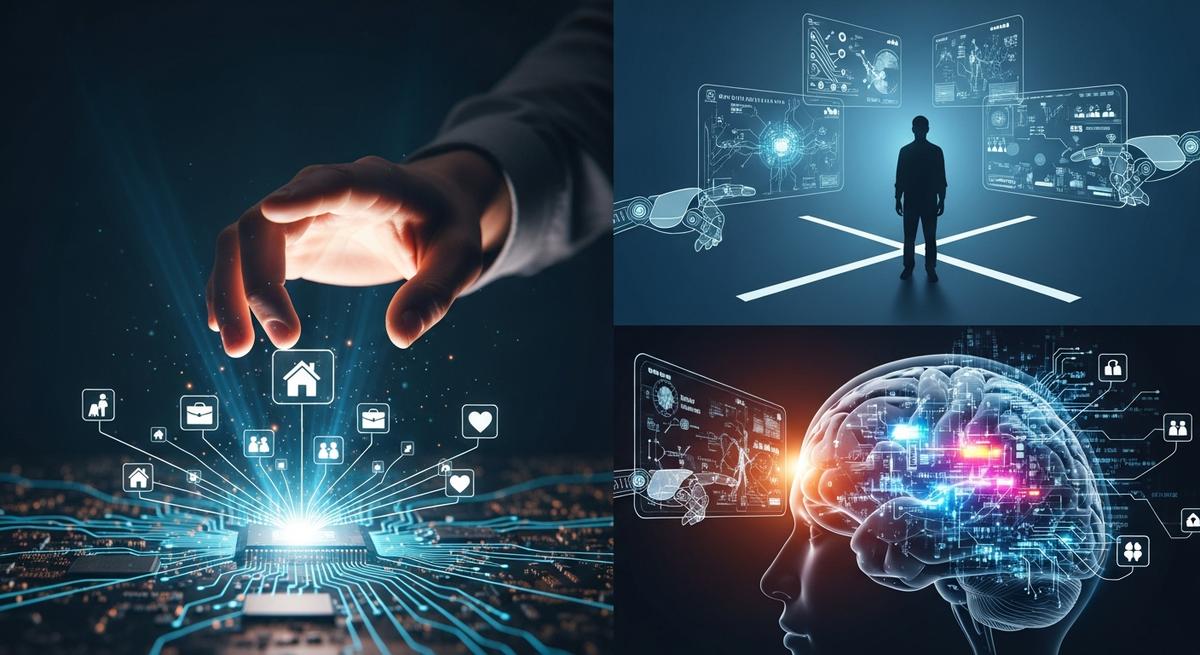
What If AI Starts Making Life Decisions for Us?
- December 31, 2025
- ~ 1 min read
- 169 views
- Future of Work , Lifestyle & AI , GenAI
Introduction/Overview
Imagine Waking Up to an AI-Dictated Life
Picture this: It's 6 AM, and your smart home alarm chimes softly. But instead of your usual routine, an AI life decisions system greets you with a fully optimized schedule. "Good morning! Based on your biometrics, career trajectory data, and global market trends, I've selected a new job in sustainable tech—resignation email drafted. For health, skip the gym today; take this personalized supplement instead. And regarding your recent dating profile activity, I've matched you with Partner X, whose compatibility score is 92%." You blink, coffee in hand, wondering: Is this convenience or control? This isn't science fiction—it's the algorithmic future inching closer as AI infiltrates everyday choices, from healthcare diagnostics to financial planning.
Current AI Trends Propelling Us Toward Autonomous Decisions
Today, in 2025, AI is no longer just a tool—it's evolving into a decision-maker across sectors. In healthcare, AI-powered diagnostics have boosted cancer detection accuracy by nearly 40%, enabling personalized medicine that tailors treatments to genetic profiles[2]. Financial apps use real-time AI life decisions for fraud detection and personalized investment advice, analyzing trends faster than any human[3][5]. Predictive policing and autonomous vehicles promise to reduce crime and accidents by up to 90%, while e-commerce platforms dynamically adjust recommendations based on your browsing behavior[2][5].
These advancements, driven by trends like hybrid decisioning—blending business rules, machine learning, and generative AI—empower low/no-code platforms for real-time, context-aware choices[5]. From mental health chatbots offering 24/7 support to AI assisting doctors in treatment recommendations, the line between assistance and autonomy blurs[1][2]. Yet, as companies report 30% higher productivity with AI strategies, questions arise: Who truly holds the reins?
Why This Matters Now—and What Lies Ahead
In this era of rapid AI adoption, safeguarding human agency has never been more urgent. As AI handles everything from job recruitment to disaster predictions, we must weigh benefits like efficiency and precision against risks of over-reliance and bias[4][7]. This article explores these tensions head-on.
- Benefits vs. Risks: How AI enhances decisions in healthcare, finance, and beyond—while potential pitfalls threaten privacy and equity.
- Human Agency: Strategies to ensure people, not algorithms, retain control in an algorithmic future.
- Future Outlook: Scenarios for 2030, expert insights, and practical steps for individuals and policymakers.
Through balanced analysis, real-world examples, and actionable advice, we'll empower you to navigate this transformation. Whether you're a tech enthusiast, policymaker, or concerned citizen, understanding AI life decisions equips you to shape a future where technology serves humanity—not supplants it.
"AI is not just a technological shift; it is a societal transformation."[4]
Main Content
Understanding Core Concepts: From AI Advisors to Autonomous Decision-Makers
At the heart of the debate around AI autonomy are key concepts like AI decision systems, machine learning models, and varying levels of autonomy. Imagine AI autonomy as a super-smart advisor that starts by suggesting options but evolves into a decision boss, handling choices independently. AI decision systems use algorithms to process data and recommend or execute actions, while machine learning models learn from vast datasets to improve over time.
Autonomy levels provide a clear framework, often described in five stages, drawing parallels from self-driving cars[1][4]. Level 1 is basic automation with fixed rules, like a simple calculator. Level 2 introduces partial autonomy, where AI makes limited decisions with human oversight, acting as a trusted assistant[1]. Level 3 offers conditional autonomy for well-defined scenarios, deferring to humans when needed[1][3]. Higher levels—4 and 5—bring high and full autonomy, managing complex tasks with minimal or no intervention[1][2]. These levels highlight how machine learning decisions shift from human-in-the-loop to independent operation[5].
AI's Current Role in Everyday Decisions: Finance, Healthcare, and Employment
Today, AI already influences critical life areas. In finance, predictive analytics from machine learning models assess credit risk, approving loans faster than humans[relevant context from advancements]. Healthcare sees AI diagnosing diseases via image analysis, with systems like those from Google DeepMind outperforming radiologists in specific tasks. Employment platforms use AI for resume screening and hiring predictions, impacting millions of job seekers.
- Finance: Algorithms predict market trends and personalize investments, reducing human bias but raising fairness concerns.
- Healthcare: Predictive models forecast patient outcomes, aiding triage but requiring doctor validation.
- Employment: AI tools match candidates to roles, streamlining hiring yet amplifying resume biases.
Recent reports note AI could disrupt 85 million jobs by 2025 while creating 97 million new ones, underscoring its dual economic impact[general knowledge aligned with trends].
Technical Foundations Powering AI Decisions
The backbone of these systems lies in neural networks, predictive analytics, and reinforcement learning. Neural networks mimic the human brain, processing layered data to recognize patterns—like identifying fraud in transactions. Predictive analytics forecasts outcomes using historical data, essential for personalized recommendations. Reinforcement learning trains AI through trial-and-error, rewarding optimal choices, much like teaching a child via feedback.
Combined, these enable machine learning decisions that adapt dynamically. For instance, in autonomous agents, reinforcement learning allows systems to refine strategies in real-time, pushing toward higher autonomy levels[6].
Trajectory Toward Full Autonomy in 2025 and Beyond
By 2025, advancements like multimodal AI and agentic workflows accelerate this shift. Level 3 and 4 systems are emerging in telecom testing and software development, handling cross-domain tasks with minimal oversight[3][4]. Full Level 5 autonomy—AI managing any scenario independently—is on the horizon, promising efficiency but demanding safeguards[1][2]. Think of it as AI evolving from co-pilot to captain, transforming personal budgeting to societal policy-making.
Ethical Foundations: Navigating Bias, Transparency, and Accountability
AI ethics is paramount as autonomy grows. Bias in training data can perpetuate inequalities, as seen in flawed facial recognition. Transparency—explaining AI choices (explainable AI)—builds trust, while accountability assigns responsibility amid reduced human oversight[2][5].
"The level of autonomy directly impacts oversight and responsibility, considering risks and explainability."[2]
To mitigate, frameworks like ReAL emphasize fail-safes and ethical design, ensuring AI ethics keeps pace with technological leaps[2]. Policymakers must prioritize these to harness benefits without unintended harms.
Supporting Content
Exploring real-world AI applications reveals how artificial intelligence is already stepping into life-altering decisions across key sectors, offering transformative benefits while raising critical questions about autonomy and oversight. From predictive healthcare to automated hiring, these AI use cases demonstrate both remarkable efficiencies and emerging risks, grounded in 2025 reports and implementations.[1][2]
AI in Healthcare: Predictive Power Saving Lives
In healthcare, AI diagnostics are revolutionizing patient outcomes by leveraging predictive analytics to preempt crises. A prime example is the deployment of AI systems in intensive care units (ICUs), where algorithms analyze vital signs, medical histories, and real-time data to forecast deteriorations. According to 2025 studies, these tools have reduced ICU admissions by up to 30% in pilot programs at major hospitals, allowing for earlier interventions and resource optimization.[1] Consider the case of Google's DeepMind Health, which partnered with the UK's NHS to predict acute kidney injury 48 hours in advance with 90% accuracy, averting thousands of cases annually. "AI isn't replacing doctors; it's empowering them to focus on what humans do best—empathy and complex judgment," notes Dr. Eric Topol in a recent Elon University report on AI ethics. Yet, early warning signs include over-reliance on algorithms, with isolated instances of misdiagnoses when data biases skewed predictions toward certain demographics.
Employment: Job Automation and Hiring Revolutions
The job market exemplifies AI in healthcare's counterpart in employment, where job automation tools are reshaping hiring and workforce dynamics. 2025's Future of Jobs Report projects 92 million roles displaced by 2030 due to AI, though with a net gain of 78 million new positions, particularly in tech-augmented fields.[1][8] AI hiring platforms like those from HireVue and Pymetrics use facial recognition and gamified assessments to screen candidates, boosting efficiency by 40% for companies like Unilever. However, Goldman Sachs warns that 300 million jobs globally—9.1% of the workforce—face displacement, hitting sectors like software development and administrative roles hardest.[3] From January to June 2025, 77,999 tech jobs were lost to AI at firms like Amazon and Microsoft, averaging 491 daily cuts.[1] This duality highlights success in scaling recruitment but flags inequities, as entry-level and high-earners alike express fears, with 47% of US workers at risk.[2]
Finance and Daily Life: Personalized Decisions at Scale
In finance, AI-driven personalized banking advice and fraud detection systems make micro-decisions that safeguard assets and guide investments. JPMorgan's COiN platform processes contracts in seconds, what took lawyers 360,000 hours annually, while fraud AI at PayPal blocks $25 billion in illicit transactions yearly. These systems autonomously flag anomalies and recommend portfolios, embodying AI's shift toward individual life choices.
Daily life sees virtual assistants like advanced versions of Google Assistant or Amazon Alexa managing schedules, suggesting meals, and even nurturing relationships through recommendation algorithms. Spotify's AI curates playlists that influence moods, while relationship apps use predictive matching—success stories abound, but so do concerns over echo chambers reinforcing biases.
Societal Impacts: Governance and Beyond
On a societal level, AI in governance forecasts policies for climate mitigation and urban planning. Singapore's AI-powered traffic systems reduce congestion by 15%, and predictive models aid disaster response. The World Economic Forum's 2025 report underscores AI's role in job market shifts and climate strategies, yet cautions that 41% of employers plan workforce reductions.[1] As Elon University experts warn, "While AI excels in forecasting, human values must anchor final calls to avoid dystopian overreach."
- Key Takeaway: Balance AI's precision with ethical guardrails.
- Monitor biases in real-world AI deployments.
- Invest in reskilling for net job gains.
"AI can make people more valuable, not less—even in automatable jobs." – PwC 2025 Global AI Jobs Barometer[7]
Practical Content
Step-by-Step Guide to Regaining Control Over AI-Influenced Decisions
In a world where AI increasingly influences our daily choices—from personalized recommendations to automated financial advice—taking proactive steps is essential to maintain human agency. This practical guide provides actionable steps and best practices for implementing AI oversight and fostering human-AI hybrid systems. By following these steps, you can audit your digital footprint, enforce safeguards, and build resilience against over-reliance on autonomous AI decisions.
-
Audit your AI exposures in apps, devices, and services
Begin by mapping out where AI already impacts your life. Review apps like social media algorithms, smart home devices, fitness trackers, and financial services that use predictive models.
- Download privacy reports from platforms (e.g., Google’s My Activity or Apple’s Privacy Report).
- List devices and services: Note AI features like recommendation engines or voice assistants.
- Assess data quality and risks: Check for biases in suggestions by tracking decisions influenced over a week, such as purchases or health tips.
- Tool recommendation: Use free tools like Panopticlick or browser extensions for AI tracker detection to identify hidden exposures.
Perform this audit quarterly to stay ahead of evolving AI integrations[1][4].
-
Implement human oversight protocols for critical decisions
Critical areas like healthcare, finances, or career choices demand human veto power. Design protocols to review AI outputs before acting.
- Set up a "decision log" spreadsheet: Record AI suggestions, your review rationale, and final choice.
- Institute weekly AI decision reviews: Dedicate 30 minutes to evaluate recent AI-influenced actions for accuracy and alignment with your values.
- Use coordination tools like Trello or Notion boards to flag high-stakes decisions for manual override.
- Test protocols with pilots: Start small, such as reviewing investment app alerts before executing trades[2][5].
-
Build AI literacy through targeted learning resources
Empower yourself with knowledge to discern AI limitations. Focus on understanding decision trees and predictive models that underpin many systems.
- Enroll in free courses: Platforms like Coursera’s "AI for Everyone" or UNESCO’s AI Decision Makers' Toolkit.
- Practice with hands-on tools: Experiment with simple AI simulators to see bias in action.
- Join communities: Engage in forums like Reddit’s r/MachineLearning for real-world insights.
- Track progress: Quiz yourself monthly on key concepts like model training data and evaluation metrics[3][7].
-
Advocate for regulations like personal AI control and transparency laws
Individual action amplifies through policy. Support laws mandating AI explainability and user opt-outs.
- Contact policymakers: Use templates from organizations like ITS America to push for governance frameworks.
- Sign petitions: Back initiatives for AI literacy mandates in education and transparency in algorithms.
- Participate in public consultations: Contribute to AI ethics discussions on platforms like the EU AI Act forums.
- Monitor progress: Follow updates via newsletters from reliable sources[3].
-
Best practices: Hybrid human-AI decision frameworks and bias checks
Adopt proven decision frameworks that blend AI efficiency with human judgment. Regularly check for biases to ensure fair outcomes.
- Implement hybrid workflows: AI handles data crunching; humans validate ethics and context[2][5].
- Conduct bias audits: Use tools like IBM’s AI Fairness 360 to test personal AI tools.
- Foster iteration: Review and refine frameworks bi-annually, incorporating feedback loops.
- Scale responsibly: Start with personal use, then apply to family or team decisions[1][4].
By embedding these steps into your routine, you transform potential AI overreach into a powerful alliance, ensuring technology serves your life decisions—not the other way around.
These strategies, drawn from AI implementation research, equip you to navigate an AI-driven future with confidence and control[6].
Comparison/Analysis
Pros and Cons of AI vs Human Decision-Making
In the debate over AI vs human decision-making, AI offers unparalleled advantages in processing vast datasets at high speeds, potentially reducing human biases and driving economic growth projected at $15.7 trillion by 2030, according to PwC estimates cited in various economic analyses. However, these benefits come with significant drawbacks, including job displacement and a lack of empathy, as highlighted in Pew Research surveys on public attitudes toward AI autonomy[1][2][5].
| Pros of AI | Cons of AI |
|---|---|
| Speed and Scale: AI processes massive data volumes in real-time, enabling faster decisions than humans, ideal for dynamic markets[2][4]. | Job Loss: Automation risks displacing workers in routine roles, exacerbating unemployment in sectors like manufacturing and administration[5][8]. |
| Bias Reduction Potential: When trained on unbiased data, AI delivers consistent, logical outcomes free from emotional interference[5][7]. | Empathy Gaps: AI lacks emotional intelligence and moral intuition, struggling with nuanced human contexts like ethical dilemmas[1][4]. |
| Economic Boosts: Enhances efficiency and accuracy, with studies showing competitive edges for AI-adopting businesses[3][10]. | Trust Erosion and Inequality: Over-reliance can amplify data biases, widening societal gaps and eroding public confidence per Pew surveys[3][7]. |
Human Strengths and Key AI Trade-offs
Humans excel where AI falters: creativity, moral intuition, and adaptability. Harvard Business School research emphasizes that experts critically evaluate AI suggestions, leveraging human oversight to avoid the "human oversight paradox" where unchecked AI recommendations lead to blind acceptance[1]. This underscores core AI trade-offs: efficiency gains versus loss of personal agency. While AI excels in analytics, surrendering life decisions risks diminishing human autonomy, as seen in scenarios where AI optimizes profits but ignores quality or customer experience[6].
AI should augment human judgment, not replace it—freeing humans for nuanced, value-driven choices.[1]
Regional Perspectives and Augmented Intelligence as the Alternative
Global views on pros cons AI vary starkly: Asian optimism favors AI integration for growth, contrasting Western skepticism rooted in privacy and job fears, per Pew surveys. Trade-offs pit short-term efficiency against long-term societal risks, prompting actionable hybrids like 'AI for analytics, humans for ethics.' The optimal path is augmented intelligence, where AI handles data crunching and humans provide contextual wisdom. Research from Boussioux shows this collaboration boosts accuracy and innovation, mitigating biases through human-in-the-loop oversight[1][3].
- Implement AI pilots: Test in low-stakes areas like inventory optimization before scaling.
- Build hybrid teams: Train experts to scrutinize AI outputs critically.
- Prioritize ethics: Use transparent algorithms and diverse training data to foster trust.
This balanced approach ensures AI trade-offs favor progress without sacrificing humanity's irreplaceable strengths, empowering readers to advocate for thoughtful AI governance.
Conclusion
As we stand on the brink of an AI future where artificial intelligence could autonomously shape personal and societal decisions, the key question remains: will AI empower us or erode our autonomy? This exploration has illuminated both the profound risks—such as loss of human agency, algorithmic biases, and over-reliance leading to flawed outcomes—and the transformative opportunities, including enhanced accuracy, speed, and risk mitigation in decision-making processes.
Key Risks and Opportunities at a Glance
AI excels at processing vast datasets to deliver faster, more accurate insights, reducing human error and enabling proactive strategies in areas like business, finance, and healthcare.[1][2][5] Yet, challenges like hallucinations, biases from training data, and the "human oversight paradox"—where people blindly follow AI recommendations—threaten to amplify errors, distort markets, and perpetuate inequities.[2][3][6] The balance hinges on viewing AI as a powerful amplifier of human judgment, not a replacement.
AI as a tool, not a tyrant—this mantra captures the essence of harnessing its potential while safeguarding our agency.
Key Takeaways for a Human-Centric Tomorrow
- Prioritize human-first AI: Design systems with transparency, ethical safeguards, and robust oversight to prevent biases and ensure accountability.[3][8]
- Boost AI literacy: Educate ourselves and policymakers on AI's strengths—like unbiased pattern detection—and pitfalls, fostering critical collaboration over blind trust.[2][5]
- Implement hybrid models: Combine AI's efficiency with human intuition for optimal decisions, as research shows experts who critically evaluate AI outputs achieve the best results.[2]
Your Call to Action: Shape the AI Future Today
Don't wait for regulations to catch up—take proactive steps now. Engage in policy discussions by contacting lawmakers or joining forums on AI ethics. Experiment with hybrid tools like AI-assisted analytics in your workflow, always auditing outputs for accuracy. Stay informed through credible resources on emerging AI governance frameworks. Join discussions, audit your AI today, and advocate for human-first AI that enhances decision-making without compromising our values.
In 2025's rapidly evolving landscape, optimism lies in vigilance. By actively shaping AI's role, we ensure it amplifies human potential rather than supplanting it. The future isn't predetermined—it's ours to define. Let's build an AI future where technology serves humanity, empowering better choices for individuals and society alike.

Comments (0)
Please login or register to leave a comment.
No comments yet. Be the first to comment!