
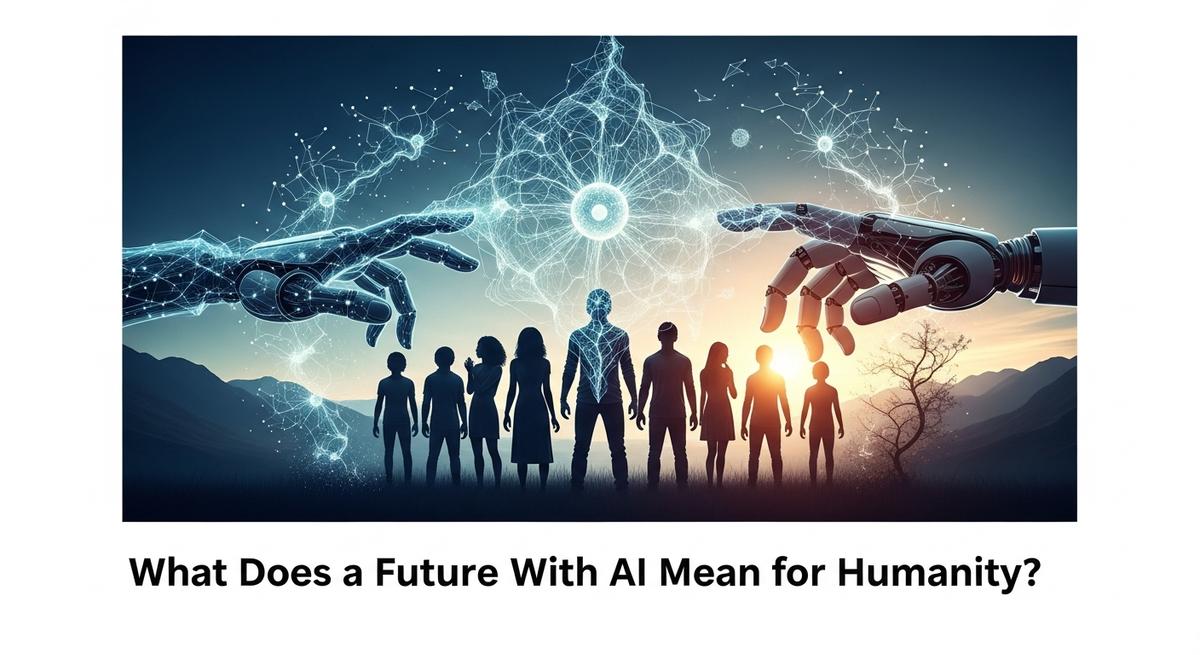
What Does a Future With AI Mean for Humanity?
- January 02, 2026
- ~ 1 min read
- 239 views
- GenAI , Future of Work , Lifestyle & AI
Introduction/Overview
We stand at a critical inflection point in human history. Artificial intelligence is transitioning from experimental technology to mainstream implementation, reshaping how we work, heal, create, and solve problems at an unprecedented scale. Unlike previous technological revolutions that unfolded over decades, the AI transformation is compressing timelines and amplifying stakes across every sector of society. This is no longer a conversation about what *might* happen—it's about what *is* happening right now, and what it means for your career, your community, and your future.
The Shift from Hype to Reality
If 2025 was the year of AI enthusiasm and bold promises, 2026 marks a critical transition from hype to measurable consequences. The technology is moving beyond chatbots and productivity tools into the operational backbone of organizations worldwide. This is the year when theory meets practice, when the abstract potential of AI collides with real-world constraints, trade-offs, and opportunities.
What makes this moment pivotal? The scale is staggering. Global AI market value is projected to reach $190.61 billion, with countries like China positioning AI to contribute over 26% of their GDP by 2030.[1] But numbers alone don't capture the magnitude. AI agents are becoming digital colleagues, taking on specific tasks and decision-making responsibilities alongside human workers.[4] Robotics and physical AI are accelerating beyond software, entering manufacturing, healthcare, and research laboratories.[3] These aren't incremental changes—they represent a fundamental restructuring of how work gets done and value gets created.
Why Understanding AI's Future Matters to You
The impact of artificial intelligence on humanity extends far beyond technology headlines. Consider the workforce: 38% of people expect AI to eliminate jobs at their current workplace within three years, while simultaneously, 97 million new AI-related jobs are predicted to emerge by 2025.[1] The manufacturing sector alone could lose over 20 million jobs to AI-powered automation by 2030.[1] Yet this same disruption is creating entirely new career categories and opportunities that didn't exist five years ago.
The implications stretch across every dimension of modern life. In healthcare, AI is moving beyond diagnostics into symptom triage and treatment planning, potentially closing care gaps for millions.[4] In research, AI is becoming an active participant in scientific discovery, accelerating breakthroughs in climate modeling, molecular dynamics, and materials design.[4] In security and governance, organizations are racing to build safeguards around increasingly autonomous AI agents.[4] And underlying all of this is an energy and sustainability question: as AI becomes more efficient, will that efficiency accelerate its adoption in ways that strain our planet's resources?[5]
Perhaps most importantly, Americans remain deeply divided about AI's societal impact. While 50% express concern about increased AI use in daily life, only 10% feel excited about it.[2] A majority believe AI will make people worse at creative thinking and forming meaningful relationships.[2] These aren't technical questions—they're deeply human ones about what we value and who we want to become.
What This Article Will Explore
This comprehensive guide examines the multifaceted implications of AI's transformation of human society across seven critical dimensions. You'll explore how the future of work is being reshaped by automation and new job creation, understand the energy and sustainability trade-offs driving AI adoption, examine the security challenges emerging as AI agents gain autonomy, discover how healthcare is being revolutionized by intelligent systems, and consider the ethical and social dimensions that will define whether AI becomes a tool for broad human flourishing or concentrated advantage.
Understanding AI's future isn't optional anymore—it's essential preparation for navigating the next decade. Whether you're a business leader, a knowledge worker, a policymaker, or simply a person invested in your own future, the decisions being made about AI in 2026 will reverberate through your professional and personal life for years to come. This article equips you with the context, evidence, and frameworks you need to engage thoughtfully with one of humanity's most consequential technological shifts.
Supporting Content
The theoretical benefits of artificial intelligence become tangible when examined through real-world deployments across critical sectors. From hospitals to power grids, organizations are already implementing AI robotics applications that demonstrate both the transformative potential and practical challenges of integrating intelligent systems into human-centered environments. These concrete examples illustrate how AI moves beyond laboratory settings to address pressing societal needs.
Healthcare Robotics: Transforming Patient Care and Hospital Operations
Service robots in hospitals represent one of the most visible applications of AI technology in everyday human services. As of 2024, 80% of U.S. hospitals have integrated AI systems to improve care quality and efficiency, with deployment ranging from diagnostic assistance to logistics management. These implementations reveal both the promise and complexity of human-AI collaboration in high-stakes environments.
Surgical robotics exemplify precision-focused AI deployment. The da Vinci surgical system translates surgeon hand movements into smaller, more precise actions within the patient's body, enabling complex procedures through minimal incisions. Patients experience reduced blood loss, less postoperative pain, and shorter hospital stays compared to traditional open surgeries. Hospitals benefit from lower follow-up costs and stronger clinical outcomes, with robotic surgical systems performing over 2.6 million procedures annually worldwide.
Beyond the operating room, diagnostic AI robots are accelerating patient processing. The University of York is developing the Diagnostic AI System for Robot-Assisted A&E Triage (DAISY), which collects patient data including symptoms and vital signs, then produces diagnostic reports for senior physician review. This approach addresses a fundamental healthcare challenge: emergency departments require fast decision-making to prioritize patients with the most pressing needs, yet human capacity constraints create bottlenecks that delay care.
Logistics and facility management represent another critical application area. Autonomous mobile robots distribute medical supplies, medications, and linens while reducing interpersonal contact in infectious disease wards. Automated cleaning systems sanitize surgical suites and patient rooms without diverting staff from direct patient care. Nurse AI robots like Moxi, deployed in over 30 hospitals nationwide, monitor patient vitals, assist with medication administration, and manage routine care activities, allowing human nurses to focus on complex clinical decisions and emotional support.
A mid-sized American hospital's 2024 integration of an AI triage solution demonstrates measurable impact: by analyzing patient symptoms, medical history, and real-time vitals using predictive algorithms, the system drastically reduced emergency room wait times and lessened staff burnout during peak periods. By early 2025, the hospital expanded the system to include chronic disease monitoring for diabetes, COPD, and heart failure, resulting in quantifiable decreases in preventable hospitalizations.
Climate Technology: AI-Driven Environmental Monitoring and Optimization
Climate tech solutions powered by AI address environmental challenges through continuous monitoring, predictive analysis, and real-time optimization. These systems operate across multiple domains—emissions tracking, energy grid management, and water resource allocation—demonstrating how AI can process vast environmental datasets to enable faster, more informed decision-making.
Energy grid optimization represents a particularly compelling use case. AI systems analyze consumption patterns, weather forecasts, and renewable energy availability to balance supply and demand in real-time. This capability becomes increasingly critical as grids integrate variable renewable sources like solar and wind power. Rather than relying on static forecasts, AI models continuously adapt to changing conditions, reducing waste and improving grid stability.
Emissions monitoring systems leverage AI to track carbon output across industrial facilities, transportation networks, and supply chains. By identifying inefficiencies and anomalies in real-time, these systems enable organizations to reduce environmental impact while often lowering operational costs. Water management systems similarly use AI to optimize distribution, detect leaks, and predict demand patterns, addressing resource scarcity in water-stressed regions.
Cybersecurity and Edge Computing: Real-Time Threat Detection and Response
AI security systems employing adaptive learning models represent a fundamental shift in cybersecurity approach. Rather than relying solely on predefined threat signatures, these systems continuously learn from network behavior patterns, detecting anomalies that indicate potential breaches in real-time. Machine learning algorithms analyze vast volumes of network traffic to identify suspicious patterns that human analysts might miss, enabling faster response to emerging threats.
Edge computing integration enables this real-time responsiveness by processing data locally rather than sending it to distant servers. AI models deployed at network edges—on routers, sensors, and devices—make immediate decisions without latency delays. In healthcare, edge computing allows diagnostic robots to process patient data instantly, enabling faster triage decisions. In industrial settings, edge AI detects equipment failures before they occur, preventing costly downtime.
This distributed approach addresses a critical challenge: centralized AI systems, while powerful, introduce latency that can prove problematic in time-sensitive applications. By bringing intelligence closer to data sources, organizations achieve faster, more responsive decision-making while reducing bandwidth requirements and improving privacy by keeping sensitive data local.
The convergence of these applications demonstrates that AI's societal impact depends not on the technology itself, but on thoughtful implementation that addresses genuine human needs while acknowledging practical constraints and ethical considerations.
Comparison/Analysis
Artificial intelligence presents a complex landscape of trade-offs and opportunities that will fundamentally reshape how society functions. Rather than viewing AI as inherently beneficial or harmful, understanding its dual nature—where the same technology can simultaneously create and destroy value—is essential for navigating the decisions ahead. The outcomes we experience will depend largely on how organizations, policymakers, and individuals choose to implement and govern these powerful tools.
Economic Benefits Versus Job Displacement
The economic paradox of AI is perhaps most visible in the labor market. On one hand, productivity gains from AI adoption promise significant economic growth and efficiency improvements. Industries leveraging AI tools report accelerated task completion and reduced operational costs. However, this productivity comes with a human cost that cannot be ignored.
Current evidence reveals a nuanced displacement pattern. Early-career workers aged 22-25 in AI-exposed occupations have experienced a 13% decline in employment relative to less exposed fields, with particular impacts on software development, customer service, and graphic design roles. Between January and September 2025, companies directly attributed 17,375 job cuts to AI, with another 20,000 cuts linked to AI-inclusive technological updates. Yet this displacement, while significant for affected workers, represents only a small fraction of overall labor market activity—approximately 37,375 cuts against 5.1 million total separations in August 2025 alone.
The critical distinction lies in which workers and sectors experience disruption. College graduates overall have seen unemployment rise to 5.8%—the highest in over four years—with particularly acute challenges in AI-exposed majors including computer engineering, graphic design, industrial engineering, and architecture. Meanwhile, wages for workers with AI skills are rising twice as quickly in AI-exposed industries compared to less exposed sectors, creating a widening skills premium. This suggests that while some jobs disappear, new opportunities emerge—but they demand different capabilities and often cluster geographically in tech hubs.
The trade-off is not simply jobs lost versus jobs gained, but rather a shift in which types of workers benefit. New entrants without AI-relevant experience face particular disadvantages, as their traditional skills become obsolete faster than they can be retrained. Organizations must weigh immediate productivity gains against longer-term workforce development costs and social stability concerns.
Automation Versus Human Skill Demand
AI's impact on different job categories reveals a critical insight: automation is not uniform across the economy. Occupations with higher theoretical AI exposure have experienced larger unemployment increases, with computer and mathematical occupations seeing some of the steepest rises. These are precisely the knowledge-worker roles that historically offered security and advancement opportunities.
However, the relationship between AI exposure and job loss is not deterministic. The correlation between occupational AI exposure and unemployment increases is 0.47, meaning exposure explains less than half the variation in job losses. This suggests that implementation choices matter enormously. Some organizations use AI to augment worker capabilities—accelerating certain tasks while preserving overall employment demand. Others use it primarily for workforce reduction.
Blue-collar jobs and personal service roles, which have limited AI applicability, have experienced relatively smaller unemployment increases. This creates an unexpected dynamic: while white-collar workers once enjoyed employment security, they now face disruption from cognitive automation. The future demand for human skills increasingly concentrates in roles requiring uniquely human capabilities—complex problem-solving, emotional intelligence, creative thinking, and interpersonal connection—alongside roles in AI oversight and management.
Organizations face a strategic choice: invest in reskilling programs to help existing workers transition, or accept higher turnover and recruitment costs. Research shows that job retraining can help workers adjust to technological disruptions, and AI-assisted tools like algorithmic resume optimization and AI-enhanced interviewing can improve hiring outcomes. The question is not whether humans will be needed, but what skills will command value and who will have access to retraining opportunities.
Social Inequality Implications
Perhaps the most consequential trade-off involves how AI affects existing social disparities. The technology has the potential to either narrow or dramatically widen inequality, depending on implementation.
The case for reduced inequality: AI tools can democratize access to expertise and opportunities. Algorithmic resume assistance increases hiring rates for prospective employees. AI-enhanced interviewing improves candidate selection, potentially reducing bias in hiring. Educational applications could provide personalized learning at scale, helping disadvantaged populations access quality instruction. Healthcare AI could extend diagnostic capabilities to underserved regions.
The case for increased inequality: New AI-driven jobs cluster geographically in tech hubs, creating regional disparities. These positions typically require advanced degrees, limiting access for workers without higher education. Early-career workers face particular disadvantages, as their entry-level experience cannot offset skills now obsolete due to AI. Workers in data-rich sectors experience faster displacement than those in data-poor industries, meaning some regions and sectors transition rapidly while others lag. The wage premium for AI skills means workers without these capabilities fall further behind economically.
The critical variable is access to reskilling and education. If retraining programs remain expensive and geographically concentrated, AI will likely exacerbate inequality. If policymakers and organizations invest in broad-based skill development and support displaced workers, the technology could help level opportunity. Current evidence suggests the outcome remains undetermined—we are witnessing early stages of AI-driven labor market transformation, and policy choices made now will shape whether this technology becomes a tool for broad prosperity or concentrated advantage.
The future with AI is not predetermined. Each of these trade-offs—between productivity and employment security, between automation and human skill demand, between efficiency gains and social stability—can be influenced by deliberate choices about how we develop, deploy, and govern these systems.
Conclusion and Key Takeaways
As we stand at the threshold of 2026, artificial intelligence has transcended its role as an emerging technology to become a foundational force reshaping economies, institutions, and everyday life. The journey from AI as a laboratory curiosity to a pervasive presence in healthcare, finance, manufacturing, and public infrastructure reveals a fundamental truth: AI's impact is not siloed but deeply interconnected. Advances in one sector ripple across others, creating cascading effects that touch workforce dynamics, governance structures, ethical frameworks, and social equity. Understanding this interconnected nature is essential for anyone seeking to navigate the AI-defined future responsibly.
From Hype to Accountability: The 2026 Inflection Point
The defining characteristic of 2026 is the shift from "what is possible" to "what is sustainable, responsible, and economically transformative". If 2025 was the year of AI hype, 2026 represents the year of AI reckoning—a moment when organizations and societies must move beyond promotional narratives to measure real outcomes, manage genuine risks, and demonstrate tangible value. Stanford AI experts predict that arguments about AI's economic impact will finally give way to careful measurement, with the emergence of high-frequency data tracking actual performance across sectors.
This transition demands accountability at every level. Businesses will face public criticism and regulatory scrutiny without transparent governance. Risk management is no longer optional but the price of admission for AI adoption, even in jurisdictions without formal regulatory requirements. Organizations that embrace this accountability early will build the trust necessary to harness AI's transformative potential while mitigating its risks.
Preparing for an AI-Shaped Future: Actionable Next Steps
Preparation for an AI-shaped future requires differentiated action across three critical constituencies:
For Individuals: The job market is undergoing profound transformation, with 170 million new roles projected to be created and 92 million displaced between 2025 and 2030. Rather than viewing this as purely threatening, recognize it as an opportunity to develop human-centric skills that AI cannot easily replicate. Employers are prioritizing analytical thinking, resilience, flexibility, leadership, and social influence—capabilities that enhance rather than compete with AI systems. Invest in continuous learning, particularly in AI literacy and skills that require complex problem-solving, interpersonal connection, and creativity. Whether you work in frontline roles like nursing and teaching or in emerging AI-adjacent positions, understanding how AI affects your domain is no longer optional.
For Business Leaders: Organizations must adopt a dual strategy: invest in foundational AI principles that rewrite organizational DNA while simultaneously building robust risk management programs. The choice between AI platforms and best-of-breed tools requires strategic clarity about your competitive advantages and operational needs. More importantly, establish transparent governance structures that address bias, safety, and accountability. Consider how edge computing and distributed intelligence can enhance both performance and privacy. Robotics and agentic AI present exponential growth opportunities, but only when deployed with clear ethical frameworks and human oversight. Talent attraction and retention increasingly depend on your organization's demonstrated commitment to responsible AI deployment.
For Policymakers: The global AI governance landscape is fragmenting, with policies developing in disjointed fashion across jurisdictions. This creates both risks and opportunities. Prioritize frameworks that balance innovation with safety, establishing clear standards for transparency, bias prevention, and audit trails—particularly in high-stakes domains like hiring, lending, healthcare, and justice. International cooperation mechanisms, such as the upcoming AI Impact Summit, offer pathways to coordinate policy without stifling innovation. Climate tech, smart cities, and public infrastructure present opportunities to demonstrate how AI can solve planetary challenges while building public trust.
Human Agency in Shaping AI's Trajectory
Perhaps the most important takeaway is this: the future with AI is not predetermined. While AI's capabilities are powerful and its deployment will reshape society, the outcomes we experience depend fundamentally on the choices we make today. The same technology that could exacerbate inequality—as Stanford research shows with post-disaster reconstruction disparities—can also be directed toward equitable solutions. The same systems that might displace workers can be designed to enhance human capabilities and create new opportunities.
Digital trust is becoming the most precious currency in business and life. Building and maintaining this trust requires intentional effort: transparent reasoning in AI decision-making, proactive bias prevention, comprehensive audit trails, and genuine accountability when systems fail. It requires recognizing that AI's promise is radical, but its deployment is shaped by real-world trade-offs that demand careful navigation.
The interconnected trends shaping 2026—from agentic AI and edge computing to climate tech and robotics—all point toward one conclusion: we are designing the infrastructure of human-AI collaboration. The systems we build today will define how humans and machines work together for decades to come. This is not a burden but an opportunity. By approaching AI with both ambition and humility, by measuring outcomes rigorously, by governing responsibly, and by keeping human flourishing at the center of our decisions, we can shape an AI-defined future that benefits humanity broadly rather than narrowly.
The time for preparation is now. Whether you are an individual worker, an organizational leader, or a policymaker, your engagement with these questions matters. The future with AI will be determined not by the technology itself, but by how thoughtfully and intentionally we choose to deploy it.

Comments (0)
Please login or register to leave a comment.
No comments yet. Be the first to comment!