
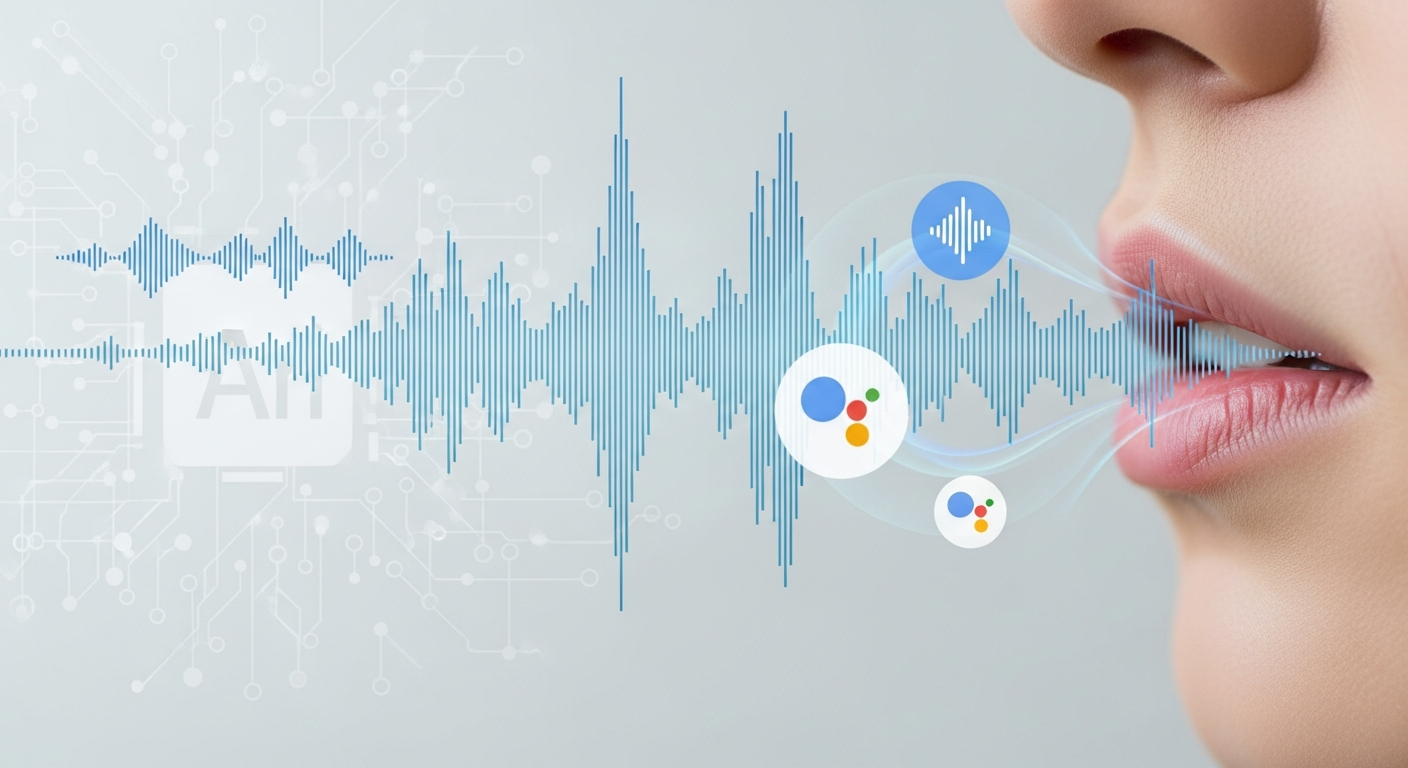
Voice assistants like Siri and Google Assistant and how they understand human speech.
- November 20, 2025
- ~ 1 min read
- 423 views
- GenAI
Introduction to Voice Assistants and Speech Understanding
From setting alarms and checking the weather to controlling smart home devices and answering complex questions, voice assistants have become an indispensable part of our daily routines. A simple "Hey Siri, what's my schedule today?" or "Okay Google Assistant, play some jazz music" is all it takes to delegate tasks, access information, and enhance our productivity or entertainment. These ubiquitous AI companions, including Amazon's Alexa, have seamlessly integrated into our lives, making interactions with technology feel intuitive, natural, and almost *magical*.
At their core, voice assistants are sophisticated software agents designed to perform tasks or provide services based on spoken commands. They bridge the gap between human language and digital actions, transforming our verbal instructions into executable tasks. Their common functions range from simple commands like sending a text message or making a call to more advanced capabilities such as providing real-time navigation, translating languages, or even engaging in conversational dialogue. This effortless interaction has reshaped our expectations for **human-computer interaction**, pushing the boundaries of what's possible with everyday technology.
However, beneath this veneer of apparent simplicity lies a profound technological mystery: how do these devices go beyond merely recognizing sounds to *genuinely understand* the intent and context of what we say? It's not just about matching keywords; it's about deep **AI understanding** that can decipher colloquialisms, handle accents, and process complex sentence structures to deduce a user's true objective. This leap from raw audio to meaningful action is a marvel of modern engineering and artificial intelligence.
In this article, we will embark on a fascinating journey to peel back the layers of technology that enable this seemingly magical feat. We'll demystify the intricate processes involved, exploring how raw sound waves are transformed into actionable commands. Prepare to dive deep into the world of advanced **speech technology**, understanding the fundamental components and cutting-edge algorithms that empower your favorite voice assistant to listen, process, and respond with remarkable intelligence. By the end, you'll have a clear grasp of how your voice, a simple biological output, becomes a powerful tool in the digital realm.
The Core Components of Speech Understanding
At the heart of every voice assistant’s ability to interact seamlessly with humans lie two fundamental pillars: Automatic Speech Recognition (ASR) and Natural Language Processing (NLP). These sophisticated technologies work in tandem, transforming the fleeting sounds of human speech into actionable insights. Think of ASR as the ‘ears’ that transcribe what you say, and NLP as the ‘brain’ that comprehends the true meaning and intent behind your words. Understanding these core components is key to grasping how AI truly "hears" and "thinks."
Automatic Speech Recognition (ASR): From Sound Waves to Text
The initial and crucial step in a voice assistant's understanding journey is converting spoken audio into written text. This is the domain of Automatic Speech Recognition (ASR). When you utter a command or question, the sound waves are captured by your device’s microphone and digitized. ASR systems then analyze these digital audio signals through a complex process involving machine learning algorithms trained on vast datasets of human speech.
Within ASR, two primary sub-components play vital roles in achieving this conversion:
-
Acoustic Modeling: This component focuses on identifying the distinct sounds, or phonemes, that make up words. Acoustic models are essentially statistical representations that map specific audio patterns to their corresponding phonetic units. For instance, when you say "cat," the acoustic model learns to recognize the individual 'k', 'æ', and 't' sounds. It accounts for variations in pitch, accent, and speed, making it robust enough to understand diverse speakers. Modern systems leverage deep neural networks, which are incredibly effective at discerning these intricate sound patterns from raw audio data.
-
Language Modeling: Once the acoustic model has identified potential sequences of sounds, the language model steps in. Its job is to predict the most probable sequence of words based on grammatical rules and the statistical likelihood of words appearing together in a given language. For example, if the acoustic model hears something that could be "recognize speech" or "wreck a nice beach," the language model, informed by typical English usage, would overwhelmingly favor "recognize speech" in most contexts. This sophisticated prediction mechanism helps to correct potential errors from the acoustic model and ensure a grammatically coherent and contextually relevant transcription. The integration of powerful language models is what makes modern speech recognition technology so accurate.
Natural Language Processing (NLP): Deciphering Meaning and Intent
Once the ASR system has meticulously transcribed your spoken words into text, the baton is passed to Natural Language Processing (NLP). This is where the real comprehension begins. NLP is a branch of artificial intelligence focused on enabling computers to understand, interpret, and generate human language in a valuable way. It moves beyond mere transcription to extract the underlying meaning, identify key entities, and determine the user's intent from the transcribed text.
For example, if you say, "What's the weather like in London tomorrow?", the ASR system accurately transcribes it into text. NLP then meticulously parses this text to:
- Identify the core intent: "Get Weather Information."
- Extract crucial entities: "Location" (London), "Time" (tomorrow).
This deep linguistic analysis allows the voice assistant to not just hear your words, but to understand what you're asking for and then formulate an appropriate response or action. NLP employs techniques such as tokenization, part-of-speech tagging, named entity recognition, and sentiment analysis to break down the language and rebuild its meaning. It's the "brain" that enables true AI understanding, transforming raw text into a structured request that the system can process and fulfill, effectively closing the loop from sound to intelligent action.
From Utterance to Action: A Step-by-Step Journey
Ever wondered what magical sequence of events unfolds from the moment you say "Hey Google" to getting a thoughtful reply? It’s far from magic; it's a meticulously engineered process involving advanced AI and machine learning techniques. This section walks you through the typical voice command flow, detailing each critical stage a voice assistant like Siri or Google Assistant navigates to understand your request and provide a relevant response.
1. Wake Word Detection and Audio Capture
The journey begins with wake word detection. Your device isn't constantly recording everything you say, but rather, it's always listening in a low-power mode for a specific acoustic pattern—the "wake word." This could be "Hey Siri," "Okay Google," or "Alexa." Sophisticated acoustic models are trained to recognize these unique sound signatures, distinguishing them from background noise and other speech. Once the wake word is detected, the device "wakes up," and the full audio capture begins, activating its more powerful microphones and processing capabilities to record your subsequent command.
2. Audio Processing and ASR Transcription
Once your command is captured, the raw audio data undergoes significant audio processing. This involves several crucial steps:
- Noise Reduction: Filters out background noise (like traffic, music, or other conversations) to isolate your speech.
- Acoustic Feature Extraction: The cleaned audio waveform is broken down into small segments, and key acoustic features (like pitch, volume, and timbre) are extracted.
- Segmentation: The system identifies distinct words and phonemes (the smallest units of sound that distinguish one word from another).
This processed audio is then fed into the Automatic Speech Recognition (ASR) engine. The ASR engine is a complex system that uses statistical models or deep neural networks to convert the spoken words into a sequence of text. It matches the acoustic features of your speech against vast databases of recorded speech and language models to transcribe what you said into text. For example, if you say, "What's the weather like in New York?", the ASR system accurately transcribes it into "what's the weather like in new york."
3. Natural Language Understanding (NLU) and Intent Recognition
With the speech successfully transcribed into text, the real comprehension begins. This stage is handled by Natural Language Understanding (NLU), a subfield of Natural Language Processing (NLP). The NLU module analyzes the text to grasp its meaning, context, and the user's underlying intention. This involves two primary components:
- Intent Recognition: This identifies the user's goal or purpose behind the utterance. For "what's the weather like in New York?", the intent would be identified as
QUERY_WEATHER. For "Set a timer for 10 minutes," the intent isSET_TIMER. - Entity Extraction: Simultaneously, the NLU system extracts key pieces of information (entities) from the text that are relevant to the identified intent. In "what's the weather like in New York?", "New York" is extracted as the
LOCATIONentity. In "Set a timer for 10 minutes," "10 minutes" is theDURATIONentity.
This phase is critical for the assistant to understand not just what words were spoken, but what the user actually wants to achieve and with what specific details.
4. Response Generation and Action Execution
Armed with a clear understanding of your intent and extracted entities, the voice assistant then formulates a response or executes an action. This often involves querying external databases or services. For our weather example, the assistant would query a weather API using "New York" as the location. Once the data is retrieved, a natural language generation (NLG) module constructs a coherent, human-like response. Finally, this text response is converted back into spoken audio through a Text-to-Speech (TTS) engine, which synthesizes a natural-sounding voice. This entire, intricate process, from your initial "Hey Siri" to the assistant's helpful reply, happens in mere milliseconds, making everyday interactions with your voice assistant seem effortless and intuitive.
Advanced AI Concepts Behind Voice Understanding
Deep Learning's Role: From Neural Networks to Transformers
Voice assistants rely on deep learning for ASR (Automatic Speech Recognition) and advanced NLP (Natural Language Processing) to decode human speech. Traditional systems used neural networks and recurrent neural networks (RNNs), which process sequential data. However, modern architectures like transformers (AI) have revolutionized the field. Transformers leverage self-attention mechanisms to analyze entire audio segments simultaneously, drastically improving accuracy and efficiency. For example, Google’s Transformer-based models reduce latency in real-time transcription while handling complex linguistic patterns. This shift has enabled voice assistants to recognize not just words, but context, tone, and intent with unprecedented precision.
Contextual Understanding: Memory and Personalization
Context is key to seamless interactions. Voice assistants use contextual AI to maintain conversation flow across multiple queries. For instance, if a user asks, “What’s the weather like?” followed by “Will I need an umbrella?”, the system references prior dialogue to infer location and conditions. This is achieved through session history tracking and user profiles that store preferences and past interactions. Personalization takes this further: Siri might prioritize your frequently visited locations, while Google Assistant adapts to your search habits. Advanced models also integrate memory networks to retain information over extended sessions, ensuring continuity in multi-turn conversations.
Addressing Ambiguity: Semantic Understanding and Feedback Loops
Human speech is riddled with ambiguity. A query like “Play ‘Bohemian Rhapsody’” could refer to a song, movie, or lyric. Here, semantic understanding disambiguates intent by analyzing syntax, context, and user history. Voice assistants employ probabilistic models and knowledge graphs to rank possible interpretations. For example, if the user previously asked for music, the system prioritizes song titles. User feedback loops refine this process: when an assistant misinterprets a command, users correct it, and the system learns from these interactions. This iterative approach enhances accuracy over time, making voice recognition more intuitive.
Multimodal AI: Beyond Audio Signals
While voice is primary, the future of assistants lies in multimodal AI. By integrating visual, textual, and environmental data, systems gain richer context. Imagine a smart home assistant using camera input to recognize a user’s face before tailoring voice responses or adjusting room settings. In healthcare, voice assistants might analyze speech patterns alongside biometric data to detect anomalies. Multimodal models combine audio-visual embeddings and cross-modal attention to synthesize inputs, creating a holistic understanding of user needs.
Challenges: Noise, Privacy, and Global Accessibility
Despite advancements, challenges persist. Accents and background noise remain hurdles, requiring robust noise suppression algorithms and accent adaptation modules. Low-resource languages lag behind in coverage, but open-source initiatives and transfer learning are bridging gaps. Ethically, privacy in voice AI is critical: voice data collection raises concerns about surveillance and consent. Leading companies now use on-device processing and differential privacy to anonymize data. Researchers are also exploring zero-shot learning to improve performance without massive labeled datasets, ensuring equitable access for all users.
“Transformers and contextual AI have transformed voice assistants from basic tools to intelligent companions—but challenges like privacy and inclusivity demand ongoing innovation.”
Optimizing Your Interaction: Tips for Users and Developers
As voice assistants become increasingly integrated into our daily lives, understanding how to interact with them effectively, and how to build applications that leverage their capabilities, is paramount. This section offers practical advice designed to enhance the experience for both the end-user seeking smoother interactions and the developer aiming to create compelling voice-enabled applications. By following these voice assistant tips, we can unlock the full potential of these sophisticated AI systems.For the User: Mastering Your Voice Assistant
For users, a better understanding of how voice assistants interpret speech can significantly improve daily interactions. Think of it as learning the 'language' of your AI companion.-
Clear Enunciation and Pacing: While modern Automatic Speech Recognition (ASR) is incredibly robust, speaking clearly and at a moderate pace remains the single most effective way to ensure accurate transcription. Avoid mumbling or rushing through commands, especially in noisy environments. A slight pause between distinct commands can also help the system process each instruction individually.
-
Natural Phrasing and Context: Voice assistants are designed to understand natural language. Instead of terse, keyword-heavy commands, try to phrase your requests as you would to another person. For example, "What's the weather like today?" is often better understood than "Weather forecast." Providing context can also be crucial; if you've just asked about a restaurant, subsequent queries like "What's their phone number?" will likely be understood in relation to the previous topic, leading to more efficient and smooth and efficient conversations.
-
Managing Background Noise: Environmental noise is a significant challenge for ASR systems. Whenever possible, try to interact with your voice assistant in a quieter setting. If that's not possible, speaking closer to the device's microphone can help the assistant better isolate your voice from ambient sounds. Reducing competing audio, such as music or TV, will dramatically boost recognition accuracy, leading to a much better improving voice interaction.
-
Understanding Limitations: Voice assistants, despite their sophistication, still have limitations. They might struggle with highly technical jargon, complex multi-part questions, or deeply nuanced emotional language. Understanding these boundaries can prevent frustration and guide you towards more effective query formulation. For instance, rather than a single, convoluted question, break it down into smaller, sequential commands.
For Developers: Crafting Superior Voice Experiences
Developers play a pivotal role in shaping the future of voice interactions. By leveraging powerful tools and adhering to user-centric design principles, they can create intuitive and highly functional voice applications.Integrating voice capabilities into applications is more accessible than ever, thanks to robust platforms and SDKs. Tools like Google Dialogflow provide a comprehensive framework for building conversational interfaces, handling natural language understanding (NLU), and managing dialogue flow. For iOS developers, Apple's SiriKit allows seamless integration of app functionalities directly into Siri and Maps, offering users a native voice experience for specific domains like ride-booking, messaging, or payments. Leveraging these APIs is key for effective voice app development.
When designing voice-enabled applications, consider these best practices:
-
User-Centric Design (UX Voice): Always prioritize the user experience. Design for natural language interactions, anticipating various ways a user might phrase a request. This includes understanding synonyms, common mispronunciations, and diverse linguistic patterns. An intuitive design ensures users can interact effortlessly, enhancing overall satisfaction and reinforcing positive user experience (UX) voice principles.
-
Clear Confirmation and Feedback: Users need to know that their command was heard and understood correctly. Provide immediate, clear audio or visual feedback. If a command is ambiguous, ask clarifying questions. For example, "Did you mean 'set an alarm' or 'add to calendar'?" This transparency builds trust and reduces errors.
-
Robust Error Handling and Recovery: It's inevitable that a voice assistant will occasionally misunderstand a command. Design your application to gracefully handle errors, offering helpful suggestions or guiding the user back to a successful interaction path. Avoid dead ends; always provide an escape route or a way to restart the interaction.
-
Contextual Awareness: Implement state management to allow for multi-turn conversations. An application that remembers previous interactions and uses that context to inform subsequent responses feels more intelligent and natural. This greatly improves the flow and utility of voice interfaces.
By understanding both the capabilities and nuances of voice technology, users can speak more effectively, and developers can build applications that truly resonate. This collaborative approach ensures that voice assistants evolve into even more indispensable and user-friendly tools.
Siri vs. Google Assistant: A Comparative Analysis of Understanding
Having explored the intricate mechanisms of speech recognition and natural language processing, it's time to put our knowledge into practice by examining how two of the leading voice assistants, Siri and Google Assistant, stack up against each other. While both leverage sophisticated AI to understand human speech, their underlying architectures, core philosophies, and resultant user experiences present distinct differences. This voice assistant comparison delves into their unique strengths and weaknesses, offering an
Divergent Architectures and Core Strengths
At a high level, the architectural approaches of Siri and Google Assistant reveal their foundational design philosophies. Siri, deeply embedded within the Apple ecosystem, often prioritizes on-device processing for certain commands and user data, aligning with Apple privacy principles. This tight integration ensures seamless operation with Apple's hardware and services, from HomeKit devices to Apple Music. Google Assistant, on the other hand, is heavily reliant on Google's vast cloud infrastructure, which enables it to tap into an unparalleled wealth of information.
Siri's strengths primarily lie in its profound integration with the Apple ecosystem. It excels at controlling Apple devices, managing personal tasks within Apple applications (like Calendar, Reminders, and Messages), and executing complex shortcuts. Its understanding of specific commands within this curated environment is highly refined, making it incredibly convenient for users invested in the Apple universe. The emphasis on user data privacy also remains a significant differentiator, resonating with users concerned about how their voice interactions are handled.
Google Assistant's prowess stems from its connection to the massive Google knowledge graph, an interconnected web of real-world entities and their relationships. This gives it a significant edge in answering general knowledge questions, providing up-to-the-minute information, and understanding complex, multi-part queries. Its contextual awareness is often superior, allowing for more natural, back-and-forth conversations where it remembers previous turns. Furthermore, Google Assistant generally offers broader and deeper multilingual support, making it a more versatile option for a global user base.
Bridging the Gaps: Areas for Improvement and User Experience
Despite their advancements, both voice assistants face ongoing challenges. Siri sometimes struggles with understanding queries outside the Apple ecosystem or with complex, open-ended questions that require deep contextual reasoning. Its perceived lack of conversational fluidity and occasional misinterpretations can be frustrating for users expecting a more human-like interaction. Improving voice assistant accuracy for highly nuanced or ambiguous requests remains an active area of development.
Google Assistant, while generally more robust in its conversational abilities, isn't without its quirks. Concerns regarding data privacy, though Google has introduced more controls, persist for some users. Occasionally, it can be overly verbose or provide information that, while accurate, isn't precisely what the user intended. Both assistants still contend with challenges like understanding diverse accents, distinguishing speech in noisy environments, and accurately interpreting user intent when commands are ambiguous or poorly phrased. The evolution of their core AI capabilities is a continuous journey.
These understanding differences have direct implications for daily user experience. Siri users often appreciate the effortless control it offers within their Apple devices and the peace of mind regarding privacy. It's a reliable assistant for specific tasks, managing smart home accessories, and making calls. Google Assistant users, conversely, often lean on it for expansive information retrieval, proactive suggestions, and its ability to maintain context across more extended conversations. Ultimately, the choice between them often comes down to an individual's priority: the integrated simplicity and privacy assurances of Siri, or the expansive knowledge and conversational breadth of Google Assistant.
The Future of Voice AI and Our Conversations
We've journeyed through the intricate process that allows voice assistants like Siri and Google Assistant to transform mere sound waves into meaningful actions. From the complex algorithms of Automatic Speech Recognition (ASR) that convert your spoken words into text, to the sophisticated Natural Language Processing (NLP) techniques that decipher intent and extract meaning, it's clear that understanding human speech is a monumental technological feat. This foundation has profoundly reshaped how we interact with technology, making our devices more accessible and intuitive than ever before.
Beyond the Present: Emerging AI Trends
The future of voice AI promises an even more seamless and intuitive interaction, marking a new era for how we converse with machines. We're on the cusp of truly transformative AI trends. Expect next-gen voice assistants to move beyond simple commands towards sophisticated multimodal AI, where voice is combined with visual cues, gestures, and contextual data for richer understanding. Hyper-personalization will mean your assistant anticipates needs, remembers preferences, and offers proactive assistance before you even ask. The evolution of conversational AI will lead to interactions so natural, they'll feel less like talking to a machine and more like engaging with a truly understanding entity.
Navigating the Ethical Landscape and Future Challenges
As voice AI becomes more powerful and pervasive in our daily lives, so too do the responsibilities associated with its development and deployment. Critical ethical AI considerations include addressing potential biases embedded in training data, ensuring robust privacy safeguards for personal conversations, and preparing for the societal impact, such as potential job displacement. These challenges require careful thought, proactive development, and collaborative solutions to ensure these powerful technologies benefit all of humanity equitably and responsibly.
Your Role in the Evolution of Voice
The journey of voice AI is far from over; it's an ongoing evolution that will continue to redefine human-computer interaction. As users, understanding these underlying technologies empowers us to engage more thoughtfully and critically with our voice assistants. We encourage you to explore further, question how your devices work, and contribute to the ongoing conversation about the responsible development of this incredible technology. The evolution of how machines understand us is a compelling story we are all helping to write, one command and one question at a time.

Comments (0)
Please login or register to leave a comment.
No comments yet. Be the first to comment!