
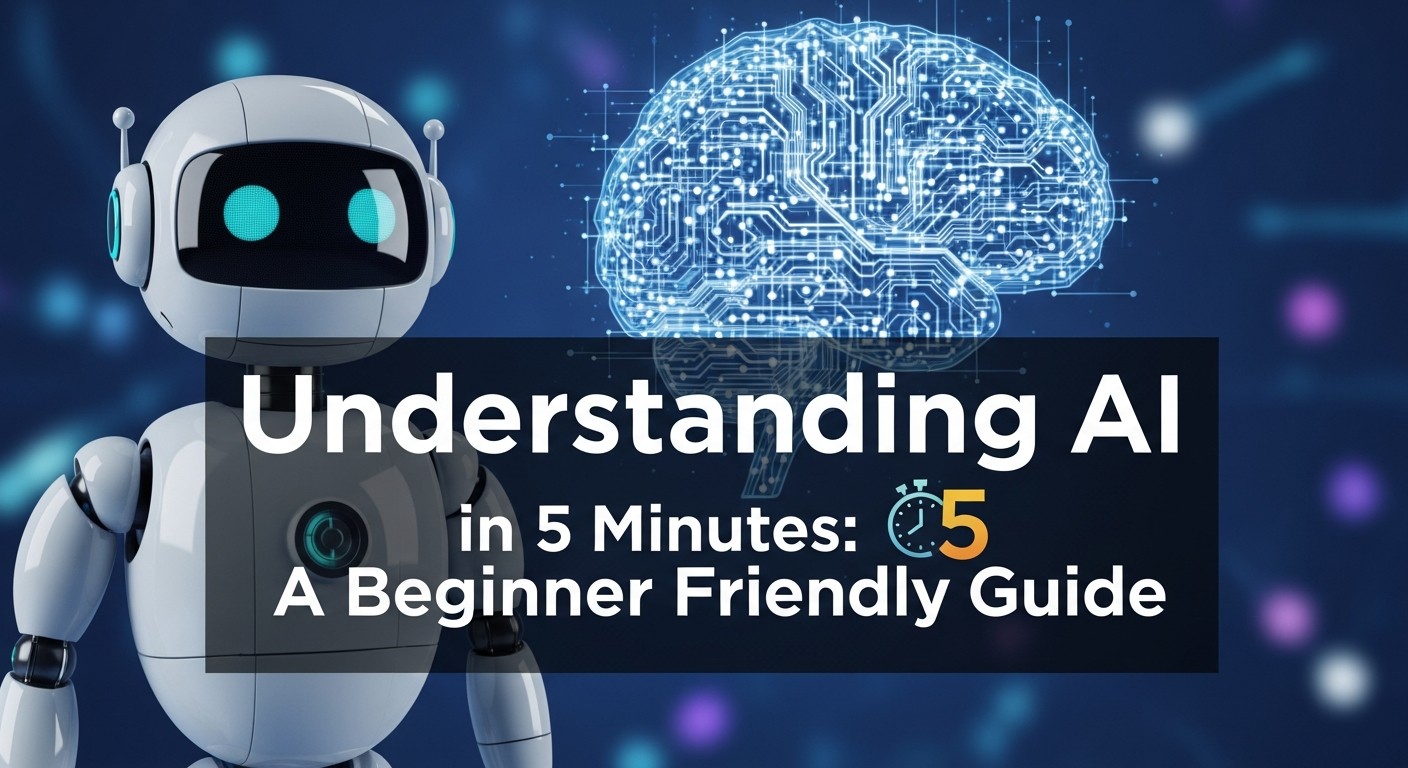
Understanding AI in 5 Minutes: A Beginner-Friendly Guide
- November 18, 2025
- ~ 1 min read
- 140 views
- GenAI
Introduction/Overview
Ever asked Siri a question, scrolled through Netflix recommendations, or unlocked your phone with your face? If so, you've already interacted with Artificial Intelligence (AI). Far from the complex, intimidating concepts often depicted in sci-fi, AI is increasingly woven into the fabric of our daily lives, quietly powering tools and services we rely on.
In a world rapidly being reshaped by technological advancements, understanding the basics of AI isn't just for tech enthusiasts anymore. It's becoming a fundamental literacy for everyone, whether you're a student, a professional navigating new industry landscapes, or simply a curious mind wanting to grasp the forces shaping tomorrow.
What is Artificial Intelligence? A Simple AI Definition
At its core, Artificial Intelligence can be thought of as the ability of machines to perform tasks that typically require human intelligence. This isn't about machines having feelings or consciousness, but rather about their capacity to learn from data, reason, solve problems, perceive, and even understand language. Think of it as teaching a computer to think and act in ways that, if a human were doing it, we'd say they were intelligent. Our simple AI definition focuses on function over philosophy: it's about smart systems designed to make our lives easier and more efficient.
Why AI Matters in Today's World
The relevance of AI today cannot be overstated. From enhancing medical diagnoses and optimizing supply chains to personalizing education and making our homes smarter, AI is a monumental force driving innovation across every sector. It's not just about convenience; AI is helping us tackle some of humanity's most complex challenges, such as climate change prediction, drug discovery, and disaster response. Embracing an AI overview helps us understand how automation, data analysis, and predictive capabilities are transforming industries and creating new opportunities.
What You'll Discover in This Beginner-Friendly Guide
This "Understanding AI in 5 Minutes" guide is specifically designed for you – the curious beginner with little to no prior technical knowledge. We'll demystify AI, breaking down its fundamental concepts into easy-to-digest pieces. By the end of this rapid exploration, you will gain a clear understanding of:
- What AI truly is and isn't.
- Key concepts like Machine Learning and Deep Learning (without the overwhelming jargon).
- Common types of AI and their real-world applications.
- The ethical considerations and future potential of this transformative technology.
Our goal is to provide a comprehensive yet accessible beginner guide, helping you navigate the exciting world of AI with confidence. We promise to keep things straightforward, avoid technical complexities, and ensure you walk away with a solid foundation.
Core Concepts of AI
Having grasped the broad idea of Artificial Intelligence, it's time to dive into the core components that make AI systems so powerful and versatile. Think of AI as a vast field, and within it are several specialized areas, each contributing to its remarkable capabilities. Understanding these core concepts will give you a solid foundation for appreciating how AI truly works.
Machine Learning: The AI Learner
At the heart of most modern AI applications lies machine learning (ML). Imagine teaching a child to recognize different animals. You wouldn't program specific rules for every single animal (e.g., "if it has pointy ears and says 'meow', it's a cat"). Instead, you'd show them many pictures of cats, dogs, birds, etc., and over time, they learn to identify patterns and distinguish between them. This is precisely how machine learning operates.
Instead of being explicitly programmed for every possible scenario, ML algorithms are fed vast amounts of data. They then learn from this data, identifying patterns, making predictions, and developing the ability to perform specific tasks without direct human intervention. This process of AI learning allows systems to adapt and improve their performance over time, much like humans learn from experience. From recommending movies to detecting fraudulent transactions, machine learning is the engine driving many of the AI solutions we encounter daily.
Neural Networks and Deep Learning: Brain-Inspired Power
Among the most exciting advancements in machine learning are neural networks. These are computing systems inspired by the structure and function of the human brain. Just as our brains consist of billions of interconnected neurons, artificial neural networks are made up of layers of interconnected "nodes" or "neurons." Each connection has a weight, which the network adjusts as it learns from data, strengthening or weakening connections to better recognize patterns.
When we talk about deep learning, we're referring to a specialized branch of machine learning that utilizes neural networks with many layers (hence "deep"). These multi-layered networks are incredibly powerful at processing complex, unstructured data like images, sounds, and text. Deep learning has been instrumental in breakthroughs such as highly accurate facial recognition, self-driving cars, and sophisticated speech interpretation.
Natural Language Processing: AI That Understands You
Another crucial area within AI is Natural Language Processing (NLP). This field focuses on enabling computers to understand, interpret, and generate human language in a valuable way. Think about voice assistants like Siri or Alexa, translation services like Google Translate, or even the spam filters in your email – these are all powered by NLP.
NLP allows AI systems to break down human language, analyze its meaning, and even respond in a way that feels natural. It bridges the gap between the complex, nuanced world of human communication and the logical, structured world of computers, making AI interactions far more intuitive and accessible for everyone.
Real-World AI Applications
Artificial Intelligence isn't just a concept from sci-fi movies; it's intricately woven into the fabric of our daily lives, often operating behind the scenes to make tasks easier, entertainment more engaging, and even healthcare more precise. Understanding AI becomes much clearer when we look at its tangible presence. Let's explore some common and impactful AI applications that you likely interact with every day.
AI in Your Pocket: Voice Assistants and Personalization
One of the most immediate and recognizable forms of AI many of us encounter are voice assistants like Apple's Siri, Amazon's Alexa, and Google Assistant. When you ask Alexa to play your favorite song or tell Siri to set a reminder, you're engaging directly with sophisticated AI. These assistants use Natural Language Processing (NLP), a branch of AI, to understand your spoken commands, interpret their meaning, and then execute the requested action. They convert your voice into text, analyze the intent, and respond appropriately, often learning from your interactions to improve over time.
Beyond listening to your commands, AI also plays a crucial role in personalizing your digital experience. Consider streaming services like Netflix or video platforms like YouTube. Their powerful recommendation systems are driven by AI algorithms. These systems analyze vast amounts of data, including your viewing history, ratings, watch times, and even what similar users are watching. Based on this analysis, the AI predicts what you might like next, suggesting movies, shows, or videos tailored specifically to your tastes. This isn't just about convenience; it's about using AI to create a highly personalized and engaging user journey.
Driving the Future: AI in Vehicles and Robotics
Perhaps one of the most talked-about AI applications is in the realm of autonomous vehicles. Self-driving cars, from companies like Tesla and Waymo, rely heavily on AI to perceive their surroundings, make decisions, and navigate without human intervention. They utilize advanced computer vision systems to interpret camera feeds, lidar, and radar data, identifying other vehicles, pedestrians, traffic signs, and lane markings. AI algorithms then process this information in real-time to plan routes, predict the movements of other objects, and control the car's steering, acceleration, and braking. This complex interplay of sensing and decision-making is a prime example of AI's capability in dynamic, real-world environments.
Beyond cars, AI also powers modern robotics, enabling machines to perform complex tasks in factories, warehouses, and even surgical operating rooms. These robots often use AI for perception (understanding their environment), manipulation (grasping and moving objects), and learning (improving performance over time). The ability of AI to adapt and learn is what makes these robotic applications so transformative.
Advancing Health: AI in Medicine
The healthcare sector is rapidly embracing AI to revolutionize diagnostics, treatment, and drug discovery. AI algorithms are proving invaluable in analyzing medical images, such as X-rays, MRIs, and CT scans, with a level of speed and accuracy that can sometimes surpass human capabilities. For instance, AI can help radiologists detect subtle abnormalities that might indicate diseases like cancer or identify early signs of conditions that are difficult to spot. This early detection can be critical for successful treatment.
Furthermore, AI is accelerating the pace of drug discovery and development. By sifting through massive datasets of genetic information, chemical compounds, and patient responses, AI can identify potential drug candidates much faster than traditional methods. It can predict how compounds might interact with the body, optimize molecular structures, and even personalize treatment plans based on a patient's unique genetic profile. AI's role here is not to replace medical professionals, but to empower them with advanced tools for better patient outcomes.
Deeper Dive: AI Technologies
You've grasped the basics of what AI is and why it's so impactful. Now, let's pull back the curtain a little further and explore some of the specific technologies and concepts that power these intelligent systems. While this might sound technical, we'll keep it as clear and engaging as possible, building on the foundations we’ve already laid.
The Fuel of AI: Why Data Matters So Much
At the heart of almost every successful AI system lies one critical ingredient: data. Think of data as the food that nourishes an AI model, allowing it to grow, learn, and make intelligent decisions. Without vast amounts of relevant data, AI models are like blank slates, unable to perform any meaningful tasks. This is where the field of data science becomes indispensable. Experts in data science collect, clean, and prepare massive datasets, which are then fed to AI algorithms during a process called "training."
For example, if you're building an AI to recognize cats, you'd need to show it thousands, even millions, of images labeled "cat" and "not a cat." The AI then learns to identify patterns, shapes, and features that distinguish a cat from other objects. The quality and quantity of this training data directly impact how accurate and effective the AI will be. Bad data leads to bad AI; good, diverse data leads to robust AI. It's a fundamental concept that underpins the entire AI ecosystem.
AI That Sees: Understanding Computer Vision
Imagine an AI that can 'see' the world just like humans do, interpreting images and videos to understand its surroundings. This incredible capability is known as computer vision. It’s the branch of AI that enables machines to derive meaningful information from visual input. From recognizing faces on your smartphone to helping self-driving cars navigate complex traffic, computer vision is transforming how machines interact with the visual world.
How does it work? Instead of just seeing pixels, computer vision systems analyze patterns, edges, shapes, and textures within an image. They can identify objects, track movement, detect anomalies, and even understand facial expressions. This technology is behind innovations in healthcare (analyzing X-rays), retail (checkout-free stores), and security (surveillance systems), making AI not just intelligent, but also visually perceptive. It’s about more than just seeing; it’s about *understanding* what's being seen.
Learning by Doing: What is Reinforcement Learning?
Not all AI learns from pre-labeled data. Some AI systems learn through a process called reinforcement learning, which is inspired by how humans and animals learn through trial and error. In reinforcement learning, an AI agent learns to achieve a goal by interacting with an environment, receiving rewards for desirable actions and penalties for undesirable ones.
Consider a simple robot learning to navigate a maze. Initially, it might bump into walls (a penalty). Over time, through repeated attempts, it learns which actions lead it closer to the exit (a reward). The AI doesn't start with instructions on how to solve the maze; instead, it discovers the optimal path through experience, constantly adjusting its strategy based on the feedback it receives. This powerful learning paradigm is particularly effective in complex environments where explicitly programming every possible scenario is impossible, finding applications in robotics, game playing (like AlphaGo), and resource management.
Navigating the Road Ahead: Challenges and Limitations of AI
While AI offers immense potential, it's crucial to acknowledge its current AI limitations and challenges. One significant concern is AI bias. If the data used to train an AI system contains inherent human biases (e.g., historical discrimination), the AI will learn and perpetuate those biases, leading to unfair or inaccurate outcomes. For instance, facial recognition systems trained on imbalanced datasets might perform poorly on certain demographic groups.
Another challenge is the "black box" problem, especially in complex deep learning models. It can be difficult for humans to understand exactly why an AI made a particular decision, making it hard to trust or debug in critical applications like healthcare or autonomous driving. Ensuring transparency, accountability, and the ability to explain AI decisions are active areas of research. Ultimately, current AI systems, while powerful, lack true human-like understanding, common sense, and empathy. They are tools, and like any tool, they require careful design, oversight, and ethical consideration to ensure they benefit humanity responsibly.
Getting Started with AI
Embarking on the journey to understand Artificial Intelligence (AI) can seem daunting, but with the right resources and mindset, it can be an exciting and rewarding experience. In this section, we will explore the practical steps you can take to get started with AI, including accessing beginner-friendly resources, understanding AI news and terminology, experimenting with simple AI tools, and considering the importance of AI ethics.
Accessing Beginner-Friendly Resources
There are numerous online courses and Massive Open Online Courses (MOOCs) designed specifically for beginners looking to learn about AI. Platforms like Coursera, Khan Academy, and edX offer a wide range of courses that cover the fundamentals of AI, including machine learning, deep learning, and natural language processing. Some recommended courses include "Machine Learning" by Andrew Ng on Coursera and "Introduction to Artificial Intelligence" on Khan Academy. Additionally, introductory books like "Life 3.0: Being Human in the Age of Artificial Intelligence" by Max Tegmark and "Artificial Intelligence: A Modern Approach" by Stuart Russell and Peter Norvig are excellent resources for those who prefer learning through reading.
Understanding AI News and Terminology
Staying updated with the latest developments in AI can be overwhelming due to the technical nature of the field. However, it's essential to stay informed about the advancements and breakthroughs in AI. To do this, it's crucial to read news from reputable sources such as The Verge, Wired, and MIT Technology Review. When encountering unfamiliar terms, don't hesitate to look them up. Understanding key concepts like machine learning, neural networks, and natural language processing will help you grasp the underlying principles of AI. You can also use online resources like Wikipedia and AI-specific dictionaries to learn more about AI terminology.
Experimenting with Simple AI Tools and Considering AI Ethics
One of the best ways to learn about AI is by experimenting with it. Many common apps and services, such as virtual assistants like Siri and Google Assistant, and photo editing software like Adobe Photoshop, have AI-powered features that you can try out. For example, you can use Google's Teachable Machine to build and train your own machine learning models. Experimenting with these tools will give you a hands-on understanding of how AI works and its potential applications. As you delve deeper into the world of AI, it's essential to consider the ethical considerations involved in AI development. AI ethics encompasses aspects like fairness, transparency, and accountability, ensuring that AI systems are designed and used in ways that benefit society as a whole. As you begin your AI learning journey, keeping these ethical considerations in mind will help you appreciate the responsibility that comes with developing and using AI technologies.
By following these steps and maintaining a curious and open-minded approach, you'll be well on your way to understanding the basics of AI and setting yourself up for further exploration into this fascinating field. Remember, the key to learning about AI is to be consistent in your efforts, patient with your progress, and willing to learn from your mistakes.
AI vs. Other Technologies
As we delve deeper into what AI is, it's crucial to understand how it stands apart from, yet sometimes complements, other established technologies and human capabilities. This comparison helps to clarify AI's unique strengths, limitations, and its evolving role in our world.
AI vs. Traditional Programming: A Fundamental Shift
At its core, the most significant difference between AI vs programming in its traditional sense lies in their approach to problem-solving. Traditional programming involves explicitly writing out every single step, rule, and condition for a computer to follow. Think of it as giving a child a recipe with precise instructions for every ingredient and action. If a new situation arises that isn't covered by a predefined rule, the program won't know how to handle it.
Artificial Intelligence, particularly through machine learning, takes a different path. Instead of being explicitly programmed with rules, AI systems are trained on vast amounts of data. They learn to identify patterns, make predictions, and adapt their behavior based on these patterns, much like a child learning from experience rather than just following strict rules. This enables AI to tackle complex, ambiguous problems where rules are difficult or impossible to define explicitly, offering a level of adaptability and intelligence that traditional code simply cannot match.
The Realities of AI Automation: Pros, Cons, and the Human Element
One of the most talked-about applications of AI is automation. AI automation brings transformative benefits, but also raises important considerations. Understanding the AI pros/cons in this context is essential:
- Pros of AI Automation: AI excels at repetitive tasks, offering unparalleled efficiency, speed, and precision. It can operate 24/7 without fatigue, leading to significant cost savings in the long run and enabling scalability across operations. AI systems can process and analyze data at speeds impossible for humans, leading to faster insights and decisions.
- Cons of AI Automation: The initial investment in developing or implementing AI systems can be substantial. Furthermore, AI lacks human qualities such as empathy, creativity, and nuanced judgment, which are vital in many roles. There's also the legitimate concern about job displacement as AI takes over tasks previously performed by humans, requiring a societal shift towards reskilling and new job creation.
Ultimately, the most effective approach often involves augmenting human capabilities with AI, rather than outright replacement. Collaboration between AI and humans often yields the best outcomes.
Predicting the Future: AI's Data-Driven Insights vs. Human Intuition
When it comes to making predictions or decisions, both AI and humans have distinct strengths. Human intuition, often described as a "gut feeling," relies on a complex interplay of experience, subconscious pattern recognition, emotions, and subtle contextual cues. It's incredibly powerful in novel situations, creative problem-solving, and understanding nuanced social dynamics, but can sometimes be biased or inconsistent.
AI, conversely, makes predictions based purely on data. It identifies statistical correlations and patterns within massive datasets to generate highly accurate and consistent forecasts. While AI lacks the "feel" or subjective understanding of a human, its ability to process and find insights in data at scale far surpasses human capacity. For tasks requiring objectivity, consistency, and the analysis of complex data, AI often provides superior predictive power. Yet, for situations requiring empathy, ethical reasoning, or understanding unique, non-quantifiable circumstances, human intuition remains irreplaceable.
Navigating the AI Trade-offs: Complexity, Accuracy, and Resources
A crucial consideration in AI development is the inherent AI trade-off between model complexity and accuracy versus the resources required. Generally, more complex AI models, such as deep learning networks with many layers, can achieve higher levels of accuracy, especially for intricate tasks like image recognition or natural language processing. These models are capable of identifying more subtle and abstract patterns within data.
However, this increased accuracy and complexity come at a significant cost: they demand vast amounts of data for training, substantial computational power (often specialized hardware like GPUs), and considerable time to train and optimize. Simpler AI models, while potentially less accurate for certain tasks, are faster to develop, require fewer resources, and are often more transparent or "explainable." Developers and organizations must constantly weigh the desire for maximum accuracy against the practical limitations of available data, computing power, and expertise, choosing the right level of complexity for the specific problem at hand.
Conclusion and Key Takeaways
A Quick Recap: What is AI and Why It Matters
As we wrap up our whirlwind tour, let's consolidate what we've learned. Artificial Intelligence, or AI, isn't science fiction but a rapidly evolving field focused on creating machines capable of performing tasks that typically require human intelligence. From processing vast amounts of data and recognizing patterns to making decisions and learning from experience, AI encompasses technologies like machine learning, deep learning, natural language processing, and computer vision.
We've seen that at its core, AI summary highlights its ability to simulate cognitive functions, empowering systems to understand, reason, learn, and adapt. This foundational understanding reveals why AI importance is escalating across every sector. It's not just about automating repetitive tasks; it's about unlocking new frontiers in medicine, enhancing user experiences, driving scientific discovery, and fundamentally reshaping how we interact with technology and the world around us.
Your Journey Continues: Embrace Lifelong Learning in AI
Understanding AI in 5 minutes is just the beginning of an exciting journey. While this guide provided a crucial stepping stone, the landscape of artificial intelligence is vast and continually expanding. We strongly encourage you to continue your exploration and delve deeper into areas that pique your interest. The best way to truly grasp AI's potential is to actively engage with it. Seek out online courses, follow reputable AI news sources, or even experiment with beginner-friendly AI tools.
The field thrives on curiosity and continuous learning. Remember, to truly learn AI isn't just about memorizing definitions; it's about understanding its practical applications, ethical considerations, and the constant innovation driving it forward. Resources are abundant, and your initial step here has equipped you with the fundamental vocabulary and context needed to tackle more advanced topics confidently.
The Future of AI: Potential and Responsible Development
Looking ahead, the potential of AI is immense and truly transformative. It promises to solve some of humanity's most complex challenges, from accelerating drug discovery to combating climate change and revolutionizing education. Imagine a future where AI assists in personalized medicine, creates sustainable energy solutions, or even helps us better understand the universe. These possibilities are not distant dreams but active areas of research and development today.
However, with great power comes great responsibility. The development and deployment of AI must be guided by strong ethical principles. Ensuring fairness, transparency, accountability, and privacy are paramount to building a future where AI benefits all of humanity. It's crucial that we, as a society, engage in thoughtful discussions about responsible AI development, ensuring that these powerful technologies are used to uplift, empower, and protect, rather than harm. Your understanding, however nascent, contributes to a more informed public discourse—a vital component in shaping AI's trajectory towards a brighter, more equitable future.

Comments (0)
Please login or register to leave a comment.
No comments yet. Be the first to comment!