
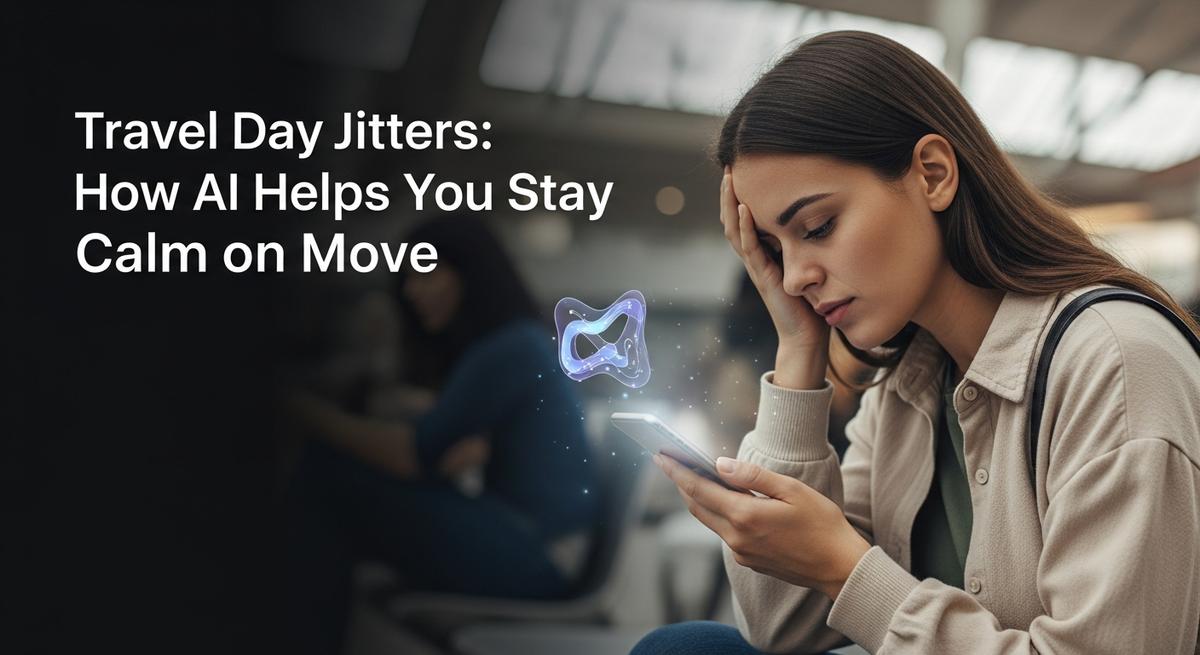
Travel Day Jitters: How AI Helps You Stay Calm on the Move
- December 02, 2025
- ~ 1 min read
- 301 views
- Lifestyle & AI , GenAI , AI Agents
Introduction/Overview
Picture this: You're standing in the airport terminal, palms sweating, heart racing. Your flight departs in two hours, but you've already checked your boarding pass five times. The departure board flickers with delays. Your mind spirals with questions: Will I make my connection? Did I pack everything? What if there's turbulence? This isn't just nervousness—this is travel day jitters, and you're far from alone.
Travel anxiety has become a defining challenge for modern travelers. Recent surveys reveal that three in four Americans experience at least some stress or anxiety before flying, with 42% consistently feeling anxious before each flight. But the anxiety doesn't stop at the airport. For 70% of Americans, travel stress begins long before boarding—it starts at home with the pressure of packing, planning, and preparing for the unknown.
The Rising Tide of Travel Day Jitters
What's driving this surge in travel day jitters? The causes are multifaceted and deeply human. Travelers worry about flight delays and cancellations, changing government policies, personal safety concerns, and the overwhelming logistics of coordinating every detail of a trip. For younger travelers, the pressure intensifies: a staggering 69% of Gen Z travelers have canceled or changed their travel plans due to anxiety and lack of preparedness. Language barriers, insufficient savings, and inadequate research about destinations compound the stress, creating a perfect storm of pre-travel anxiety.
The emotional toll is real and measurable. More than half of Americans report trouble sleeping the night before flying. One in five have canceled trips entirely due to flight anxiety. The constant stream of travel-related news—from flight delays to safety concerns—amplifies fears through social media and news cycles, making it harder for travelers to feel confident and calm about their journeys.
AI: Your Calm Travel Companion
Enter artificial intelligence—a modern solution designed to transform how travelers experience travel stress. Rather than leaving you to navigate uncertainty alone, AI-powered travel solutions work as your personal travel concierge, providing real-time support, predictive insights, and personalized planning that addresses the root causes of travel anxiety.
AI doesn't just streamline logistics; it provides emotional reassurance through intelligent anticipation. Imagine having a system that monitors your flight status in real-time, alerts you to potential delays before they happen, suggests optimal packing strategies, and provides destination-specific guidance tailored to your needs. This is the promise of AI-driven travel solutions—technology that understands your concerns and proactively addresses them before anxiety takes hold.
Throughout this guide, we'll explore how artificial intelligence is revolutionizing the travel experience, turning travel day jitters from an inevitable part of journeys into a manageable challenge. From predictive analytics that prevent missed connections to personalized itineraries that reduce decision fatigue, AI is redefining what it means to travel with confidence and peace of mind.
Main Content
Travel day anxiety is real. Whether you're worried about missing a flight, dealing with unexpected weather changes, or juggling multiple bookings across different platforms, the stress can quickly overshadow the excitement of your journey. This is where AI itinerary planning and intelligent travel tools transform the experience, turning potential chaos into a calm, organized adventure. By automating the details and providing real-time intelligence, artificial intelligence removes the guesswork from travel and lets you focus on what matters: enjoying the experience.
Personalized Itinerary Planning Tailored to Your Needs
One of the biggest sources of travel stress is the overwhelming number of decisions you need to make. Where should you go first? How much time should you spend at each location? What if you miss a connection or want to change plans? AI itinerary planning eliminates this decision fatigue by creating structured, personalized schedules that account for your unique preferences, travel style, and pace.
Modern AI travel planners work by analyzing your input—your destination, trip duration, interests, and budget—and then generating day-by-day itineraries that balance must-see highlights with optional activities and downtime. The system automatically calculates travel times between attractions, suggests meal breaks, and clusters nearby activities to minimize backtracking and wasted transit time. This means your itinerary flows naturally, reducing the mental load of constant planning decisions.
What makes this especially valuable for anxious travelers is the flexibility built into these plans. You're not locked into a rigid schedule. Instead, AI-powered platforms allow you to swap activities, adjust transportation, or upgrade accommodations with a single click. If you decide to skip a museum visit for a food tour, the system automatically recalculates travel times, updates costs, and suggests nearby alternatives. Nothing feels broken or disorganized—the itinerary adapts to you, not the other way around.
Real-Time Updates That Keep You Ahead of Surprises
Travel surprises—flight delays, sudden weather changes, sold-out attractions, price fluctuations—are a major source of anxiety. The moment something unexpected happens, you're scrambling to adjust, rebook, or find alternatives. Real-time travel updates powered by AI eliminate this reactive stress by keeping you informed and prepared before problems escalate.
AI travel platforms continuously monitor flight data, weather forecasts, local event schedules, and pricing information. If your flight is delayed, you receive an instant notification with rebooking options. If weather threatens to disrupt your outdoor plans, the system suggests covered alternatives in your area. If a better hotel deal appears, you're alerted immediately so you can decide whether to upgrade or save money. This constant stream of intelligent information means you're never caught off-guard.
Beyond notifications, real-time updates enable instant re-planning. Modern AI tools don't just tell you there's a problem—they automatically recalculate your itinerary based on the new information. Your travel times adjust, your schedule shifts, and alternative suggestions appear without you lifting a finger. This proactive approach transforms potential disasters into minor adjustments, keeping your stress levels low and your confidence high.
Automated Booking and Logistics Management
The logistics of travel planning—comparing flights across multiple airlines, checking hotel availability, managing confirmation emails, tracking reservations—can feel like a full-time job. Many travelers experience anxiety simply from the fear of missing a detail or making a costly mistake. Automated booking systems powered by AI consolidate this entire process into one unified platform, eliminating the chaos of juggling multiple tabs and reservation confirmations.
AI travel planners serve as all-in-one travel organizers that handle flights, hotels, activities, and transportation in a single interface. Instead of visiting dozens of websites, comparing prices manually, and managing separate confirmation emails, you work through one intelligent system that understands your preferences and constraints. The AI scans available options, filters for your budget and style, and presents the best choices. Once you decide, the booking is handled automatically, and all details are consolidated in one place.
This centralization provides significant stress relief. You have a single source of truth for all your travel information—no more searching through email folders for confirmation numbers or worrying about whether you booked the right hotel. The system manages your itinerary, your bookings, and your logistics in real time, so you can access everything you need from your phone or computer at any moment.
24/7 AI-Powered Support for Instant Answers and Reassurance
Travel anxiety often peaks when you have questions or concerns and can't find immediate answers. What time should I arrive at the airport? What's the weather forecast for my destination? Are there any local events happening during my visit? Traditional customer service can't always respond quickly enough, leaving you stressed and uncertain.
AI travel support available 24/7 provides instant answers to these questions without waiting for business hours or navigating phone menus. AI chatbots understand your travel needs in seconds and deliver personalized recommendations, whether you're asking about packing, local customs, transportation options, or last-minute changes. This constant availability means reassurance is always just a message away.
Beyond answering questions, AI support systems can proactively address common travel anxieties. They can suggest the best times to visit attractions to avoid crowds, recommend less-busy alternative destinations that offer similar experiences, and provide eco-friendly travel options that align with your values. For group travel, shared AI workspaces reduce endless message threads and coordination headaches by maintaining a single, always-updated plan that everyone can access and contribute to.
By combining personalized planning, real-time intelligence, automated logistics, and constant support, AI transforms travel from a source of anxiety into a calm, organized experience where you can focus on creating memories instead of managing details.
Examples and Use Cases
AI Managing Last-Minute Flight Changes
Imagine you’re at the airport, boarding pass in hand, when a sudden announcement reveals your flight has been canceled due to weather. Panic sets in—your connecting flight, hotel reservation, and carefully planned itinerary are now at risk. This is where AI travel case studies show real impact. Modern AI travel assistants instantly detect the change, cross-reference your booking details, and generate a new itinerary within minutes. The system not only rebooks your flights but also notifies your hotel and activity providers, updating your schedule automatically. You receive a push notification with your revised plan, including alternative routes and estimated arrival times. This seamless intervention transforms a stressful disruption into a manageable hiccup, allowing you to focus on your journey rather than the chaos.
AI Recommending Activities During Delays
Delays are inevitable, but they don’t have to be boring or anxiety-inducing. In one AI travel scenario, a traveler stuck at the airport for several hours receives a personalized suggestion from their AI assistant: a nearby art exhibit, a quiet café, or even a yoga class—all within walking distance. The AI analyzes your preferences, local events, and real-time crowd data to recommend activities that match your mood and interests. This not only keeps you occupied but also turns a frustrating wait into an unexpected adventure. The emotional relief is palpable—instead of feeling trapped, you feel empowered to make the most of your time.
AI Chatbots for Instant Booking and Safety Support
Travelers often face urgent issues, from lost reservations to sudden health concerns. AI travel chatbots excel in these moments, providing instant support and solutions. For example, if you arrive at your hotel only to find your booking hasn’t been confirmed, an AI chatbot can verify your reservation, contact the hotel, and resolve the issue in real time. Similarly, during travel, AI can send health and safety alerts—such as weather warnings, local health advisories, or emergency contacts—ensuring you’re always informed and prepared. These tools act as a 24/7 travel companion, offering peace of mind and practical assistance whenever you need it.
“With AI, a travel disruption isn’t a crisis—it’s just another part of the journey, handled with calm and efficiency.”
- AI instantly rebooks flights and updates itineraries during cancellations
- Personalized activity suggestions turn delays into opportunities
- AI chatbots resolve booking issues and provide real-time safety alerts
These AI travel scenarios demonstrate how technology is transforming the travel experience, making it not only smoother but also more emotionally supportive. Whether you’re facing a last-minute change or simply want to stay informed, AI is there to help you stay calm on the move.
Advanced Concepts and Deep Dive
Modern AI travel tools are powered by sophisticated machine learning travel algorithms that analyze vast datasets to deliver highly personalized experiences. These systems don’t just automate booking—they learn from your behavior, preferences, and feedback to continuously refine recommendations. By processing historical travel data, real-time updates, and even biometric inputs, AI can anticipate your needs and proactively address potential stressors before they arise.
How Machine Learning Powers Personalization
At the core of AI-driven travel solutions is machine learning, which enables systems to identify patterns in user behavior. For example, if you consistently book hotels with wellness amenities or prefer morning flights, the AI will prioritize these options in future suggestions. The system also adapts based on feedback—whether you accept, reject, or modify a recommendation, the algorithm learns and improves. This adaptive learning process ensures that your travel experience becomes increasingly tailored over time, reducing uncertainty and anxiety.
Advanced models use predictive analytics to forecast travel disruptions, such as flight delays or crowded destinations, and suggest alternatives before issues occur. By analyzing weather patterns, airline performance, and local events, AI can provide real-time alerts and contingency plans, helping you stay calm and in control.
Seamless AI Travel Integration
AI doesn’t operate in isolation—it integrates with a wide range of travel platforms and ecosystems, from airline booking engines to hotel reservation systems and even wearable fitness devices. This interconnectedness allows for a unified travel experience, where your preferences and itinerary are synchronized across all services. For instance, if your flight is delayed, the AI can automatically update your hotel check-in time and notify your ground transportation provider, minimizing the stress of last-minute changes.
Integration also enables AI to access real-time data streams, such as traffic updates, weather forecasts, and local event schedules. This ensures that your travel plans remain flexible and responsive to changing conditions, giving you peace of mind throughout your journey.
Advanced Features: Predictive Analytics, Crisis Management, and Health Monitoring
Today’s AI travel tools go beyond basic itinerary management. They offer advanced features like:
- Predictive analytics for delays and disruptions, providing early warnings and alternative options
- Automated crisis management, such as rebooking flights or hotels during emergencies
- AI-powered health monitoring, which can suggest rest periods or relaxation activities based on your fitness data
By leveraging machine learning travel and AI predictive analytics, these tools transform travel from a source of anxiety into a seamless, personalized experience.
For tech-savvy travelers, these advanced capabilities mean greater control, reduced stress, and a more enjoyable journey—no matter where the road takes you.
Implementation Guide and Best Practices
Setting up an AI travel assistant doesn't require technical expertise or extensive resources. With modern no-code platforms and intuitive interfaces, you can have a functional AI travel companion operational in minutes. This section walks you through the practical steps to get started, maximize your AI's capabilities, and maintain the flexibility that keeps travel stress-free.
Getting Started: Your AI Travel Setup in Simple Steps
The foundation of any effective AI travel setup begins with choosing the right platform. Popular options like Dify, Lindy, and Voiceflow offer user-friendly interfaces designed for non-technical users. Here's how to get started:
Step 1: Define Your Travel Needs
Before diving into any platform, clarify what you need from your AI assistant. Are you planning multi-city trips? Do you need real-time flight monitoring? Are you looking for restaurant recommendations? Understanding your specific pain points—whether it's booking anxiety, itinerary overwhelm, or fear of missing connections—helps you configure the right features from the start.
Step 2: Create Your Assistant Application
Most platforms require you to create an application or workspace first. Switch to "Assistant" mode if available, as this enables advanced features like chain-of-thought reasoning and function calling. This mode allows your AI to break down complex travel planning tasks into manageable steps, reducing the cognitive load on you.
Step 3: Configure Essential Tools and Integrations
The real power of AI travel assistants comes from their ability to access live data. Connect your assistant to essential APIs and services including flight search engines (Skyscanner, Amadeus), accommodation platforms (Booking.com, Airbnb), and mapping services (Google Maps). These integrations ensure your assistant provides current pricing, availability, and routing information rather than outdated recommendations. Start with 2-3 reliable providers rather than attempting to integrate dozens at once—stability matters more than breadth.
Step 4: Set Your Preferences and Constraints
Personalization is crucial for reducing travel anxiety. Input your preferences clearly: budget ranges, preferred airlines, hotel amenities, dietary restrictions, accessibility needs, and travel style (adventure vs. relaxation). The more specific you are during setup, the better your AI can tailor recommendations and catch potential issues before they become problems.
Step 5: Test and Deploy
Before relying on your assistant for actual travel, test it with a hypothetical trip. Try different scenarios—what happens if you ask about a destination you've never considered? How does it handle budget constraints? Once you're confident, publish your application and integrate it into your workflow through web access or API connections.
Maximizing AI Features: Tips for Better Results
Simply having an AI travel assistant isn't enough—you need to know how to extract maximum value from it. These AI travel tips will help you get smarter recommendations and real-time support:
Leverage Real-Time Updates for Peace of Mind
One of the most anxiety-reducing features of modern AI assistants is real-time monitoring. Enable alerts for flight delays, price drops, and weather changes. Rather than obsessively checking your email or flight status, let your AI watch for disruptions and notify you proactively. This transforms travel from a constant worry into a managed process where you're informed without being overwhelmed.
Use Conversational Input for Detailed Planning
Don't just ask your AI for "a trip to Paris." Instead, have a conversation: "I'm traveling to Paris in spring with my partner. We have a budget of $3,000 total, we love museums and cafes but want to avoid crowded tourist traps, and we're concerned about pickpocketing in certain areas." The more context you provide through natural conversation, the more nuanced and personalized your itinerary becomes. Voice interfaces make this even easier—simply speak your preferences as if talking to a human travel agent.
Review and Refine Recommendations
AI suggestions are starting points, not final answers. When your assistant recommends a hotel or restaurant, take time to review the reasoning. Does it align with your actual preferences? If not, provide feedback. Most modern assistants learn from your corrections, improving future recommendations. This iterative process also gives you confidence in the suggestions because you understand the logic behind them.
Set Up Automated Itinerary Building
Rather than manually sequencing activities, let your AI create day-by-day plans that account for travel time, opening hours, and logical geographic flow. Request that the assistant include buffer time between activities—this built-in flexibility reduces the anxiety of feeling rushed. A well-structured itinerary with breathing room is far less stressful than a packed schedule.
Best Practices and Troubleshooting Strategies
Following these AI travel best practices ensures you get consistent value while maintaining control over your travel experience:
Stay Flexible and Maintain Manual Backup Plans
While AI assistants are remarkably capable, they're not infallible. Always have a backup plan for critical elements like accommodation and transportation. If your AI-recommended hotel has an issue, know your second choice. This isn't distrust in the AI—it's practical travel wisdom. The goal is to reduce anxiety, and knowing you have alternatives actually provides more peace of mind than relying entirely on a single recommendation.
Respond Promptly to AI Alerts
When your assistant alerts you to a flight delay or price drop, act quickly. Many travel disruptions require immediate decisions. Set up notifications on your phone so you don't miss important updates. However, don't let constant alerts create new anxiety—configure your notification settings to only alert you for genuinely important changes, not minor price fluctuations.
Common Pitfalls to Avoid
Over-reliance on AI recommendations without personal research: Use AI as your starting point, but verify important details independently, especially for accommodations in unfamiliar areas.
Ignoring your own intuition: If an AI-suggested itinerary doesn't feel right to you, trust that feeling. Your preferences matter more than algorithmic suggestions.
Setting unrealistic expectations: AI can't eliminate all travel uncertainty. Weather, traffic, and human factors remain unpredictable. Use AI to manage what can be managed, and accept what can't.
Failing to update your preferences: As you travel and learn more about what you actually enjoy, update your AI assistant's understanding. A profile that reflects your real preferences becomes increasingly valuable over time.
Adapting When Plans Change
Travel disruptions are inevitable—flights get delayed, hotels overbook, attractions close unexpectedly. The advantage of AI assistance is that your agent can instantly recalibrate. When something goes wrong, communicate the change to your assistant and let it suggest alternatives. This transforms what could be a stressful crisis into a managed adjustment. The assistant handles the cognitive load of rethinking your entire day while you focus on staying calm and making decisions.
The goal of AI travel assistance isn't to remove all uncertainty from travel—that's impossible. Instead, it's to shift your role from anxious planner to confident decision-maker, with intelligent support handling the details and monitoring for problems.
By following these implementation steps and best practices, you'll transform your AI travel assistant from a novelty into an indispensable travel companion that genuinely reduces stress and enhances your journey.
Comparison and Analysis
AI-Powered Planning vs. Traditional Travel Planning
AI travel planning harnesses machine learning and real-time data processing to create personalized, dynamic itineraries quickly and efficiently. These tools analyze vast amounts of information—such as flight options, hotel availability, weather conditions, and local events—to generate optimized travel plans tailored to individual preferences and budgets. AI planners provide instant updates and can adapt itineraries on the fly, offering travelers flexibility and convenience that traditional methods often lack.
In contrast, traditional travel planning involves manual research or consulting with travel agents who use their expertise and personal knowledge to craft itineraries. This approach offers a high degree of customization and human touch, allowing travelers to engage deeply with the planning process and receive expert advice. However, it can be time-consuming and less responsive to last-minute changes.
The key difference lies in flexibility versus control: AI excels in speed and adaptability, while traditional methods emphasize structure and personalized human insight.
Pros and Cons of AI Travel Planning
- Pros:
- Efficiency: AI dramatically reduces planning time by automating research and booking processes.
- Personalization: Algorithms tailor recommendations based on user preferences, travel history, and real-time data.
- Cost savings through continuous price comparison and deal optimization.
- Real-time itinerary updates and instant notifications about delays, weather, or cancellations.
- 24/7 availability, offering support anytime without human limitations.
- Cons:
- Dependence on technology may reduce traveler autonomy and sense of control.
- Privacy concerns: AI systems collect and analyze personal data, raising questions about data security and usage.
- Potential loss of the human touch that can provide empathy, nuanced advice, and cultural insights.
- Some complex or highly personalized trips may require human expertise beyond AI capabilities.
Alternatives and Hybrid Approaches
Besides fully AI-driven and fully manual planning, many travelers benefit from hybrid approaches that combine the strengths of both. For example:
- Using AI tools for initial research, itinerary generation, and price optimization.
- Consulting travel agents or experts to refine plans, add local insights, and address special requests.
- Employing AI for real-time monitoring and adjustments during the trip, while relying on human support for complex issues.
- Traditional planners integrating AI-powered tools to enhance their services, improving efficiency without sacrificing personalization.
This blended strategy often delivers the best balance of cost, control, and emotional comfort, catering to diverse traveler preferences.
Trade-Offs: Cost, Control, and Emotional Comfort
When choosing between AI vs traditional travel planning, travelers face important trade-offs:
| Aspect | AI Travel Planning | Traditional Planning |
|---|---|---|
| Cost | Generally lower; many AI tools offer free or subscription-based services significantly cheaper than human agents. | Higher; professional agents charge fees or commissions, especially for complex or luxury trips. |
| Control | Automated, with quick adaptations but limited manual customization unless user intervenes. | Full manual control and customization, with expert guidance but slower adjustments. |
| Emotional Comfort | Instant support and updates reduce uncertainty, but some travelers miss human empathy. | Human interaction provides reassurance and personalized attention, valuable for anxious travelers. |
Ultimately, the choice depends on individual travel style and priorities. Tech-savvy travelers seeking speed and flexibility may prefer AI-driven solutions, while those valuing personalized human interaction and deep customization might lean toward traditional methods. Many find that a hybrid approach offers the most satisfying experience, combining AI's efficiency with human expertise to stay calm and confident on travel days.
Conclusion and Key Takeaways
Travel anxiety doesn't have to be an inevitable part of your journey. Throughout this article, we've explored how AI travel benefits extend far beyond simple itinerary planning—they fundamentally transform the way you experience travel by addressing the root causes of stress and uncertainty. From real-time flight updates to personalized recommendations and intelligent problem-solving, artificial intelligence has emerged as your personal travel companion, working tirelessly to ensure your trips are smoother, safer, and more enjoyable.
The Transformative Power of AI in Travel
The impact of AI on travel stress reduction cannot be overstated. AI-powered tools cut planning time by almost half, allowing you to spend less time coordinating logistics and more time anticipating the excitement of your adventure.[3] These intelligent systems handle the three biggest traveler anxieties—price uncertainty, flight delays, and document-related stress—by providing real-time updates, cost optimization, and comprehensive travel information at your fingertips.[3] Whether you're a seasoned traveler or embarking on your first international trip, AI travel solutions adapt to your unique needs, learning from your preferences and adjusting their support accordingly.[2]
Beyond planning, AI excels at crisis management and real-time problem-solving. When unexpected challenges arise—a delayed flight, a hotel booking discrepancy, or an unforeseen emergency—AI agents can provide immediate solutions, rebooking arrangements, and access to critical information like nearby medical facilities or embassy locations.[1] This proactive approach means you're never left scrambling for answers when things don't go according to plan.
Embrace Flexibility and Trust the Process
While AI handles the operational complexities of travel, your role is to embrace flexibility and remain open to adaptation. The most calm travel experiences come from a combination of intelligent planning and a willingness to adjust when circumstances change. AI provides the safety net—the real-time alerts, the backup options, the contextual understanding—but you provide the human touch: the ability to appreciate unexpected discoveries, to pivot gracefully when plans shift, and to find joy in the journey itself.[2]
Remember that AI's continuous learning capabilities mean your travel experience improves with each trip. The more you use these tools, the better they understand your preferences, your travel style, and your specific needs. Over time, what once felt like a stressful planning process becomes an intuitive, almost effortless experience.
Your Next Steps: Take Action Today
The question is no longer whether AI can help reduce travel stress—the evidence is clear that it can. The real question is: are you ready to experience calm, stress-free travel? Here's how to get started:
- Explore AI travel platforms designed for itinerary management and real-time updates. Look for tools that offer personalized recommendations, expense tracking, and 24/7 travel assistance.
- Start with your next trip, no matter how short or long. Use AI tools to handle the planning phase and observe how much time and mental energy you save.
- Test different features such as real-time flight alerts, weather monitoring, and AI-powered customer support to discover which benefits matter most to you.
- Share your experience with fellow travelers. Your insights about how AI transformed your travel experience could inspire others to embrace these powerful tools.
Travel should be an experience filled with anticipation and joy, not anxiety and uncertainty. By leveraging AI travel benefits, you're not just adopting new technology—you're reclaiming your peace of mind and transforming the way you explore the world. The future of travel is here, and it's designed to keep you calm, informed, and empowered every step of the way.
Don't let travel jitters hold you back. Start your journey toward stress-free travel today by exploring AI-powered travel solutions. Your next adventure awaits, and with AI by your side, you'll be ready to embrace it fully.


Comments (0)
Please login or register to leave a comment.
No comments yet. Be the first to comment!