
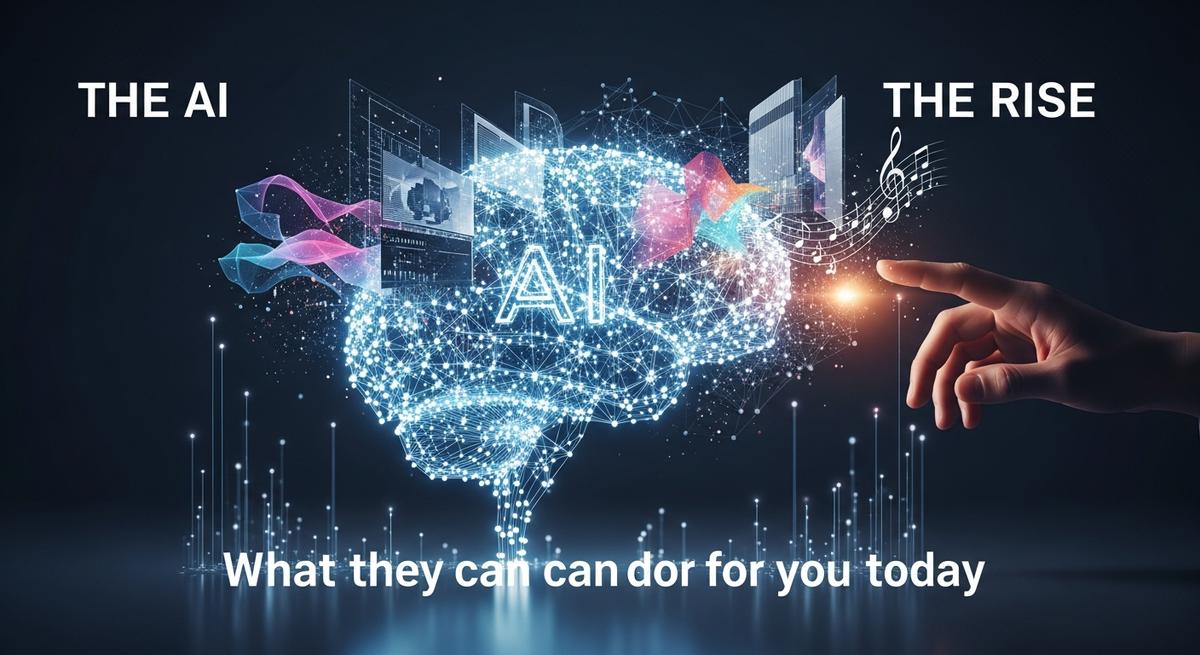
The rise of generative AI tools: what they can do for you today
- November 22, 2025
- ~ 1 min read
- 183 views
- GenAI , Everyday AI , AI in Business
Introduction/Overview
Generative AI is rapidly transforming the way we work, create, and innovate, marking a pivotal moment in the ongoing AI revolution. As we step into 2025, these advanced AI tools are no longer futuristic concepts but practical solutions reshaping industries across the globe. From automating routine tasks to generating original content, generative AI is empowering professionals to achieve more with greater efficiency and creativity.
What Is Generative AI and Why It Matters Now
At its core, generative AI refers to artificial intelligence systems designed to produce new content—whether text, images, audio, or code—based on patterns learned from vast datasets. Unlike traditional AI that focuses on analyzing or classifying data, generative AI creates fresh, original outputs tailored to user prompts. This capability unlocks unprecedented opportunities for businesses and creators alike, enabling rapid content generation, personalized customer interactions, and accelerated innovation cycles.
In 2025, the significance of generative AI lies in its maturation and widespread accessibility. Advances in natural language processing and machine learning have made these tools more powerful and user-friendly, allowing enterprises to integrate AI-driven workflows seamlessly. The result is a technology that not only enhances productivity but also democratizes skills, helping both beginners and experts excel in their roles.
Rapid Adoption Across Industries
The adoption of generative AI is surging across diverse sectors, including retail, healthcare, finance, manufacturing, and technology. Businesses are leveraging these tools to streamline operations, reduce costs, and deliver hyper-personalized experiences to customers. For example, marketing teams use AI to generate compelling campaign content in seconds, while product designers accelerate prototyping through AI-assisted creativity. This broad uptake reflects generative AI’s versatility and its capacity to drive competitive advantage in an increasingly digital economy.
What to Expect in This Article
This article will explore the key 2025 trends shaping generative AI’s impact, focusing on practical applications and tangible benefits for business professionals, tech enthusiasts, and decision-makers. You will learn how generative AI enhances productivity by automating repetitive tasks, fosters innovation by expanding creative possibilities, and improves decision-making through advanced data synthesis. Additionally, we will address challenges and considerations for adopting these tools responsibly.
Prepare to discover how generative AI can transform your workflows, unlock new growth opportunities, and position your organization at the forefront of the evolving AI revolution.
Main Content
Generative AI tools have rapidly evolved from experimental novelties to essential assets for professionals across industries. In 2025, these platforms are no longer just futuristic concepts—they are actively reshaping how we create, collaborate, and innovate. At their core, generative AI tools leverage advanced algorithms to produce high-quality content, code, images, and even video, making them indispensable for anyone looking to boost both productivity and creativity.
Core Capabilities: What Generative AI Can Do
Today’s leading generative AI tools excel in several key areas:
- Text Generation: From drafting emails and reports to crafting marketing copy and blog posts, AI-powered writing assistants like ChatGPT and GrammarlyGO help users produce clear, engaging content in minutes.
- Image and Video Creation: Platforms such as Midjourney, DALL·E 3, and Runway ML enable users to generate stunning visuals and videos for presentations, social media, and product design.
- Code Generation: Tools like GitHub Copilot and Microsoft 365 Copilot accelerate software development by suggesting code snippets, automating repetitive tasks, and flagging potential errors.
- Multimedia and Design: AI tools are now used to create music, design websites, and prototype apps, making creative workflows faster and more accessible.
Real-World Use Cases Across Business Functions
Generative AI is transforming a wide range of business operations:
- Marketing & Sales: Marketers use AI to generate personalized content, optimize ad copy, and analyze customer data, resulting in more effective campaigns and higher engagement.
- Product Development: Teams leverage AI for rapid prototyping, automating documentation, and brainstorming new product ideas, speeding up innovation cycles.
- Customer Service: AI-powered chatbots provide instant, 24/7 support, improving response times and customer satisfaction.
- Legal & Compliance: Specialized tools like Writer.com help regulated industries maintain brand voice, enforce compliance, and generate secure, accurate documentation.
Boosting Productivity and Creativity
One of the most significant benefits of generative AI is its ability to enhance both productivity and creativity. By automating routine tasks and providing instant inspiration, these tools free up valuable time for strategic thinking and innovation. For example, developers using AI coding assistants report up to 50% higher productivity, while content creators can overcome writer’s block and experiment with new ideas more easily.
Generative AI is not just about doing things faster—it’s about unlocking new possibilities and empowering teams to achieve more with less effort.
Supporting Remote and Hybrid Work Environments
In today’s flexible work landscape, generative AI tools are especially valuable for remote and hybrid teams. They facilitate seamless collaboration, streamline communication, and ensure consistent output regardless of location. Whether you’re drafting a proposal, designing a presentation, or troubleshooting code, AI-powered platforms help bridge gaps and keep projects moving forward, no matter where your team is based.
By integrating generative AI into daily workflows, professionals can harness the full power of these tools to drive efficiency, foster innovation, and thrive in an increasingly digital world.
Examples and Use Cases
Marketing and Sales: Personalized Content and Campaigns
Generative AI has revolutionized marketing by enabling hyper-personalized content creation that drives engagement and conversions. Tools like Jasper and AdCreative.ai automatically generate tailored ad creatives, email campaigns, and social media posts optimized for specific audiences and platforms. For instance, marketing teams at leading e-commerce companies use AI to produce targeted ads that resonate with different customer segments, increasing click-through rates and reducing campaign costs. This capability allows brands to scale content production rapidly while maintaining relevance and quality, providing a significant competitive advantage in customer acquisition and retention.
Product and Engineering: Rapid Prototyping and Documentation
In product development and engineering, generative AI accelerates innovation by automating design prototyping and technical documentation. Companies like Grid Dynamics leverage AI-powered tools to generate and modify product concepts from textual or visual prompts, significantly shortening development cycles. For example, their Generative AI Product Design Starter Kit enables retailers and manufacturers to create multiple design variations quickly, facilitating early-stage ideation and personalized product experiences at scale. Additionally, AI assists engineers by auto-generating detailed documentation and code snippets, improving productivity and reducing time-to-market. This results in faster iteration, reduced R&D costs, and enhanced alignment with customer needs.
Customer Service: AI-Powered Chatbots and Support
Customer service is another area transformed by generative AI through intelligent chatbots and virtual assistants that provide 24/7, context-aware support. Businesses deploy AI-driven conversational agents to handle common inquiries, troubleshoot issues, and guide users through complex processes, reducing response times and operational costs. For example, enterprises across finance, retail, and telecommunications report improved customer satisfaction scores due to faster resolutions and personalized interactions powered by AI. These tools also integrate seamlessly with CRM systems, enabling proactive service and predictive issue management, which leads to higher customer loyalty and operational efficiency.
Content Creation: Blogs, Social Media, and Video Scripts
Generative AI tools like ChatGPT and Synthesia have become indispensable for content creation, producing high-quality written and video materials at scale. Content creators and marketing teams use these platforms to generate blogs, social media posts, and even video scripts tailored to brand voice and audience preferences. For example, Synthesia empowers companies to convert standard operating procedures and training manuals into engaging AI-generated videos, significantly enhancing internal and external communications. This capability not only accelerates content production but also improves engagement metrics and reduces reliance on costly creative resources.
Advanced Concepts and Deep Dive
How Generative AI Models Work: NLP, Deep Learning, and Multimodal Capabilities
At the core of generative AI lies a sophisticated interplay of natural language processing (NLP) and deep learning techniques. NLP enables machines to understand, interpret, and generate human language, making it fundamental for tasks such as text generation, translation, and conversational AI. Deep learning architectures, particularly transformer-based models, power this capability by learning complex patterns from vast datasets, enabling context-aware and coherent content creation.
Beyond text, generative AI has evolved into multimodal models that integrate multiple data types—such as text, images, and audio—into a unified generation process. These models leverage cross-modal learning to produce richer, more contextually relevant outputs, enabling applications like generating images from textual descriptions or creating videos with synchronized narration. This multimodal approach broadens the scope of generative AI, making it a versatile tool across industries.
Emerging Trends: Agentic AI, Orchestration Platforms, and Enterprise Integration
The landscape of generative AI in 2025 is marked by the rise of agentic AI—autonomous systems capable of setting goals, planning actions, and executing complex tasks with minimal human intervention. These AI agents act as collaborators or digital assistants that can navigate workflows, make decisions, and adapt dynamically to changing environments, greatly enhancing productivity and innovation.
Complementing agentic AI are orchestration platforms, which serve as the backbone for managing and coordinating multiple AI models and services. These platforms handle resource allocation, workflow management, and integration across diverse AI components, ensuring seamless interoperability and scalability. In enterprise contexts, orchestration enables the embedding of generative AI capabilities directly into business processes, from customer service automation to content creation pipelines, thereby driving operational efficiency and value creation.
Enterprise integration also involves sophisticated API frameworks and middleware that maintain semantic coherence and state management across modalities, facilitating real-time collaboration between AI systems and human users. This integration is critical for deploying generative AI as reliable, production-grade solutions rather than experimental prototypes.
Challenges and Limitations: Bias, Accuracy, and Ethical Considerations
Despite remarkable advances, generative AI faces significant challenges that must be addressed for responsible adoption. One of the foremost issues is bias embedded in training data, which can lead to skewed or unfair outputs, perpetuating stereotypes or misinformation. Mitigating bias requires rigorous dataset curation, transparency in model design, and ongoing monitoring.
Accuracy remains a complex hurdle, especially for applications demanding high trustworthiness such as legal, medical, or financial domains. Generative models may produce plausible but incorrect information, necessitating robust validation mechanisms and human oversight.
Ethics is a critical dimension encompassing concerns over privacy, consent, and the potential misuse of AI-generated content. The development and deployment of generative AI must adhere to ethical frameworks that prioritize transparency, accountability, and respect for user rights. Industry standards and regulatory guidelines are evolving to address these issues, but proactive governance and interdisciplinary collaboration remain essential.
Future Outlook: What’s Next for Generative AI
Looking ahead, generative AI is poised to become even more integrated, intelligent, and autonomous. Advances in agentic AI will enable systems to undertake increasingly complex, multi-step tasks with minimal human input, transforming industries such as software development, architecture, and creative arts.
We anticipate the continued evolution of orchestration platforms that will unify diverse AI capabilities into cohesive ecosystems, facilitating end-to-end automation and real-time decision-making at enterprise scale. Moreover, research into reducing bias, improving model explainability, and embedding ethical principles directly into AI architectures will be paramount.
Ultimately, generative AI is set to reshape how businesses innovate, create, and operate—ushering in an era where human expertise and AI capabilities coexist synergistically to unlock unprecedented potential.
Implementation Guide and Best Practices
Step-by-Step Guide to Selecting and Integrating AI Tools
Implementing generative AI tools successfully begins with a clear understanding of your business objectives and project goals. Follow these steps to ensure a smooth implementation process:
- Identify your goals: Define what you want to achieve with generative AI, such as automating content creation, enhancing customer service, or accelerating software development. Clear goals help narrow down the right tools and approaches.
- Assess data readiness: Evaluate the availability, quality, and structure of your data. High-quality, well-organized data is essential for training and fine-tuning AI models effectively.
- Research and select tools: Choose generative AI platforms that align with your needs, considering features like integration capabilities, scalability, and security compliance. Popular tools in 2025 include Jasper for content, GAN-based models for image generation, and large language models (LLMs) for text-based tasks.
- Pilot and test: Start with small-scale pilots or proofs of concept (PoCs) to validate the AI tool’s effectiveness within your workflows. Use no-code or low-code platforms if possible to reduce complexity.
- Integrate into workflows: Seamlessly embed AI outputs into existing processes, ensuring that human oversight complements AI-generated content for optimal quality and creativity.
- Monitor and iterate: Establish performance metrics such as relevance, coherence, and user satisfaction. Regularly evaluate AI outputs and refine models based on feedback and evolving needs.
Best Practices for Maximizing ROI and Minimizing Risks
To maximize your ROI while minimizing risks during generative AI adoption, adhere to these best practices:
- Align AI initiatives with business strategy: Ensure AI projects directly address key business challenges or opportunities to drive measurable value.
- Engage cross-functional teams: Involve stakeholders from IT, operations, legal, and end-user departments early to foster collaboration and comprehensive understanding.
- Prioritize data privacy and compliance: Implement strong data governance frameworks to safeguard sensitive information and comply with regulations, reducing legal and reputational risks.
- Start small and scale thoughtfully: Begin with manageable projects to mitigate complexity and build organizational confidence before expanding AI applications.
- Invest in training and change management: Provide ongoing education and support to employees to reduce resistance and accelerate adoption.
- Maintain human oversight: Use AI to augment human creativity and decision-making rather than replace it, ensuring quality control and ethical considerations.
Common Pitfalls to Avoid and Tips for Successful Adoption
Avoid these common pitfalls to ensure your generative AI implementation delivers sustained success:
- Neglecting clear objectives: Without defined goals, projects risk becoming unfocused and failing to deliver tangible benefits.
- Underestimating data preparation: Poor data quality or insufficient data volume can severely limit AI performance and output relevance.
- Overlooking integration challenges: AI tools that do not fit well into existing systems can create workflow bottlenecks and user frustration.
- Ignoring scalability: Choosing solutions that cannot grow with your needs leads to costly replacements or rework.
- Failing to measure impact: Without clear KPIs and feedback loops, it’s difficult to optimize AI models or justify further investment.
To foster successful adoption, emphasize transparency about AI capabilities, encourage experimentation, and celebrate early wins to build momentum.
Resources and Tools for Further Exploration
For hands-on experimentation and deeper learning, consider these trusted resources and platforms:
- AI platforms: Explore Jasper for content generation, OpenAI’s GPT models for language tasks, and GAN-based frameworks for image creation.
- Learning resources: Engage with online courses and tutorials from providers like Coursera, Udacity, and specialized AI bootcamps focusing on generative AI technologies.
- Community and support: Join AI forums, LinkedIn groups, and professional networks to share insights, troubleshoot challenges, and stay updated on emerging trends.
- Implementation frameworks: Utilize AI implementation roadmaps and strategic guides from industry leaders to structure your adoption journey effectively.
"Successful generative AI adoption hinges on clear goals, seamless integration, and continuous refinement—combining technology with human expertise to unlock maximum value."
Comparison and Analysis
Leading Generative AI Tools: Strengths and Weaknesses
As generative AI continues to reshape industries, several platforms have emerged as leaders in 2025. ChatGPT, powered by OpenAI’s GPT-4o, remains the industry benchmark for versatility, offering robust text generation, code assistance, and creative ideation. Its main strengths include a user-friendly interface, broad language support, and continuous updates. However, users may encounter occasional hallucinations and verbose outputs, especially with complex queries.
Jasper excels in marketing and content creation, making it a top choice for businesses focused on copywriting, social media, and SEO. Its intuitive workflow and integration with creative tools streamline content production. The downside is its limited free tier and a steeper learning curve for advanced features.
Synthesia leads in AI-powered video generation, enabling users to create professional videos with customizable avatars and multilingual support. It’s ideal for training, marketing, and internal communications. Yet, its pricing can be prohibitive for smaller teams, and customization options are less flexible than traditional video editing software.
GrammarlyGO stands out for real-time writing enhancement, grammar correction, and tone adjustment. It’s widely adopted by professionals who prioritize polished, error-free communication. However, its generative capabilities are more limited compared to broader AI assistants.
Alternatives and Trade-offs
For those seeking alternatives, Perplexity AI offers grounded, citation-rich answers ideal for research and fact-based tasks. Claude is known for its long-context handling and nuanced style options, making it suitable for detailed document analysis. Microsoft Copilot integrates seamlessly with Office 365, enhancing productivity for enterprise users. Each tool presents unique trade-offs: Perplexity’s depth versus ChatGPT’s breadth, Claude’s context length versus Jasper’s marketing focus, and Copilot’s ecosystem integration versus standalone AI platforms.
Choosing the right tool often depends on your specific needs—whether it’s creative ideation, technical accuracy, or workflow integration.
Selection Criteria for Your Needs
When evaluating generative AI tools, consider the following selection criteria:
- Primary Use Case: Are you focused on content creation, research, video production, or productivity?
- Budget: Many tools offer free tiers, but advanced features often require paid plans.
- Integration: Does the tool work with your existing software stack?
- Data Privacy: Ensure the platform meets your organization’s security and compliance standards.
By weighing these factors, you can make an informed tool comparison and select the best fit for your goals. Remember, the ideal solution balances functionality, cost, and ease of use—helping you maximize the benefits of generative AI while minimizing potential drawbacks.
Conclusion and Key Takeaways
Generative AI tools have rapidly evolved from experimental technologies to essential assets driving transformation across industries in 2025. Their ability to automate repetitive tasks, enhance decision-making, and unlock new creative and operational possibilities is reshaping the way businesses and professionals work. From boosting productivity and reducing costs to enabling innovation in product design and customer engagement, generative AI is proving to be a powerful catalyst for growth and efficiency.
Summary of Generative AI Benefits
As explored throughout this article, generative AI delivers a broad range of benefits including:
- Increased productivity by automating routine workflows and freeing up human talent for higher-value activities.
- Enhanced creativity and innovation through AI-assisted content creation, design simulation, and data-driven insights.
- Cost reduction by streamlining operations and accelerating decision-making processes.
- Improved customer experiences via personalized recommendations and real-time AI-powered support.
- Workforce empowerment through upskilling and enabling employees to focus on strategic tasks rather than repetitive work.
Key Takeaways and Actionable Insights
To harness the full potential of generative AI, consider these key takeaways:
- Start small but think big: Experiment with accessible AI tools to gain familiarity while planning for broader integration aligned with your business goals.
- Focus on responsible adoption: Prioritize ethical AI use, data governance, and employee training to ensure sustainable and inclusive benefits.
- Leverage AI to augment human skills: Use AI as a collaborative partner that enhances creativity, decision-making, and problem-solving rather than replacing talent.
- Monitor and measure impact: Track productivity gains, cost savings, and customer satisfaction to continuously refine AI strategies.
- Stay informed about evolving AI capabilities: The future of AI is dynamic—keep pace with innovations to maintain competitive advantage.
Call-to-Action: Embrace the Future of AI Today
The rise of generative AI marks a pivotal moment for businesses and professionals eager to innovate and excel. Your next step could be as simple as exploring a new AI tool tailored to your industry or as strategic as developing an enterprise-wide AI adoption roadmap. By actively engaging with these technologies now, you position yourself and your organization to thrive in the rapidly evolving digital landscape.
Take action today: experiment with generative AI applications, invest in upskilling your teams, and foster a culture that embraces AI-driven transformation. The future of AI is not just about technology—it’s about empowering people to achieve more. Embrace this exciting journey and unlock new possibilities for growth, innovation, and success.

Comments (0)
Please login or register to leave a comment.
No comments yet. Be the first to comment!