
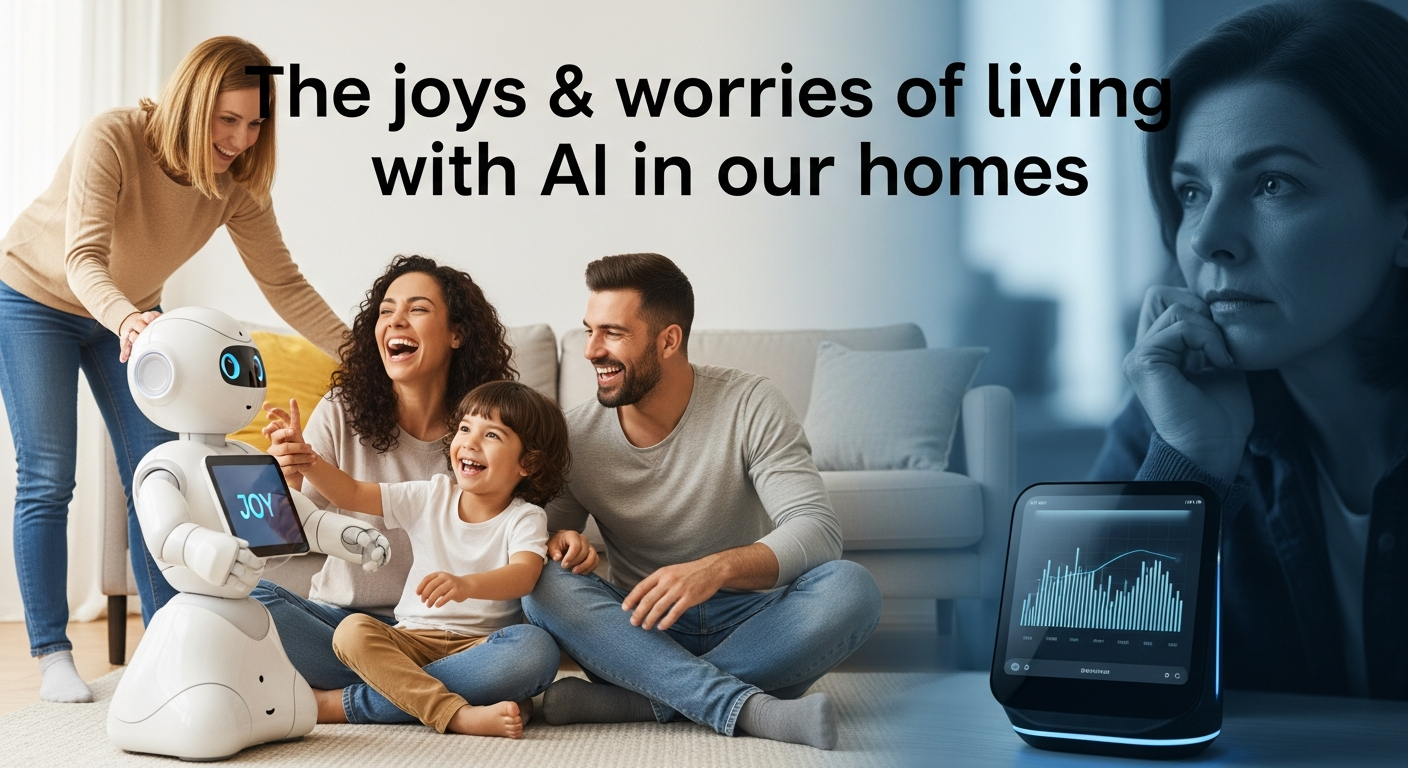
The joys & worries of living with AI in our homes
- November 22, 2025
- ~ 1 min read
- 134 views
- GenAI , Lifestyle & AI
Introduction to AI in Our Homes: Embracing the Future
Imagine walking into your home after a long day, and the lights adjust to your preferred brightness, your favorite playlist starts softly in the background, and the thermostat has already set the perfect temperature—all without you lifting a finger. This isn’t science fiction; it’s the reality for millions of households embracing AI in homes today. Artificial intelligence is no longer a futuristic concept reserved for labs and tech giants; it’s now an integral part of our daily lives, quietly transforming the way we live, work, and interact with our living spaces.
The Rise of Smart Home Technology
From voice-activated assistants to AI-powered appliances, smart home technology is rapidly becoming the norm. According to recent market forecasts, the global smart home industry is projected to generate over $170 billion in revenue by 2025, with household penetration expected to reach nearly 78%. This surge is driven by advancements in the Internet of Things (IoT), machine learning, and, most notably, artificial intelligence. Devices like smart thermostats, security cameras, and even kitchen gadgets are now equipped with AI capabilities that learn from our habits, anticipate our needs, and automate routine tasks.
Why AI in Homes Matters in 2025
The year 2025 marks a pivotal moment in the evolution of home automation. As AI becomes more accessible and affordable, it’s no longer just for tech enthusiasts or early adopters—it’s for everyone. Whether it’s optimizing energy usage, enhancing security, or simply making life more convenient, AI is reshaping the way we experience our homes. But with these advancements come important questions: How much control are we willing to give to machines? What are the trade-offs between convenience and privacy? And how do we ensure that these technologies serve us, rather than complicate our lives?
“The integration of AI and IoT in homes reflects the growing trend of mutual adaptation. On the one hand, there’s technology adapting to human needs, and on the other, there’s humans adapting to the potential and capacity of technology.”
What to Expect in This Article
In the following sections, we’ll explore both the joys and worries of living with AI in our homes. We’ll dive into the benefits—like increased efficiency, personalized experiences, and enhanced security—as well as the concerns, such as data privacy, over-reliance on technology, and the potential loss of human touch. Our goal is to provide a balanced, insightful look at how AI is changing home life, helping you make informed decisions about the role of technology in your own home.
So, whether you’re already living in a smart home or just curious about what the future holds, get ready to discover the exciting—and sometimes challenging—world of AI in our homes.
Understanding AI Technologies in Smart Homes
Artificial intelligence (AI) is rapidly transforming the way we interact with our homes, making everyday living more convenient, efficient, and personalized. At the heart of this revolution are several core AI technologies that power the smart devices and systems found in modern homes. Understanding these technologies is key to appreciating both the capabilities and the implications of AI in home environments.
Core AI Technologies Powering Smart Homes
The most fundamental AI technologies in smart homes include machine learning, natural language processing, and predictive analytics. Machine learning enables devices to learn from data, recognize patterns, and make decisions without explicit programming. For example, a smart thermostat uses machine learning to analyze your daily routines and adjust the temperature automatically, optimizing comfort and energy efficiency.
Natural language processing (NLP) allows devices to understand and respond to human speech. This is the technology behind popular voice assistants like Amazon Alexa, Google Assistant, and Apple Siri. With NLP, you can control lights, thermostats, and security systems using simple voice commands, making your home more accessible and intuitive.
Predictive analytics uses historical data and algorithms to forecast future events or behaviors. In smart homes, this means devices can anticipate your needs—such as turning on the lights before you enter a room or adjusting the climate based on weather forecasts.
Common AI-Powered Home Devices
AI home devices are now commonplace in many households. These include:
- Smart assistants (e.g., Alexa, Google Assistant) that manage tasks, answer questions, and control other smart devices.
- Smart thermostats (e.g., Nest, Ecobee) that learn your preferences and optimize heating and cooling.
- Security cameras and doorbells (e.g., Ring, Arlo) that use AI to recognize faces, detect unusual activity, and send alerts.
- Smart lighting systems that adjust brightness and color based on your habits and time of day.
These devices work together to create a seamless, responsive home environment that adapts to your lifestyle.
Personalization, Automation, and Connectivity
AI personalizes your home by learning your preferences and automating routine tasks. For instance, your smart home might dim the lights, play your favorite music, and start brewing coffee when you wake up—all without manual intervention. This level of automation is made possible by the integration of AI with the Internet of Things (IoT), where devices communicate and share data to create a unified ecosystem.
Connectivity enablers like 5G connectivity further enhance AI functionality by providing faster, more reliable communication between devices. This ensures that your smart home responds quickly and efficiently, even when managing multiple tasks simultaneously.
AI in smart homes is not just about convenience—it’s about creating a living space that learns, adapts, and evolves with you, making daily life more comfortable and efficient.
By leveraging machine learning, natural language processing, and advanced connectivity, AI home devices are redefining what it means to live in a smart home.
Real-World Examples of AI Enhancing Home Life
Artificial intelligence has moved from science fiction into the living rooms, kitchens, and bedrooms of millions of homeowners worldwide. The transformation isn't happening in isolation—it's a coordinated evolution where smart assistants, energy management systems, security platforms, and entertainment devices work together to create genuinely intelligent homes. More than 60% of smart home users now rely on AI daily, and their experiences reveal how profoundly these technologies can reshape everyday routines.
Smart Assistants Learning Your Lifestyle
The foundation of most modern smart homes rests on AI-powered smart assistants like Amazon Alexa, Google Assistant, and Apple Siri. These aren't simply voice-activated search engines—they're learning systems that adapt to your unique patterns and preferences. When you ask your assistant to set the thermostat to 72 degrees on a winter evening or play jazz while you cook dinner, the system records these preferences and begins to anticipate your needs.
Over time, machine learning algorithms analyze your behavior patterns and create predictive models of your lifestyle. Your assistant remembers that you prefer your home warmer in the evenings during winter, that you enjoy upbeat music during morning routines, and that you typically set reminders for weekly tasks on Thursdays. Through this continuous learning process, these systems can better anticipate your needs and personalize their responses without requiring explicit commands.
The practical applications extend far beyond convenience. Voice-controlled routines automate entire sequences of actions—a single command like "Good morning" can trigger your coffee maker, adjust lighting gradually to simulate sunrise, pull up your calendar, and deliver personalized news briefings. Family agenda management becomes centralized, allowing household members to coordinate schedules, share shopping lists, and stay synchronized without constant manual updates.
Smart Thermostats and Intelligent Energy Management
One of the most tangible benefits of home AI appears in your utility bills. Energy management systems, particularly intelligent thermostats, represent a perfect marriage of AI capability and practical benefit. These devices continuously monitor temperature fluctuations, learn your comfort preferences, and adjust heating and cooling systems automatically—sometimes saving households significant amounts on energy costs.
Smart thermostats operate as simple reflex agents at their core: detecting changing temperatures and configuring automatically as needed. However, advanced models incorporate machine learning to understand seasonal patterns, occupancy schedules, and weather forecasts. They anticipate that you'll want your home warmer at 6 PM on winter evenings and cooler during summer afternoons. Some systems even integrate with weather data to predict temperature changes before they occur, allowing preemptive adjustments that maximize comfort while minimizing energy waste.
Beyond thermostats, AI extends to comprehensive home climate control. Lighting systems detect darkness—whether from nighttime or unexpected thunderstorms—and adjust accordingly. These intelligent systems require genuine AI reasoning because they must distinguish between different types of darkness and respond appropriately. Integration with other smart devices creates cascading automation: as evening approaches, lights gradually brighten in occupied rooms while dimming in empty spaces, and the thermostat begins its evening warm-up cycle.
Security Systems That Never Sleep
Home security has undergone a revolution through AI-driven surveillance and access control. Modern AI security systems use facial recognition, behavior prediction, and real-time threat analysis to provide protection that's both more effective and less intrusive than traditional systems. Cameras don't simply record footage—they actively analyze it, identifying unusual activity and sending alerts before potential threats materialize.
A key advancement involves reducing false alarms through continuous learning. Early security systems triggered alerts for every motion or sound, creating alert fatigue that actually reduced security effectiveness. Modern AI systems learn what constitutes normal activity in your home's specific environment. They understand that your cat moving across the living room at 2 AM is routine, but an unfamiliar person approaching your back door requires immediate notification. Smart locks and intelligent doorbells interact with these systems, creating a coordinated security network that can identify visitors, verify their identity, and grant or deny access automatically.
The integration extends to emergency services. When AI systems detect genuine threats, they can automatically alert law enforcement with real-time video feeds and precise location data, dramatically reducing response times. This proactive protection represents a fundamental shift from reactive security—systems that respond after incidents occur—to predictive security that prevents problems before they happen.
Entertainment and Comfort Personalization
AI transforms how we experience entertainment and comfort within our homes. Systems like Sonos and Bose, integrated with AI agents, adjust music and multimedia content according to your preferences, daily schedule, and even mood detected by environmental sensors. Rather than manually selecting playlists or adjusting volume, these systems create automatic thematic environments that respond to context.
Imagine arriving home after work: your AI system recognizes your presence, adjusts lighting to a warm, welcoming tone, sets the temperature to your preferred comfort level, and begins playing music that matches your typical evening mood. The system might suggest recipes based on ingredients currently in your refrigerator—a feature pioneered by devices like the Samsung Family Hub, which combines touchscreen interfaces with AI recommendation engines. These refrigerators can create intelligent shopping lists, recommend recipes based on available ingredients and time of day, and synchronize with other smart devices throughout your home.
Entertainment personalization extends across multiple rooms simultaneously. AI systems understand that you prefer different music in different spaces—perhaps classical in your home office, energetic pop in your workout room, and ambient sounds in your bedroom. The system maintains these preferences and applies them automatically, creating a cohesive yet personalized audio environment throughout your home.
The convergence of these AI systems creates homes that don't just respond to commands—they anticipate needs, learn preferences, and adapt continuously to create living spaces that feel genuinely intelligent and responsive to their inhabitants.
Deep Dive: Technical Insights and Advanced AI Concepts in Smart Homes
Emotional Intelligence AI and Behavioral Prediction
Modern smart homes are increasingly powered by sophisticated emotional intelligence AI systems that go beyond simple automation to interpret and respond to human emotions. These systems leverage multimodal data—such as facial expressions, voice tone, and body language—to simulate empathy and tailor interactions accordingly. Although current AI cannot truly experience emotions, it can mimic emotional responses to enhance user engagement and trust, creating a more natural and intuitive home environment. For example, AI-powered assistants may detect frustration or satisfaction in a user’s voice and adjust their responses to improve the experience. This capability is crucial for developing personalized behavioral prediction models that anticipate occupant needs by learning from daily routines and emotional cues, enabling proactive adjustments in lighting, temperature, or security settings to optimize comfort and safety.
Behavioral prediction in smart homes uses continuous data collection and machine learning algorithms to create dynamic user profiles, allowing AI to forecast actions such as preferred room temperature or lighting levels at specific times. This predictive intelligence fosters a seamless, anticipatory environment that adapts to individual lifestyles with minimal manual input, enhancing convenience while reducing energy consumption.
Data Processing: Edge Computing and Cloud Integration
To manage the vast amounts of data generated by smart home devices and maintain real-time responsiveness, advanced AI systems employ a hybrid processing architecture combining edge computing with cloud integration. Edge computing processes data locally on devices or nearby gateways, significantly reducing latency and bandwidth usage by handling immediate, time-sensitive tasks such as motion detection or voice recognition within the home network.
Meanwhile, cloud computing complements this by performing more complex analytics, long-term data storage, and cross-device synchronization. This dual approach ensures that smart home AI systems remain efficient and scalable, balancing privacy concerns with computational demands. Edge nodes filter and pre-process data before securely transmitting relevant insights to the cloud, where deeper learning models refine user profiles and system behaviors over time.
AI Algorithms for Context Awareness and Adaptive Learning
At the core of intelligent smart homes lie advanced algorithms designed for context awareness and adaptive learning. Context-aware AI integrates environmental data—such as time of day, occupancy, weather conditions, and user activity—to interpret situational nuances and adjust device operations accordingly. For example, a smart thermostat might lower heating when it detects no one is home or brighten lights when a user enters a room during evening hours.
Adaptive learning enables these systems to evolve continuously by updating their models based on new data and user feedback. Reinforcement learning techniques allow AI to optimize decision-making policies through trial and error, improving over time without explicit reprogramming. This results in a personalized, self-tuning home ecosystem that aligns closely with occupant preferences and habits, enhancing both comfort and energy efficiency.
Security Architecture and Encryption Methods in AI Home Systems
Given the sensitive nature of data collected and processed by smart home AI, robust AI security frameworks are essential. These systems employ multi-layered security architectures combining hardware-based protections, encrypted communication protocols, and stringent access controls. End-to-end encryption ensures that data transmitted between devices, edge nodes, and cloud servers remains confidential and tamper-proof.
Advanced cryptographic methods, such as AES (Advanced Encryption Standard) and TLS (Transport Layer Security), safeguard data in transit and at rest. Additionally, secure boot processes and hardware root-of-trust mechanisms prevent unauthorized firmware modifications. AI-powered anomaly detection algorithms monitor network traffic and device behavior in real time to identify potential intrusions or malicious activities, enabling rapid threat response and mitigation.
Expert Perspectives on Future AI Developments in Smart Homes
"The integration of emotional intelligence AI and adaptive learning will transform smart homes from reactive environments into proactive companions, capable of anticipating needs and enhancing well-being," notes Dr. Elena Rossi, a leading AI researcher in human-computer interaction.
Industry experts predict that future AI advancements will focus on deeper emotional understanding and more seamless human-AI collaboration. Emerging technologies like brain-computer interfaces and extended reality are poised to extend the smart home experience beyond physical devices, enabling immersive, personalized environments that respond to cognitive and emotional states.
Moreover, ethical AI design emphasizing transparency, privacy, and user autonomy will become increasingly important as smart homes evolve. Researchers advocate for frameworks that balance innovation with responsible data stewardship, ensuring that AI-driven homes remain secure, trustworthy, and aligned with occupant values.
Implementing AI in Your Home: Practical Tips and Best Practices
Bringing AI into your home can transform everyday routines, but a thoughtful approach is key to maximizing benefits while minimizing risks. From choosing the right devices to securing your network, here’s a practical guide to help you set up and maintain a smart, AI-powered home.
Selecting the Right AI-Enabled Devices
Start by identifying your home’s unique needs—whether it’s energy efficiency, security, or convenience. Look for AI devices that offer features like machine learning, predictive analytics, and voice recognition. Popular choices include smart thermostats (like the Nest Learning Thermostat), AI-powered cameras (such as Ring or Aqara), and smart lighting systems (like Philips Hue). Ensure compatibility with your preferred ecosystem (Google Home, Amazon Alexa, or Apple HomeKit) to guarantee seamless integration. Devices supporting the Matter protocol are ideal for cross-platform communication and future-proofing your setup.
Step-by-Step AI Device Setup and Security
Begin with a secure home network. Update your router’s firmware and use a strong, unique password. When setting up AI devices, follow these steps:
- Download the manufacturer’s app and create a dedicated account.
- Connect devices to your Wi-Fi, ensuring they’re on a separate network if possible.
- Enable two-factor authentication (2FA) for added security.
- Regularly update device firmware to patch vulnerabilities.
- Configure privacy settings to limit data collection and sharing.
For complex installations, consider professional help to ensure optimal placement and configuration. Proper AI device setup not only enhances performance but also reduces the risk of security breaches.
Privacy Best Practices and Smart Home Optimization
Protecting your privacy is crucial in an AI-powered home. Review each device’s privacy policy and disable unnecessary features like remote access or cloud storage if not needed. Use encrypted connections and avoid sharing sensitive information with voice assistants. To optimize AI performance:
- Regularly review and refine automation routines.
- Train AI systems by interacting with them consistently to improve responsiveness.
- Monitor device usage and adjust settings based on changing needs.
- Integrate devices that support local processing to minimize data exposure.
By following these privacy best practices and focusing on smart home optimization, you can enjoy a seamless, secure, and personalized AI experience. Remember, ongoing vigilance and regular updates are essential for maintaining home AI security and ensuring your smart home remains both intelligent and safe.
Balancing Benefits and Risks: A Comparative Analysis
Major Benefits of AI Integration in Homes
Integrating AI benefits into home environments offers significant advantages that enhance daily living. Foremost among these is convenience: AI-powered systems automate routine tasks such as adjusting lighting, managing thermostats, and controlling entertainment devices, often through simple voice commands or predictive learning of user habits. This automation not only saves time but creates a seamless, personalized living experience tailored to individual preferences.
Another critical benefit is energy efficiency. AI systems optimize energy consumption by learning occupancy patterns and adjusting heating, cooling, and lighting accordingly. Smart thermostats and AI-driven energy management can reduce utility bills and environmental impact by minimizing unnecessary energy use, contributing to sustainability goals. Additionally, enhanced security is a major advantage; AI-powered security cameras and smart locks use facial recognition and behavioral analysis to differentiate between familiar and suspicious activities, reducing false alarms and improving home safety.
Key Worries: Privacy, Data Security, and Dependence
Despite these advantages, there are notable concerns accompanying AI adoption in homes. Privacy concerns arise because AI devices continuously collect and process personal data to function effectively. This data, often stored in the cloud, can be vulnerable to breaches or misuse, raising questions about who controls and accesses sensitive information.
Data security risks are closely linked, as smart home systems can become targets for cyberattacks. Unauthorized access to cameras, microphones, or control systems could compromise safety and privacy. Moreover, the increasing reliance on AI technologies introduces technology dependence, where homeowners may lose manual control or become vulnerable to service outages or software failures, potentially disrupting everyday life.
DIY vs Professional Installation: A Comparative Perspective
When adopting AI in smart homes, homeowners face a choice between DIY vs professional installation. DIY setups offer affordability and flexibility, allowing tech-savvy users to customize their systems and integrate devices at their own pace. However, they may lack the robustness and security features of professionally installed systems, which typically include expert configuration, optimized network security, and ongoing support.
Professional installations often ensure seamless integration across diverse devices and provide better protection against vulnerabilities through expert knowledge of secure configurations. Conversely, DIY solutions might expose users to misconfigurations or compatibility issues, increasing data security risks. The decision depends on the user's technical expertise, budget, and desired level of system reliability and security.
Alternatives and Complementary Technologies
Beyond AI, several technologies can complement or serve as alternatives in smart homes. Traditional automation systems, such as programmable timers and manual sensors, offer simpler control without extensive data collection, thus reducing privacy concerns. Additionally, edge computing—processing data locally on devices rather than in the cloud—can enhance privacy and reduce latency, mitigating some risks associated with cloud-based AI.
Complementary technologies like blockchain are emerging to secure data transactions within smart home networks, offering enhanced transparency and security. Moreover, integrating AI with Internet of Things (IoT) devices, voice assistants, and energy management platforms creates a holistic ecosystem that balances automation benefits with user control and security measures.
Balancing the convenience and efficiency of AI with privacy and security safeguards is essential for a sustainable and trustworthy smart home experience.
Conclusion: Navigating the Future of AI in Home Living
The Balanced Reality of AI in Your Home
Living with artificial intelligence in our homes presents a compelling paradox: the same technologies that promise unprecedented convenience, security, and efficiency also introduce new considerations around privacy, cost, and dependence. Throughout this exploration of AI home integration, we've seen how innovations ranging from autonomous robot companions to AI-powered security systems are fundamentally transforming the way we live. The future is undeniably intelligent, but it's also one that demands our thoughtful participation.
The joys are tangible and immediate. Smart home technology is no longer reserved for tech enthusiasts—it's becoming essential for sustainability, safety, and quality of life. Homeowners are experiencing real returns through energy savings, enhanced security systems, and improved well-being. From voice-controlled automation that requires no programming knowledge to AI companions that can manage appliances and even feed your pets, these technologies are making our homes more responsive to our needs. For aging populations, AI-enabled smart homes are enabling independence and dignity through remote monitoring and automation. The smart home market's projected growth to surpass $633 billion by 2032 reflects not hype, but genuine adoption driven by real value.
Yet the worries deserve equal attention. Security vulnerabilities, data privacy concerns, initial investment costs, and the potential for over-reliance on automated systems all merit serious consideration. The integration of increasingly autonomous systems into our most personal spaces requires vigilance and informed decision-making.
The Path Forward: Informed Adoption and Continuous Learning
The key to maximizing the benefits of AI in home living lies in informed adoption. This means taking time to understand what data your devices collect, how that information is protected, and what permissions you're granting. It means starting small—perhaps with a single smart device—and expanding gradually as you become comfortable with the technology. It means reading reviews, comparing options, and choosing reputable manufacturers who prioritize security and privacy.
Security awareness cannot be overstated. As your home becomes smarter, it also becomes a potential target for cyber threats. Implement strong passwords, enable two-factor authentication, keep firmware updated, and regularly audit which devices have access to your network. These practices aren't paranoid—they're prudent stewardship of your digital home.
The landscape of smart home technology is evolving at breakneck speed. AI-powered voice assistants are becoming more intuitive, home batteries are gaining traction as energy costs rise, and advanced security systems now use computer vision to detect humans, packages, vehicles, and even license plates. Staying informed about these developments helps you make decisions aligned with your values and needs rather than being swept along by marketing momentum.
Your Next Steps: Embracing the Smart Home Future Thoughtfully
We encourage you to explore AI solutions thoughtfully, asking critical questions about each technology you consider: Does this genuinely improve my life or create unnecessary complexity? What data does it collect and who has access to it? What happens if the service is discontinued or the company goes out of business? How does it align with my values around privacy, sustainability, and independence?
Start by identifying one area of your home life where AI could deliver genuine value—whether that's energy efficiency, security, health monitoring, or daily convenience. Research options, read user experiences, and make a deliberate choice. As you integrate these technologies, monitor their impact on your daily life and adjust accordingly.
The future of home living is undoubtedly intertwined with artificial intelligence. By approaching this future with eyes open—embracing the genuine benefits while remaining vigilant about the risks—you can create a home that is not just smarter, but truly aligned with your needs and values. Keep learning, stay skeptical of hype, and remember that the best technology is ultimately the one that serves your life, not the other way around.