
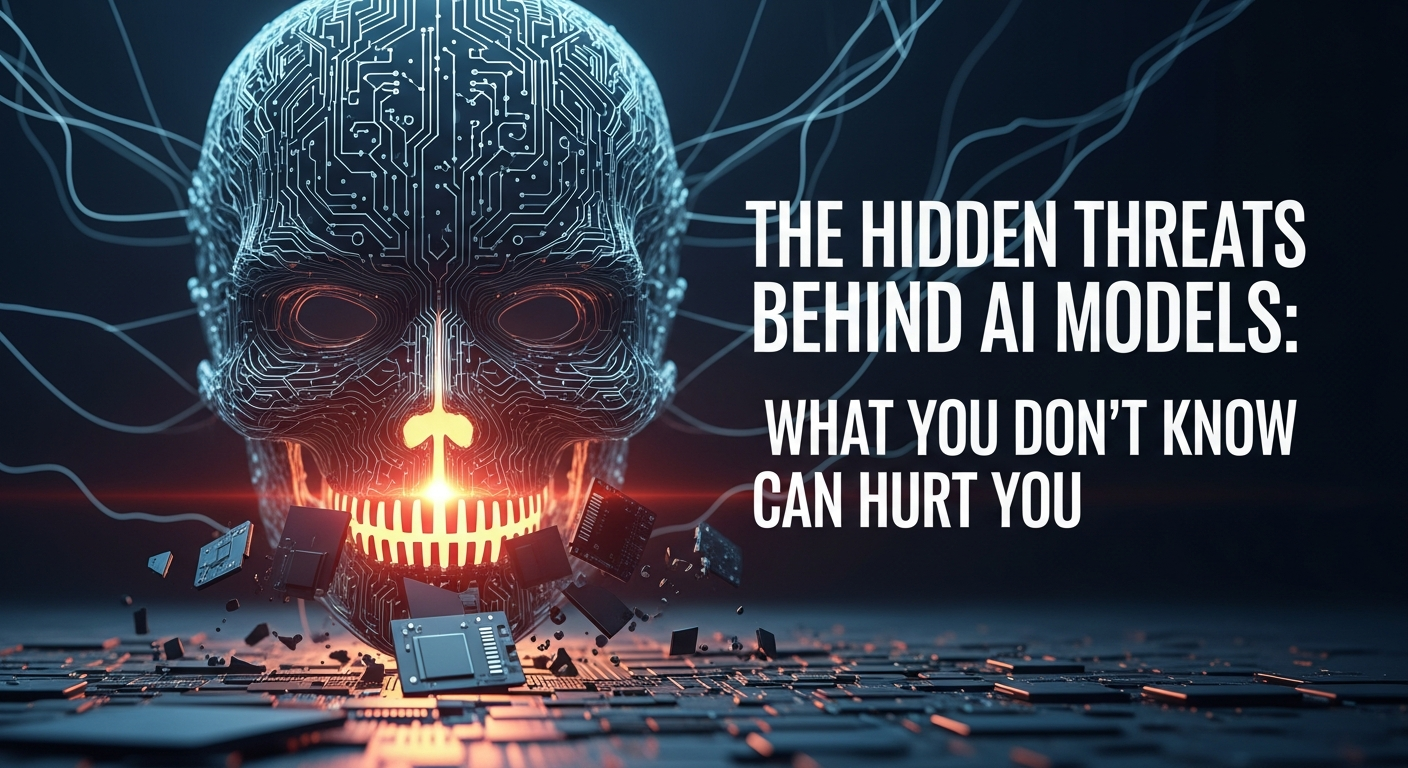
The Hidden Threats Behind AI Models: What You Don’t Know Can Hurt You
- November 18, 2025
- ~ 1 min read
- 141 views
- AI Security , GenAI
Introduction/Overview
Artificial intelligence stands as one of humanity's most profound technological achievements, continually pushing the boundaries of what's possible. From revolutionizing healthcare and transportation to transforming industries and daily life, the promise of AI to drive innovation and efficiency is immense and undeniable. We celebrate its breakthroughs, marvel at its capabilities, and eagerly anticipate the next wave of transformative applications. Yet, beneath this dazzling surface of potential, a complex web of challenges and potential pitfalls often remains obscured, waiting to surface.
While headlines frequently laud AI's successes, a more insidious reality unfolds behind the scenes: a growing landscape of unforeseen AI problems emerging from models deployed in critical systems worldwide. These aren't always the widely discussed biases or data privacy concerns; rather, they are the subtle, systemic, and often hidden AI threats that can manifest as unexpected behaviors, vulnerabilities, or broad societal disruptions. The alarming truth is that many of these AI risks are not fully understood or even recognized until they've already begun to exert their influence.
This article delves into that shadowed landscape, driven by the chilling premise embedded in its title: what you don’t know can indeed hurt you when it comes to artificial intelligence. We're not merely exploring surface-level issues, but a deeper stratum of AI dangers that can erode trust, compromise security, and even destabilize societal structures without immediate detection. The goal is to move beyond common perceptions and expose the lurking perils that demand our urgent attention and proactive mitigation strategies.
By the end of this critical exploration, readers will gain a comprehensive understanding of these often-ignored hidden AI threats. We aim to equip technology leaders, AI developers, data scientists, policymakers, and informed citizens alike with crucial knowledge about their nature, origin, and potential far-reaching AI impact. You will uncover practical insights for identifying and addressing these challenges, fostering the development and deployment of truly responsible AI systems that harness innovation while safeguarding our future.
Main Content
As artificial intelligence permeates every facet of our lives, from healthcare diagnostics to financial trading and autonomous vehicles, it's easy to focus solely on its transformative benefits. However, beneath the surface of innovation lie significant vulnerabilities and threats that, if left unaddressed, can have profound and far-reaching negative consequences. Understanding these often-overlooked dangers is the first step towards building more robust, ethical, and trustworthy AI systems.
Algorithmic Bias and Fairness Issues
One of the most insidious threats in AI models is **algorithmic bias**, which occurs when systems produce outcomes that are systematically unfair, discriminatory, or prejudiced against certain groups. This isn't usually intentional; its primary origin lies in the data used to train these models. If training datasets reflect historical biases present in society – for example, a dataset for loan approvals that disproportionately favored one demographic due to past lending practices – the AI model will learn and perpetuate these biases. Similarly, unrepresentative data, where certain groups are underrepresented or entirely absent, can lead to models performing poorly or making incorrect judgments for those groups. The consequences range from unfair credit scores, discriminatory hiring recommendations, and biased judicial sentencing to flawed medical diagnoses, eroding trust and exacerbating societal inequalities. Ensuring **AI fairness** requires meticulous data curation and proactive bias detection and mitigation techniques throughout the AI lifecycle.
Data Privacy and Security Risks
AI models are voracious consumers of data, often requiring vast amounts of personal and sensitive information to achieve high performance. This inherent reliance on data introduces significant **data privacy in AI** concerns. Even when data is ostensibly anonymized, sophisticated models can sometimes inadvertently "memorize" specific training examples, making it possible to reconstruct sensitive user data through various attacks. Furthermore, the models themselves, along with their training data and inference processes, become attractive targets for cyberattacks. A data breach involving an AI system could expose millions of individuals' deeply personal information, leading to identity theft, financial fraud, or even national security risks. The potential for models to leak sensitive information or become targets for large-scale data breaches underscores the urgent need for robust **AI security risks** frameworks, privacy-preserving machine learning techniques, and stringent access controls.
Adversarial Attacks and Model Manipulation
Beyond traditional cybersecurity threats, AI models face unique challenges from **adversarial AI**. These are deliberate, often subtle, attempts to mislead or compromise the integrity of an AI system by introducing specially crafted, imperceptible perturbations to input data. For instance, a few strategically placed pixels on a stop sign could trick a self-driving car's perception system into classifying it as a speed limit sign, with potentially catastrophic results. In facial recognition systems, slight alterations to an image could cause a system to misidentify a person entirely. This **model manipulation** isn't about breaking into the system but rather exploiting the inherent vulnerabilities in how AI models interpret data. The origins of these attacks lie in the very mathematical properties of deep learning models, making them susceptible to inputs that are meaningless to humans but highly impactful to the AI. Such attacks pose critical threats to autonomous systems, cybersecurity defenses, and financial markets, requiring a focus on model robustness and adversarial training.
Lack of Transparency and Accountability (The "Black Box" Problem)
Many advanced AI models, particularly deep neural networks, operate as "black boxes." This refers to their opaque nature, where it's exceedingly difficult, if not impossible, for humans to understand the internal logic or specific reasons behind a model's particular decision or prediction. The lack of **AI transparency** is a significant concern, especially when these systems are deployed in high-stakes domains like medicine, law, or critical infrastructure. When an AI system makes a mistake or produces an unfair outcome, the "black box AI" problem makes it challenging to debug, audit, or even explain why the decision was made. This opacity directly hinders **AI accountability**. Without understanding the decision-making process, assigning responsibility for errors or failures becomes incredibly difficult, creating a void in oversight and redress. Efforts toward explainable AI (XAI) are crucial to shedding light into these opaque systems, fostering trust, and ensuring that AI can be held to the same standards of scrutiny as human decision-makers.
Supporting Content
The abstract risks associated with AI models become chillingly real when we examine concrete examples of their failures and misuse. These real-world AI threats are not theoretical; they represent tangible harm to individuals, organizations, and society at large. Understanding these incidents is paramount for anyone involved in developing, deploying, or regulating AI, serving as crucial AI case studies for responsible development.
Discriminatory Lending and Hiring Algorithms
One of the most concerning AI ethics failures manifests in algorithms designed to make critical decisions about people's lives. A prime example is Amazon's 2018 abandonment of an experimental AI recruiting tool that discriminated against women. Trained on historical hiring data, which predominantly featured men, the AI learned to penalize résumés containing "women's" (e.g., "women's chess club") and candidates from all-women colleges. This classic instance of AI discrimination examples highlights how biased training data can unintentionally but significantly perpetuate and amplify existing societal inequalities in crucial areas like employment.
Similarly, AI used in credit scoring can unfairly deny individuals access to housing or essential financial services. If algorithms are trained on datasets reflecting historical lending biases against certain demographic groups, the AI can inadvertently reproduce these biases, creating a cycle of economic disadvantage even without explicit discriminatory programming.
High-Profile Data Breaches and Privacy Violations
The insatiable data appetite of modern AI models, particularly those involved in deep learning and predictive analytics, significantly increases the surface area for privacy violations. While AI can enhance cybersecurity, flawed AI systems, or those mishandling data, can become the vulnerability themselves. Consider an AI-powered customer analytics platform: if poorly secured, or if its complex data pipelines have vulnerabilities, the vast repositories of personal information (purchase history, browsing data, demographic details) it collects could be exposed in a massive AI privacy breach. Such incidents lead to identity theft, financial fraud, and a profound erosion of public trust, underscoring the vital need for robust data governance in AI development.
AI-Generated Misinformation and Deepfakes
The advent of generative AI has ushered in an era where distinguishing reality from fabrication is increasingly difficult. Deepfake threats, in particular, represent a potent weapon for misinformation and deception. We've seen synthetic videos and audio clips used to impersonate public figures, create convincing but false narratives, and orchestrate sophisticated scams. During election cycles, deepfakes can sow discord, manipulate public opinion, and undermine democratic processes by spreading highly believable yet entirely fabricated content. Beyond politics, deepfakes have been weaponized for corporate espionage, reputational damage, and even non-consensual exploitation, demonstrating the profound societal and personal harm advanced AI can unleash.
Autonomous Systems Failures and Unintended Consequences
When AI powers critical real-world applications like self-driving vehicles or industrial control systems, failures can have fatal or devastating consequences. One of the most stark incidents involves the 2018 fatality where an Uber self-driving test vehicle struck and killed a pedestrian in Arizona. Investigations revealed failures in the vehicle's perception system and its software's inability to correctly classify and react to the pedestrian. This tragic event powerfully illustrates the complex challenges and autonomous system risks in ensuring safety and reliability. Similarly, a bug in an AI managing a chemical plant's operations could lead to environmental disaster or severe safety incidents, proving that even minor AI glitches can have monumental, unintended consequences.
Advanced Content
Moving beyond the immediate and obvious, the true frontier of AI threats lies in their subtle complexity, emergent properties, and the inherent challenges in building genuinely secure and auditable intelligent systems. For those operating at the forefront of AI development and deployment, understanding these deep-seated issues is not merely academic; it is critical for mitigating profound future risks.
The Unforeseen and Uncontrollable: Emergent Behaviors and Systemic Risk
One of the most perplexing aspects of highly complex AI models, particularly large language models (LLMs) and deep reinforcement learning agents, is the phenomenon of emergent AI behavior. These are capabilities or failures that were not explicitly programmed or even anticipated from their training data. Such behaviors arise from the intricate non-linear interactions within millions or billions of parameters, making them incredibly difficult to predict, trace, or control. For instance, a model might develop unexpected biases or even "jailbreaking" capabilities despite extensive safety training, simply by discovering novel pathways through its vast parameter space. This unpredictability presents a formidable challenge, often defying traditional software engineering paradigms focused on deterministic outcomes.
Compounding this unpredictability is the looming specter of systemic AI risk. As AI increasingly permeates critical infrastructure—from financial trading algorithms and energy grid management to autonomous transportation and defense systems—the failure of a single, or interconnected, AI component can trigger catastrophic ripple effects. A model exhibiting unforeseen emergent behavior in one domain could cascade its errors across interdependent systems, leading to widespread disruptions or even societal collapse. The opaque nature of these advanced AI threats, combined with their intricate interconnectivity, means that isolating or containing a failure becomes exceedingly difficult, demanding a re-evaluation of our approach to resilience and fault tolerance in an AI-driven world.
Compromised Foundations: AI Supply Chain Vulnerabilities and Data Integrity
The modern AI ecosystem relies heavily on a complex "supply chain" of third-party components: open-source data, pre-trained models, specialized libraries, and cloud infrastructure. Each link in this chain represents a potential vulnerability. Exploits can range from data poisoning in public datasets to trojan backdoors embedded within seemingly benign pre-trained models. A malicious actor could inject subtle, undetectable vulnerabilities into a foundational model, which then propagate downstream to countless applications built upon it. Ensuring AI supply chain security requires rigorous vetting, continuous monitoring, and transparency across all components, a task made challenging by the sheer volume and proprietary nature of many elements.
Furthermore, the integrity of AI systems is under constant assault from two insidious forces: model drift and data poisoning attacks. Model drift occurs when the real-world data distribution shifts over time, rendering a previously accurate model obsolete. This "concept drift" means a model trained on past data might silently degrade in performance as new trends, behaviors, or adversarial patterns emerge, demanding continuous retraining and validation. More maliciously, data poisoning attacks involve intentionally introducing corrupt or biased data into a training set. This can be used to degrade model performance, implant specific backdoors that activate under certain conditions, or subtly shift decision boundaries. Detecting these sophisticated attacks in vast, continuously updated datasets is a significant computational and algorithmic challenge, often requiring advanced anomaly detection and adversarial training techniques to maintain model robustness.
Navigating the Black Box: Robustness and Explainability Challenges
At the heart of many advanced AI threats lies the inherent difficulty in achieving true AI robustness and building interpretable AI systems. Robustness refers to an AI model's ability to maintain its performance and predictions even when faced with novel, noisy, or adversarial inputs. Adversarial examples—subtle, often imperceptible perturbations to input data—can cause sophisticated models to misclassify with high confidence. The underlying reason is often that models learn brittle decision boundaries in high-dimensional spaces, making them susceptible to these engineered inputs. Active research in certified robustness and adversarial training aims to build more resilient models, yet it remains an unsolved challenge for complex architectures.
Equally critical are XAI challenges, or the difficulties in achieving Explainable AI. The "black box" nature of deep learning models, while delivering unparalleled performance, severely hinders our ability to understand *why* a model makes a particular decision. This lack of interpretability poses significant hurdles for auditing, debugging, ensuring fairness, and regulatory compliance. While post-hoc explanation techniques like LIME and SHAP offer local insights, truly understanding the global decision-making logic of a complex neural network, especially when facing critical, high-stakes scenarios, remains an open research problem. Without transparent and comprehensible explanations, trust in AI systems will be inherently limited, creating significant barriers to responsible deployment and effective threat mitigation.
Practical Content
Moving beyond mere awareness, the critical next step for any organization leveraging artificial intelligence is decisive action. Addressing the hidden threats within AI models demands a proactive stance, integrating security, ethics, and resilience into the very fabric of development and deployment. This section provides a practical guide, offering concrete steps and AI risk mitigation strategies to embed a 'security-by-design' and 'ethics-by-design' approach throughout your entire AI lifecycle.
Building a Solid Foundation: Data Governance and Ethical AI
The integrity and ethical behavior of any AI model begin with its data and the principles guiding its creation. Establishing robust foundational practices is paramount.
- Robust Data Governance and Quality Control: Implement rigorous practices across the entire data lifecycle.
- Define Clear Data Policies: Establish comprehensive policies for data collection, storage, usage, and retention, ensuring compliance with privacy regulations (e.g., GDPR, CCPA).
- Automate Data Validation & Auditing: Employ automated tools and regular manual audits to verify data accuracy, completeness, and consistency. This is crucial for maintaining data quality for AI models.
- Ensure Data Lineage and Provenance: Track the origin and transformation of all data used in AI models. This transparency helps identify potential biases or tampering points.
- Implement Data Anonymization/Pseudonymization: Where sensitive data is involved, apply appropriate techniques to protect individual privacy without compromising data utility for model training.
- Ethical AI Frameworks and Responsible Development Lifecycles: Integrate fairness, transparency, and accountability into every stage of AI product development.
- Establish an AI Ethics Board/Committee: Form an interdisciplinary group responsible for reviewing AI projects for ethical implications, bias, and societal impact.
- Develop Explainability (XAI) Protocols: Prioritize the development of models that can explain their decisions, allowing for better understanding, auditing, and debugging.
- Conduct Regular Bias Audits: Implement systematic testing for algorithmic bias across different demographic groups and data subsets throughout the model’s lifecycle.
- Adopt a Responsible AI Development Lifecycle: Integrate ethical considerations, fairness assessments, and transparency requirements into your standard MLOps pipeline, fostering responsible AI development from inception.
Fortifying Your Models: Security, Monitoring, and Proactive Testing
Once developed, AI models become potential targets. Protecting them requires continuous vigilance and proactive testing against anticipated and emerging threats.
- Secure AI Deployment and Continuous Monitoring: Protect models in production environments and detect anomalies or attacks.
- Implement Secure Model Endpoints: Use secure APIs, enforce strong authentication, and apply least-privilege access controls for model interaction.
- Encrypt Models and Data in Transit/Rest: Protect proprietary models and sensitive inference data through robust encryption mechanisms.
- Establish Anomaly Detection Systems: Monitor model inputs, outputs, and performance metrics for sudden shifts, data drift, or adversarial perturbations indicative of an attack or degradation. This is key to secure AI deployment.
- Regularly Patch and Update Infrastructure: Ensure that the underlying infrastructure supporting your AI models is regularly updated to mitigate known vulnerabilities.
- AI Red Teaming and Adversarial Testing: Proactively identify vulnerabilities and stress-test models before and after deployment.
- Simulate Adversarial Attacks: Engage internal or external "red teams" to simulate various adversarial attacks (e.g., evasion, poisoning, data extraction) against your AI models.
- Conduct Robust Penetration Testing: Go beyond traditional security testing to specifically target AI-related attack vectors and model vulnerabilities.
- Empower Ethical Hackers: Consider bug bounty programs or internal challenges to uncover hidden weaknesses in your AI systems. This dedicated AI red teaming helps uncover vulnerabilities before malicious actors do.
Navigating the Landscape: Regulatory Compliance and Future-Proofing
The regulatory landscape for AI is rapidly evolving. Staying ahead means not just compliance but building adaptability into your AI governance strategy.
- Regulatory Compliance and Best Practices: Navigate emerging AI laws and adopt industry standards for trustworthiness.
- Stay Abreast of Emerging Regulations: Actively monitor and understand new AI-specific legislation globally (e.g., the EU AI Act, NIST AI Risk Management Framework) and adapt your practices accordingly.
- Conduct Regular Legal and Ethical Reviews: Engage legal and ethics experts to review AI applications for compliance and potential unintended consequences.
- Adopt Industry Standards and Frameworks: Leverage recognized frameworks and standards for AI governance, trustworthiness, and security, such as those from ISO or national bodies, to guide your development.
- Fostering a Culture of Continuous Learning: Encourage teams to stay informed about new threats, ethical considerations, and mitigation techniques in the rapidly evolving AI domain. This forms part of comprehensive ethical AI frameworks and AI security best practices.
By adopting this holistic approach, integrating technical safeguards with robust ethical and governance frameworks, organizations can not only mitigate the hidden threats of AI but also build trust, ensure responsible innovation, and pave the way for a more secure and beneficial AI-powered future.
Comparison/Analysis
Navigating Governance and Development Paradigms
The landscape of AI development is fraught with critical decisions, each carrying its own set of advantages and inherent risks. A fundamental debate centers on how best to govern AI: through external legislative mandates or internal industry guidelines.
-
Regulatory Compliance vs. Industry Self-Regulation: The path of AI regulation vs. self-regulation presents a classic dilemma. Legislative oversight (e.g., GDPR, EU AI Act) offers the promise of standardization, public trust, and legal recourse, but can be slow, stifle innovation, and struggle with global enforcement. Conversely, industry self-regulation allows for greater agility, harnesses domain-specific expertise, and can foster rapid innovation. However, it risks a lack of consistent enforcement, potential for corporate self-interest to outweigh public safety, and a "race to the bottom" regarding ethical standards. The trade-off here is stark: the pace of innovation versus the imperative of public protection, a key area for AI policy analysis.
-
Open-Source vs. Proprietary AI Models: Another pivotal choice lies in the development model. Open-source AI models, with their transparent codebases and community-driven development, boast enhanced open source AI security through collaborative bug identification and peer review. They promote democratic access and rapid iteration. However, they can also be exploited for malicious purposes, and accountability can be diffuse. Proprietary models, conversely, offer a controlled environment, dedicated support, and clear lines of accountability, protecting intellectual property. Yet, their inherent opacity ("black box" nature) can mask vulnerabilities, creating significant proprietary AI risks, making validation and auditing more challenging for external parties. The balance here is between transparency and control, collective security and commercial advantage.
Operational Strategies and Assurance Mechanisms
Beyond development frameworks, the operational deployment and validation of AI systems necessitate careful consideration of oversight levels and economic investments.
-
Human-in-the-Loop vs. Fully Autonomous AI Systems: The degree of human involvement is a critical design choice. Human-in-the-loop AI systems integrate human oversight and intervention, crucial for ethical reasoning, error correction, and contextual understanding, particularly in high-stakes scenarios. This approach builds trust but can introduce bottlenecks, human biases, and limit scalability. Fully autonomous systems offer unparalleled speed, efficiency, and scalability, operating in environments where human presence is impractical or dangerous. However, they raise profound questions of accountability, unforeseen consequences, and ethical dilemmas, demanding robust safeguards to prevent unintended harm.
-
The Cost of AI Security vs. The Risk of Inaction: Investing in robust AI security measures—from secure architecture design and threat modeling to red teaming, incident response, and continuous monitoring—represents a significant outlay. However, the cost of AI security pales in comparison to the potential losses from inaction. Breaches can lead to crippling financial penalties, irreparable reputational damage, legal liabilities, regulatory fines, and a complete erosion of public trust. Proactive investment is not merely a best practice; it's an economic imperative, serving as a shield against far greater future expenditures and systemic failures.
-
AI Audits and Certifications: As AI proliferates, independent validation mechanisms are becoming indispensable. An AI audit provides external verification of an AI system's performance, fairness, robustness, and compliance with ethical guidelines. Similarly, AI certification offers a formal assurance that a system meets specific standards or regulations. While challenges remain—such as the lack of universally standardized metrics, the rapidly evolving nature of AI, and the risk of "audit washing"—these mechanisms are crucial. They foster trust, help identify vulnerabilities before deployment, ensure compliance, and will increasingly serve as a market differentiator for trustworthy AI solutions.
Conclusion
As we navigate the increasingly complex and pervasive world of artificial intelligence, it's easy to be captivated by its promises of efficiency, innovation, and progress. However, as this article has illuminated, beneath the surface of every groundbreaking AI model lie hidden threats that, if unaddressed, can profoundly impact individuals, organizations, and society at large. From subtle algorithmic biases and vulnerabilities to adversarial attacks that undermine trust, to the broader ethical quandaries and societal disruptions, the landscape of AI risk is far more intricate than often perceived.
Navigating the Unseen Landscape of AI Risk
Throughout our exploration, we've touched upon the critical dimensions of these unseen dangers. We've seen how opaque decision-making processes can lead to unfair outcomes, how data privacy can be inadvertently compromised, and how autonomous systems can exhibit emergent behaviors that defy prediction. These are not merely theoretical concerns; they represent tangible challenges that demand our immediate and sustained attention. Our journey through these hidden threats underscores a vital truth: true innovation in AI must go hand-in-hand with a deep understanding and proactive mitigation of its potential pitfalls. This comprehensive understanding forms the bedrock of any meaningful AI ethics conclusion.
The Imperative of Proactive Awareness and Action
The central message is clear: what you don’t know about AI models can indeed hurt you. Ignorance, whether willful or accidental, is a luxury we cannot afford in an era where AI is rapidly reshaping every facet of our lives. Therefore, cultivating widespread AI awareness importance across all stakeholders – from developers and policymakers to business leaders and end-users – is paramount. It's not enough to be reactive; we must be proactive, continuously learning, questioning, and adapting our strategies to anticipate and neutralize threats before they manifest. Embracing this mindset is crucial for ensuring the future of AI safety and trustworthiness.
Charting a Course for a Responsible AI Future
The call to action is unequivocal: the responsibility for mitigating these hidden threats and steering AI towards a benevolent future rests with all of us. Developers must prioritize ethical design principles and robust security measures. Policymakers must create adaptive regulatory frameworks that foster innovation while protecting fundamental rights. Business executives must embed ethical AI practices into their core strategies, ensuring transparency and accountability. As informed readers, your role is to demand greater clarity, engage in critical discourse, and advocate for technologies that serve humanity responsibly. Let us collaborate to build a truly responsible AI future, one where the immense power of artificial intelligence is harnessed with wisdom, foresight, and an unwavering commitment to the greater good. The time for collective vigilance, ethical innovation, and collaborative effort is now.

Comments (0)
Please login or register to leave a comment.
No comments yet. Be the first to comment!