
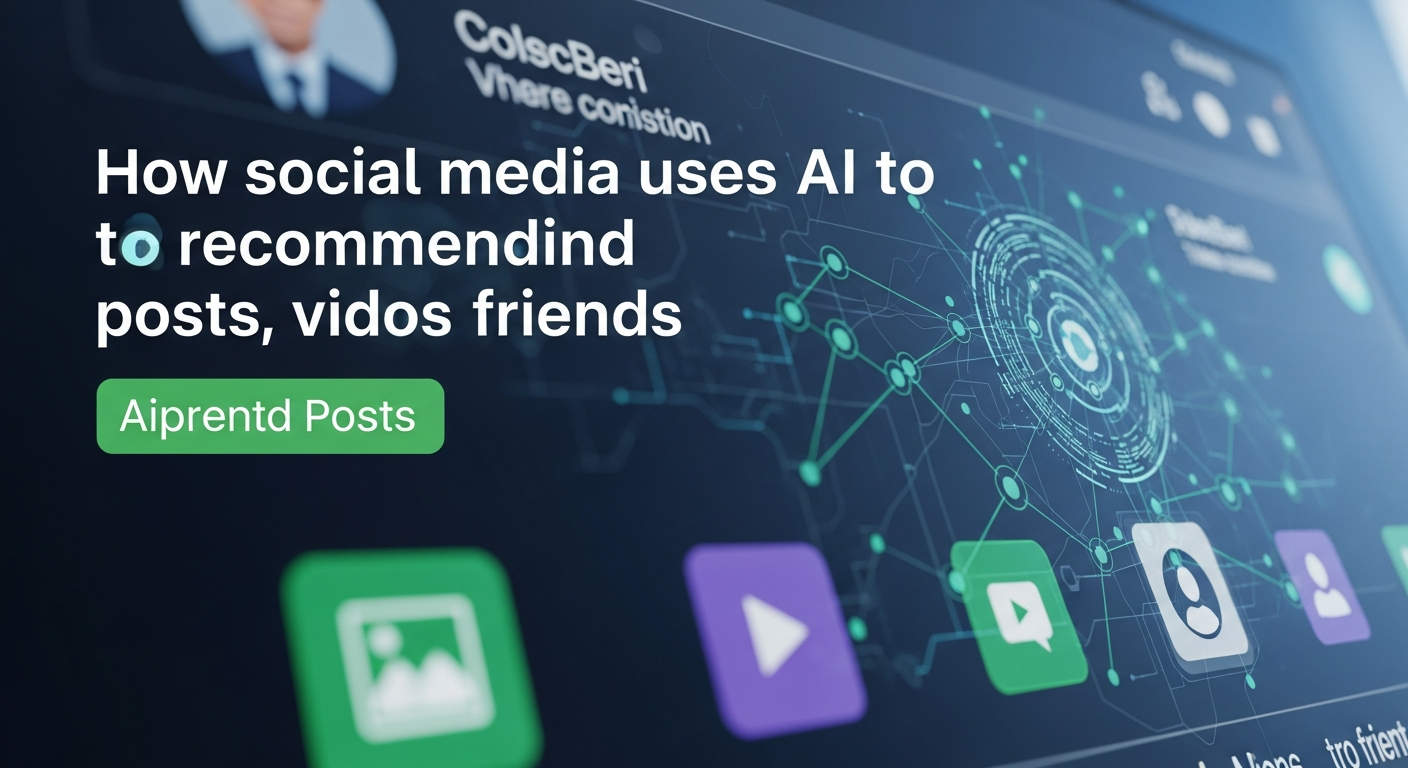
How social media uses AI to recommend posts, videos, and friends.
- November 20, 2025
- ~ 1 min read
- 125 views
- GenAI
Introduction: The Invisible Hand Shaping Your Social Media
Ever scrolled through your social media feed and felt an uncanny sense that it just gets you? A video about a niche hobby you only casually mentioned once, an article perfectly aligning with your latest interest, or a suggested friend who seems like a long-lost connection? It’s not magic, nor is it a coincidence. This experience of 'just right' content is the hallmark of a sophisticated system working tirelessly behind the scenes.
Behind every perfectly timed post and tailor-made suggestion lies a powerful, silent architect: Artificial Intelligence. Far from being a concept confined to science fiction, social media AI is the invisible hand actively shaping our daily digital experiences, transforming raw data into highly personalized journeys across platforms like TikTok, Instagram, Facebook, and X (formerly Twitter). It’s how your favorite app anticipates your next click, keeps you engaged, and continuously refines your view of the online world.
This seemingly seamless personalization raises fascinating and crucial questions. How do these platforms know what we want before we do? What are the intricate mechanisms behind our addictive scrolls and serendipitous discoveries? Understanding the deep integration of AI isn't just for tech enthusiasts; it's essential for every user navigating the modern internet. The AI impact on social media is profound, influencing our daily information consumption, the content we engage with, and even how we form and maintain social connections. As users, we're naturally curious about the power behind the curtain, and increasingly, concerned about data privacy and algorithmic transparency.
In this article, we’ll peel back the layers to demystify how these advanced recommendation algorithms function. You'll discover the secrets behind your truly personalized feed, understand the different types of recommendations – from viral videos to potential new friends – and explore the broader implications for your overall digital experience. Get ready to gain a comprehensive understanding of the intelligent systems that make your social media feed uniquely yours, transforming passive browsing into an active, guided exploration.
The Core Mechanics: How Recommendation Engines Work
Ever wondered how your social media feed seems to know exactly what you want to see, or who you might know? This isn't magic; it's the sophisticated work of recommendation engines. At their heart, these powerful systems are designed with one primary goal: to predict your preferences and present content, videos, or even potential connections that are most likely to engage you. They are the unseen architects behind the personalized digital experiences we've come to expect.
The foundation of these engines lies in advanced Artificial Intelligence, specifically leveraging two key paradigms: Machine Learning (ML) and Deep Learning (DL). Machine learning algorithms enable systems to learn from vast amounts of data without being explicitly programmed for every scenario. Deep Learning, a subset of ML, takes this a step further, using neural networks with multiple layers to uncover intricate patterns and more abstract representations within data, proving particularly effective for complex tasks like image or video analysis within social media contexts. This sophisticated use of deep learning in social media allows platforms to understand not just what you interact with, but why you interact with it.
Decoding User Preference: Collaborative vs. Content-Based Filtering
To deliver these tailored suggestions, recommendation engines primarily employ two fundamental types of filtering:
- Collaborative Filtering: Imagine you and a friend have similar tastes in movies. If your friend watches a new film and loves it, chances are you'll enjoy it too. Collaborative filtering works on this principle. It identifies patterns by analyzing the behavior and preferences of a large group of users.
- User-User Collaborative Filtering: Finds users with similar interaction histories and recommends items liked by those "similar" users.
- Item-Item Collaborative Filtering: Identifies items that are frequently liked or engaged with by the same users, then recommends similar items to individuals.
- Content-Based Filtering: This approach focuses directly on the attributes of the content itself. If you frequently like posts about space exploration, a content-based filter will recommend more posts, videos, or articles that are tagged with "astronomy," "NASA," or "cosmos." It learns your preferences based on the characteristics of items you’ve previously shown interest in. It’s like having a personal curator who knows your specific thematic interests.
While effective on their own, most modern platforms rarely rely on a single filtering method. Instead, they employ hybrid approaches, combining collaborative and content-based filtering to create more robust, accurate, and diverse recommendations. This synergistic approach mitigates the weaknesses of individual methods, for instance, by solving the "cold start problem" (recommending to new users with little data) or offering fresh content beyond a user's known interests.
The Fuel: What Powers the Recommendation Engine
The intelligence of these systems is only as good as the data they receive. Social media platforms collect a staggering array of information, meticulously feeding it into their recommendation engine architecture. Key data inputs include:
- Direct Interactions: Likes, shares, comments, saves, reactions, and follows are explicit signals of your interests.
- Implicit Behaviors: Crucially, these include dwell time (how long you view a piece of content), clicks, searches, and even scrolling speed. These often reveal more nuanced preferences than explicit actions.
- Network Connections: Your friends, followers, and the groups you join help the system understand your social graph and recommend relevant people or content.
- Content Attributes: Metadata associated with posts, videos, and profiles (e.g., topics, keywords, hashtags, creator, location, time of day).
Through continuous user data analysis, these algorithms evolve, learning from every tap, swipe, and interaction. This constant feedback loop allows the engine to refine its understanding of your preferences over time, leading to an increasingly personalized and engaging online experience. Understanding these mechanics is the first step in appreciating the complex dance between AI and our digital lives.
Real-World Applications: AI in Action Across Platforms
Understanding the theoretical underpinnings of AI in social media is one thing, but witnessing its practical application across the platforms we use daily truly brings its power into focus. From the moment you open an app to the connections you make, artificial intelligence is constantly at work, refining your experience. Let's delve into specific real-world examples that illustrate how AI makes your digital world uniquely tailored to you.
Curating Your Feed: Posts, Articles, and Timely Updates
When you scroll through platforms like Facebook, X (formerly Twitter), or LinkedIn, the content you see isn't random. It's the product of sophisticated AI content curation engines. These algorithms meticulously analyze a vast array of signals to determine what posts, articles, or updates are most relevant and engaging for you at any given moment.
Consider your Facebook newsfeed: if you frequently interact with a particular friend's posts – liking their photos, commenting on their status updates, or watching their videos – AI recognizes this pattern. Consequently, you're likely to see more content from that friend prioritized in your feed. Similarly, on X, if you often engage with discussions around a specific hashtag or follow certain journalists, the AI will elevate tweets related to those topics, ensuring you stay updated on subjects important to you. LinkedIn, on the other hand, leverages AI to surface industry news, articles, and professional updates that align with your career interests, skills, and connections, making your professional learning dynamic and targeted. These systems learn from your explicit actions (likes, shares, follows) and implicit behaviors (how long you linger on a post, what you skip) to create a feed that feels both personal and timely.
The Magic of Moving Pictures: Video Recommendations
Video platforms have perfected the art of keeping users hooked, primarily through their incredibly advanced AI recommendation systems. These engines go beyond simple viewing history, analyzing intricate details to serve up content you're likely to enjoy.
YouTube stands as a prime example of a highly evolved YouTube recommendation engine. It doesn't just remember what videos you've watched; it delves into the genres you prefer, the channels you subscribe to, the search terms you use, and even how much of a video you watched before clicking away. If you spend an hour watching DIY home improvement videos, YouTube's AI will swiftly begin suggesting more tutorials, product reviews, and related channels, often introducing you to creators you've never encountered before.
Then there's TikTok, famous for its addictively precise "For You Page." The TikTok algorithm is renowned for its rapid learning curve. Within minutes of a new user joining, by observing initial interactions like rewatches, likes, shares, and even the speed at which a video is scrolled past, the AI can build a remarkably accurate profile of their tastes. It analyzes visual elements, audio cues, and trending sounds to match content with users, often leading to the discovery of highly niche communities and trends. This ability to understand granular user preferences, even without explicit input, is what makes the platform so compelling. Instagram also employs similar AI techniques for its Instagram explore page, curating a visual tapestry of photos and reels based on your past engagement and interests across the platform.
Connecting the Dots: Friend and Professional Network Suggestions
Social media isn't just about content; it's about connections. AI plays a crucial role in helping us build and maintain our social and professional networks, making suggestions that often feel serendipitous.
Ever wondered how Facebook knows "People You May Know"? The platform's Facebook friend suggestions are powered by sophisticated AI that analyzes your existing network, shared friends, mutual groups, workplace and educational history, and even location data if enabled. If you have several friends in common with someone, or if you both attended the same university, Facebook's AI flags them as a potential connection. Uploading your phone contacts can also provide the AI with a rich dataset to identify individuals you might already know offline.
LinkedIn applies similar principles but with a professional twist for its LinkedIn connections feature. The AI here focuses on your career trajectory: former colleagues from previous jobs, individuals in your industry, people with similar skills, or alumni from your educational institutions are frequently suggested. This meticulous network analysis helps professionals expand their reach, find mentors, or even discover new career opportunities. The underlying AI models for these suggestions continuously refine their understanding of your social graph and professional circle, leading to increasingly relevant recommendations over time.
Beyond the Basics: Advanced AI Techniques and Ethical Dilemmas
While the fundamental principles of AI-driven recommendations might seem straightforward, the actual implementation by leading social media platforms involves incredibly sophisticated techniques. Moving past basic collaborative filtering and content-based methods, these systems leverage cutting-edge artificial intelligence to create truly dynamic and hyper-personalized user experiences. However, this advanced capability comes with a unique set of ethical challenges that demand critical consideration.
Deep Dive into Advanced AI Methodologies
At the heart of modern social media recommendation engines are advanced machine learning models, particularly neural networks. Unlike simpler algorithms, deep neural networks (DNNs) possess multiple layers of interconnected nodes, allowing them to learn incredibly complex, non-linear relationships and intricate patterns within vast datasets. They can identify subtle correlations between your past interactions, the nuances of content features, and the behaviors of millions of other users. This capability allows AI to move beyond surface-level preferences, understanding underlying interests and predicting engagement with remarkable accuracy.
Another pivotal technique is reinforcement learning. Imagine an AI system that isn't just predicting what you might like, but actively learning how to optimize your long-term engagement through trial and error. Reinforcement learning (RL) agents are designed to make sequences of decisions to maximize a cumulative "reward" – in this case, metrics like your total time spent on the platform, number of interactions, or likelihood of returning. The AI continuously adapts its strategy for content delivery based on real-time feedback, making the feed feel alive and responsive to your evolving preferences. This dynamic learning process is crucial for keeping feeds fresh and compelling over time.
AI's Eyes and Ears: Understanding Content with NLP and Computer Vision
To recommend content effectively, AI must first understand the content itself. This is where natural language processing (NLP) and computer vision become indispensable. NLP empowers AI to "read" and comprehend text data – from the words in your posts and comments to article headlines and video descriptions. Techniques like sentiment analysis gauge the emotional tone, while entity recognition identifies key topics, people, and places. This allows the AI to accurately categorize textual content and match it with your linguistic preferences and interests.
Complementing NLP, computer vision gives AI the ability to "see" and interpret visual media. It can identify objects, faces, scenes, activities, and even emotions within images and videos. For example, an AI might detect a cat in a photo, recognize a specific landmark in a travel video, or understand the general theme of a montage. By combining insights from both NLP and computer vision, social media AI builds a comprehensive understanding of every piece of content uploaded, moving beyond simple metadata to truly grasp its essence and relevance to users.
The Ethical Crossroads: Bias, Privacy, and Societal Impact
While these advanced AI techniques drive unparalleled personalization, they also introduce profound ethical challenges. One of the most pressing concerns is algorithmic bias. AI systems learn from the data they're trained on. If this historical data contains societal biases – be it racial, gender, or socioeconomic – the AI can inadvertently perpetuate or even amplify these biases in its recommendations. This could lead to discriminatory outcomes, such as showing certain job opportunities more to one demographic, or inadvertently reinforcing harmful stereotypes. Ensuring algorithmic fairness and transparency is a complex and ongoing battle for platform developers.
Furthermore, the sheer volume of personal data collected and processed to fuel these hyper-personalized systems raises significant questions about data privacy social media. To build an accurate user profile for recommendations, platforms collect everything from your clicks and likes to your location, browsing history, and even the duration you spend viewing specific content. While this data enables incredible personalization, it also creates privacy risks, data security vulnerabilities, and concerns about user autonomy. The balance between personalized user experience and robust user privacy is a delicate tightrope walk that constantly evolves with technological advancements and regulatory pressures. The ongoing conversation around AI ethics compels us to think critically about how these powerful technologies shape our perceptions, interactions, and ultimately, our society.
Navigating the Algorithms: Tips for Users and Creators
For Users: Reclaiming Your Feed and Influencing AI
While social media algorithms are designed to personalize your experience, you're not a passive recipient. You have significant power to shape what you see, making your online interactions more intentional and enjoyable. Taking control begins with mindful engagement and utilizing the tools platforms provide.
- Interact Mindfully: Every like, comment, share, or save you make sends a strong signal to the AI. Actively engage with content you want to see more of, and scroll past or explicitly ignore what you don't. This direct feedback is crucial for influencing AI recommendations over time.
- Adjust Social Media Privacy Settings: Regularly review and update your social media privacy settings. These settings not only protect your personal information but can also influence what data algorithms use to tailor content and ads for you. Be aware of location sharing, activity status, and ad preference settings.
- Utilize 'Hide' and 'Unfollow' Features: Don't hesitate to 'unfollow' accounts that no longer serve your interests or 'hide' specific posts or ads. Most platforms offer options like "See Fewer Posts Like This," "Not Interested," or "Why Am I Seeing This Ad?". Using these granular controls is a direct way of telling the algorithm what you prefer, actively managing social media feed content.
- Manage Ad Preferences: Dive into your platform's ad settings. Here, you can often remove specific interest categories that the AI has inferred about you or even block certain advertisers. This gives you more agency over the commercial content you encounter.
For Content Creators: Optimizing for Algorithmic Success
For those looking to grow their presence, understanding and working with AI algorithms is paramount. Effective algorithm optimization isn't about tricking the system, but rather about creating high-quality, valuable content that resonates deeply with your target audience.
- Understand Platform Algorithms: Each platform has its nuances. Instagram prioritizes engagement and saves; TikTok thrives on watch time and re-shares; YouTube values watch time, retention, and consistent uploads. Research and adapt your strategy to the specific AI drivers of each platform you use.
- Prioritize Engagement Metrics: Algorithms often favor content that generates meaningful interaction. Encourage comments, shares, saves, and longer watch times (for video). These signals tell the AI that your content is valuable and worth distributing to a wider audience.
- Know Your Audience: Deeply understand who you're trying to reach. What are their interests, pain points, and preferred content formats? Tailoring your content to specific demographics and psychographics improves relevance, which algorithms then reward with better visibility. Use relevant hashtags, keywords, and captions to aid discoverability.
- Consistency and Quality: While not a direct algorithmic 'hack,' consistent posting of high-quality, authentic content builds audience loyalty and provides the AI with more data points to understand your content's value. This is one of the most effective content creator tips for long-term growth.
Cultivating Digital Literacy in an AI-Driven World
Beyond active management and optimization, a foundational skill in the age of AI-driven social media is robust digital literacy. This involves developing a critical lens through which you consume information and interact online.
- Question and Diversify: Always question the source and intent behind the information presented to you. Algorithms can create 'filter bubbles,' showing you only what reinforces existing beliefs. Actively seek out diverse news sources and perspectives outside your main social feeds.
- Recognize Algorithmic Influence: Be aware that your feed is not a neutral reflection of reality but a curated experience. Understand that the AI aims to keep you engaged, which can sometimes lead to sensationalism or echo chambers.
- Protect Your Well-being: Practice mindful consumption. Set screen time limits, take regular breaks, and unfollow accounts that negatively impact your mental health. Your well-being should always take precedence over algorithmic demands.
By empowering yourself with these strategies, you can transform your relationship with social media from passive consumption to active, intentional engagement, whether you're a user or a creator.
The Dual Edge of Personalization: Benefits, Challenges, and the Future
The Promise of Personalization: Enhanced Engagement and Discovery
Artificial Intelligence has fundamentally reshaped our social media experience, offering a level of personalization that was once unimaginable. At its core, AI-driven recommendation systems strive to enhance user engagement by serving up content, videos, and connections that are most likely to resonate with individual tastes. This leads to a significantly improved user experience, where feeds feel curated and relevant, reducing the time spent sifting through uninteresting posts. Users benefit from efficient content discovery, unearthing niche topics, artists, or communities they might never have found otherwise. This capability fosters genuine connections, leading to the formation of vibrant online communities centered around shared interests, from obscure hobbies to professional networking groups. For platforms, this translates into higher user satisfaction, longer session times, and increased loyalty, creating a positive feedback loop where more data leads to better recommendations, and better recommendations lead to more engagement.
Navigating the Perils: Filter Bubbles, Misinformation, and Well-being
While the benefits of hyper-personalization are clear, the mirror image reveals significant challenges. One of the most widely discussed drawbacks is the creation of a filter bubble and the subsequent echo chamber effect. As AI learns our preferences, it tends to show us more of what we already agree with, inadvertently shielding us from diverse viewpoints and challenging perspectives. This can lead to intellectual isolation and a reinforced sense of our own beliefs, hindering critical thinking and societal dialogue.
Another pressing concern is the potential for algorithmic addiction. Recommendation systems are expertly designed to maximize engagement, often exploiting psychological vulnerabilities to keep users scrolling, clicking, and interacting. This constant craving for stimulation can contribute to unhealthy screen time habits, impacting productivity, sleep, and overall well-being. Furthermore, the rapid misinformation spread AI poses a grave threat. Engaging but false content can quickly go viral within personalized feeds, as algorithms prioritize engagement over veracity, leading to widespread confusion, societal polarization, and even real-world harm. The mental health implications, from comparison anxiety to feelings of inadequacy driven by curated online lives, are also a growing area of concern.
The quest for hyper-personalization, while aimed at improving user experience, inadvertently creates digital echo chambers and amplifies harmful content, necessitating a crucial re-evaluation of ethical AI deployment.
The Road Ahead: AI Regulation and the Evolving Digital Landscape
The trade-off between deeply personalized experiences and the need for diverse perspectives and serendipitous discovery is a complex one that platforms, regulators, and users are grappling with. The future of social media will undoubtedly involve advancements in predictive AI, where algorithms anticipate user needs and desires even before they are consciously articulated. We may also see deeper integration with extended reality (XR) technologies, allowing AI to craft immersive and personalized virtual social environments.
However, alongside technological evolution, there's a growing global call for robust AI regulation. Governments and advocacy groups are pushing for greater transparency in algorithmic decision-making, accountability for content amplification, and user control over their data and recommendation settings. Future iterations of social platforms may offer users more levers to consciously break out of their filter bubbles, perhaps through 'serendipity modes' or 'diverse perspective' toggles. Ultimately, the evolving relationship between users and algorithms will likely be defined by a more conscious effort to balance the allure of perfect personalization with the societal imperative for critical engagement, diverse exposure, and digital well-being.
Conclusion: Understanding and Engaging with AI-Driven Social Media
Recap: The AI Engine Behind Your Feed
Throughout this article, we've journeyed deep into the intricate world where social media meets Artificial Intelligence. We've uncovered how AI is not merely a background process but the very engine that drives your online experience. From the carefully curated posts that grace your feed, determined by your engagement history and implicit biases, to the endless stream of videos tailored to your viewing habits, and even the friend suggestions that expand your network, AI's sophisticated algorithms are constantly at work. Deep learning models analyze vast datasets, predicting your preferences and serving up content designed to maximize your time on the platform. This relentless personalization, powered by cutting-edge AI technologies, aims to create an environment that feels *uniquely yours*.
Empowering Informed Digital Citizenship
Understanding these powerful systems is no longer just for tech experts; it's fundamental to becoming an informed digital citizen. Knowing *why* certain content appears on your feed, or *how* a friend recommendation is generated, provides a crucial layer of clarity and control. This knowledge empowers you to see beyond the surface, recognizing the subtle yet profound AI impact on users and their online experiences. Such awareness serves as your shield against echo chambers, your tool for critically evaluating information, and your compass for navigating the digital landscape with greater autonomy. It's about shifting from being a passive consumer to an *empowered participant*.
Mindful Engagement and Continuous Learning
As AI continues its rapid evolution, so too must our approach to social media. We encourage you to engage mindfully, always questioning the content you consume and critically evaluating its source and intent. Cultivate robust social media awareness by actively seeking diverse perspectives and recognizing the algorithmic filters at play that might narrow your worldview. Embrace continuous learning about these technologies, as they will undoubtedly continue to shape our digital future in ways we can only begin to imagine. Your journey as an empowered social media user has just begun; stay curious, stay critical, and most importantly, stay connected *on your own terms*.

Comments (0)
Please login or register to leave a comment.
No comments yet. Be the first to comment!