
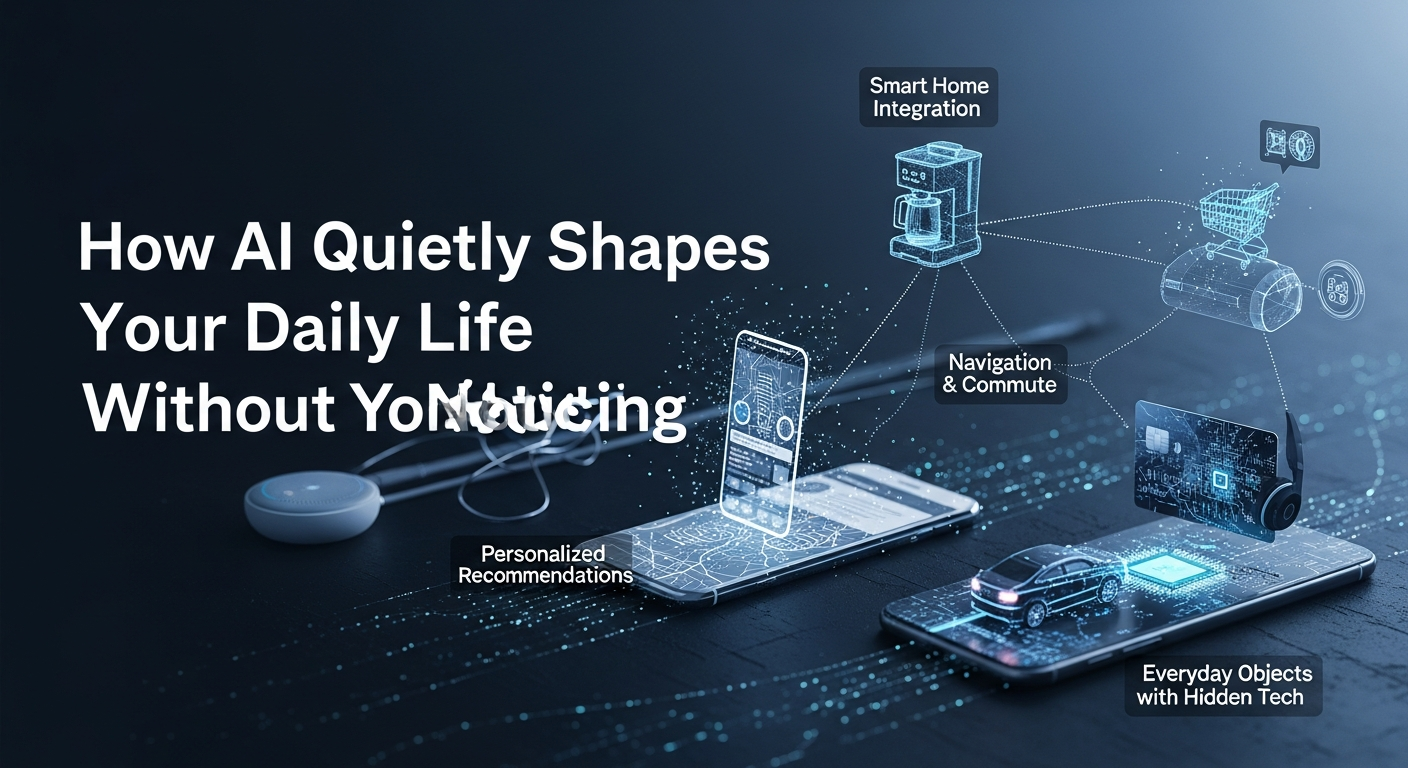
How AI Quietly Shapes Your Daily Life Without You Noticing
- November 18, 2025
- ~ 1 min read
- 129 views
- GenAI , AI Security
Introduction/Overview
Think for a moment about your morning. Did your alarm clock gently wake you with a personalized playlist suggestion? Did your news feed curate the top stories relevant to your interests, or your coffee machine remember your preferred brew strength? These seemingly mundane occurrences, so seamlessly woven into the fabric of modern existence, often carry a silent secret: the pervasive influence of Artificial Intelligence. While headlines frequently highlight groundbreaking AI advancements like self-driving cars or conversational chatbots, the truth is that AI isn't just a futuristic concept or a niche technology. It is a powerful, unseen force, quietly shaping your world in countless ways you likely haven't even registered.
The Unseen Hand of AI
The paradox of AI's omnipresence is its invisibility. When we talk about AI daily life, we're not always referring to explicit interactions with a smart assistant or a direct command to a robot. Instead, we're delving into the realm of 'quiet AI' – sophisticated algorithms and data processing systems operating deep in the background. These are the engines that power your streaming service recommendations, optimize your delivery routes, filter spam from your inbox, and even suggest the next word you type. This hidden AI is designed for efficiency and personalization, working tirelessly behind the scenes to make your digital and physical experiences smoother, more intuitive, and often, more addictive. It’s precisely because these systems are so integrated and perform their tasks with such finesse that their presence often goes AI unnoticed.
Unveiling the Pervasive Impact
The goal of this article is to pull back the curtain on this subtle yet significant technological revolution. We aim to illuminate how artificial intelligence everyday systems are constantly making decisions, learning from your behaviors, and adapting to your needs without demanding your direct attention or even your conscious acknowledgment. From enhancing your productivity and protecting your finances to influencing your entertainment choices and even your health, AI's footprint is far wider than most realize. Prepare to embark on an eye-opening journey that will reveal the true breadth of AI’s subtle influence, providing an essential AI impact introduction to the invisible forces at play in your world.
Main Content
Artificial Intelligence isn't a futuristic concept confined to sci-fi films; it's an intrinsic part of your present, working diligently in the background of your daily routine. Much like the air you breathe, AI's influence is often unnoticed because it seamlessly integrates into services and devices designed to make your life easier, more personalized, and undeniably more efficient. Let's peel back the layers and explore the core domains where AI quietly shapes your everyday existence.
The Unseen Hand: AI Personalization and Smart Living
One of the most pervasive yet subtle ways AI touches your life is through personalization. Every time you open a streaming service like Netflix or Spotify, the recommendations you see are not random; they are the result of sophisticated AI personalization algorithms analyzing your viewing and listening history, preferences, and even what similar users enjoy. This extends to online shopping, where AI suggests products you might like, and to social media feeds, which are carefully curated to show you content most likely to keep you engaged. This constant, effortlessly tailoring of your digital experience often feels natural, making AI's role easy to overlook.
Beyond your screens, AI is increasingly at the heart of your home environment. From smart thermostats like Nest or Ecobee that learn your heating and cooling preferences and optimize energy usage based on occupancy and weather patterns, to voice assistants in smart speakers that respond to your commands, AI is making homes more responsive. Security systems leverage smart home AI for advanced features like motion detection, facial recognition, and instant alerts, transforming traditional security into an intuitive and efficient guardian. These devices are marketed for their convenience, but it's the embedded AI that grants them their intelligence and autonomy.
Navigating Your Day: Communication, Productivity, and Movement
In the realm of digital communication and productivity, AI acts as a tireless assistant. Consider your email inbox: sophisticated AI filters tirelessly work to identify and isolate spam, ensuring your important messages aren't buried under junk. On your smartphone or computer, predictive text and autocorrect features anticipate your next words and correct typos, speeding up your typing and reducing errors. Even scheduling tools employ AI productivity tools to find optimal meeting times by cross-referencing calendars and suggesting slots that work for everyone, helping you save countless hours of coordination. These features are so ingrained that their AI backbone is rarely acknowledged.
When you venture out, AI continues its silent work. Navigation apps like Google Maps or Waze rely on advanced AI navigation algorithms to provide real-time traffic updates, suggest the fastest routes, and dynamically reroute you to avoid congestion or accidents. Ride-sharing services utilize AI to efficiently match drivers with passengers, calculate dynamic pricing, and optimize routes for drivers to minimize fuel consumption and maximize pickups. Even public transportation systems are increasingly using AI to optimize schedules and predict delays. We take these accurate, real-time services for granted, forgetting that behind every optimal route and timely arrival is a complex network of everyday AI applications constantly learning and adapting to the dynamic world.
Supporting Content
While the concept of Artificial Intelligence might seem abstract or confined to sci-fi movies, its influence is remarkably concrete, shaping many of your daily interactions without you consciously registering it. These are not futuristic scenarios, but rather real-world AI examples making your life smoother, more personalized, and often safer right now. Let's delve into some specific areas where AI works tirelessly behind the scenes.
Your Smart Shopping Assistant: AI Online Shopping
Every click, every search, and every purchase you make online feeds sophisticated AI algorithms designed to enhance your shopping experience and, of course, guide your buying decisions. Have you ever wondered why Amazon seems to know exactly what you might want next, or why prices sometimes fluctuate even within hours? That's AI online shopping at play.
- Dynamic Pricing: AI constantly analyzes factors like demand, inventory levels, competitor pricing, and even your browsing history to adjust product prices in real-time. This ensures competitive offers while optimizing retailer profits.
- Personalized Product Suggestions: When you see "customers who bought this also bought..." or tailored recommendations on e-commerce sites, AI is processing vast amounts of data about your past purchases, viewed items, and similar users' behavior to predict what you'll find most appealing. This is similar to how YouTube suggests the next video you're likely to watch.
- Fraud Detection: Behind the scenes, AI systems scrutinize millions of transactions, looking for unusual patterns that might indicate fraudulent activity. If your credit card is suddenly used for a large purchase in a foreign country after a smaller one locally, AI is often the first to flag it, protecting your financial security.
Personalized Well-being: AI Health Apps
Your smartphone is increasingly becoming a powerful tool for personal health management, largely thanks to embedded AI. From tracking your fitness goals to analyzing your sleep, AI health apps are providing insights that were once only available from medical professionals or specialized equipment.
- Fitness Tracking & Coaching: Apps like Apple Health, Google Fit, or Fitbit use AI to interpret data from your wearable devices – steps taken, calories burned, heart rate variability. They then offer personalized workout suggestions, track progress toward goals, and even gently nudge you towards healthier habits.
- Sleep Analysis: Many apps now use AI to monitor your sleep patterns, differentiating between light, deep, and REM sleep cycles based on movement and heart rate data. They can then offer personalized advice on improving sleep quality, helping you understand why you might feel tired.
- Personalized Health Insights: Beyond just tracking, AI can analyze trends in your health data over time, identifying potential risks or areas for improvement, and providing actionable insights for a healthier lifestyle tailored just for you.
Curating Your Digital World: AI Entertainment
Whether you're unwinding with music, binge-watching a series, or conquering digital realms, AI is the invisible hand guiding your entertainment choices. It’s revolutionizing how content is delivered and consumed, ensuring you're always engaged.
- Content Curation & Recommendations: Services like Netflix, Spotify, and YouTube are prime examples. Their AI algorithms learn your preferences from every show you watch, song you skip, or video you pause. This allows them to suggest the next show you'll love or create a playlist perfectly tailored to your mood, making your experience incredibly sticky.
- Targeted Advertising: While sometimes controversial, AI ensures that the advertisements you see across websites and social media are highly relevant to your interests, rather than random. It analyzes your online behavior to present products or services it believes you'll genuinely consider.
- Game AI: In video games, AI powers non-player characters (NPCs), making them realistic opponents, helpful companions, or dynamic elements in the game world. It adapts to your skill level, offering a challenging yet fair experience. This adaptive difficulty is a subtle but powerful AI feature.
Securing Your Finances: AI in Financial Services
The financial world, with its immense data flows and critical security needs, is a cornerstone of AI application. AI works tirelessly to protect your money, assess risks, and even influence markets.
- Fraud Prevention: This is perhaps one of AI's most critical contributions. Imagine an **AI finance** system constantly monitoring your transactions. If it detects an unusual transaction on your bank account—say, a large international transfer when you've never left your home country—it can immediately flag it, potentially saving you from financial loss by alerting you or blocking the transaction.
- Credit Scoring: When you apply for a loan or credit card, AI algorithms analyze vast datasets, including your financial history, repayment patterns, and other indicators, to generate a precise credit score. This helps lenders assess risk quickly and fairly, often providing immediate decisions.
- Algorithmic Trading: On Wall Street, AI-powered algorithms execute millions of trades per second, identifying market trends and opportunities far faster than any human possibly could. While complex, this often influences stock prices and investment outcomes on a global scale.
Advanced Content
Machine Learning Basics: Supervised vs. Unsupervised Learning
At the heart of many machine learning basics lies the distinction between supervised and unsupervised learning—two fundamental approaches that power much of the AI we encounter daily. Supervised learning involves training algorithms on labeled data, where the correct output is known. For instance, when you use a voice assistant like Siri or Alexa, it often relies on supervised learning to recognize speech patterns and commands. The system is fed vast amounts of data, including audio samples labeled with the corresponding text, enabling it to predict outputs for new, unseen inputs.
Conversely, unsupervised learning deals with unlabeled data, where the algorithm must find patterns and relationships on its own. This is crucial for tasks like clustering similar user behaviors or identifying anomalies in data. For example, recommendation systems on streaming platforms (like Netflix or Spotify) often use unsupervised learning to group users with similar preferences and suggest new content. Understanding these two types of learning is essential for grasping how AI systems make decisions without explicit programming for every scenario.
The Power of Data: Enabling Personalized AI
The true power of AI lies in its ability to process and learn from massive datasets, making it possible to deliver highly personalized experiences. Every interaction you have with technology—searching the web, browsing social media, or using navigation apps—contributes to a growing pool of data that AI algorithms analyze. This data is not just about what you search for but also how you interact with the results, the time spent on certain pages, and even your location.
Through sophisticated machine learning basics, AI systems can identify patterns and preferences, enabling features like personalized news feeds, targeted advertising, and smart home devices that learn your habits. For example, your smart thermostat might use historical temperature data and your schedule to optimize energy usage, creating a comfortable environment without explicit instructions. The more data an AI system processes, the better it becomes at predicting your needs and preferences, blurring the line between technology and anticipation.
Ethical Considerations: Bias, Filter Bubbles, and AI Data Privacy
While AI-driven personalization enhances user experiences, it also raises significant ethical concerns. One major issue is algorithmic bias, where AI systems reflect and amplify existing societal biases present in their training data. For example, if a facial recognition system is trained primarily on images of light-skinned individuals, it may perform poorly for darker skin tones, leading to discriminatory outcomes in areas like law enforcement or hiring.
Another concern is the creation of filter bubbles, where algorithms curate content based on your past behavior, limiting exposure to diverse viewpoints. This can reinforce existing beliefs and reduce critical thinking, making it harder to encounter new ideas. Additionally, the constant monitoring required for personalized AI raises questions about AI data privacy. Every click, search, and interaction is logged and analyzed, creating detailed digital profiles that companies and even governments can access. These ethical dilemmas highlight the need for greater transparency and user control over how AI systems operate.
The Future of Invisible AI: Predictive Analytics and Ambient Intelligence
As AI continues to evolve, its presence in our lives will become increasingly seamless and predictive. Future of AI trends point toward systems that anticipate needs before they are explicitly stated. Imagine a home environment that not only adjusts the temperature based on your schedule but also orders groceries before you run out, or a healthcare system that detects potential health issues through subtle changes in behavior or biometric data.
A key development in this direction is ambient intelligence, where AI is embedded in our surroundings—smart homes, wearable devices, and public spaces—that respond to our presence and needs without active input. This involves advanced predictive analytics, where AI systems analyze historical and real-time data to forecast events and take proactive measures. While this level of integration offers unprecedented convenience, it also necessitates careful consideration of privacy and ethical implications to ensure that the benefits of AI are realized without compromising individual rights.
Practical Content
As AI quietly weaves itself into the fabric of our daily routines, moving from a passive observer to an informed participant is key. This section empowers you with actionable strategies to not only recognize AI's presence but also to thoughtfully engage with and manage its influence in your digital world. Understanding these practical steps will allow you to navigate the AI-driven landscape with greater control and awareness.
Spotting AI in Your Daily Tech
The first step to managing AI's presence is to identify it. AI doesn't always announce itself with a flashing light; its power lies in its seamless integration. Start by paying attention to personalized experiences:
- Streaming Services: Notice how suggested videos or songs perfectly match your mood or previous viewing history? That's AI analyzing your preferences and predicting what you'll enjoy next.
- Online Shopping: Ever wonder how product recommendations on e-commerce sites seem to anticipate your next purchase, or how ads for something you just searched for appear everywhere? AI-driven algorithms are at work, learning from your browsing and buying habits.
- Social Media Feeds: Your personalized feed, designed to keep you engaged, is curated by AI based on who you interact with, what content you linger on, and even your emotional responses to posts.
- Smart Devices & Voice Assistants: From predictive text on your phone to smart home thermostats learning your schedule, AI algorithms are constantly processing data to make your devices more "intelligent" and responsive to your needs.
By simply pausing to ask, "How did this service know that?" you'll begin to uncover the subtle hand of AI guiding your digital interactions.
Taking Charge of Your AI Data and Experience
Once you start spotting AI, the next crucial step is to actively manage AI influence by taking control of the data you share and curating your personalized experiences. This isn't about shunning technology, but rather about interacting with it mindfully.
- Review AI Privacy Settings: Regularly check the privacy settings on your most-used apps, social media platforms, and smart devices. Look for options that allow you to limit data collection, opt out of personalized advertising, or prevent data sharing with third parties. Many services have dedicated "Data & Privacy" sections.
- Control AI Data Shared: Be selective about the permissions you grant apps (e.g., location, microphone, camera access). If an app doesn't genuinely need certain data to function, consider denying or revoking that permission. Understand that the more data AI has, the more accurately it can predict and personalize.
- Curate Your Recommendations: Don't just accept what AI suggests. On streaming platforms, actively use "like," "dislike," "not interested," or "remove from history" buttons. On social media, unfollow accounts that don't serve you and hide content you dislike. These actions directly feed into the AI's learning model, helping it refine future recommendations to better suit your actual preferences, making your experience truly yours.
Cultivating Critical AI Awareness
Developing an informed perspective on AI-driven services means understanding the trade-offs between convenience and data sharing. Here are some essential AI awareness tips:
- Question the "Why": When a recommendation seems eerily perfect or an ad follows you persistently, take a moment to consider why AI might be showing it to you. This critical lens helps you understand the underlying algorithms.
- Understand the Value Exchange: Many "free" AI-powered services operate by collecting your data. Be mindful of this exchange. Is the convenience offered worth the data you're providing?
- Seek Diverse Information: AI-curated feeds can create "filter bubbles" where you're only exposed to information that reinforces your existing views. Actively seek out diverse news sources and perspectives to counteract this effect.
By adopting these practical habits, you can shift from being a passive recipient of AI's influence to an active participant, shaping your digital environment with greater intention and control.
Comparison/Analysis
Efficiency vs. Autonomy: The Trade-off
At the heart of the quiet AI revolution lies a fundamental trade-off between efficiency and autonomy. AI systems excel at streamlining processes, reducing human effort, and delivering near-instantaneous results. Imagine your smartphone instantly suggesting the perfect route home based on real-time traffic, or your email client filtering out spam while you focus on important messages. These conveniences are powered by AI, offering unprecedented efficiency that saves us time and mental energy.
However, this efficiency often comes at the cost of human autonomy. As AI makes decisions on our behalf, we gradually cede control over certain aspects of our lives. For instance, recommendation algorithms on streaming services like Netflix or Spotify curate our entertainment, but they also shape our choices by prioritizing content that aligns with our past behavior. While this saves time, it subtly influences our preferences and habits, raising questions about how much control we truly retain over our daily decisions.
This trade-off is not merely theoretical. It's a practical consideration for anyone using AI-driven tools. The convenience of AI is undeniable, but it requires us to weigh the benefits against the potential erosion of independent decision-making. As we grow increasingly reliant on AI, the balance shifts, and the line between assistance and overstepping becomes increasingly blurred.
Pros of Quiet AI
The advantages of quiet AI integration into our daily lives are numerous and often taken for granted. Here are some of the key benefits:
- Enhanced convenience: AI-powered tools handle mundane tasks, freeing up time for more meaningful activities. Think of voice assistants managing schedules or smart home devices automating routine tasks.
- Increased efficiency: AI algorithms optimize processes from logistics to personal productivity, making operations faster and more effective.
- Personalization: AI learns from our behavior to deliver tailored experiences, from shopping recommendations to customized news feeds.
- Improved safety: In vehicles, medical devices, and industrial settings, AI systems can detect potential hazards faster than humans, potentially preventing accidents and saving lives.
- Accessibility: AI-powered tools like screen readers and speech-to-text software break down barriers for people with disabilities, enabling greater independence.
These advantages demonstrate why AI integration is so pervasive. From simplifying daily routines to enabling complex functions, the AI benefits are clear. However, as we'll explore next, these advantages come with significant counterpoints.
Cons of Quiet AI
While the pros of quiet AI are compelling, the technology is not without its drawbacks. Understanding these challenges is crucial for a balanced perspective:
- Privacy concerns: AI systems often require vast amounts of personal data to function effectively, raising alarms about surveillance and data misuse.
- Filter bubbles: Personalization algorithms can create echo chambers, limiting exposure to diverse viewpoints and reinforcing existing biases.
- Over-reliance: Excessive dependence on AI can diminish critical thinking skills and human problem-solving abilities.
- Potential job displacement: Automation driven by AI threatens to replace certain jobs, particularly those involving repetitive tasks, potentially increasing economic inequality.
- Ethical considerations: AI decision-making, especially in sensitive areas like healthcare or criminal justice, can introduce biases and errors with serious consequences.
These AI drawbacks highlight the need for careful consideration. While AI offers remarkable conveniences, it also introduces risks that demand attention. The AI pros and cons must be weighed thoughtfully to ensure that the technology serves humanity without unintended negative consequences.
Finding Balance: A Practical Approach
Living in an AI-dominated world doesn't mean we have to choose between embracing technology and maintaining control. Finding the right balance is key to leveraging AI's benefits while mitigating its risks. Here's how to approach this:
- Stay informed: Understand how AI works in the tools you use daily. Knowing the basics empowers you to make better choices.
- Question algorithms: Be aware that AI systems may have biases. When a recommendation or decision seems off, consider alternative perspectives.
- Limit data sharing: Review app permissions and privacy settings regularly. The less data you share, the less AI can potentially exploit your information.
- Prioritize human oversight: In critical areas, ensure human judgment remains a key component. Don't fully delegate decisions with significant consequences.
- Pursue continuous learning: Develop skills that complement AI rather than compete directly. Focus on creativity, emotional intelligence, and complex problem-solving.
Ultimately, the goal isn't to eliminate AI but to use it wisely. By adopting a balanced AI use approach, we can harness the power of artificial intelligence while preserving our autonomy and well-being. This thoughtful integration ensures that AI remains a tool to enhance our lives, not a force that dictates them.
Conclusion
Recap of AI's Pervasive Influence
As we've explored throughout this article, AI is not merely a futuristic concept—it's already deeply integrated into our daily routines, often working behind the scenes. From the moment we wake up to the moment we go to sleep, AI systems are quietly shaping our experiences, making decisions, and enhancing our interactions with the world around us.
Whether it's the recommendation algorithms on streaming platforms, the smart assistants in our homes, or the complex data analysis powering healthcare and transportation, AI is everywhere. Yet, most of the time, we don't consciously notice its presence. This quiet, pervasive influence is what makes understanding AI awareness so crucial in today's world.
The Crucial Role of AI Awareness
The most important takeaway from this discussion is that awareness is the first step toward a more conscious relationship with technology. Understanding how AI impacts our lives allows us to make informed decisions about the tools we use and the data we share. It empowers us to navigate the digital landscape with greater confidence and critical thinking.
Without a basic understanding of how AI works and what it does, we risk being passive participants in a technology-driven world. By developing AI awareness, we can better appreciate the benefits of AI while also being mindful of potential risks and ethical considerations. This knowledge is essential for anyone looking to engage thoughtfully with the modern world.
Embracing the Future with Informed Choices
As we look toward the future, the impact of AI will only continue to grow. New applications and advancements will further embed artificial intelligence into our daily lives, making it even more seamless and ubiquitous. While this evolution brings exciting possibilities, it also underscores the importance of staying informed and engaged.
Instead of viewing AI as something to fear or ignore, let's embrace it with curiosity and critical thinking. Cultivate your AI awareness, question how technology influences your decisions, and stay informed about the future of AI impact. By doing so, you can ensure that you're not just benefiting from these advancements but also shaping them in ways that align with your values and priorities.
Remember, the power to shape the future of AI lies in our hands. Let's approach it with awareness, curiosity, and a commitment to thoughtful engagement.

Comments (0)
Please login or register to leave a comment.
No comments yet. Be the first to comment!