
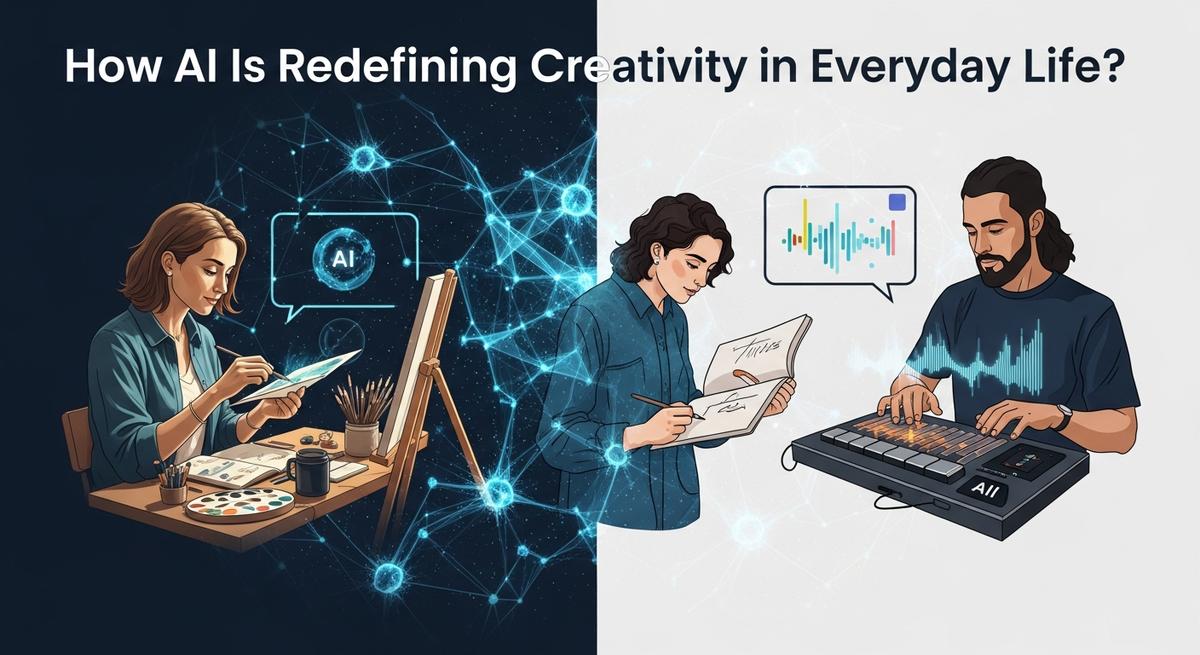
How AI Is Redefining Creativity in Everyday Life?
- January 02, 2026
- ~ 1 min read
- 197 views
- GenAI , Lifestyle & AI
Introduction/Overview
For years, the narrative around artificial intelligence and creativity has been dominated by a single, anxiety-laden question: Will AI replace human creators? But as we enter 2026, that conversation is fundamentally shifting. Rather than displacing creative professionals, AI is emerging as a powerful amplifier of human creativity, enabling individuals and teams to accomplish what was previously impossible for a single person to achieve.
The Misconception: From Threat to Opportunity
The initial fear that generative AI tools would render human creativity obsolete was understandable. When ChatGPT, Midjourney, and similar platforms burst onto the scene, they seemed to democratize skills that took years to master. But this perspective missed a crucial insight: the most powerful creative breakthroughs happen at the intersection of human judgment and machine capability. According to recent industry analysis, the future belongs not to those who avoid AI, but to those who learn to harness it strategically. As one expert notes, "The difference between average and great is taste"—and taste is fundamentally human.[3]
What's emerging in 2026 is a new paradigm where creative transformation happens through collaboration rather than replacement. Teams are discovering that when AI handles the labor-intensive aspects of creative work—research synthesis, initial drafts, asset generation—humans can focus on what machines cannot replicate: strategic direction, emotional resonance, and the critical judgment that separates exceptional work from the merely competent.
The Current Landscape: Mainstream Adoption and Real-World Impact
The adoption of AI tools for creators has accelerated dramatically. From content writers using AI to research alongside them while maintaining creative control, to filmmakers streamlining production workflows, to designers generating initial concepts in seconds, these tools are no longer experimental—they're becoming essential infrastructure for creative work.[4]
This shift reflects a broader transformation in how creative professionals approach their craft. Rather than asking "How do I do less?", forward-thinking creators are asking "What can I do now that I couldn't before?"[3] This reframing unlocks genuine innovation. A three-person team can now launch a global campaign in days, with AI handling data analysis, content personalization, and asset generation while humans steer strategy and creativity.[1]
What This Article Explores
Throughout this article, you'll discover how artificial intelligence creativity is reshaping creative industries and everyday creative expression. We'll examine:
- The practical mechanisms through which AI amplifies human creative potential
- Real-world examples of creators leveraging AI to expand their capabilities
- The specific skills and mindsets that separate AI-enabled creators from those left behind
- Emerging trends in creative AI tools and their applications across industries
- How to integrate AI into your creative workflow without compromising authenticity or control
- The future landscape of creative work in an AI-augmented world
The central thesis guiding this exploration is clear: AI is not replacing human creativity but amplifying and democratizing it. Those who understand this distinction—and act on it—will find themselves positioned at the forefront of creative innovation in 2026 and beyond.
Core Concepts and Mechanisms
Understanding how artificial intelligence is redefining creativity requires examining the fundamental mechanisms that enable AI to function as a creative partner. At its core, AI's creative capability rests on two complementary cognitive processes: divergent thinking and convergent thinking. These processes mirror how human creativity operates, but with distinct advantages in scale, speed, and consistency. By exploring these mechanisms, we can better appreciate how AI tools are transforming creative work across industries and everyday contexts.
Divergent Thinking: Generating Novel Ideas at Scale
Divergent thinking represents the ability to generate multiple unique solutions to open-ended problems—the kind of thinking that produces breakthrough ideas and unexpected connections. Research demonstrates that AI excels at this cognitive task in ways that rival or exceed human performance. In comparative studies, generative AI models like ChatGPT-4o outperformed human participants on standardized divergent thinking assessments, including the Alternate Uses Task, which asks participants to imagine creative uses for everyday objects like shoes or tires[2]. The findings were striking: AI-generated ideas demonstrated significantly higher originality than human-generated ideas, both in terms of average performance and peak creative output[2][3].
The mechanism behind this capability lies in how AI processes vast datasets to identify novel associations and combinations. When you prompt an AI tool to brainstorm ideas, the algorithm doesn't simply retrieve stored information—it synthesizes patterns across millions of data points to generate unexpected connections. This process enables AI to break through conventional thinking patterns and explore possibilities from a broader perspective, much like how human designers use divergent thinking to "break through predefined problem boundaries and explore innovative possibilities"[1]. The practical result is that AI brainstorming can rapidly generate dozens or hundreds of conceptual directions that might take human teams significantly longer to develop.
What makes this particularly valuable is the sheer volume and diversity of ideas AI can produce. Where a human brainstorming session might generate 10-20 ideas in an hour, AI tools can generate hundreds, allowing creative professionals to explore a much wider solution space. This abundance of options serves as what researchers call an "idea bank" that can counter groupthink and help teams avoid converging too quickly on conventional solutions[4].
The Human-AI Creative Partnership: Evaluation and Refinement
While AI excels at generating volume and originality, the creative process requires more than idea generation alone. This is where the collaborative nature of human-AI creativity becomes essential. The most effective creative outcomes emerge when AI collaboration combines machine-generated possibilities with human judgment, aesthetic sensibility, and strategic vision.
In design and creative work, this partnership unfolds through alternating phases of divergent and convergent thinking. During the divergent phase, AI tools like Midjourney and ChatGPT enable rapid exploration of conceptual directions, pushing the boundaries of what's possible[1]. But the convergent phase—where ideas are evaluated, filtered, and refined—remains fundamentally human work. Designers and creative professionals engage in "critical filtering, evaluation, and restructuring of the AI-generated content, selecting the most promising directions and integrating their own aesthetic judgment"[1]. This iterative interplay ensures that AI's generative capacity is channeled toward outcomes that are both innovative and aligned with human values and goals.
This collaborative model transforms AI from a replacement tool into a thought partner. Rather than asking "Can AI replace human creativity?" the more productive question becomes "How can AI augment human creative capability?" Research on human-AI co-creation shows that this partnership is most effective when designers maintain evaluative control, using AI to accelerate exploration while preserving their ability to make critical creative decisions[1].
Democratization of Creativity: Making Professional-Quality Work Accessible
One of AI's most transformative impacts on everyday creativity is creative democratization—making professional-quality creative output accessible to people without specialized training or expensive tools. Historically, producing high-quality creative work required years of skill development, access to professional software, or hiring specialized professionals. AI is fundamentally changing this equation.
Research demonstrates that access to generative AI ideas enhances individual creativity, particularly among less experienced creators. When writers had access to AI-generated ideas, their stories were evaluated as more creative, better written, and more enjoyable by evaluators[5]. This effect was especially pronounced for writers with lower baseline creativity scores, suggesting that AI tools help level the creative playing field by providing scaffolding and inspiration that less experienced creators might otherwise lack[5].
The democratization mechanism works by simplifying complex creative processes and removing skill barriers. AI tools handle technical execution—generating visual concepts, refining language, exploring variations—allowing users to focus on higher-level creative direction and decision-making. A marketer without graphic design experience can use AI image generation to create professional visuals. A writer can use AI to overcome writer's block and explore narrative directions. A business leader can rapidly prototype ideas for product innovation. By automating the technical aspects of creative work, AI enables people across skill levels to produce creative ideation that would have previously required professional expertise.
This democratization has profound implications for innovation and creative expression. When more people can engage in creative work effectively, the collective pool of ideas and solutions expands. However, research also reveals an important trade-off: while individual creativity increases with AI assistance, the diversity of outputs can narrow as multiple creators converge on similar AI-suggested directions[5]. This dynamic suggests that the most valuable use of AI in creative work involves maintaining intentional diversity and human judgment alongside AI-generated suggestions.
Understanding these core mechanisms—divergent thinking capability, collaborative partnership, and democratization—provides the foundation for leveraging AI effectively in creative work. The most successful applications combine AI's generative power with human judgment, using technology to accelerate exploration while preserving the distinctly human elements of creativity that drive meaningful innovation.
Real-World Applications and Use Cases
Artificial intelligence has moved beyond theoretical promise into practical, everyday creative work across industries. Today's creative professionals—from content marketers to video producers to graphic designers—are leveraging generative AI tools to accelerate their workflows, enhance their output quality, and unlock creative possibilities previously constrained by time and resources. The following real-world applications demonstrate how AI content creation is fundamentally reshaping creative processes in 2026.
Content Creation at Scale: Writing, Scripts, and Social Media
AI writing tools have become essential for content teams managing high-volume output demands. Marketing professionals now use generative AI to produce blogs, articles, social media posts, product descriptions, and advertising copy in a fraction of the traditional time. Rather than starting from a blank page, writers use AI to generate initial drafts, variations, and headlines—then refine and personalize the output with their unique voice and strategic insights.
Video production teams leverage AI to generate podcast scripts, video storyboards, and narration, dramatically reducing pre-production timelines. For example, content creators can input a topic or concept and receive multiple script variations optimized for different platforms—YouTube, TikTok, LinkedIn—each tailored to that platform's audience expectations and format requirements. This creative automation allows small teams to produce professional-quality content at enterprise scale.
Social media optimization represents another powerful application. AI analyzes engagement patterns, audience demographics, and trending topics to recommend optimal posting times, content formats, and messaging strategies. Rather than relying on intuition, creators now use data-driven insights to maximize reach and engagement with each post.
Visual Design and Image Generation: From Concept to Execution
AI-assisted design tools have democratized visual creativity, enabling professionals without specialized design training to produce polished, professional graphics. Tools like Midjourney, Adobe Firefly, Figma AI, and Stable Diffusion allow designers and marketers to generate logos, UI/UX wireframes, marketing materials, 3D models, and storyboards in minutes rather than hours.
The creative workflow has fundamentally changed. A designer can now describe a visual concept in natural language—"a minimalist tech company logo with geometric shapes in blue and silver"—and receive multiple AI-generated variations to choose from, modify, and refine. This accelerates the ideation phase and enables rapid iteration. Color matching, layout automation, and design consistency across brand materials are now handled by AI systems, freeing designers to focus on strategic creative decisions rather than repetitive technical tasks.
For content creators, AI photo editing tools integrated into smartphones and desktop applications automatically enhance images through intelligent adjustments: background removal, lighting correction, object removal, and style transfers. These capabilities, once requiring specialized software expertise, are now accessible to anyone creating visual content.
Video Production and Media Automation: From Raw Footage to Finished Product
Video production has been transformed by video production AI that automates time-consuming technical tasks. Automated color correction, scene transitions, pacing adjustments, and even automatic subtitle generation and dubbing in multiple languages reduce production timelines significantly. What previously required a dedicated colorist and editor working for days can now be accomplished in hours, with AI handling the technical heavy lifting while human creators focus on storytelling and creative direction.
Generative video technology has reached mainstream adoption in 2026. Entertainment studios are using AI to accelerate animation and special effects production, reducing both costs and timelines. Producers report that generative AI can slash production time compared to traditional techniques, enabling faster content delivery without sacrificing quality. Gaming developers are creating emergent storylines that adapt to player actions in real-time, with AI-generated characters that respond naturally to unexpected player choices rather than following predetermined scripts.
Automated dubbing and subtitle generation powered by AI enable creators to reach global audiences instantly. A video produced in English can be automatically adapted with professional-quality voiceovers and subtitles in dozens of languages, eliminating traditional localization bottlenecks.
Writing and Storytelling: AI as Creative Partner
Beyond simple content generation, AI is becoming a true creative partner in writing and storytelling workflows. Writers use AI to generate story variations, explore narrative alternatives, and develop character backgrounds—then select, refine, and personalize the strongest elements. This creative workflow optimization doesn't replace human creativity; instead, it amplifies it by handling ideation and initial drafting, allowing writers to focus on voice, structure, and emotional resonance.
Editing workflows have been similarly transformed. AI tools now assist with grammar checking, tone adjustment, readability optimization, and structural suggestions. A writer can receive real-time feedback on pacing, clarity, and engagement—enabling faster iteration cycles and higher-quality final output.
Data-Driven Creative Strategy: Analytics and Optimization
Creative professionals increasingly rely on AI analytics to make informed decisions about content strategy. Rather than guessing which topics, formats, or posting times will resonate with audiences, creators now use AI-powered business intelligence tools to analyze performance data, predict trends, and optimize content calendars.
AI systems can analyze large datasets of audience behavior, engagement patterns, and competitive content to answer strategic questions: "What topics should we cover next month?" "Which content formats drive the highest engagement?" "When should we post to maximize reach?" These insights enable creative teams to allocate resources more effectively and produce content that resonates with their target audience.
For designers and marketers, AI-powered recommendation engines suggest design elements, color palettes, and layout options based on successful precedents in their industry. This data-driven approach to creativity ensures that aesthetic choices are grounded in what actually works for their audience, not just personal preference.
The transformation is clear: AI is not replacing creative professionals, but rather amplifying their capabilities. Workers are saving 30–50% of their time on routine tasks, enabling them to focus on strategy, storytelling, and the uniquely human elements of creative work that require judgment, emotion, and original thinking.
These real-world applications demonstrate that generative AI tools have moved from novelty to necessity in creative workflows. The professionals thriving in 2026 are those who have integrated AI into their creative processes—using it to accelerate execution, explore more variations, and make data-informed decisions—while maintaining their unique creative vision and human judgment.
Advanced Concepts and Expert Insights
Machine Learning and Neural Networks: How AI Models Learn Creative Patterns
At the foundation of AI-driven creativity lies a sophisticated process of machine learning and neural networks that fundamentally differs from traditional programming. Rather than following explicit rules defined by developers, neural networks learn by example, discovering underlying patterns independently from training data.[6] This paradigm shift enables AI systems to tackle creative challenges that would require impossibly complex rule sets in conventional programming approaches.
Deep neural networks accomplish this through a hierarchical learning structure that mirrors human cognition. When processing visual data, for instance, the first layers of neurons act as edge detectors, while subsequent layers progressively learn to recognize shapes, shadows, and eventually complex features like facial characteristics.[2] This spontaneous emergence of abstraction hierarchies—where each layer builds upon the previous one—enables networks to encode increasingly sophisticated representations of creative elements.
The training process relies on minimizing a loss function through backpropagation, where the network's weights are systematically adjusted based on how far its predictions deviate from desired outputs.[2] What makes this particularly powerful for creative applications is that the representations learned during training can be repurposed across diverse tasks. A network trained to classify thousands of different objects can be adapted to match visual aesthetics, analyze artistic styles, or generate novel creative combinations—demonstrating the transferability of learned creative patterns.
Modern implementations leverage unsupervised learning approaches that don't require labeled training data, allowing networks to discover patterns organically. The Livermore Brain, for example, trained on 99.2 million unlabeled images to distinguish among city skylines, buildings, aircraft, and other visual categories without explicit human categorization.[1] This capability proves essential for creative AI, as it enables systems to identify novel pattern combinations that humans may not have explicitly defined.
The Adjacent Possible and Functional Novelty: Beyond Randomness to Purposeful Innovation
The concept of the adjacent possible—creative directions that exist just beyond current creative boundaries—represents a crucial distinction in understanding AI's creative potential. Rather than generating purely random outputs, sophisticated creative AI models operate within constrained possibility spaces, identifying novel combinations that are both original and meaningful within specific contexts.
Functional novelty distinguishes AI-generated work that is both original and useful from mere novelty for its own sake. This represents a higher-order creative capability where AI doesn't simply recombine existing elements randomly but generates solutions that advance creative objectives. In image generation, for example, systems like DALL·E and Midjourney don't produce arbitrary pixel combinations; instead, they generate coherent, purposeful visual outputs that align with human creative intent.[6]
This distinction matters profoundly for creative professionals. When AI generates a design concept, writes a marketing headline, or composes musical elements, the value emerges not from novelty alone but from novelty that serves a specific creative purpose. The system must balance exploration—discovering new creative territory—with exploitation—ensuring generated outputs remain functionally relevant to the creative challenge at hand.
Machine learning enables this balance through learned representations that encode domain-specific knowledge. A language model trained on millions of texts doesn't generate random word sequences; it generates text that respects grammar, semantics, and stylistic conventions while introducing novel combinations that advance the creative objective. This represents a fundamental shift from automation—replacing human effort—to augmentation—expanding human creative capacity.
Cognitive Partnership and Prompt Engineering: The New Creative Collaboration Model
The most sophisticated applications of AI in creative work position the technology as a cognitive partnership rather than a replacement for human creativity. This model recognizes that AI excels at identifying patterns across vast datasets and generating novel combinations, while humans excel at defining meaningful objectives, making aesthetic judgments, and infusing work with intentionality and purpose.
Prompt engineering has emerged as a critical creative skill in this partnership model. Rather than simply requesting outputs, effective prompt engineering involves crafting detailed, nuanced instructions that guide AI systems toward specific creative directions.[2] This process itself becomes a form of creative thinking—clarifying creative intent, anticipating system capabilities and limitations, and iteratively refining outputs through dialogue with the AI system.
This collaborative approach introduces what might be termed productive friction—the AI system's unexpected outputs, alternative interpretations, and novel suggestions challenge human assumptions and deepen creative thinking. When an AI misclassifies an object or generates an unexpected connection, rather than representing failure, these moments often spark new creative directions that neither human nor machine would have discovered independently.[4] The system functions as a thought partner that expands the creative possibility space through its unique pattern-recognition capabilities.
This represents a fundamental reimagining of what creative work entails. Instead of the artist or designer working in isolation, they engage in an iterative dialogue with an intelligent system that brings different capabilities to the creative process. The human maintains creative direction and judgment while the AI contributes pattern recognition, rapid iteration, and novel combination-generation. This partnership model suggests that the future of creative work involves developing new forms of creative thinking specifically designed for human-AI collaboration.