
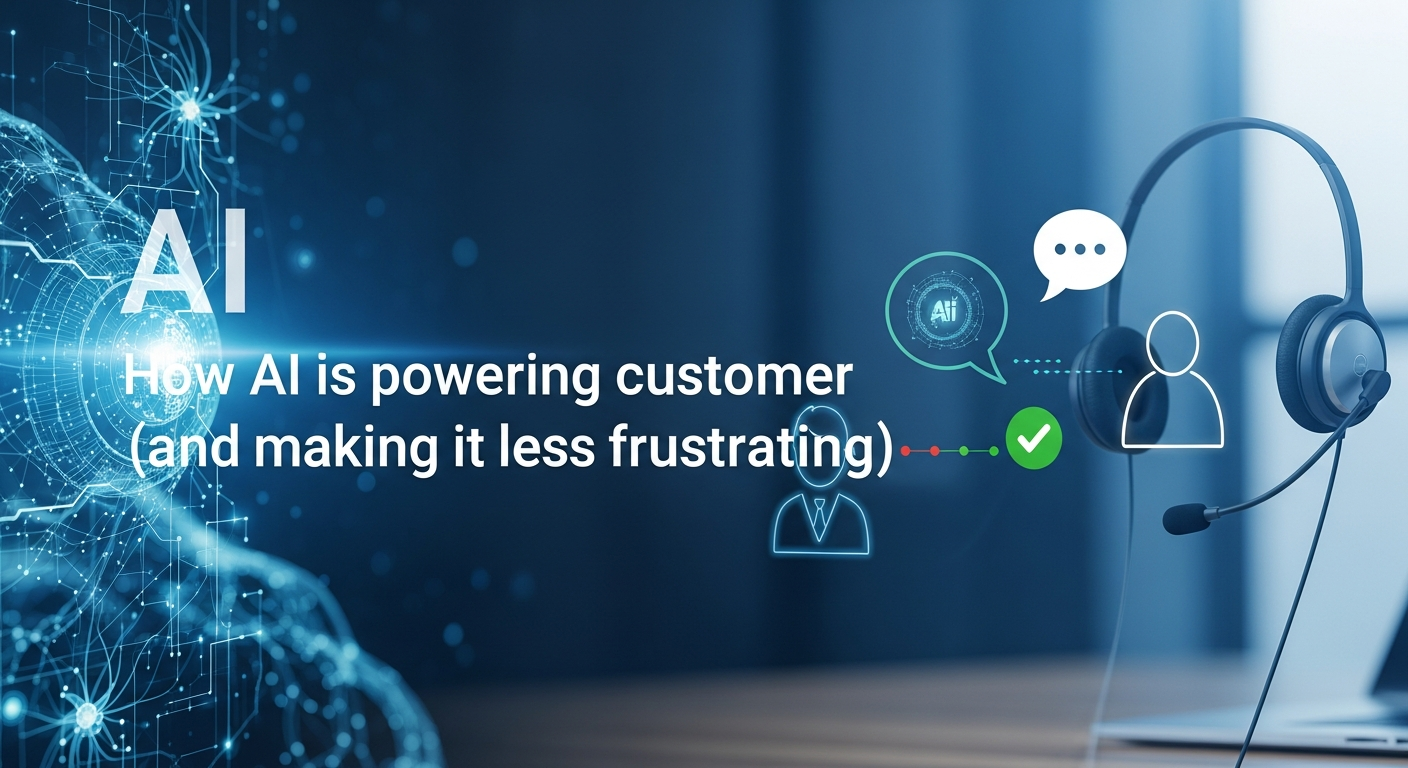
How AI is powering customer service (and making it less frustrating)
- November 21, 2025
- ~ 1 min read
- 123 views
- GenAI , AI in Business
Introduction to AI-Powered Customer Service
We've all been there - stuck on hold for what feels like an eternity, only to be transferred to a representative who can't seem to resolve our issue. Traditional customer service has long been a source of frustration for consumers, with lengthy wait times, unhelpful representatives, and unfulfilled expectations. In fact, a staggering 75% of customers have reported feeling frustrated with their customer service experiences. However, with the advent of AI technology, the customer service landscape is undergoing a significant transformation.
The Challenges of Traditional Customer Service
Traditional customer service models often rely on human representatives to handle customer inquiries, which can lead to a range of challenges, including high operational costs, limited scalability, and inconsistent service quality. Moreover, the emotional toll of dealing with frustrated customers can lead to representative burnout, further exacerbating the problem. It's clear that a new approach is needed - one that leverages the power of technology to enhance the customer experience and reduce frustration.
Introducing AI-Powered Customer Service
Enter AI, a technology that has the potential to revolutionize the customer service industry. By harnessing the power of machine learning algorithms and natural language processing, AI can help businesses provide faster, more personalized, and more effective customer support. From chatbots and virtual assistants to sentiment analysis and predictive analytics, AI is enabling companies to respond to customer needs in a more intelligent and intuitive way. For example, companies like Amazon and Netflix are already using AI to provide personalized product recommendations and resolve customer issues in real-time.
The Future of Customer Service
As AI continues to evolve and improve, we can expect to see even more innovative applications in the customer service space. With the ability to analyze vast amounts of customer data, AI can help businesses identify patterns and trends, anticipate customer needs, and provide proactive support. The result is a customer experience that is more streamlined, more efficient, and more satisfying. In short, AI is transforming customer service for the better, and it's an exciting time for businesses and consumers alike. As we'll explore in more detail throughout this article, the potential of AI to enhance customer service and reduce frustration is vast, and it's an opportunity that businesses can't afford to miss.
In the following sections, we'll delve deeper into the world of AI-powered customer service, exploring the benefits, challenges, and best practices for implementing this technology in your business. Whether you're a business owner, customer service manager, or simply a professional interested in the latest advancements in AI and technology, this article will provide you with a comprehensive overview of the role of AI in customer service and what it means for the future of customer experience.
How AI Enhances Customer Service
Artificial intelligence (AI) is revolutionizing the customer service landscape by introducing innovative solutions that enhance efficiency, accuracy, and customer satisfaction. One of the key applications of AI in customer service is the deployment of AI-powered chatbots. These chatbots are designed to simulate human-like conversations with customers, providing them with instant support and resolving their queries in a timely manner. With the ability to understand natural language processing (NLP), chatbots can comprehend customer requests, identify the intent behind their messages, and respond accordingly.
AI-Driven Sentiment Analysis and Emotional Intelligence
Another significant aspect of AI in customer service is sentiment analysis, which enables businesses to gauge customer emotions and sentiments in real-time. By analyzing customer interactions, AI-powered systems can detect emotional cues such as frustration, anger, or satisfaction, allowing customer support agents to respond in a more empathetic and personalized manner. This emotional intelligence is crucial in de-escalating conflicts and turning negative experiences into positive ones. Moreover, sentiment analysis helps businesses to identify areas of improvement, enabling them to make data-driven decisions and implement changes that enhance the overall customer experience.
For instance, a company can use AI-driven sentiment analysis to monitor customer feedback on social media, identifying trends and patterns that indicate customer dissatisfaction. By addressing these concerns promptly, the company can demonstrate its commitment to customer satisfaction, ultimately leading to increased loyalty and retention. As a result, businesses can leverage sentiment analysis to create a more customer-centric approach, prioritizing their needs and preferences above all else.
AI-Based Personalization in Customer Service
Personalization is a critical component of modern customer service, and AI plays a vital role in enabling businesses to offer tailored experiences to their customers. By analyzing customer data, behavior, and preferences, AI-powered systems can create detailed profiles, allowing customer support agents to provide personalized recommendations, offers, and solutions. This level of personalization not only enhances customer satisfaction but also increases the chances of upselling and cross-selling, ultimately driving revenue growth. Furthermore, AI-based personalization enables businesses to anticipate customer needs, proactively offering support and resolving issues before they escalate into major problems.
Some of the key benefits of AI-based personalization in customer service include:
- Improved customer engagement and loyalty
- Increased efficiency and productivity in customer support
- Enhanced customer satisfaction and reduced churn rates
- Personalized recommendations and offers that drive revenue growth
As AI continues to evolve, its potential to transform customer service will only continue to grow. By embracing AI-powered solutions, businesses can stay ahead of the curve, delivering exceptional customer experiences that drive loyalty, retention, and revenue growth.
Real-World Examples of AI in Customer Service
The integration of AI in customer service has been a game-changer for many companies, leading to improved efficiency, reduced costs, and enhanced customer experiences. In this section, we'll explore some case studies and success stories of businesses that have successfully implemented AI-powered customer service, highlighting the challenges they faced, the solutions they implemented, and the outcomes they achieved.
Example: Chatbots in Customer Support
One notable example is the implementation of chatbots by Domino's Pizza. The company introduced a chatbot named "Dom" that allows customers to place orders, track their delivery, and even provide feedback. The chatbot uses natural language processing (NLP) to understand customer queries and respond accordingly. According to Domino's, the chatbot has reduced the average order time by 30% and has increased customer satisfaction ratings by 25%.
The implementation of the chatbot was not without its challenges, however. Domino's faced issues with integrating the chatbot with their existing customer service systems, as well as ensuring that the chatbot could handle complex customer queries. To overcome these challenges, the company invested in machine learning algorithms that enabled the chatbot to learn from customer interactions and improve its responses over time.
Benefits and Results
The benefits of AI-powered customer service are numerous, and the results achieved by companies that have implemented these solutions are impressive. Some of the key benefits include:
- 24/7 customer support: AI-powered chatbots can provide customer support around the clock, reducing the need for human customer support agents.
- Personalized experiences: AI can analyze customer data and provide personalized recommendations and offers, leading to increased customer satisfaction and loyalty.
- Reduced costs: AI-powered customer service can reduce the need for human customer support agents, leading to significant cost savings.
According to a study by Gartner, companies that have implemented AI-powered customer service have seen an average reduction of 30% in customer support costs. Additionally, a study by Forrester found that companies that use AI-powered chatbots have seen an average increase of 25% in customer satisfaction ratings.
Key Takeaways and Lessons Learned
So, what can we learn from these case studies and success stories? Firstly, it's essential to invest in machine learning algorithms that enable AI-powered customer service solutions to learn from customer interactions and improve their responses over time. Secondly, it's crucial to ensure that AI-powered customer service solutions are integrated with existing customer service systems to provide a seamless customer experience. Finally, it's essential to monitor and analyze the performance of AI-powered customer service solutions to identify areas for improvement and optimize their performance.
The key to successful AI-powered customer service is to strike a balance between technology and human touch. While AI can provide efficient and personalized support, human customer support agents are still essential for handling complex and emotional customer queries.
By following these lessons and investing in AI-powered customer service, businesses can improve their customer experiences, reduce costs, and increase customer satisfaction ratings. As the use of AI in customer service continues to evolve, we can expect to see even more innovative solutions and success stories emerge, transforming the way companies interact with their customers and providing a competitive edge in the market.
Advanced AI Concepts in Customer Service
The integration of Artificial Intelligence (AI) in customer service has revolutionized the way businesses interact with their customers. At the forefront of this revolution are advanced AI concepts such as Natural Language Processing (NLP), machine learning, and data analytics. These technologies have enabled businesses to provide more efficient, personalized, and effective customer service. In this section, we will delve into the technical aspects of these concepts and their applications in customer service.
Natural Language Processing (NLP) in AI-Powered Chatbots
NLP is a subset of AI that enables computers to understand, interpret, and generate human language. In the context of customer service, NLP is used to power chatbots that can engage with customers in a more human-like manner. These chatbots use sophisticated algorithms to analyze customer inquiries, identify intent, and respond accordingly. NLP-powered chatbots can understand nuances of language, such as idioms, colloquialisms, and sarcasm, allowing them to provide more accurate and personalized responses. For instance, a customer may ask a chatbot, "I'm feeling really frustrated with my current phone plan, can you help me?" The NLP-powered chatbot can recognize the customer's emotional state and respond with empathy, "I apologize that you're feeling frustrated, let me see what I can do to help you with your phone plan."
Machine Learning Algorithms in Customer Service
Machine learning algorithms play a crucial role in customer service by enabling businesses to analyze large amounts of customer data and identify patterns. These algorithms can be used to predict customer behavior, such as likelihood of churn or propensity to purchase. Machine learning can also be used to automate routine tasks, such as responding to frequently asked questions or routing customer inquiries to the relevant department. Some common machine learning algorithms used in customer service include decision trees, random forests, and support vector machines. For example, a business may use machine learning to analyze customer interaction data and identify the most common pain points, allowing them to proactively address these issues and improve the overall customer experience.
The Role of Data Analytics in AI-Driven Customer Service
Data analytics is a critical component of AI-driven customer service, as it provides businesses with the insights needed to make informed decisions. By analyzing customer data, businesses can identify trends, patterns, and areas for improvement. Data analytics can be used to measure key performance indicators (KPIs) such as customer satisfaction, first response time, and resolution rate. This data can then be used to optimize customer service strategies and improve the overall customer experience. For instance, a business may use data analytics to identify the most common channels used by customers to contact them, allowing them to allocate resources more effectively and ensure that customers receive timely and effective support.
In conclusion, advanced AI concepts such as NLP, machine learning, and data analytics are revolutionizing the customer service landscape. By understanding these technologies and their applications, businesses can provide more efficient, personalized, and effective customer service. As the field of AI continues to evolve, it is essential for businesses to stay up-to-date with the latest advancements and developments in order to remain competitive. By leveraging these technologies, businesses can drive customer loyalty, increase revenue, and gain a competitive edge in the market.
The future of customer service is AI-driven, and businesses that fail to adapt will be left behind. By embracing advanced AI concepts and technologies, businesses can provide exceptional customer experiences that drive loyalty, revenue, and growth.
To stay ahead of the curve, businesses should consider investing in technical expertise and infrastructure to support the development and implementation of AI-powered customer service solutions. This may include hiring data scientists, machine learning engineers, and NLP specialists to develop and train AI models. By doing so, businesses can unlock the full potential of AI in customer service and provide exceptional experiences that meet the evolving needs and expectations of their customers.
Implementing AI in Your Customer Service Strategy
As businesses continue to adopt AI-powered customer service solutions, it's essential to have a strategic approach to implementation. A well-planned guide can help you navigate the process and ensure a seamless integration of AI into your customer service operations. In this section, we'll provide a step-by-step guide to implementing AI-powered chatbots, discuss the importance of data quality and integration, and offer tips for training and maintaining AI models.
Step-by-Step Guide to Implementing AI-Powered Chatbots
Implementing AI-powered chatbots requires careful planning and execution. Here's a step-by-step guide to help you get started:
- Define your goals and objectives: Identify the specific customer service challenges you want to address with AI-powered chatbots.
- Choose a platform: Select a chatbot platform that integrates with your existing customer service software and supports your business goals.
- Design the conversation flow: Create a conversation flow that mimics human-like interactions and provides a seamless customer experience.
- Train the AI model: Train the AI model using high-quality data and continuous feedback to improve its accuracy and effectiveness.
- Test and deploy: Test the chatbot thoroughly and deploy it to your customer service channels.
The Importance of Data Quality and Integration
High-quality data is essential for training and maintaining AI models. Poor data quality can lead to inaccurate results, which can negatively impact the customer experience. To ensure data quality, it's crucial to integrate your AI-powered chatbot with your existing customer service software and data sources. This integration enables the chatbot to access relevant customer information and provide personalized support.
A well-integrated AI-powered chatbot can also help you to streamline your customer service operations and reduce the workload of your human customer support agents. By automating routine tasks and providing 24/7 support, AI-powered chatbots can help you to improve the overall customer experience and increase customer satisfaction.
Best Practices for Training and Maintaining AI Models
Training and maintaining AI models require ongoing effort and attention. Here are some best practices to keep in mind:
- Use high-quality data to train the AI model.
- Provide continuous feedback to improve the AI model's accuracy and effectiveness.
- Regularly update and refine the AI model to adapt to changing customer needs and preferences.
- Monitor the AI model's performance and make adjustments as needed.
By following these best practices and taking a strategic approach to implementation, you can unlock the full potential of AI-powered customer service and provide a better experience for your customers. Remember, the key to success lies in careful planning, high-quality data, and ongoing maintenance. With the right approach, you can harness the power of AI to transform your customer service operations and drive business growth.
According to a recent study, companies that implement AI-powered customer service solutions can see a significant reduction in customer complaints and an increase in customer satisfaction. By following the steps outlined in this guide, you can join the ranks of these successful companies and start reaping the benefits of AI-powered customer service.
Comparison of AI-Powered Customer Service Solutions
As businesses continue to adopt AI-powered customer service solutions, it's essential to evaluate the various options available in the market. A thorough comparison of these solutions can help businesses make informed decisions that align with their specific needs and goals. In this section, we'll delve into the pros and cons of different AI-powered customer service platforms, discussing their strengths and weaknesses, and highlighting the key factors to consider when choosing an AI solution.
Evaluating AI-Powered Customer Service Platforms
When evaluating AI-powered customer service platforms, businesses should consider several key factors, including the level of automation, integration with existing systems, and the quality of customer support. Some popular AI-powered customer service solutions include chatbots, virtual assistants, and machine learning-based platforms. Each of these solutions has its own set of pros and cons, which are discussed below.
Chatbots, for example, are a popular choice for businesses looking to automate simple customer inquiries. They are relatively easy to implement and can provide 24/7 support to customers. However, they can lack the nuance and empathy of human customer support agents, which can lead to frustration if the customer's issue is complex or requires a more personalized approach. On the other hand, virtual assistants can provide a more personalized experience, but they often require more significant investment in terms of time and resources.
Key Factors to Consider When Choosing an AI Solution
When choosing an AI-powered customer service solution, businesses should consider several key factors, including the specific needs and goals of their business, the level of automation required, and the quality of customer support. Some other important factors to consider include:
- Scalability: Can the solution handle a large volume of customer inquiries and scale with the business?
- Integration: Can the solution integrate with existing systems, such as CRM and helpdesk software?
- Customization: Can the solution be customized to meet the specific needs of the business?
- Security: Does the solution provide robust security features to protect customer data?
In addition to these factors, businesses should also consider the potential trade-offs between different solutions. For example, a solution that provides a high level of automation may require more significant investment in terms of time and resources. On the other hand, a solution that is easy to implement may lack the level of customization required by the business. By carefully evaluating these factors and considering the specific needs and goals of their business, businesses can choose an AI-powered customer service solution that provides a comprehensive evaluation of their customer service needs.
Conclusion and Recommendations
In conclusion, choosing the right AI-powered customer service solution requires a thorough evaluation of the various options available in the market. By considering the pros and cons of different solutions, businesses can make informed decisions that align with their specific needs and goals. As customer service continues to evolve, it's essential for businesses to stay ahead of the curve and adopt solutions that provide a high level of automation, integration, and customization. By doing so, businesses can provide a better experience for their customers and stay competitive in a rapidly changing market.
Ultimately, the key to success lies in finding a solution that provides a balance between automation, customization, and customer support, and that aligns with the specific needs and goals of the business.
Conclusion and Future of AI in Customer Service
In conclusion, the integration of AI in customer service has revolutionized the way businesses interact with their customers. From chatbots to virtual assistants, AI-powered customer service has made it possible for companies to provide 24/7 support, improve response times, and enhance the overall customer experience. As we've discussed throughout this article, the benefits of AI-powered customer service are numerous, and it's essential for businesses to start exploring this technology to stay ahead of the curve.
Future Developments and Trends
The future of AI in customer service looks promising, with advancements in natural language processing, machine learning, and emotional intelligence. We can expect to see more sophisticated chatbots and virtual assistants that can understand and respond to customer emotions, providing a more empathetic and personalized experience. Additionally, the integration of AI with other technologies like IoT and augmented reality will create new opportunities for businesses to provide innovative and immersive customer experiences.
Some of the key trends to watch out for in the future of AI-powered customer service include:
- Increased use of voice assistants and conversational interfaces
- More emphasis on emotional intelligence and empathy in AI-powered customer service
- Greater integration of AI with other technologies like IoT and augmented reality
- More focus on personalization and tailored customer experiences
Call-to-Action
As we move forward, it's essential for businesses to take a proactive approach to adopting AI-powered customer service. We encourage you to start exploring the possibilities of AI in customer service and to consider how you can leverage this technology to improve your customer experience. Whether it's implementing a chatbot or virtual assistant, or integrating AI with your existing customer service systems, there are many ways to get started. Don't wait – take the first step today and discover the benefits of AI-powered customer service for yourself.
As customer expectations continue to evolve, it's crucial for businesses to stay ahead of the curve and provide innovative and effective customer service solutions. By embracing AI-powered customer service, you can enhance the customer experience, improve efficiency, and drive business success. So, what are you waiting for? Take the call-to-action and start exploring the possibilities of AI-powered customer service today.
The future of customer service is AI-powered, and it's time for businesses to get on board. By leveraging the latest advancements in AI and customer service, you can provide innovative, effective, and personalized experiences that meet the evolving needs of your customers.

Comments (0)
Please login or register to leave a comment.
No comments yet. Be the first to comment!