
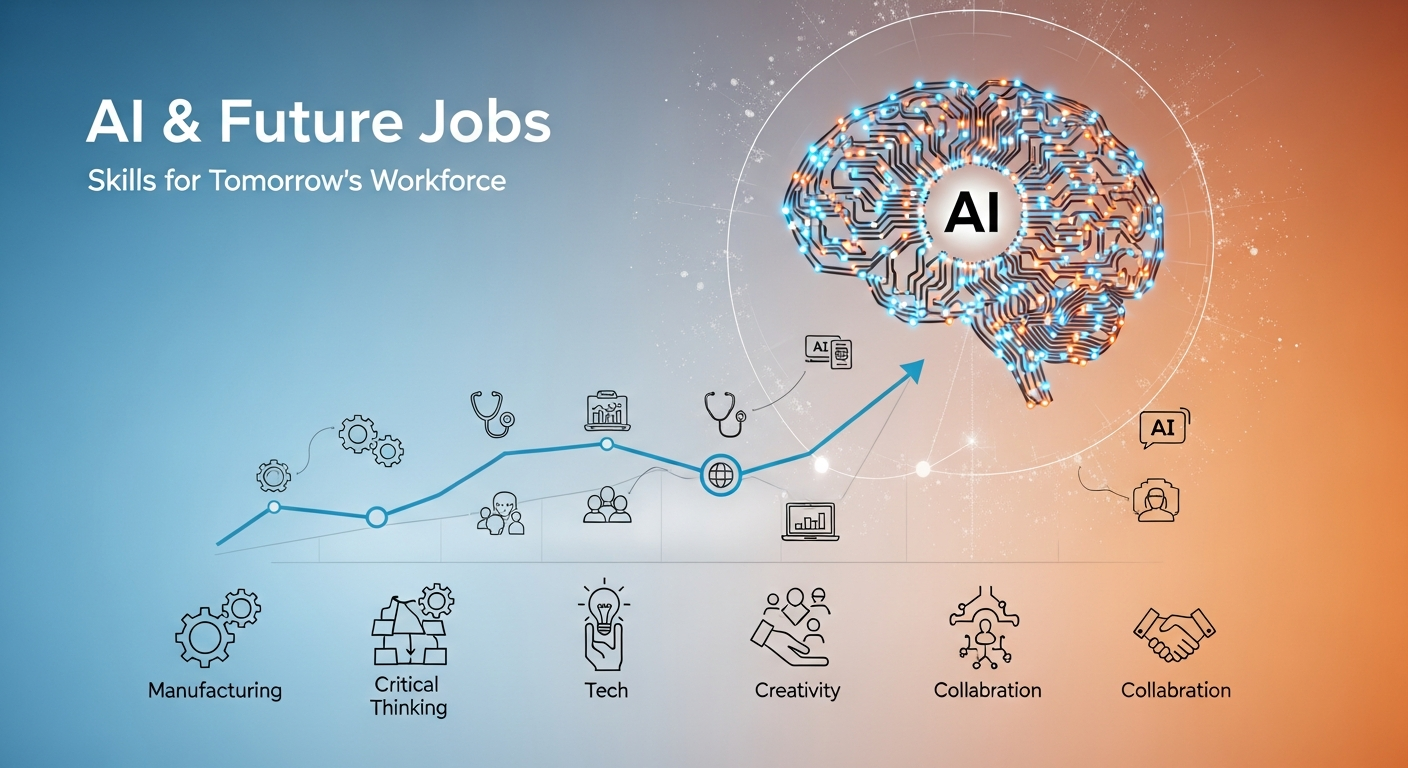
How AI is influencing future jobs and what skills people will need.
- November 20, 2025
- ~ 1 min read
- 121 views
- Future of Work , AI in Business
Introduction to the Future of Work
The job market is on the cusp of a significant transformation, driven by the increasing presence of Artificial Intelligence (AI) in the workforce. A staggering 77% of companies consider AI to be a key component of their business strategy, and this shift is expected to impact future jobs in profound ways. To remain relevant in this changing landscape, it's essential for professionals, students, and individuals to understand the implications of AI on the job market and the required skills that will be in demand.
Understanding the Impact of AI on Future Jobs
As AI continues to advance, it's likely to augment human capabilities, automate routine tasks, and create new job opportunities that we cannot yet anticipate. However, it's also expected to displace certain jobs, particularly those that involve repetitive or mundane tasks. It's crucial for individuals to be aware of these changes and to develop the required skills that will enable them to thrive in an AI-driven economy. By understanding the impact of AI on future jobs, individuals can make informed decisions about their career paths and invest in the skills that will be in highest demand.
Preview of the Skills in Demand
As we look to the future, it's clear that AI will play a significant role in shaping the job market. Some of the key skills that will be in demand include:
- Technical skills, such as programming and data analysis
- Soft skills, such as communication, collaboration, and creativity
- Critical thinking and problem-solving skills, which will enable individuals to work effectively with AI systems
Setting the Stage for an Informative Exploration
In the following sections, we'll delve into the specifics of how AI is influencing the job market, and what individuals can do to prepare for the changes that are coming. We'll examine the current state of AI adoption, the potential benefits and drawbacks of AI in the workforce, and the key required skills that will be essential for success. By the end of this article, readers will have a comprehensive understanding of the impact of AI on future jobs and the skills they need to develop to remain relevant in a rapidly changing job market.
The future of work is arriving faster than we think, and it's essential to be prepared.
The Impact of AI on Job Markets
The integration of Artificial Intelligence (AI) into various industries is transforming the job market in profound ways. AI automation is not only streamlining processes and increasing efficiency but also significantly altering the nature of work. As AI systems take over routine and repetitive tasks, there is a growing concern about the displacement of traditional jobs. However, it's crucial to note that while AI might replace some jobs, it is also a catalyst for job creation in new and innovative fields.
Automation and Job Displacement
According to a report by the McKinsey Global Institute, up to 800 million jobs could be lost worldwide due to AI automation by 2030. This phenomenon is not limited to manufacturing and production lines; AI is also being used in service sectors, such as customer service, where chatbots and virtual assistants are becoming increasingly common. The displacement of jobs due to AI underscores the need for workers to acquire new skills that are complementary to AI, emphasizing the importance of addressing the skills gap in the workforce.
The Emergence of New Job Roles
Despite the potential for job displacement, AI is also driving the creation of new job roles that we cannot yet fully imagine. As AI technologies advance, new industries and job categories are emerging, such as AI ethics specialists, AI trainers, and data scientists. These roles require a deep understanding of AI, its applications, and its limitations. The creation of these new job roles highlights the dynamic nature of the job market and the need for continuous learning and adaptation. Embracing lifelong learning will be essential for professionals to remain relevant in an AI-driven economy.
Adapting Education and Skills
The skills gap resulting from AI automation necessitates a significant shift in how we approach education and skill development. Traditional educational systems often focus on imparting knowledge rather than fostering skills like critical thinking, creativity, and problem-solving, which are essential in an AI-driven job market. There is a growing need for educational institutions to incorporate AI literacy and skills training into their curricula, ensuring that future generations are equipped to work alongside AI systems. Moreover, continuous professional development will be critical for existing workers to upskill and reskill, enabling them to transition into new roles created by AI.
Examples of industries already seeing significant changes due to AI include healthcare, finance, and transportation. In healthcare, AI is being used for diagnosis and personalized medicine, while in finance, AI-driven systems are enhancing risk management and portfolio optimization. The transportation sector is witnessing the development of autonomous vehicles, which could revolutionize the way we travel. These examples illustrate the profound impact of AI on various sectors and the need for workers to be adaptable and skilled in working with AI technologies.
In conclusion, the impact of AI on job markets is multifaceted, involving both the displacement of traditional jobs and the creation of new ones. Addressing the skills gap through education and continuous learning is paramount. As we look towards the future of work, it's clear that AI automation and job creation will continue to shape the job market, requiring professionals to be agile, innovative, and committed to lifelong learning.
Real-World Examples and Use Cases
The integration of Artificial Intelligence (AI) into various industries is not just a theoretical concept, but a reality that many companies are already embracing. In this section, we will explore some real-world examples of businesses that have successfully navigated the transition to an AI-centric model. These case studies will provide valuable insights into the challenges faced during the transition and the strategies employed to overcome them.
Case Studies of Successful AI Integration
Companies like Amazon, Google, and Microsoft are at the forefront of AI integration, using machine learning algorithms to improve their operations, customer service, and product development. For instance, Amazon's recommendation engine, which suggests products based on a customer's browsing and purchasing history, is a classic example of AI in action. This technology has not only enhanced the customer experience but also increased sales and revenue for the company.
Another example is the use of chatbots in customer service. Many companies, including banks and healthcare providers, are using chatbots to provide 24/7 support to their customers. These chatbots can answer frequently asked questions, help with simple transactions, and even route complex issues to human customer support agents. This has resulted in significant cost savings and improved customer satisfaction.
New Job Roles Created by AI Adoption
The adoption of AI technologies has also led to the creation of new job roles that did not exist before. Some examples include:
- AI Engineer: responsible for designing and developing AI systems
- Machine Learning Specialist: responsible for training and deploying machine learning models
- Data Scientist: responsible for analyzing and interpreting complex data to inform business decisions
- AI Ethicist: responsible for ensuring that AI systems are fair, transparent, and unbiased
These new job roles require a unique combination of technical, business, and soft skills, and are in high demand across various industries. As digital transformation continues to accelerate, we can expect to see even more new job roles emerge.
Overcoming Challenges and Reaping Benefits
While the benefits of AI integration are numerous, the transition to an AI-centric model can be challenging. Companies may face resistance to change from employees, technical difficulties in implementing AI systems, and concerns about job displacement. However, with careful planning, execution, and change management, these challenges can be overcome.
The key to successful AI adoption is to focus on augmenting human capabilities, rather than replacing them. By leveraging AI to automate routine tasks, enhance decision-making, and improve customer experiences, companies can unlock new levels of efficiency, productivity, and competitiveness.
As we look to the future, it is clear that AI integration will play a critical role in shaping the future workforce. By understanding the real-world examples and use cases of AI adoption, individuals and organizations can better prepare themselves for the opportunities and challenges that lie ahead. Whether you are a professional looking to upskill, a student exploring career options, or an entrepreneur seeking to innovate, the world of AI has something to offer. By embracing digital transformation and developing the skills required for an AI-driven economy, we can unlock a brighter, more prosperous future for all.
Advanced Concepts and Technical Insights
As we delve into the intricacies of Artificial Intelligence (AI) and its impact on future jobs, it's essential to explore the technical aspects of AI algorithms and machine learning. These complex systems are being designed to perform tasks that typically require human intelligence, such as learning, problem-solving, and decision-making. The development of ethical AI is a critical consideration, as it ensures that AI systems are fair, transparent, and accountable.
Technical Explanation of AI and Machine Learning Algorithms
The foundation of AI lies in machine learning algorithms, which enable systems to learn from data and improve their performance over time. These algorithms can be broadly categorized into supervised, unsupervised, and reinforcement learning. Supervised learning involves training models on labeled data, while unsupervised learning focuses on discovering patterns in unlabeled data. Reinforcement learning, on the other hand, involves training models to make decisions based on rewards or penalties. Deep learning, a subset of machine learning, has gained significant attention in recent years due to its ability to learn complex patterns in data.
A key challenge in developing AI algorithms is ensuring that they are transparent, explainable, and fair. This requires a deep understanding of the underlying machine learning models and the data used to train them. Researchers are actively exploring techniques such as model interpretability, feature attribution, and adversarial testing to address these challenges. For instance, techniques like SHAP (SHapley Additive exPlanations) and LIME (Local Interpretable Model-agnostic Explanations) are being used to provide insights into model decisions.
Ethical Considerations and Future Directions
The development and deployment of AI systems raise important ethical considerations. As AI becomes increasingly pervasive, there is a growing need to ensure that these systems are aligned with human values and promote social good. This requires a multidisciplinary approach, involving experts from fields such as computer science, philosophy, sociology, and law. Responsible AI development involves considering the potential consequences of AI systems on individuals, communities, and society as a whole.
According to Dr. Fei-Fei Li, Director of the Stanford Artificial Intelligence Lab (SAIL), "The future of AI research lies in developing systems that are not only intelligent but also transparent, explainable, and fair. This requires a deep understanding of the underlying machine learning models and the data used to train them." As we move forward, it's essential to prioritize ethical AI development and ensure that AI systems are designed to augment human capabilities, rather than replace them.
Current Limitations and Future Research Directions
Despite the significant advancements in AI research, there are still several challenges that need to be addressed. One of the major limitations of current AI systems is their lack of common sense and real-world experience. Researchers are actively exploring techniques such as multimodal learning, transfer learning, and meta-learning to address these challenges. Additionally, there is a growing need to develop AI systems that can learn from limited data, adapt to new situations, and generalize across domains.
Some of the current areas of ongoing research in AI include:
- Explainable AI (XAI): developing techniques to provide insights into model decisions
- Adversarial robustness: designing models that are resilient to adversarial attacks
- Transfer learning: developing models that can adapt to new situations and domains
- Multimodal learning: developing models that can learn from multiple sources of data
The future of work will be shaped by the intersection of human and artificial intelligence. As we develop more advanced AI systems, it's essential to prioritize ethical AI development and ensure that these systems are designed to augment human capabilities, rather than replace them.
Preparing for an AI-Driven Future
As we navigate the evolving landscape of work, it's essential to focus on acquiring the future skills that will be in high demand. Key skills such as data analysis, critical thinking, creativity, and problem-solving will be crucial for success in an AI-driven job market. To stay ahead of the curve, individuals must be proactive in seeking out opportunities for professional development and lifelong learning. This mindset of continuous learning will enable professionals to adapt to new technologies and work environments, ensuring they remain relevant and competitive.
Acquiring Essential Skills
To acquire the necessary skills for the future job market, individuals can leverage various resources such as online courses, workshops, and professional certifications. Platforms like Coursera, LinkedIn Learning, and edX offer a wide range of courses on topics like data science, machine learning, and digital marketing. Additionally, attending industry conferences and seminars can provide valuable insights and networking opportunities. It's also important to note that soft skills like communication, collaboration, and time management will become increasingly important in an AI-centric work environment.
Some of the essential skills for the future job market include:
- Data analysis and interpretation
- Critical thinking and problem-solving
- Creativity and innovation
- Digital literacy and proficiency
- Emotional intelligence and empathy
Upskilling and Reskilling
For professionals looking to upskill or reskill, it's essential to identify areas where AI is likely to have a significant impact. This could include industries like healthcare, finance, or education, where AI is already being used to automate tasks and improve efficiency. By focusing on these areas, professionals can acquire the skills needed to work alongside AI systems and augment their capabilities. Adaptability and a willingness to learn will be key in this process, as professionals will need to be able to pivot and adjust to new technologies and work environments.
The future of work will require individuals to be agile, curious, and committed to continuous learning. By embracing this mindset and acquiring the necessary skills, professionals can thrive in an AI-driven job market and unlock new opportunities for growth and development.
In conclusion, preparing for an AI-driven future requires a proactive approach to professional development and lifelong learning. By acquiring essential skills, upskilling and reskilling, and embracing a mindset of continuous learning, individuals can position themselves for success in a rapidly changing job market. As we move forward, it's essential to prioritize future skills and remain adaptable, ensuring we can navigate the opportunities and challenges presented by AI and emerging technologies.
Comparison and Analysis of Different Approaches
As the world grapples with the implications of Artificial Intelligence (AI) on the future job market, it's essential to compare and analyze different approaches to preparing the workforce for this shift. One crucial aspect is AI education, which can take various forms, including specialized training programs and broad-based skill development. In this section, we'll delve into the pros and cons of different educational paths, the role of governments and educational institutions, and the potential societal impact of AI on economic inequality.
Specializing in AI versus Broad Skill Development
The debate surrounding skill specialization versus broad skill development is a contentious one. On one hand, specializing in AI and related technologies can provide individuals with a competitive edge in the job market, as companies increasingly seek professionals with expertise in these areas. On the other hand, developing a broad set of skills that complement AI can make individuals more adaptable and resilient in the face of technological change. It's essential to strike a balance between these two approaches, as a narrow focus on AI specialization can lead to obsolescence, while a broad skill set can provide a foundation for lifelong learning and career flexibility.
Some of the key pros of specializing in AI include:
- High demand for AI professionals in various industries
- Competitive salaries and benefits
- Opportunities for innovation and entrepreneurship
- Limited job security due to rapid technological advancements
- Narrow skill set that may not be transferable to other industries
- Potential for AI to automate certain tasks, making some jobs redundant
The Role of Governments and Educational Institutions
Governments and educational institutions play a critical role in preparing the workforce for an AI-dominated economy. They can invest in AI education initiatives, such as training programs, workshops, and degree courses that focus on AI and related technologies. Additionally, they can promote policies that encourage lifelong learning, skill development, and entrepreneurship. It's crucial for governments and educational institutions to work together to create a comprehensive framework for AI education and training, one that addresses the needs of both individuals and industries.
The future of work will require a fundamental transformation of our education and training systems, with a focus on developing skills that are complementary to AI, such as creativity, critical thinking, and emotional intelligence.
Societal Impact and Economic Inequality
The potential for AI to exacerbate existing economic inequality is a pressing concern. As AI automates certain tasks and jobs, there is a risk that certain segments of the population may be left behind, particularly those with limited access to education and training. It's essential to address these concerns through inclusive policies that ensure the benefits of AI are equitably distributed. This can include initiatives such as basic income guarantees, education and training programs, and social safety nets. By prioritizing societal impact and promoting inclusive policies, we can mitigate the negative effects of AI on economic inequality and create a more equitable future for all.
In conclusion, the comparison and analysis of different approaches to preparing the workforce for an AI-dominated economy reveal a complex landscape of pros and cons, trade-offs, and societal implications. By understanding the advantages and disadvantages of skill specialization, AI education, and broad skill development, individuals and societies can make informed decisions about how to thrive in this new economy. Ultimately, it's crucial to prioritize societal impact and promote inclusive policies that ensure the benefits of AI are equitably distributed, mitigating the potential for economic inequality and creating a brighter future for all.
Conclusion and Key Takeaways
As we conclude our exploration of how AI future is influencing the job market, it's essential to summarize the key points discussed. We've delved into the impact of Artificial Intelligence on various industries, the skills required to thrive in an AI-driven job market, and the importance of professional preparation for the changes that lie ahead. The main takeaway is that the future of work is inevitably tied to AI, and understanding this shift is crucial for individuals, businesses, and educational institutions alike.
Preparing for an AI-Driven Job Market
Preparing for the AI future of work requires a proactive approach to acquiring new skills and knowledge. This involves embracing lifelong learning and being open to continuous professional development. By focusing on skills that complement AI, such as creativity, critical thinking, and problem-solving, individuals can position themselves for success in the evolving job market. Moreover, professional preparation should include staying updated on the latest AI trends and technologies, as well as understanding how these can be applied to enhance productivity and efficiency in various professions.
Final Thoughts on the Potential of AI
In conclusion, while the integration of AI into the job market presents challenges, it also offers tremendous opportunities for growth and innovation. The potential for AI to enhance human capabilities and create new job opportunities is vast. By leveraging AI, professionals can automate routine tasks, focus on high-value work, and contribute to the development of new industries and job roles. As we move forward into an AI future, it's essential to approach this transition with a positive and proactive mindset, recognizing the potential for AI to improve not just the job market but also our overall quality of life.
As you consider your next steps in preparing for the AI future of work, remember that the key to success lies in professional preparation and a willingness to adapt and learn. By taking the first steps towards acquiring the necessary skills and knowledge, you can ensure that you thrive in a job market that is increasingly influenced by Artificial Intelligence. The future of work is exciting and full of possibilities, and with the right mindset and preparation, you can unlock the full potential of AI to enhance your career and life.

Comments (0)
Please login or register to leave a comment.
No comments yet. Be the first to comment!