
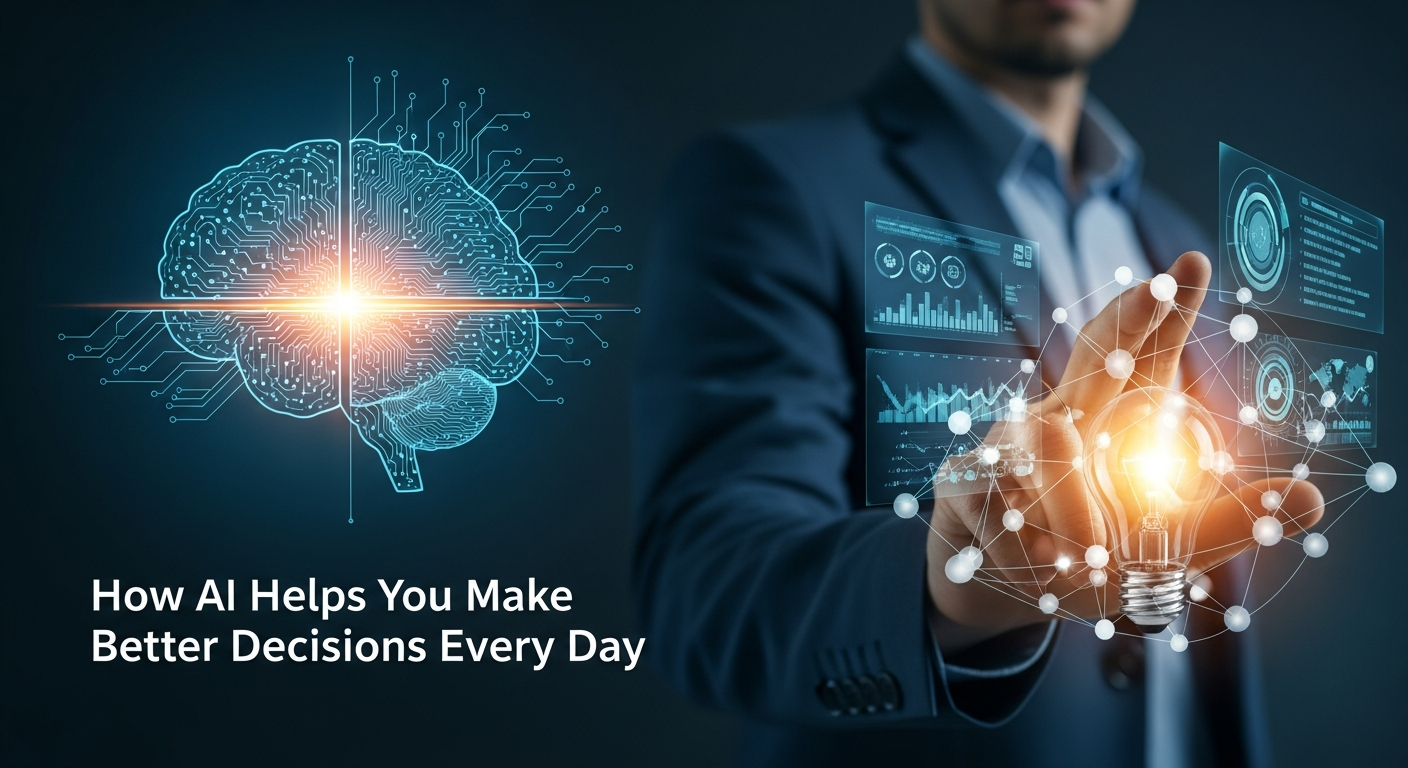
How AI Helps You Make Better Decisions Every Day
Introduction: Navigating Decisions with AI
Every day, we are faced with a multitude of choices, from the mundane, such as what to eat for breakfast, to the profound, like deciding on a career path or where to invest our savings. The sheer volume of decisions we must make can lead to decision fatigue, a state where the quality of our choices deteriorates due to the depletion of our mental resources. Furthermore, our decisions are often influenced by biases, unconscious patterns that can skew our judgment and lead to suboptimal outcomes. In this complex landscape of daily decisions, Artificial Intelligence (AI) emerges as a powerful tool, not to replace human decision-making, but to augment it, helping us make smarter choices with greater ease and accuracy.
The Role of AI in Decision Making
AI is not intended to supplant human intelligence but to serve as an intelligent assistant, cutting through the complexity of data and presenting us with informed options. By leveraging AI decision making, individuals can navigate the vast array of daily decisions with more confidence and less mental strain. Whether it's analyzing market trends to make informed investment decisions, optimizing daily routines for better time management, or simply choosing the most efficient route to work, AI can provide the insights needed to make better, more informed choices.
Exploring Practical Applications of AI
This article promises to delve into the practical applications of AI in enhancing our daily decision-making processes. We will explore how AI can be used in various aspects of life, from personal finance and health to professional development and business strategy. By understanding how artificial intelligence benefits can be harnessed in real-world scenarios, readers will gain a deeper insight into how AI can be a valuable co-pilot in navigating the complexities of daily life. The goal is to empower individuals with the knowledge of how AI can support, rather than replace, human decision-making, leading to more informed and smarter choices.
Augmenting Human Intelligence
It's essential to emphasize that the ultimate goal of integrating AI into our decision-making processes is to augment human intelligence, not to diminish it. By automating routine analyses, providing data-driven insights, and offering predictive models, AI frees us to focus on the strategic, creative, and empathetic aspects of decision-making that are uniquely human. As we embark on this exploration of how AI can help us make better decisions every day, we'll discover that the true power of AI decision making lies not in replacing human judgment, but in enhancing it, leading to a future where technology and human intuition work in harmony to create better outcomes in all facets of life.
Through the lens of AI benefits and its applications in daily life, this article aims to provide readers with a comprehensive understanding of how AI can aid in decision making, from mitigating decision fatigue to fostering more informed choices. By the end of this journey, readers will be equipped with the knowledge to leverage AI as a powerful tool for making smarter, faster decisions in their personal and professional lives.
Core Mechanics: How AI Powers Better Decisions
Data Analysis & Pattern Recognition
At the heart of AI's decision-making assistance lies its ability to perform AI data analysis on an unprecedented scale. Humans can only process a limited amount of information at any given time, but AI systems can analyze massive datasets—ranging from financial records to social media trends—in mere seconds. This capability allows AI to identify complex pattern recognition AI that would be invisible to the human eye. For instance, imagine trying to spot fraudulent transactions in a company's payment database. A human auditor might miss subtle anomalies buried within thousands of entries, but AI can quickly flag suspicious patterns by recognizing deviations from established norms.
Consider a retail company analyzing customer purchase histories. Humans might notice that certain products are frequently bought together, but AI can uncover nuanced correlations across millions of transactions, revealing hidden purchasing behaviors. This pattern recognition AI enables businesses to optimize inventory, tailor marketing strategies, and ultimately make better decisions about resource allocation and customer engagement. The result is a significant improvement in decision-making accuracy and efficiency, transforming raw data into actionable insights.
Predictive Analytics
Another powerful mechanism through which AI enhances decision-making is predictive analytics. Unlike traditional analysis that focuses on historical data, predictive analytics uses AI to forecast future outcomes based on past trends and patterns. This forward-looking capability allows individuals and organizations to make proactive decisions rather than reactive ones. For example, a logistics company can predict potential supply chain disruptions by analyzing weather patterns, historical shipping data, and global events—enabling them to reroute shipments before problems occur.
Imagine a financial advisor using AI-powered tools to predict market trends. By processing vast amounts of economic indicators, social sentiment, and historical performance data, the AI can generate forecasts about potential market movements. This allows the advisor to make more informed investment recommendations, helping clients prepare for various scenarios. The power of predictive analytics lies in its ability to transform complex data into clear, actionable predictions, giving users a competitive edge in an ever-changing world.
Personalization & Recommendations
AI excels at delivering tailored experiences through sophisticated AI personalization algorithms. These systems analyze individual preferences, past behaviors, and contextual information to provide highly relevant recommendations. Consider how streaming services like Netflix or Spotify curate content for each user—these platforms use AI to understand your viewing/listening habits and suggest new content you're likely to enjoy.
For professionals, this translates to receiving personalized news alerts that filter out noise and focus on industry-specific developments. E-commerce platforms use similar technology to recommend products based on past purchases and browsing history, saving valuable time during shopping. The beauty of AI personalization is that it learns and adapts over time, continuously refining its suggestions to align with evolving preferences. This targeted approach ensures users receive the most relevant information, enabling better decisions with minimal effort.
Automation of Repetitive Decisions
One of the most liberating aspects of AI is its ability to automate routine decision-making processes. By handling repetitive tasks efficiently, AI frees up human cognitive resources for more complex challenges. Consider how AI-powered systems in banking can automatically approve low-risk loan applications, reducing the need for manual review. This not only speeds up the process but also minimizes human error in standard procedures.
In professional settings, AI tools can automate scheduling conflicts, prioritize tasks based on urgency, and even generate initial drafts of reports. For individuals, smart home systems use AI to automate energy usage decisions, optimizing consumption patterns without constant manual oversight. This automation of repetitive decisions allows humans to focus their attention on creative problem-solving and strategic planning—activities where human judgment truly excels. The result is a more efficient allocation of mental resources, enabling better performance across all aspects of life.
Real-World Impact: AI in Your Everyday Life
Artificial Intelligence is no longer a concept confined to science fiction or futuristic labs. It's an integral part of our present, quietly enhancing our capabilities and helping us make smarter choices across countless aspects of our daily existence. Far from being an abstract technology, AI's real-world impact is felt in virtually every interaction we have with digital tools and smart devices. Let's explore some vivid examples of AI applications daily life, illustrating how AI actively supports better decision-making.
Personal Finance & Investing: Intelligent Money Management
Managing personal finances can often feel daunting, from budgeting and saving to making informed investment choices. AI is revolutionizing this space by providing tools that act as a personal financial advisor, without the hefty fees.
- Problem: You struggle to stick to a budget, identify wasteful spending, or know where to invest your savings effectively.
- AI Solution: AI-powered budgeting apps analyze your spending patterns, categorize transactions, and predict future expenses. They send personalized alerts when you're over budget in a certain area or suggest ways to optimize savings. For investing, robo-advisors use AI algorithms to assess your risk tolerance and financial goals, then automatically build and rebalance diversified investment portfolios. They remove emotional biases, leading to more rational, data-driven investment decisions.
- Mini-Case Study: Sarah, a young professional, used to find managing her money overwhelming. Now, her AI-driven budgeting app not only tracks every penny but also recommends how much she can comfortably save each month towards a down payment. Simultaneously, an personal finance AI robo-advisor manages her retirement fund, adjusting investments automatically based on market conditions and her evolving profile, ensuring she’s always making optimally informed financial choices.
Health & Wellness: Personalized Paths to Better Health
From tracking fitness goals to understanding complex health data, AI is empowering individuals to take proactive control of their well-being.
- Problem: You want to improve your fitness, track nutritional intake accurately, or detect potential health issues early, but lack personalized guidance.
- AI Solution: Wearable fitness trackers leverage AI to not just count steps, but also analyze sleep patterns, heart rate variability, and stress levels. They provide personalized insights and suggestions for improvement. AI-powered nutrition apps recommend meal plans based on your activity, dietary preferences, and health goals. Furthermore, advanced diagnostic tools use AI in health to analyze medical images or data, assisting in the early detection of conditions that might be missed by the human eye, enabling quicker interventions and better health outcomes.
- Mini-Case Study: Mark's AI-enabled smartwatch noticed a consistent dip in his sleep quality and a rise in his resting heart rate. It prompted him to adjust his evening routine, recommending earlier bedtimes and meditation exercises. This small, AI-driven nudge helped him proactively address potential stress-related health issues before they escalated, making a vital decision for his long-term health.
Productivity & Workflows: Streamlining Your Day
In a world of constant information overload and competing priorities, AI acts as a smart assistant, helping us manage our professional and personal workflows more efficiently.
- Problem: Your inbox is overflowing, scheduling meetings is a chore, and finding relevant information feels like searching for a needle in a haystack.
- AI Solution: Smart assistants (like virtual personal assistants) can manage your calendar, set reminders, filter emails, and even draft responses based on context. AI-powered project management tools analyze task dependencies and team availability to optimize project timelines. Content curation platforms use AI to sift through vast amounts of information, delivering only the most relevant news, articles, or research papers directly to you, saving valuable time and ensuring you're always acting on the most pertinent data. These AI productivity tools are invaluable.
- Mini-Case Study: Maria, a marketing manager, used to spend hours sifting through industry news. Now, an AI-driven news aggregator learns her interests and prioritizes articles from key sources, presenting her with a concise daily briefing. Her AI assistant also automates meeting scheduling, finding optimal slots for all attendees without endless email chains. This allows her to focus on strategic tasks rather than administrative ones, significantly boosting her professional decision-making efficiency.
Consumer Choices & Shopping: Smarter Purchases and Home Management
AI helps navigate the vast landscape of consumer products and services, empowering us to make more informed and personalized choices.
- Problem: You're overwhelmed by product choices, unsure if you're getting the best deal, or want to manage your home devices more intelligently.
- AI Solution: E-commerce platforms use AI to analyze your past purchases, browsing history, and even external trends to provide highly personalized product recommendations. Price comparison tools, powered by AI, scour the web to ensure you're getting the best value. Furthermore, smart home systems employ AI to learn your habits and preferences, automatically adjusting lighting, temperature, and security settings to enhance comfort, save energy, and improve safety. These tools facilitate smart consumer decisions by providing context and foresight.
- Mini-Case Study: David loves online shopping but often felt overwhelmed by options. Now, his favorite retail site, powered by AI, suggests items eerily close to his style and needs, reducing decision fatigue. When he's looking for a new gadget, an AI price tracker alerts him when his desired item drops to his target price, ensuring he makes the best purchasing decision. Even his smart thermostat, learning his family's daily routine, optimizes heating and cooling, saving energy without him lifting a finger. The convenience and efficiency are remarkable.
Deep Dive: Understanding the AI Behind the Decisions
The Core Technologies Driving AI Decisions
While AI often feels like a monolithic entity, its practical application in daily decision-making is powered by a sophisticated interplay of specialized technologies. At the heart of many intelligent systems is machine learning decision making, the backbone that enables computers to learn from data without explicit programming. This capability is pivotal for systems that adapt and improve over time, making them invaluable for dynamic decision support across various domains.
Within Machine Learning (ML), we primarily encounter two fundamental paradigms. Supervised learning involves training models on labeled data to make predictions or classifications, such as an AI predicting loan default risk based on historical financial records. In contrast, unsupervised learning identifies hidden patterns and structures within unlabeled data, invaluable for tasks like customer segmentation or anomaly detection that inform critical business strategies. Beyond these, Natural Language Processing (NLP) allows AI to understand, interpret, and generate human language – powering everything from smart assistants to sentiment analysis tools that gauge public opinion for strategic business machine learning decisions. Complementing this, Computer Vision enables AI to "see" and interpret visual information, from recognizing faces to detecting manufacturing defects, further enriching the data available for analysis and automated decision processes.
These impressive capabilities are all underpinned by sophisticated AI algorithms. These are the meticulously designed sets of rules and mathematical models that allow a system to process vast amounts of information, identify intricate patterns, and continuously refine its predictions or recommendations. The power of these AI algorithms lies in their ability to learn iteratively; through feedback loops and continuous training on new data, they adapt and evolve, leading to increasingly accurate and nuanced decision outcomes over time. This continuous learning cycle is what makes AI decision support so powerful and adaptable, driving constant improvement in accuracy and relevance.
Ensuring Trust: AI Ethics, Bias Mitigation, and Data Privacy
As AI's influence pervades various aspects of life, critical discussions around AI ethics become paramount. The integrity and fairness of any AI system are intrinsically linked to the data it's trained on. If this data reflects societal prejudices or contains historical inequalities, the AI will inevitably learn and, unfortunately, amplify these biases. This leads to what is widely known as algorithmic bias, which can result in unfair outcomes such as discriminatory hiring recommendations, skewed credit assessments, or even misdiagnosis in healthcare applications. Mitigating such algorithmic bias requires meticulous data curation, diverse datasets, and continuous auditing of AI outputs to ensure equitable application and prevent unintended discrimination.
Transparency, often referred to as "explainable AI" (XAI), is another cornerstone of building trust. Understanding why an AI arrived at a particular recommendation or decision is crucial for accountability and user acceptance, especially in high-stakes scenarios like medical diagnoses or legal judgments. Furthermore, establishing clear lines of accountability ensures that humans remain ultimately responsible for the outcomes of AI-driven decisions, fostering a robust framework of ethical governance that prioritizes human oversight and intervention when necessary.
Equally vital is the consideration of AI data privacy. Every interaction with AI systems, from health trackers to smart home devices, generates personal data. Responsible AI development absolutely demands robust measures for data collection, storage, and processing. This includes advanced anonymization techniques, stringent encryption protocols, and strict adherence to global regulations like GDPR and CCPA, ensuring personal information is handled with the utmost care. Protecting personal information is not just a regulatory requirement; it’s a fundamental ethical imperative. Consumers need assurance that their data isn't merely a commodity, but a protected asset used solely to enhance their experience and facilitate more informed choices, thereby strengthening trust in AI decision-making tools and respecting their AI data privacy rights.
The Future: Augmented Intelligence for Strategic Decisions
The trajectory of AI isn't solely aimed at replicating human intelligence but, more profoundly, at augmenting it. This transformative concept, known as augmented intelligence, envisions AI as a powerful co-pilot, working seamlessly with human intellect rather than independently. Instead of replacing human decision-makers, AI serves as an indispensable tool for advanced analysis, predictive modeling, and sophisticated scenario planning, especially in complex, strategic contexts. This collaborative approach enhances our collective capacity to make better choices and navigate increasingly intricate challenges.
In this synergistic future, AI takes on the heavy lifting of processing vast, intricate datasets, identifying subtle patterns, and generating predictive models at speeds and scales impossible for humans. This crucial support frees up human decision-makers to focus on higher-level tasks: applying intuition, creativity, ethical judgment, and strategic thinking that AI currently cannot replicate. For businesses, this means AI can distill complex market trends and potential risks, allowing executives to make more informed and nuanced strategic decisions. For individuals, it could mean highly personalized health plans developed with AI's analytical prowess, but refined and approved by a medical professional's expertise. The ultimate goal of augmented intelligence is a partnership where the distinct strengths of both human and artificial intelligence combine to achieve optimal outcomes, elevating our collective decision-making capacity to unprecedented levels and fostering a future where intelligent systems truly empower human potential.
Actionable Steps: Integrating AI for Smarter Choices
1. Identifying Decision Pain Points: Pinpointing Areas for AI Value
Before diving into AI tools, take a moment to reflect on where your decision-making struggles most. This self-assessment is the first step in an effective AI implementation strategy. Ask yourself:
- Are you overwhelmed by information when making choices?
- Do you often feel rushed or stressed during decision-making?
- Are certain types of decisions (like financial, health-related, or time management) consistently difficult?
- Do you wish you had more data or different perspectives to inform your choices?
Common decision pain points include:
- Information overload: Sifting through vast amounts of data to find relevant insights.
- Time constraints: Needing to make quick decisions without adequate analysis.
- Emotional bias: Letting personal feelings unduly influence rational choices.
- Limited perspective: Not having access to diverse viewpoints or expert knowledge.
Once you've identified your specific challenges, you can research AI tools specifically designed to address those areas. For instance, if information overload is a problem, look into AI-powered research assistants. If emotional bias is an issue, consider AI tools that offer cognitive bias analysis.
2. Choosing the Right AI Tools: Guidance on Selecting Effective AI-Powered Applications
The AI landscape offers a vast array of tools, making selection crucial. An effective AI implementation strategy involves finding tools that align with your identified pain points without overwhelming you.
Consider these categories and examples:
"Start small and focus on tools that solve specific, high-frequency decision problems in your daily life or work."
- Personal Productivity & Organization: Tools like Notion AI or Microsoft To Do with AI features can help prioritize tasks and suggest schedules based on your goals and commitments.
- Research & Information Gathering: Platforms such as Google Scholar (with AI enhancements) or specialized AI research tools can summarize articles, extract key points, and identify trends much faster than manual reading.
- Financial Decisions: AI-powered apps like Mint or YNAB (You Need A Budget) offer insights into spending habits, investment suggestions, and budget planning based on your financial data.
- Health & Wellness: AI tools can analyze health data (from wearables or journals) to provide personalized recommendations for diet, exercise, and preventative care.
- Learning & Skill Development: Adaptive learning platforms use AI to personalize educational content and identify areas needing improvement.
When choosing, evaluate based on:
- Specificity: Does the tool directly address your identified pain points?
- Usability: Is the interface intuitive, or is there a significant learning curve?
- Customization: Can the tool be tailored to your preferences and needs?
- Integration: Does it work well with other tools or platforms you already use?
- Privacy & Data Security: What data does the tool require, and how is it protected?
3. Best Practices for AI Integration: Tips for Seamless Incorporation
Successfully integrating AI into your decision-making process requires thoughtful integration, not just tool selection. Follow these best practices for a smooth AI implementation strategy:
- Start Incrementally: Don't overhaul your entire decision-making process overnight. Select one or two tools to address a specific pain point and integrate them gradually.
- Customize Your Experience: Many AI tools offer customization options. Take the time to set preferences, define your goals, and tailor the output to your specific needs. This helps the AI provide more relevant suggestions.
- Combine AI with Human Insight: Never fully delegate your decision-making to AI. Use AI-generated insights and suggestions as a starting point or for data analysis, but always apply your own judgment, experience, and ethical considerations.
- Integrate into Your Workflow: Choose tools that fit naturally into your existing routines. For example, set aside specific times to review AI suggestions related to project planning or financial summaries.
- Use a Personal AI Assistant: Consider leveraging your smartphone's personal AI assistant (like Siri, Google Assistant, or Alexa) for quick information retrieval, reminders, or even brainstorming ideas during daily planning.
Think of AI as a powerful co-pilot, enhancing your capabilities rather than replacing your unique perspective and expertise.
4. Overcoming Initial Challenges: Addressing Potential Hurdles
Integrating AI might present challenges, especially if you're new to it. Acknowledge these potential hurdles and proactively address them:
- Learning Curve: AI tools can have different interfaces and functionalities. Allow time for learning. Start with tutorials and basic features. Remember, the goal is progress, not perfection, in your initial integration.
- Data Input Requirements: Many AI tools need data to function optimally. Be prepared to input information consistently (e.g., your budget data for financial tools, tasks for productivity tools). The quality of AI output often depends on the quality and completeness of your input.
- Skepticism & Validation: AI isn't always 100% accurate. Develop a habit of verifying AI-generated suggestions, especially for critical decisions. Cross-reference information where possible.
- Privacy Concerns: Be mindful of the data you share. Read privacy policies and use tools from reputable sources. Avoid sharing highly sensitive personal information unless absolutely necessary and you trust the platform.
- Over-reliance: Maintain a healthy balance. Use AI to augment your decision-making, not to completely replace critical thinking or intuition.
Frame these challenges as part of the learning process. Your willingness to navigate the initial complexities is key to unlocking AI's long-term benefits.
5. Continuous Learning and Adaptation: Evaluating AI's Performance
Integrating AI isn't a "set it and forget it" task. Continuous learning and adaptation are essential for ongoing improvement and maximizing the value of your AI tools.
Regularly evaluate your AI integration experience:
- Assess Effectiveness: Are the AI suggestions helping you make better decisions? Are you saving time? Are you getting more accurate insights? Keep a journal noting the outcomes of decisions supported by AI.
- Seek Feedback: If possible, use tools that provide feedback mechanisms.
Balanced Perspective: AI vs. Intuition and Human Judgment
As we delve into the realm of Artificial Intelligence (AI) and its role in enhancing daily decision-making, it's essential to acknowledge the strengths and weaknesses of both AI and human judgment. While AI excels in data-driven logic and processing vast amounts of information, human intuition and experience bring emotional intelligence and creative problem-solving to the table. Understanding the pros and cons of relying on AI versus human decision-making is crucial for making informed choices.
Comparing AI and Human Decision-Making Capabilities
A comparative analysis of AI and human strengths reveals that AI is superior in processing and analyzing large datasets, identifying patterns, and providing predictive insights. However, human intuition and experience are invaluable in situations that require critical thinking, empathy, and understanding of complex social dynamics. Moreover, humans are better equipped to handle unforeseen circumstances and ethical dilemmas that may arise in personal and professional settings.
Despite the benefits of AI, there are risks associated with over-reliance on automation. Automation bias can lead to a loss of critical thinking skills, as individuals become too dependent on AI-driven recommendations. It's essential to strike a balance between leveraging AI as a powerful tool and maintaining human oversight and decision-making authority. By adopting a human-AI collaboration approach, individuals can harness the strengths of both AI and human judgment to make more informed decisions.
The Importance of Human Oversight and Intervention
The human in the loop principle emphasizes the need for human oversight and final decision-making authority. This approach ensures that AI-driven recommendations are reviewed and validated by humans, taking into account contextual factors and nuances that may not be apparent to AI systems. By maintaining human intervention, individuals can avoid the pitfalls of automation bias and ensure that decisions are made with a balanced perspective.
In situations where AI may struggle, such as ethical dilemmas or unforeseen circumstances, human judgment is paramount. Humans can provide empathy and understanding in complex social situations, and make decisions that take into account long-term consequences and moral implications. By recognizing the limitations of AI and the importance of human intervention, individuals can create a more effective human-AI collaboration that leverages the strengths of both parties.
Best Practices for Human-AI Collaboration
To maximize the benefits of AI in decision-making, individuals should follow best practices for human-AI collaboration. These include:
- Clearly defining the role of AI in the decision-making process
- Establishing human oversight and review mechanisms
- Providing ongoing training and education on AI capabilities and limitations
- Encouraging critical thinking and contextual understanding in AI-driven decision-making
- Fostering a culture of transparency and accountability in AI-driven decision-making
By adopting these best practices and recognizing the importance of human intuition and human judgment, individuals can create a more effective and balanced approach to decision-making that leverages the strengths of both AI and human capabilities.
The key to successful decision-making lies in striking a balance between the data-driven logic of AI and the emotional intelligence and creative problem-solving of human intuition. By embracing a human-AI collaboration approach, individuals can make more informed decisions and achieve greater success in their personal and professional lives.
Conclusion: Your Future of Empowered Decisions
Embracing Intelligence for Better Choices
Throughout this article, we've explored how Artificial Intelligence isn't just a futuristic concept but a practical partner in our daily lives. From streamlining personal finance and optimizing health routines to enhancing professional productivity and enriching leisure, AI acts as a powerful analytical engine. It sifts through vast amounts of data, identifies patterns, and provides insights that empower us to make better, faster, and more informed decisions. This leads to reduced stress, increased efficiency, and ultimately, a higher quality of life. AI is transforming how we interact with the world, offering clarity where complexity once reigned.
However, the true magic unfolds when AI's analytical prowess is combined with human intuition and wisdom. AI provides the data-driven recommendations, but you provide the context, the empathy, and the final judgment. This human-AI synergy ensures that decisions are not only data-backed but also aligned with your personal values and long-term aspirations. It’s about leveraging technology to augment, not replace, our innate ability to think and choose wisely, leading to truly AI empowered decisions.
Your Next Step Towards Smart Living
The journey towards a more intelligent and efficient life begins with a single step. We encourage you to identify one area where you feel your decision-making could benefit from AI. Perhaps it's using a smart assistant for scheduling, an AI-driven app for financial tracking, or a recommendation engine for learning new skills. Don't aim for perfection; simply start experimenting. Embrace the tools that offer paths to smart living and discover how they can simplify your choices and amplify your impact.
The future of AI is bright and constantly evolving, promising even more sophisticated and integrated assistance. By proactively engaging with these technologies today, you're not just adopting a trend; you're investing in your own continuous improvement and shaping a future where every decision is an opportunity for growth and empowerment. Your journey into AI-assisted decision-making has just begun, and the possibilities are limitless.

Comments (0)
Please login or register to leave a comment.
No comments yet. Be the first to comment!