
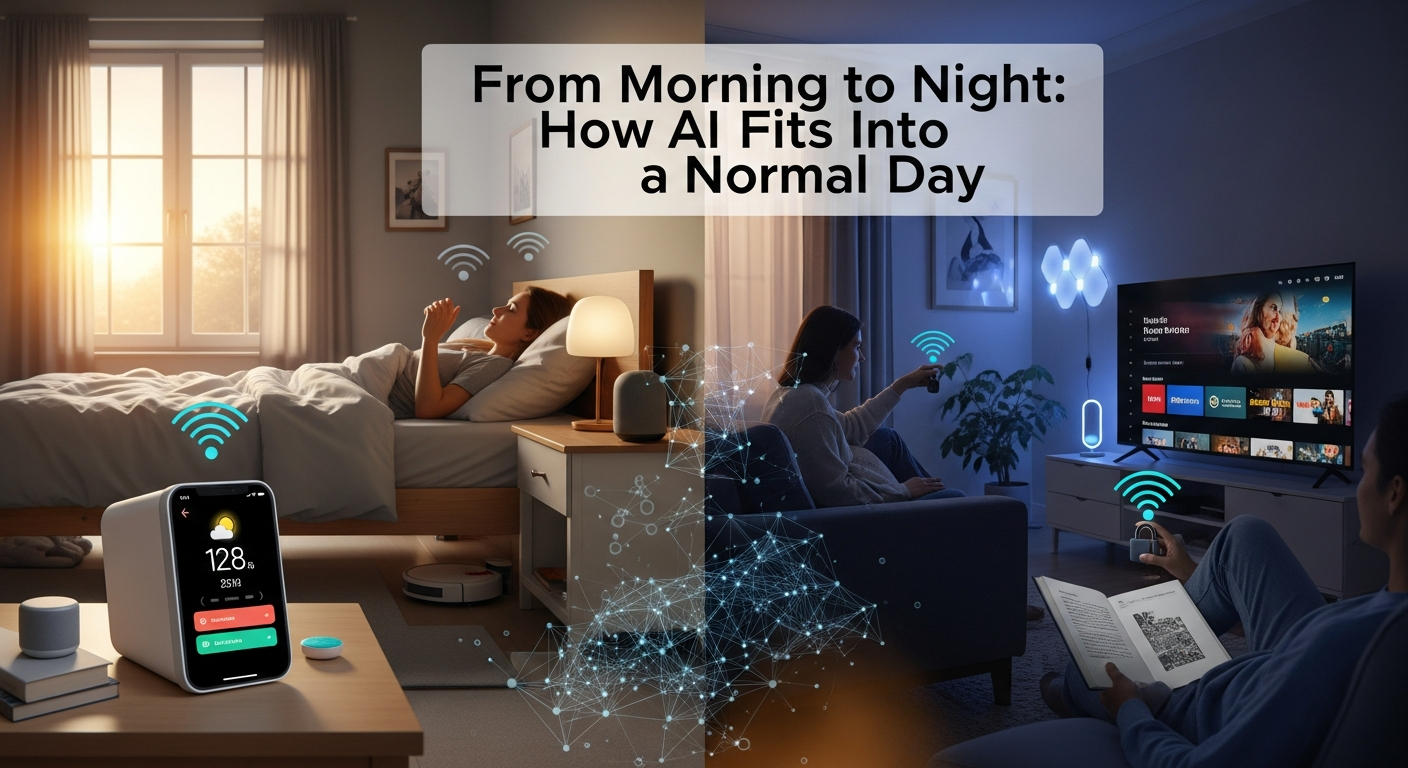
From Morning to Night: How AI Fits Into a Normal Day
Introduction: Waking Up to the AI-Enhanced Day
Imagine your morning routine. Does your smartphone alarm gently rouse you with a personalized playlist, learning your preferences over time? Does your smart speaker offer a concise weather update and a quick news briefing before your feet even hit the floor? Perhaps your coffee maker starts brewing precisely when you need it, thanks to a schedule you set weeks ago. These aren't futuristic fantasies; they're immediate, tangible examples of AI in daily life, quietly working behind the scenes.
For many, the term "artificial intelligence" still conjures images of sentient robots, self-driving cars dominating every street, or complex supercomputers debating philosophy. While those aspects of AI are certainly developing, the truth is that AI's most pervasive and profoundly impactful presence is far more subtle and integrated. It's the silent force orchestrating countless moments of your day, often without you even realizing you're interacting with advanced algorithms.
This article isn't about the distant AI of tomorrow, but the everyday AI that's already here, now. We're going to take you on a journey through a typical day, from the moment your eyes open until you drift to sleep, uncovering the pervasive and often unnoticed ways artificial intelligence enhances, assists, and even anticipates your needs. You'll discover that AI isn't just a cutting-edge technology; it’s a foundational layer of modern convenience.
Prepare to see how seamless AI integration has become, making tasks simpler, information more accessible, and our environments more responsive. We’ll explore how various algorithms, machine learning models, and smart technologies contribute to what we now simply call smart living. Get ready to look at your routine through a new lens, revealing the intelligent threads woven throughout your ordinary day, demonstrating just how essential AI has become to our contemporary existence.
Main Content: AI's Morning Rituals and Commute Companions
Waking Up Smart: AI in Your Home
As the sun begins to peek through your curtains, the subtle presence of Artificial Intelligence is already at work, orchestrating your morning. Gone are the days of jarring alarms; today, many smart devices employ sleep tracking AI to monitor your sleep cycles, gently waking you during a light sleep phase. This helps you feel more refreshed and less groggy. Even before your feet hit the floor, your smart home AI might spring into action. Imagine lights gradually brightening, mimicking a natural sunrise, or your smart thermostat adjusting the temperature to your preferred morning warmth. For many, the aroma of fresh coffee isn't a manual effort anymore; AI-enabled coffee makers can be programmed to brew your favorite cup just as you’re about to emerge from slumber, all based on your routine or a simple voice command.
Your Personalized Information Stream
With coffee in hand, you might reach for your phone or tablet to catch up on the world. This is where personalized content algorithms, powered by AI, truly shine. Your news app isn't just showing you generic headlines; it's curating a feed based on your past reading habits, interests, and even location. Podcast apps recommend new episodes from creators you might like, while social media feeds prioritize updates from people and topics you engage with most. This intelligent filtering ensures that the information you consume is highly relevant, making your morning media consumption more efficient and enjoyable. AI works tirelessly in the background, learning your preferences to deliver exactly what you want to see and hear, saving you time scrolling through irrelevant information.
Navigating Your Morning Journey with AI
For millions, the morning routine culminates in the daily commute, and here, AI becomes your indispensable co-pilot. Apps like Google Maps or Waze leverage sophisticated AI navigation to predict traffic patterns, identify accidents, and suggest the fastest routes in real-time. This isn't just about avoiding a jam; it's about dynamic analysis of countless data points – road sensors, user reports, historical data – to provide uncanny accuracy. If you use ride-sharing services, AI algorithms are constantly at work, optimizing driver routes, calculating fares, and matching you with the nearest available car, ensuring seamless commute optimization. Even within modern vehicles, AI powers infotainment systems, offering voice commands for music, calls, and navigation, keeping your focus on the road and making your drive smarter and safer.
AI as Your Digital Productivity Assistant
Before you even step into the office, AI has likely streamlined your preliminary work tasks. Your email inbox is a prime example: AI-powered filters tirelessly sort spam, categorize important messages, and even suggest quick replies, making it easier to manage your communications. Calendar applications leverage AI productivity tools to suggest optimal meeting times, considering everyone’s availability, time zones, and even travel times. Virtual assistants integrated into your devices can schedule appointments, set reminders, and provide summaries of your day’s agenda with just a voice command. This subtle, intelligent assistance ensures you start your workday not just organized, but also several steps ahead, thanks to AI handling the administrative minutiae.
Supporting Content: AI Enhancing Work, Learning, and Leisure
As the day progresses, AI continues its subtle yet significant influence, transforming how we work, learn, and relax. Far from being a futuristic concept, AI is the engine behind many of the conveniences and efficiencies we now take for granted, making our professional and personal lives smoother and more productive. Let's delve into concrete examples of how AI is seamlessly integrated into these mid-day activities.
AI at Work: Boosting Productivity and Streamlining Tasks
In the professional realm, Artificial Intelligence has become an indispensable partner for many, quietly revolutionizing everything from project management to customer interaction. Consider the multitude of tools that leverage AI in the workplace to make tasks more efficient. Project management software, for instance, often uses AI to analyze past performance, predict potential bottlenecks, and even suggest optimal task assignments, helping teams stay on schedule and collaborate more effectively.
Data analysis, once a labor-intensive chore, is now accelerated by AI algorithms that can sift through vast datasets in moments, identifying trends, anomalies, and actionable insights that would take human analysts weeks to uncover. Furthermore, Customer Relationship Management (CRM) systems employ AI to personalize customer interactions, predict customer needs, and automate follow-ups, ensuring no lead or query goes unnoticed. Perhaps one of the most visible applications is the rise of automated customer service chatbots. These intelligent assistants handle routine inquiries, provide instant support, and guide users through common issues, freeing up human agents to focus on more complex problems and significantly improving response times.
AI in Learning: Personalized Growth and Knowledge Discovery
The landscape of education and learning has also been dramatically reshaped by AI, offering more personalized and accessible pathways to knowledge. Online learning platforms and intelligent tutoring systems are prime examples of AI in education, adapting to individual learning styles and paces. These platforms can identify areas where a student struggles and provide targeted resources, practice questions, or alternative explanations, creating an educational experience that is tailored to your unique needs. Think of language learning apps that use AI to analyze your pronunciation and grammar, providing instant, personalized feedback.
For researchers and students alike, AI-powered tools are invaluable for sifting through mountains of academic papers and publications. They can help identify relevant studies, summarize complex articles, and even translate content across languages, accelerating discovery and breaking down communication barriers. This means less time spent searching and more time dedicated to understanding and innovating.
AI in Leisure & Commerce: Enhancing Everyday Experiences
When it's time to unwind or tackle daily errands, AI continues to play a starring role in enhancing personal experiences. For entertainment, streaming services like Netflix or Spotify leverage sophisticated AI algorithms to provide incredibly accurate personalized recommendations, suggesting your next binge-watch or favorite song based on your past viewing and listening habits. In gaming, advanced AI entertainment powers non-player characters (NPCs) that react dynamically to your actions, creating more immersive and challenging experiences. Even your personal photos and videos benefit from AI, with smart editing tools that can automatically enhance colors, remove imperfections, or even suggest creative edits, making your memories look their best with minimal effort.
Online shopping has been similarly transformed. When you browse your favorite e-commerce sites, AI is behind the product suggestions that appear, showing you items you're more likely to purchase based on your browsing history and purchase patterns. This targeted approach extends to personalized ads you see across the web. Some retailers even offer virtual try-ons powered by AI, allowing you to see how clothes or accessories might look on you before making a purchase. And just as in professional settings, e-commerce AI and customer service chatbots are on hand to answer questions about products, track orders, or assist with returns, making the shopping experience smoother and more convenient.
Advanced Content: Understanding the AI Underpinnings
While AI seamlessly integrates into our daily lives, often operating behind the scenes, a deeper look reveals the sophisticated mechanisms that power these interactions. Moving beyond the surface, this section delves into the foundational concepts that enable AI to learn, understand, and make decisions, giving you a clearer picture of the intelligence at play.
The Engine Room: Demystifying Machine Learning Basics
At the heart of most modern AI applications is machine learning basics (ML). Unlike traditional programming where every instruction is explicitly coded, ML allows systems to learn from data. Imagine teaching a child to recognize a cat; you don't give them a detailed code for "cat," but rather show them many pictures of cats until they learn to identify one themselves. Similarly, ML algorithms are fed vast amounts of data – images, text, sounds, numbers – and through statistical analysis and pattern recognition, they develop the ability to make predictions or take actions without being explicitly programmed for every scenario.
This "learning from experience" is what enables everything from your email's spam filter to your music streaming service's next song suggestion. The more data these systems process, the better and more accurate their learning becomes, constantly refining their understanding of the world.
AI's Senses: Natural Language Processing and Computer Vision
To truly integrate into our lives, AI needs to understand and interact with the human world. This is primarily achieved through two key domains: Natural Language Processing and Computer Vision.
Natural Language Processing (NLP): Speaking AI's Language
Natural Language Processing (NLP) is the branch of AI that equips computers with the ability to understand, interpret, and generate human language. When you ask your smart speaker about the weather, it's NLP that breaks down your spoken words into text, understands the intent behind your query ("weather inquiry"), extracts key information ("today," "location"), and then formulates a coherent, verbal response. Similarly, NLP is at work in translation apps, grammar checkers, and even the predictive text on your smartphone, making communication with technology feel incredibly intuitive.
Computer Vision (CV): Teaching AI to See
Just as NLP handles language, computer vision AI grants machines the capacity to "see" and interpret the visual world. This involves training AI models to process and understand images and videos, discerning objects, faces, activities, and even emotions. From unlocking your phone with facial recognition to identifying hazardous objects in industrial settings or enhancing photos with smart filters, CV is transforming how machines interact with our physical environment. Autonomous vehicles heavily rely on CV to identify pedestrians, traffic signs, and other cars, making split-second decisions based on what they "see."
Personalization and Principles: Recommendation Algorithms, Data, and Ethics
Beyond understanding and seeing, AI excels at anticipating our needs and shaping our digital experiences. But this power comes with significant responsibilities.
The Magic Behind Recommendations
Ever wondered how Netflix knows exactly what show you'll binge next, or how Amazon suggests products you genuinely might want? This is the work of AI recommendation algorithms. These sophisticated systems analyze your past behavior – what you've watched, clicked, purchased, or even skipped – and compare it with the behaviors of millions of other users. By identifying patterns and similarities, they predict what you're likely to enjoy, creating a highly personalized and often surprisingly accurate experience. It's a continuous learning loop, where every interaction refines the algorithm's understanding of your unique preferences.
The Bedrock of AI: Data, Privacy, and Ethics
It’s crucial to understand that all these advanced AI capabilities – from ML learning patterns to NLP understanding language and CV interpreting images – are fundamentally fueled by data. Vast amounts of data are collected, processed, and analyzed to train and improve these AI models. This critical dependency on information underscores the paramount importance of data privacy. Safeguarding personal information, ensuring transparency about data usage, and giving users control over their data are not just legal requirements but ethical imperatives.
Moreover, the development and deployment of AI raise broader questions of AI ethics. How do we prevent bias in algorithms? Who is responsible when an AI makes a mistake? How do we ensure AI is used for good, respecting human autonomy and societal values? These are complex considerations that require ongoing dialogue and responsible innovation to build a future where AI genuinely benefits everyone.
Practical Content: Optimizing Your AI Interactions
As we delve into the world of Artificial Intelligence, it's essential to understand how to optimize AI interactions to suit our needs. From customizing AI settings to leveraging AI for personal growth, there are numerous ways to take control of our AI-powered experiences. In this section, we'll explore the practical aspects of AI interactions and provide actionable tips for readers to make the most out of their AI-driven devices and apps.
Customizing AI Settings for a Personalized Experience
One of the most significant advantages of AI is its ability to learn and adapt to our preferences. To personalize AI, we need to customize the settings of our smart devices and apps. For instance, we can tailor our virtual assistants to recognize our voice, adjust the notification settings to minimize distractions, and refine content recommendations to suit our interests. By doing so, we can create a more intuitive and user-friendly experience that enhances our daily lives.
To customize AI settings, follow these steps:
- Review the settings of your virtual assistant and adjust the preferences to suit your needs.
- Explore the customization options of your smart devices and apps to refine content recommendations and notification settings.
- Take advantage of AI-powered features such as voice recognition and facial recognition to create a more personalized experience.
Managing Data and Privacy in the Age of AI
As we increasingly rely on AI-powered devices and apps, it's crucial to understand how to manage AI data and protect our privacy. This involves reviewing AI privacy settings, understanding permissions, and being mindful of data retention. By taking control of our data, we can ensure that our personal information is secure and that we're not compromising our privacy. It's essential to be proactive in managing our data, as it can have a significant impact on our online security and digital well-being.
To manage data and privacy, consider the following tips:
- Regularly review the privacy settings of your devices and apps to ensure that you're not sharing more data than necessary.
- Be cautious when granting permissions to apps and services, and only provide access to necessary information.
- Use strong passwords and enable two-factor authentication to protect your accounts and data.
Leveraging AI for Personal Growth and Wellness
AI can be a powerful tool for personal growth and wellness. By utilizing AI for wellness, we can take advantage of features such as fitness tracking, mental health support, and language learning tools. For example, we can use AI-powered health apps to monitor our physical activity, track our sleep patterns, and receive personalized recommendations for improvement. Similarly, we can leverage AI-driven language learning tools to develop new skills and expand our knowledge.
To leverage AI for personal growth, consider the following suggestions:
- Explore AI-powered health and fitness apps that can help you track your progress and achieve your goals.
- Use AI-driven language learning tools to develop new skills and expand your knowledge.
- Take advantage of AI-powered mental health support services that can provide personalized guidance and recommendations.
By following these tips and being mindful of our AI interactions, we can optimize AI to enhance our daily lives. Remember to stay informed about the latest AI developments and trends, and be proactive in managing your data and privacy. With the right approach, AI can be a powerful tool for personal growth, wellness, and success.
By taking control of our AI-powered experiences, we can create a more intuitive, user-friendly, and personalized world that enhances our daily lives.
Comparison/Analysis: The Pros, Cons, and Future Outlook
As we've explored how Artificial Intelligence subtly orchestrates elements of our daily lives, from waking up with smart alarms to winding down with personalized entertainment, it's crucial to step back and conduct a balanced appraisal. AI's integration is a double-edged sword, offering incredible advantages while also presenting significant challenges that demand our attention and
thoughtful consideration
.The Dual Edges of Everyday AI: Benefits and Challenges
On one hand, the AI benefits are undeniable. We experience unmatched convenience, whether it's navigating traffic with predictive mapping or receiving smart suggestions for our next purchase. This leads to profound personalization, with everything from streaming content to news feeds tailored to our individual preferences, creating a feeling of *true personalization*. Efficiency is another major win; AI optimizes routes, automates repetitive tasks, and helps us manage our time better, making our days smoother and more productive. Furthermore, AI significantly improves accessibility, empowering individuals with disabilities through voice assistants and predictive text, fostering greater independence.
However, this widespread adoption is not without its hurdles, presenting notable AI challenges. Concerns around data privacy risks are paramount, as our daily interactions feed vast amounts of personal information into systems that can be vulnerable. Over-reliance on AI can dull our own critical thinking skills and problem-solving abilities, leading to a dependency on technology rather than self-sufficiency. A major ethical concern is algorithmic bias, where inherent biases in training data can lead AI systems to make unfair or discriminatory decisions in areas like loan applications, hiring, or even facial recognition. Lastly, the looming specter of job displacement concerns continues to be a societal discussion, as automation impacts various industries and roles.
Striking the Balance: Human Judgment vs. AI Efficiency
Understanding when to let AI take the reins and when human oversight is indispensable is key to a harmonious future. AI excels at processing vast amounts of data, identifying patterns, and executing repetitive tasks with incredible speed and accuracy. For instance, predictive maintenance in smart homes or complex data analysis for personalized health recommendations are areas where AI's efficiency shines. Yet, human judgment remains essential for tasks requiring creativity, empathy, and nuanced ethical reasoning. Decisions that involve complex social interactions, moral dilemmas, or artistic expression still demand the unique capabilities of the human mind. The most effective approach often lies in a collaborative model, where AI augments human capabilities, handling the data-heavy lifting while humans provide the *critical thinking* and ethical framework.
Glimpsing Tomorrow: The Future of AI Integration
Looking ahead, the future of AI promises even deeper integration into our lives. We can anticipate increasingly autonomous systems, from self-driving vehicles that reshape urban planning to proactive AI assistants that anticipate our needs before we even voice them. Hyper-personalization will evolve, with AI not just reacting to our preferences but actively shaping our experiences in even more profound ways. These emerging AI applications will undoubtedly lead to significant AI societal impact, transforming industries, reshaping workforces, and redefining how we interact with technology and each other. As AI continues its rapid evolution, it prompts us to consider how we will adapt, ensure equitable access, and uphold strong AI ethics in this increasingly interconnected and intelligent world.
Conclusion: Embracing the AI-Driven Future, Consciously
Throughout this journey, from the gentle nudge of your smart alarm in the morning to the curated entertainment that helps you unwind at night, we’ve explored the subtle yet profound integration of Artificial Intelligence into our lives. This deep dive has offered a comprehensive daily AI summary, revealing that AI isn't a distant technological marvel but rather an invisible assistant, facilitator, and often, an unnoticed architect of our everyday experiences. It powers our navigation apps, refines our search results, personalizes our shopping, and even helps us manage our home environments, making life more convenient and efficient in countless ways.
The Power of Conscious AI Interaction
The pervasive nature of AI, while undeniably beneficial, necessitates more than just passive acceptance. It calls for a commitment to conscious AI use. Understanding how these systems work, what data they utilize, and the implications of their algorithms empowers us to interact with them more effectively and ethically. This isn't about becoming a tech expert; it's about developing an informed perspective – a critical understanding of the digital tools that shape our decisions, relationships, and daily routines. By being conscious users, we can better identify potential biases, protect our privacy, and ensure that AI serves our best interests, not just those of the systems themselves. It’s about recognizing that the ongoing development of the AI future isn't just happening to us; it's happening with us.
Your Role in the Evolving AI Landscape
As AI continues to evolve at a breathtaking pace, your role as an informed user becomes increasingly vital. Don't be a mere spectator; be an engaged participant. We encourage you to:
- Explore: Dive into the settings of your smart devices and apps. Understand what data they collect and how it's used.
- Question: When an AI offers a recommendation or an answer, take a moment to consider its source and potential motivations. Why was this suggested?
- Provide Feedback: Many AI systems learn from user interaction. Providing thoughtful feedback can help refine and improve these systems for everyone.
- Stay Informed: Keep abreast of AI developments, ethical discussions, and policy changes. Knowledge is your most powerful tool in navigating this new landscape.
Your active engagement helps foster a more transparent, accountable, and ultimately, beneficial AI ecosystem for all.
Embracing AI Empowerment Thoughtfully
Ultimately, AI is a tool of immense potential. When approached with curiosity, understanding, and a commitment to responsible interaction, it transforms from a mere technological convenience into a profound source of AI empowerment. It allows us to automate mundane tasks, unlock new creative avenues, gain deeper insights, and connect in unprecedented ways. The future isn't about fearing AI or blindly embracing it; it's about intelligently integrating it into our lives to enhance human potential and well-being. So, let’s continue to explore, question, and engage, consciously shaping an AI-driven future that truly serves humanity's best interests. The journey with AI is just beginning, and your thoughtful participation is key to its success.

Comments (0)
Please login or register to leave a comment.
No comments yet. Be the first to comment!