
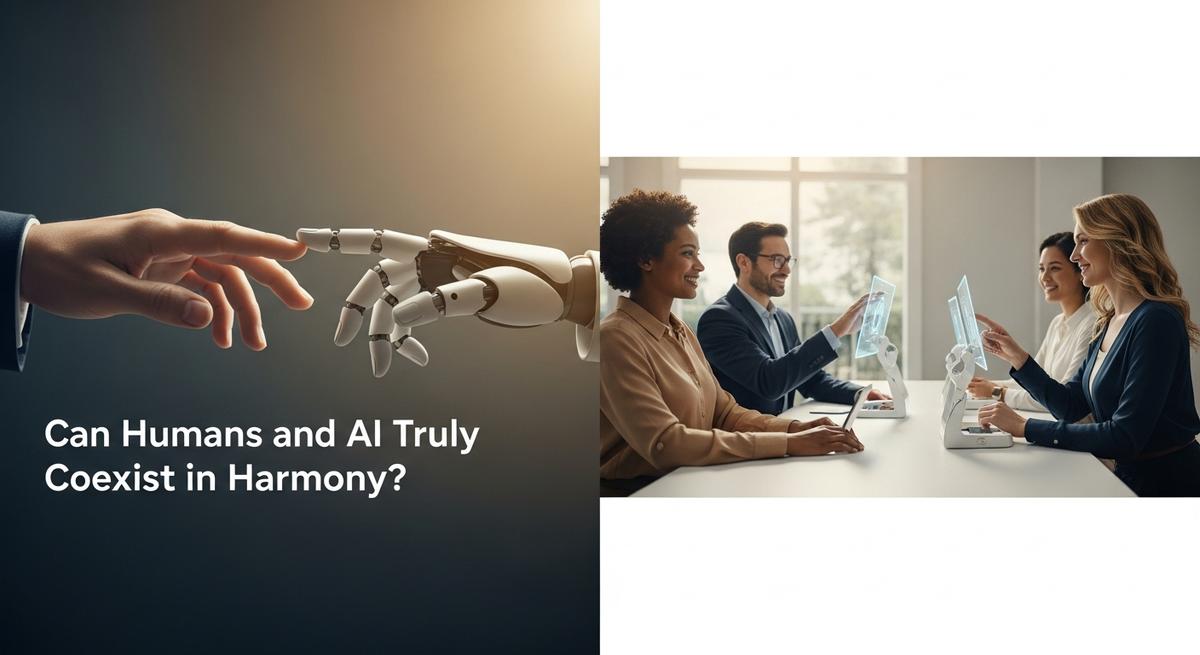
Can Humans and AI Truly Coexist in Harmony?
- January 04, 2026
- ~ 1 min read
- 153 views
- GenAI
Introduction/Overview
Imagine a bustling marketing agency in 2026, where AI agents tirelessly generate dozens of campaign variations, crunch data for personalized outreach, and automate routine content creation. Meanwhile, human creative directors step in with their irreplaceable empathy and cultural intuition, refining ideas that resonate deeply with audiences and steering strategic narratives that build lasting brands. This isn't dystopian displacement—it's a glimpse of human-AI harmony, where technology amplifies human potential rather than erasing it[1][2][3].
The Rapid Rise of AI and 2026 Trends
AI coexistence has evolved from science fiction to everyday reality, driven by breakthroughs like agentic AI—autonomous digital coworkers that handle tasks from hypothesis generation in research labs to pair programming in software development. By 2026, these trends are transforming workplaces: AI boosts productivity in medicine by closing care gaps, accelerates scientific discoveries as virtual lab assistants, and empowers small teams to launch global campaigns in days[2]. Yet, HR professionals face paradoxes—jobs in data-rich sectors like software development and customer support are automating rapidly, while roles demanding empathy, such as therapists and social workers, remain firmly AI-proof[1][4]. In creative fields, 86% of professionals already use AI as an enhancer for initial concepts and variations, freeing them for breakthrough innovations that capture human emotions and trends[1][3].
Defining Harmony: Mutual Enhancement, Not Replacement
What does true human-AI harmony really mean? It's not about AI supplanting humans, but a symbiotic AI integration where machines excel at scale and speed—optimizing repetitive tasks, simulating audience reactions, and personalizing experiences—while humans provide the judgment, creativity, and ethical oversight that define our shared future[2][3]. Rhetorical questions arise: Can a three-person team outpace entire departments with AI as their force multiplier? Will policymakers and business leaders seize this for ethical advancement, or risk widening divides in job markets projected to shift millions of roles by 2030[6]? This article explores these tensions optimistically yet realistically.
Why This Matters: Navigating Jobs, Ethics, and Society
In 2026, the stakes couldn't be higher. AI's impact ripples through economies—replacing routine manufacturing jobs while birthing hybrid roles that blend adaptability with human skills like UX research and empathetic leadership[1][4]. For technology enthusiasts, business leaders, HR pros, and policymakers, understanding AI integration is crucial to fostering societies where innovation thrives without sacrificing humanity. This 7-part series outlines the path forward:
- Defining harmony and its challenges
- Opportunities in agentic AI and creative amplification
- Job market realities and adaptation strategies
- Ethical frameworks for coexistence
- Practical integration tips for businesses and HR
- Future visions and policy recommendations
- Actionable steps for readers
By examining real-world examples and evidence-based strategies, we'll uncover how AI coexistence can elevate us all—if we design it intentionally[2].
"The future isn’t about replacing humans. It’s about amplifying them."[2]
Supporting Content
In the quest for human-AI collaboration, real-world applications demonstrate how AI augments human strengths, creating symbiotic partnerships that drive efficiency and innovation. These AI case studies from 2026 highlight transformative workplace AI integrations, proving that harmonious coexistence is not just possible but already delivering measurable results.
HR-IT Fusion at TeamViewer: Elevating Employee Experience
At TeamViewer, HR leaders pioneered a seamless HR-IT integration in early 2026, dissolving traditional boundaries to boost performance and employee satisfaction. By merging Digital Employee Experience (DEX) platforms with Salesforce's Agentforce IT Service, AI-driven insights empowered IT teams to resolve issues proactively, reducing disruptions by up to 40%.[3] Imagine an AI agent autonomously handling routine admin tasks like ticket triage, while HR professionals focused on trust-building interactions—such as personalized onboarding chats that increased goal-setting participation to 91%.[2] This real-world AI approach not only cut recruitment times by 40% and boosted diversity hires by 30% but also fostered a culture of experimentation, with full rollouts in weeks.[1][2]
Suggested visual: An infographic showing before-after workflows: chaotic ticket overload vs. streamlined AI-human handoffs, with metrics like "40% faster resolutions."
Healthcare Breakthroughs: AI Diagnostics Meets Human Empathy
In healthcare, 2026 saw AI diagnostics paired with human empathy slashing error rates dramatically. At Pihlajalinna Oyj, TeamViewer's remote support tools enabled secure IT assistance, allowing clinicians to prioritize patient care over technical glitches.[5] AI analyzed sessions for root causes, preventing recurrences, while doctors provided the irreplaceable empathy in consultations—reducing diagnostic errors by 25% and enhancing outcomes in high-stakes environments. This synergy exemplifies how human-AI collaboration in real-world AI settings saves lives by letting machines handle data crunching and humans nurture connections.
Empowering Citizen Developers and Global Inclusion
Workplace scenarios evolved with citizen developer programs, where non-technical staff accessed sandboxed AI tools. Companies like Customer.io co-designed AI workflows in Slack, enabling managers to refine onboarding content—accelerating new hire productivity by 30-50% without losing the human touch.[2] Globally, G20 dialogues in 2026 championed inclusive AI for low-income countries, drawing from TeamViewer's AI Opportunity Report, which showed employees saving 12 hours weekly and upskilling in strategic tasks.[4] These initiatives empowered caregivers and those with disabilities, equalizing opportunities and proving workplace AI as a great equalizer.
- Actionable takeaway: Launch cross-functional training to bridge HR-IT gaps, mirroring TeamViewer's success.
- Implement transparent AI policies for trust, as seen in diversity-boosting recruitments.
- Adopt agentic AI for proactive support, transforming reactive tickets into predictive excellence.[8]
"Integrating TeamViewer with Agentforce helps deliver an agentic, AI-powered solution that executes IT operations with precision." – Oliver Steil, CEO, TeamViewer[3]
These examples underscore that true harmony arises when AI handles the mundane, freeing humans for creativity and empathy—paving the way for a resilient future.
Advanced Content
Agentic AI Mechanics: Decision Rights, Escalation, and Governance Frameworks
At the heart of harmonious human-AI coexistence lies agentic AI, where autonomous systems make decisions, execute actions, and self-regulate within defined boundaries. Unlike traditional AI, agentic systems operate with decision rights—clear scopes on data access, tool usage, and authority—while incorporating escalation protocols to defer complex judgments to humans. Governance frameworks, such as those outlined by KPMG and BigID, emphasize codifying machine-readable policies that integrate ethical principles like GDPR and ISO/IEC 42001, ensuring AI adheres to risk tolerance thresholds[1][2].
Effective AI governance requires hybrid models: AI ethics boards collaborate with developers to embed transparency via audit trails and real-time monitoring tools. For instance, escalation matrices enable dynamic intervention, shifting from human-in-the-loop (HITL) controls to graduated autonomy, where agents prove reliability before expanding permissions[3][5]. Organizations must invest in identity-centric access controls and zero-trust architectures to mitigate new attack vectors, treating governance as a strategic enabler rather than a compliance burden[5][6].
Energy, Sustainability, and Net-Positive AI Frameworks
Net-positive AI demands addressing AI's escalating power demands, projected to rival small nations' energy consumption by 2030. World Economic Forum reports highlight the need for sustainability frameworks that offset computational footprints through renewable integration and efficiency optimizations. Agentic AI exacerbates this by enabling continuous, multi-agent operations, necessitating governance protocols that prioritize energy-efficient decision-making and carbon tracking[1].
Trade-offs emerge between productivity gains—such as autonomous workflow closures—and social risks like grid strain. Frameworks like NIST AI RMF advocate for lifecycle assessments, embedding energy metrics into AI ethics evaluations to ensure deployments contribute positively to societal sustainability[6][8].
Bias, Transparency, and Expert Insights on Global Governance
Declining AI transparency in proprietary models heightens hallucination risks and bias amplification, as disclosures wane amid competitive pressures. Stanford researchers predict challenges in economic measurement, urging "AI civics"—public education on questioning algorithms—to foster accountability. CHROs emphasize upskilling workforces for oversight, while global governance calls for harmonized standards like the EU AI Act's tiered guardrails: foundational ethics, risk-based controls, and societal safeguards[7].
"As AI agents gain autonomy, robust governance frameworks built on transparency, accountability, fairness, and safety are essential to align with human values."[6]
Edge Cases: High-Stakes Decisions and Inequity Risks
In disaster response, agentic AI's high-stakes decisions—such as resource allocation—can exacerbate inequities if biases persist in training data. Governance must include incident response protocols, emergency shutdowns, and diverse stakeholder input to simulate edge cases. Balancing autonomy with human override ensures equitable outcomes, turning potential pitfalls into opportunities for resilient coexistence[1][7].
- Conduct gap assessments for current AI deployments.
- Deploy sandbox testing and progressive permissions.
- Form cross-functional oversight committees for continuous adaptation.
By prioritizing these advanced mechanisms, humans and AI can navigate complexities toward true harmony, mitigating risks while unlocking transformative potential.
Practical Content
To achieve harmonious coexistence between humans and AI implementation, organizations must prioritize actionable human-AI strategies that integrate technology thoughtfully. This section provides step-by-step guides, best practices AI frameworks, hands-on tips, and pitfalls to avoid, drawing from expert recommendations like PwC's 2026 emphasis on sandboxed AI agents for low-risk pilots.
Step-by-Step: Implement AI Governance with HR-Led Communication and Pilots
- Assess Current State and Needs: Evaluate your organization's governance processes to identify AI opportunities, such as automating routine HR tasks while preserving human oversight. Define clear success metrics, like 20% reduction in decision-making time without increasing errors[1][6].
- Form a Cross-Functional Team: Assemble an AI governance committee with HR leads, IT, legal, and business representatives. HR drives communication to build buy-in, ensuring alignment on ethical use and AI literacy[2][5].
- Launch Sandboxed Pilots: Start with contained environments for AI agents, testing tools like recruitment screeners. HR communicates benefits via town halls, gathering feedback iteratively before scaling[1][4].
- Monitor and Iterate: Track outcomes with dashboards measuring compliance, employee satisfaction, and technostress reduction. Adjust based on learning reviews and expand to full deployment[6].
Best Practices: Foster Psychological Safety via Leadership Scorecards and Learning Reviews
- Embed Leadership Scorecards: Create scorecards evaluating leaders on AI adoption, empathy, and team well-being. Tie to performance reviews to incentivize supportive cultures that reduce technostress[4].
- Conduct Regular Learning Reviews: Hold post-pilot debriefs focusing on human-AI collaboration wins and challenges. Promote AI literacy through mandatory training, covering bias detection and ethical guidelines[2][5].
- Prioritize Certification Programs: Offer ongoing education on AI ethics, ensuring all staff—from executives to frontline workers—understand governance policies. Aim for 100% completion to build trust[4].
- Checklist for Psychological Safety:
- Encourage open feedback channels without retaliation.
- Integrate empathy training in AI tool rollouts.
- Measure outcomes like employee engagement scores quarterly.
Hands-On Tips: Launch Citizen Developer Programs and Prioritize Human Premium Skills
Empower employees through citizen developer programs where non-technical staff build simple AI workflows in safe sandboxes, boosting innovation while HR oversees ethics. Embed empathy in hiring by assessing "human premium skills" like creativity and relationship-building alongside AI proficiencies.
- Roll out no-code AI platforms with HR-vetted templates for tasks like performance analytics.
- Initiate national-style skills programs: Partner with platforms for free AI literacy courses, targeting 80% workforce upskilling in six months.
- Track measurable outcomes: Reduced technostress via surveys (target 15% drop) and increased productivity from hybrid human-AI teams[1].
Pitfalls to Avoid in AI Implementation
Avoid top-down mandates that erode trust—always involve stakeholders early for sustainable adoption.[1]
- Top-Down Mandates: Don't impose AI without pilots; they breed resistance and overlook needs[1].
- Ignoring Technostress: Monitor workload impacts—unaddressed stress leads to burnout, not harmony[4].
- Siloed HR-IT Approaches: Mandate cross-departmental collaboration to prevent fragmented policies and compliance gaps[5].
By following these best practices AI and human-AI strategies, leaders can drive ethical AI implementation, fostering environments where technology amplifies human potential and minimizes risks.
Comparison/Analysis
In the quest for human-AI coexistence, a balanced AI comparison reveals stark trade-offs between human-only, AI-only, and hybrid models. Drawing from 2026 insights, hybrid approaches promise productivity surges—up to 4x faster growth in AI-exposed sectors—while mitigating risks like job displacement and inequality[5][1]. This section dissects AI pros cons, alternatives, and human-AI trade-offs to guide technology enthusiasts, business leaders, and policymakers toward informed strategies.
Pros and Cons: Efficiency Gains vs. Societal Risks
AI drives transformative AI pros, including enhanced decision-making through data-driven predictions and scalable empathy in applications like mental health support, where human-in-the-loop oversight ensures safety[1][2]. Productivity in financial services and IT has grown nearly four times faster than the economy, automating routine tasks and augmenting human capabilities[5].
Yet, the AI cons are profound: automation threatens up to 40% of jobs by 2025, exacerbating inequality without upskilling or universal basic income pilots[1]. Soaring energy demands strain grids, while trust erosion from opaque algorithms risks psychological safety and critical thinking[2][3]. Transparent governance and AI literacy programs are essential countermeasures[1].
Model Comparison: Human-Only, AI-Only, and Hybrid
The following table compares operational models, highlighting human-AI trade-offs informed by WEF paradoxes and 2026 data[3][5]. Hybrids balance AI's speed with human empathy, but demand careful integration to avoid social pitfalls.
| Aspect | Human-Only | AI-Only | Hybrid |
|---|---|---|---|
| Productivity | Steady but limited (1x baseline) | Explosive (4x in key sectors), but error-prone without oversight[5] | Optimal: 4x gains with human augmentation[5] |
| Job Impact | Stable employment | High displacement (40% risk)[1] | Shifts roles; requires reskilling[1][2] |
| Energy/Sustainability | Low demand | Massive (data centers strain grids)[3] | Net-positive via clean energy frameworks[3] |
| Trust & Empathy | High inherent trust | Erosion from bias, deepfakes[1] | Enhanced with transparency[2] |
| Inequality Risk | Persistent gaps | Widens divides[3] | Mitigable via equitable access[6] |
Alternatives and Trade-Offs: Global Governance Scenarios
AI alternatives hinge on governance: a cooperative "global OS of trust" via G20-EU-India alignment enables interoperable safety and shared benefits, contrasting fragmented unilateral rules that breed trade conflicts[6]. In 2026's hype-to-reckoning shift, trade-offs pit AI's rapid speed against human needs for psychological safety and equity[3][2].
"If 2025 was the year of AI hype, 2026 might be the year of AI reckoning," underscoring the need for human-centric strategies[3].
Business leaders should pilot citizen developer programs and HR-IT mergers to empower workers, while policymakers prioritize alignment research and multilateral funds[5][1][6]. These steps weigh human-AI trade-offs, fostering harmony over discord.
Conclusion
As we conclude our exploration of whether humans and AI harmony is possible, the journey reveals a clear path from initial paradoxes—where AI excels in precision but falters in creativity, and humans shine in empathy yet struggle with scale—to practical strategies for future coexistence. Research consistently shows that human-AI combinations outperform either alone in tasks like content creation and image classification, achieving up to 90% accuracy where humans hit 81% and AI 73%[1]. By prioritizing human-centric approaches, such as redefining processes over mere task reassignment, we resolve these tensions, fostering synergy rather than competition[1].
Key Takeaways for Achieving AI Harmony
- Prioritize governance: Establish ethical frameworks and inclusive policies to guide AI integration, ensuring it augments human potential in areas like healthcare diagnostics and sustainable agriculture rather than replacing jobs outright[4].
- Invest in skills development: HR professionals must act as culture architects, reskilling workforces for collaboration—emphasizing creativity, judgment, and emotional intelligence that AI cannot replicate[2][3].
- Cultivate psychological safety: Build environments where teams trust AI outputs when appropriate, knowing humans excel at discerning when to override, as seen in decision-making scenarios[1].
- Embrace mutualism: Treat AI harmony as a partnership, revaluing human roles in care, local knowledge, and ethical oversight for mutual benefit[2][4].
These key takeaways AI integration provides underscore that proactive leadership turns potential disruption into opportunity, much like how generative AI boosts content tasks over pure decision-making[1].
Your Call-to-Action: Steps Toward Future Coexistence
Don't wait for harmony to emerge—start today. Business leaders and HR professionals, launch AI pilots in low-risk areas like demand forecasting or creative brainstorming to experience firsthand how human-AI synergy outperforms baselines[1]. Policymakers, advocate for inclusive upskilling initiatives that prepare workforces for 2026 workplaces blending tech precision with human warmth. Technology enthusiasts and general readers, assess your organization's AI readiness with a simple audit: What tasks can AI augment? Join or promote skills programs to bridge the gap.
"Human-AI collaboration will improve the overall quality of life by finding new approaches to persistent problems across industries."[3]
Share your thoughts in the comments: How is your team achieving future coexistence? Subscribe for more insights on navigating AI's societal impact.
In final thoughts, AI harmony is not a distant dream but an achievable reality through deliberate, human-led action. By 2026, envision workplaces where AI handles data patterns and humans infuse ethical warmth—elevating productivity, sustainability, and joy. The future of coexistence awaits your leadership; let's build it together.

Comments (0)
Please login or register to leave a comment.
No comments yet. Be the first to comment!