
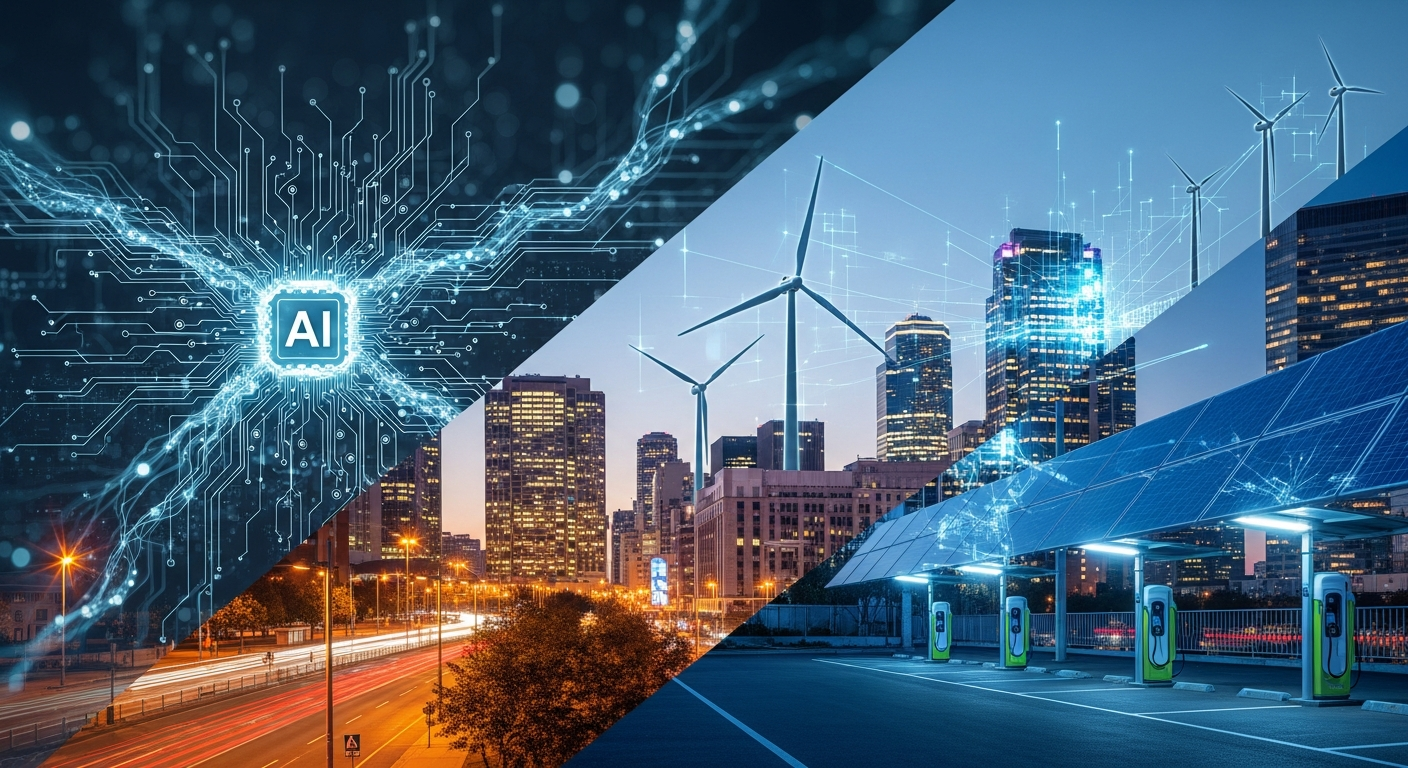
AI’s role in sustainability: smarter energy, smarter cities
- November 21, 2025
- ~ 1 min read
- 166 views
- AI in Business , Smart Cities , AI in Agriculture
Introduction to AI’s Impact on Sustainability
Understanding Sustainability in Energy and Urban Development
Sustainability in the context of energy and urban development refers to the responsible management of resources to meet current needs without compromising the ability of future generations to meet theirs. It encompasses reducing carbon emissions, optimizing energy consumption, and fostering resilient, livable urban environments that balance economic growth with environmental stewardship. As cities continue to grow and energy demands escalate, sustainable development becomes critical to curbing climate change and ensuring equitable access to resources.
AI as a Transformative Tool for Sustainability Challenges
Artificial intelligence (AI) has emerged as a powerful enabler in addressing complex sustainability challenges. By leveraging advanced data analytics, machine learning, and real-time sensor inputs, AI systems can optimize energy management, improve resource allocation, and enhance decision-making processes. This technological capability allows for smarter, more adaptive solutions that traditional methods cannot achieve, such as predictive maintenance of infrastructure, dynamic energy distribution, and real-time environmental monitoring. In essence, AI transforms raw data into actionable insights that drive sustainable outcomes.
The Growing Importance of Smarter Energy and Smart Cities
The concepts of smarter energy and smart cities are at the forefront of sustainable development efforts worldwide. Smarter energy systems use AI to optimize generation, storage, and consumption, minimizing waste and carbon footprints. Meanwhile, smart cities integrate AI technologies across urban infrastructure to enhance efficiency, resilience, and quality of life. Examples include AI-powered building management systems that adjust energy use based on occupancy and weather, and digital twins that simulate city operations to inform sustainable urban planning. These innovations are essential for meeting the escalating demands of urban populations while reducing environmental impact.
What to Expect in This Article
This article explores the multifaceted role of AI in advancing sustainability through smarter energy management and the development of smart cities. It will cover:
- How AI optimizes energy systems for greater efficiency and reduced emissions
- The integration of AI in urban planning and infrastructure for resilient, sustainable cities
- Challenges and ethical considerations in deploying AI-driven sustainability solutions
- Case studies demonstrating real-world applications and benefits
- Future outlook on AI’s evolving role in sustainable development
By understanding these dimensions, technology professionals, sustainability advocates, urban planners, and energy stakeholders can better appreciate how AI is shaping a more sustainable future.
How AI Enhances Sustainability: Core Concepts and Technologies
Artificial intelligence has emerged as a transformative force in addressing sustainability challenges, offering unprecedented capabilities to optimize resource consumption, reduce environmental impact, and accelerate the transition toward a more sustainable future. At its core, AI enables organizations to harness vast amounts of environmental data, identify patterns invisible to human analysis, and make informed decisions in real time. The intersection of machine learning, predictive analytics, and environmental science creates powerful opportunities for reducing waste, optimizing energy systems, and building smarter cities that respond dynamically to changing conditions.
Core AI Technologies Driving Sustainability Solutions
Several foundational AI technologies form the backbone of modern sustainability initiatives. Machine learning algorithms excel at identifying complex patterns within massive datasets, enabling systems to learn from historical environmental data and improve their performance over time without explicit programming. Predictive analytics leverages these learned patterns to forecast future conditions—from energy demand fluctuations to waste generation patterns—allowing organizations to proactively adjust their operations rather than react to problems after they occur.
Computer vision and sensor integration represent another critical dimension of AI for sustainability. By processing data from satellite imagery, IoT sensors, and weather stations, AI systems can monitor environmental conditions across vast geographic areas in real time. This capability proves particularly valuable in agriculture, where intelligent crop monitoring combines satellite data, ground-based sensors, and weather information to support informed agricultural decisions that optimize resource usage for health, safety, and yield.
Natural language processing and data integration technologies enable AI systems to synthesize information from diverse sources—regulatory documents, scientific research, operational metrics, and market trends—creating comprehensive environmental intelligence that informs strategic decision-making across organizations.
Optimizing Energy Consumption and Renewable Integration
Energy management represents one of the most impactful applications of AI for sustainability. Traditional energy systems operate with limited visibility into consumption patterns and grid dynamics, resulting in inefficiencies that waste resources and increase emissions. AI-powered smart grids transform this landscape by analyzing energy usage patterns in near real time, predicting peak demand periods, and automatically adjusting energy distribution to match supply with demand more precisely.
The practical results of these optimizations are substantial. Google demonstrated this potential nearly a decade ago by using AI to reduce the energy consumed for cooling its data centers by 40%—a breakthrough that illustrated how machine learning could identify subtle inefficiencies in complex systems. Today, smart grids powered by AI manage energy production and distribution across entire regions, reducing transmission losses and improving overall system efficiency while simultaneously enhancing grid resilience by predicting potential outages and enabling preventive maintenance.
Beyond demand management, AI accelerates the integration of renewable energy sources into existing power infrastructure. By forecasting renewable generation based on weather patterns and historical data, AI systems help balance intermittent solar and wind power with conventional generation, making renewable energy more reliable and economically viable. This capability addresses one of the fundamental challenges in the energy transition: managing the variability of renewable sources without compromising grid stability.
Renewable energy optimization through AI extends to facility-level applications as well. Commercial and industrial buildings can leverage AI to dynamically adjust heating, cooling, and lighting based on occupancy patterns, weather forecasts, and time-of-use electricity pricing, significantly reducing energy consumption without compromising comfort or productivity.
Urban Infrastructure and Resource Management
Cities consume approximately 80% of global energy and generate substantial waste, making them critical frontiers for sustainability innovation. AI technologies enable urban resource management by optimizing multiple interconnected systems simultaneously. Traffic flow optimization exemplifies this potential: intersection emissions can be 29 times higher than emissions on open roads, with approximately half of intersection emissions resulting from stop-and-go traffic patterns. AI systems like Green Light analyze traffic patterns using real-time data and historical trends to generate intelligent recommendations for traffic signal timing, reducing stops at intersections by up to 30% and decreasing emissions by more than 10%.
Waste management represents another critical urban challenge where AI delivers measurable improvements. Rather than relying on fixed collection schedules, AI systems predict waste generation patterns across different neighborhoods and optimize collection routes to minimize fuel consumption and emissions. Additionally, computer vision-powered sorting systems identify and separate recyclable materials more accurately and efficiently than manual sorting, significantly increasing recycling rates and reducing the volume of waste destined for landfills.
Water management in urban environments benefits equally from AI's analytical capabilities. Smart water systems use predictive analytics to forecast demand, detect leaks in distribution networks, and optimize treatment processes, reducing both water consumption and the energy required for water delivery and treatment.
Environmental Data Analysis and Decision-Making
The foundation of effective sustainability initiatives rests on comprehensive, accurate environmental data. AI excels at collecting, integrating, and analyzing information from diverse sources—weather stations, satellite systems, ground-based sensors, and operational databases—to create unified environmental intelligence. This capability transforms raw data into actionable insights that guide strategic decisions at organizational and policy levels.
Environmental data analysis powered by AI enables organizations to conduct precise carbon footprint assessments, identify the most impactful reduction opportunities, and track progress toward sustainability targets. Predictive models help anticipate environmental challenges before they materialize, enabling proactive interventions rather than reactive responses.
The broader impact of AI-driven environmental monitoring extends to supporting all 17 United Nations Sustainable Development Goals. By providing real-time visibility into environmental conditions and system performance, AI empowers stakeholders across sectors—from agriculture to energy to urban planning—to make decisions that balance immediate operational needs with long-term environmental responsibility. This capability represents a fundamental shift in how organizations approach sustainability: from compliance-driven initiatives to data-informed strategies that integrate environmental performance into core business operations.
The landscape of sustainable AI adoption possibilities is exponential, with estimates suggesting that AI could reduce worldwide greenhouse gas emissions by 1.5 to 4 percent by 2030—a transformation that requires harnessing technology to reduce waste, optimize resources, increase efficiency, and improve decision-making through near-real-time data analysis.
Real-World Applications of AI in Smarter Energy and Cities
The theoretical promise of AI in sustainability becomes tangible when we examine how leading organizations worldwide are deploying these technologies to achieve measurable environmental and operational gains. From data centers to urban infrastructure, AI is fundamentally transforming how we manage energy efficiency, optimize resource distribution, and build smarter cities. These real-world applications demonstrate that AI isn't merely a future solution—it's actively reshaping our energy landscape and urban environments today.
Breakthrough Energy Efficiency in Data Centers and Industrial Operations
One of the most compelling examples of AI's impact on energy efficiency comes from Google's DeepMind initiative. By training deep neural networks on historical data collected from thousands of sensors within their data centers, DeepMind achieved a remarkable 40% reduction in energy used for cooling. This breakthrough illustrates how AI can analyze complex operational patterns and identify optimization opportunities that human operators might miss, translating directly into substantial cost savings and reduced carbon emissions.
Beyond data centers, Tesla demonstrates AI's versatility in energy management across multiple domains. Their AI systems optimize solar panel performance by predicting energy demand and adjusting production accordingly, making renewable energy generation more efficient and cost-effective. Simultaneously, Tesla's battery management AI enhances the performance and longevity of electric vehicle batteries by optimizing charging and discharging cycles, creating a cascading effect of efficiency improvements throughout their energy ecosystem.
The industrial sector is experiencing similar transformations. Vestas partnered with Microsoft and minds.ai to leverage AI and high-performance computing for optimizing wind turbine operations through wake steering technology, enabling turbines to generate more energy from the same wind resources. These examples underscore how AI-driven optimization delivers measurable environmental benefits while simultaneously improving operational economics.
Smart Grids and Intelligent Energy Distribution Networks
AI is revolutionizing how cities and utilities manage energy distribution through smart grid technologies that represent a fundamental shift from passive to intelligent energy management. Modern smart grids leverage AI to analyze real-time consumption patterns across neighborhoods, automatically rebalancing distribution loads to prevent overstrain on specific grid segments. This dynamic load management not only prevents infrastructure failures but also enables utilities to predict and mitigate low-voltage events before they affect residents.
The concept of sector coupling exemplifies AI's sophisticated approach to renewable energy forecasting and resource allocation. AI systems monitor usage patterns across electricity, heating, and transportation sectors simultaneously, identifying timing gaps and overlaps in energy demand. When power is abundant or inexpensive, AI directs it to heat storage or electric vehicle charging stations, avoiding waste and mitigating demand spikes. This intelligent coordination ensures that renewable energy is utilized where it's most needed, precisely when it's needed, maximizing the value of every kilowatt generated.
Con Edison's AI adoption demonstrates these principles in practice, significantly lowering power generation costs and CO₂ emissions while empowering customers with enhanced information and control over their energy consumption. Duke Energy similarly utilizes AI for infrastructure inspection and system resilience enhancement, minimizing expenses and emissions while strengthening maintenance logistics and improving worker safety by reducing the need for physically challenging inspections.
Smart City Applications: From Traffic to Pollution Control
Beyond energy systems, AI is transforming urban environments through comprehensive smart city initiatives that enhance quality of life while reducing environmental impact. Smart building systems represent a foundational element of this transformation, with AI tracking lighting, heating, and appliance usage to identify waste and adjust settings in real-time. These systems learn occupancy patterns and weather conditions, automatically dimming lights, lowering heating, or turning off devices when spaces are unoccupied, resulting in energy savings of up to 20% in buildings without compromising occupant comfort.
JLL's Hank platform exemplifies this approach, analyzing occupancy and external data to optimize HVAC systems, achieving 20% energy reductions while maintaining comfortable conditions for building users. The platform also scales back energy consumption during peak pricing periods, generating additional cost savings for building owners and reducing strain on grid infrastructure during high-demand periods.
Air quality management represents another critical smart city application where AI delivers immediate public health benefits. Systems like IQAir and Plume Labs process real-time pollution data from multiple sources, delivering instant alerts when pollution levels spike and enabling residents to make informed decisions about outdoor activities. Given that air pollution causes over seven million premature deaths annually, these AI-powered monitoring networks represent a tangible investment in urban health and livability.
Forest fire detection showcases AI's protective capabilities in environmental management. Dryad Networks has deployed approximately 400 "electronic noses" throughout Brandenburg's Eberswalde forest, detecting gases during fire's earliest stages while monitoring temperature, humidity, and air pressure. This early detection capability enables rapid response before devastation spreads, protecting both ecosystems and communities from catastrophic wildfires.
Predictive Maintenance and Waste Reduction
AI's capacity for predictive analysis extends beyond energy optimization to encompass comprehensive facility management and safety enhancement. Predictive maintenance systems flag wear in turbines, transformers, and other critical infrastructure using sensor feedback and historical fault data, enabling maintenance teams to address issues before failures occur. This proactive approach prevents energy waste, reduces costly emergency repairs, and extends equipment lifespan—creating a triple benefit of improved reliability, reduced costs, and environmental protection.
The cumulative impact of these applications is substantial. Research indicates that AI can deliver energy efficiency improvements ranging from 10.2% to 40%, with Model Predictive Control emerging as the most effective AI technology for energy management. In buildings specifically, AI-driven retrofits addressing elements from lighting to mechanical and electrical systems can reduce energy consumption by 10-40%, supporting organizations' progress toward net-zero targets and decarbonization goals.
These real-world applications demonstrate that AI's role in sustainability extends far beyond theoretical potential. From data centers to urban streets, AI is actively delivering measurable reductions in energy consumption, emissions, and resource waste while simultaneously improving operational efficiency, safety, and quality of life in our cities.
Advanced Insights: Technical Deep Dive into AI for Sustainability
The intersection of artificial intelligence and sustainability presents a compelling paradox: while AI offers unprecedented potential to optimize energy systems and accelerate the transition to sustainable cities, the technology itself demands enormous computational resources. Understanding this complex relationship requires examining both the technical challenges of deploying AI sustainably and the sophisticated applications that make this investment worthwhile.
The Computational Cost-Benefit Analysis: Energy Consumption and Environmental Trade-offs
Generative AI energy consumption represents one of the most pressing technical challenges in modern computing. Training large language models like GPT-3 consumed approximately 1,287 megawatt hours of electricity during its development phase alone—equivalent to powering roughly 120 average U.S. homes for an entire year—while generating approximately 552 tons of carbon dioxide emissions.[3] More strikingly, a single run of an AI foundation model can cost up to $500,000 on cloud infrastructure and produce emissions equivalent to burning more than 11,400 pounds of coal.[5]
The power density requirements of generative AI fundamentally distinguish it from traditional computing workloads. A generative AI training cluster might consume seven to eight times more energy than conventional computing operations, creating what researchers describe as an unprecedented computational burden.[6] When considering deployment at scale, a single generative AI query consumes energy at four to five times the magnitude of a typical search engine request, with image-generating tasks proving even more resource-intensive.[2]
Beyond electricity demands, water consumption presents an equally critical concern. Training GPT-3 in Microsoft's state-of-the-art U.S. data centers potentially consumed approximately 700,000 liters of freshwater, illustrating the substantial water footprint required for model development.[6] Projections suggest that deployment of AI servers across the United States could generate an annual water footprint ranging from 731 to 1,125 million cubic meters, straining municipal water supplies particularly in water-scarce regions.[7]
This environmental burden extends beyond operational costs. The rapid expansion of AI infrastructure drives demand for high-performance computing hardware, creating indirect environmental impacts through manufacturing and transportation. The short lifespan of GPUs and other high-performance computing components contributes to growing electronic waste problems, while their manufacturing requires extraction of rare earth minerals—a process that depletes natural resources and contributes to environmental degradation.[1]
However, dismissing AI's environmental costs without acknowledging its sustainability potential would be incomplete analysis. The critical question becomes not whether to deploy AI, but how to deploy it sustainably while maximizing its benefits for energy optimization and climate resilience.
Advanced AI Applications: Material Discovery, Optimization, and Predictive Analytics
Despite significant computational costs, AI demonstrates transformative potential in accelerating technological advances and optimizing complex systems. In material science, AI-driven material discovery dramatically reduces development timelines for sustainable alternatives. Machine learning algorithms can analyze vast datasets of material properties and predict novel compounds with desired characteristics—such as improved battery materials for energy storage or more efficient solar cell designs—without requiring exhaustive physical experimentation.
The efficiency gains from AI optimization justify computational investments in many applications. AI can improve energy efficiency across industrial processes by identifying operational inefficiencies that human analysis might overlook. Predictive maintenance systems powered by machine learning analyze sensor data from energy infrastructure to forecast equipment failures before they occur, preventing costly downtime and reducing energy waste from inefficient operations. These systems examine patterns in historical performance data to distinguish between normal operational variations and early indicators of degradation.
In the renewable energy sector, AI predictive analytics optimize grid management and resource allocation. Machine learning models forecast wind and solar generation with increasing accuracy, enabling grid operators to balance variable renewable energy sources more effectively. AI algorithms analyze weather patterns, historical generation data, and consumption trends to predict energy availability hours or days in advance, allowing utilities to coordinate battery storage deployment and demand response programs more intelligently.
Complex optimization problems that would be computationally intractable through traditional methods become manageable with AI approaches. Energy distribution networks, water treatment systems, and industrial manufacturing processes all benefit from AI-enabled optimization that reduces resource consumption while maintaining or improving output quality. These applications demonstrate that strategic AI deployment in high-impact domains can generate environmental returns that exceed the computational costs of model training and deployment.
Smart Cities Infrastructure: IoT Integration and Real-Time Optimization
The convergence of AI with Internet of Things (IoT) sensor networks creates the technical foundation for genuinely intelligent urban systems. IoT integration in smart cities generates continuous streams of data from distributed sensors monitoring energy consumption, air quality, water usage, traffic patterns, and building performance. AI systems process this data in real-time, identifying optimization opportunities that static systems cannot detect.
Building management systems enhanced with AI analyze occupancy patterns, weather forecasts, and energy pricing signals to optimize heating, cooling, and lighting in real-time. Machine learning models trained on historical building performance data predict energy demand with sufficient accuracy to enable demand-side management programs that reduce peak loads and improve grid stability. These systems learn from operational patterns across thousands of buildings, identifying best practices and anomalies that individual building operators might never recognize.
Transportation networks represent another critical application domain. AI traffic management systems process data from connected vehicles, traffic signals, and infrastructure sensors to optimize traffic flow, reducing congestion-related emissions and fuel consumption. Predictive models forecast traffic patterns and recommend route adjustments before congestion develops, while adaptive signal timing algorithms adjust in real-time based on current conditions. These optimization techniques reduce vehicle idle time and unnecessary acceleration, generating measurable reductions in urban transportation emissions.
Water management systems benefit similarly from AI-enabled optimization. Sensor networks throughout water distribution infrastructure detect leaks with precision impossible through manual inspection, while AI algorithms optimize pump operations to minimize energy consumption during distribution. Predictive models forecast water demand based on weather, occupancy patterns, and historical consumption, enabling utilities to manage storage and treatment capacity more efficiently.
The technical sophistication of these systems lies not merely in data collection but in the adaptive algorithms that continuously refine optimization strategies based on real-world performance feedback. Machine learning models improve their predictions as they encounter new scenarios, creating systems that become increasingly effective over time.
Expert Perspective on Balancing AI Benefits with Sustainability Concerns: As noted by sustainability researchers, "In the race to produce faster and more-accurate AI models, environmental sustainability is often regarded as a second-class citizen." However, this perspective misses a critical point: the computational investment in AI becomes justified when applied to problems where optimization generates environmental benefits exceeding the training and deployment costs. The challenge lies in strategic prioritization and transparent accounting of both costs and benefits.
Distinguished researchers in computer science emphasize that making AI sustainable requires proactive solutions across multiple dimensions: streamlining AI models to reduce computational requirements, developing greener infrastructure powered by renewable energy sources, and fostering collaboration between technology companies, researchers, and policymakers. Data centers currently consume approximately 4.4% of U.S. electricity, with projections suggesting this could triple by 2028 if current trends continue.[1] However, this trajectory is not inevitable—deliberate choices about infrastructure investment, model architecture, and deployment strategies can substantially alter these outcomes.
The International Energy Agency estimates that by 2026, electricity consumption by data centers, cryptocurrency, and artificial intelligence could reach approximately 4% of annual global energy usage—roughly equivalent to the electricity consumed by the entire country of Japan.[6] This sobering projection underscores the urgency of deploying AI infrastructure powered by renewable energy sources and optimizing computational efficiency at every layer of the technology stack.
Ultimately, the technical deep dive into AI for sustainability reveals a nuanced reality: the technology presents genuine environmental challenges that demand serious attention, but also offers transformative potential for optimizing complex systems and accelerating the development of sustainable technologies. Success requires acknowledging both dimensions honestly while making strategic choices about where AI deployment generates the greatest environmental benefit relative to computational cost.
Implementing AI for Smarter Energy and Cities: Practical Guide
Integrating AI into Energy Management Systems
Implementing energy management AI begins with a structured approach to assess and enhance existing systems. Start by conducting a comprehensive evaluation of your current energy infrastructure to identify inefficiencies and opportunities for AI integration. Define clear objectives such as reducing energy costs, improving grid reliability, or increasing renewable energy utilization.
Next, select appropriate AI tools and platforms tailored to your needs, including machine learning frameworks like TensorFlow or PyTorch, and IoT devices such as smart meters and sensors for real-time data collection. Prioritize high-quality data collection and preprocessing to ensure accurate model training. Implement pilot projects to validate AI solutions on a small scale before scaling organization-wide.
Once deployed, continuously monitor AI performance and refine models to adapt to changing conditions. This iterative process enables predictive analytics for demand forecasting, anomaly detection, and dynamic energy distribution, all crucial for maximizing efficiency and sustainability.
Guidelines for Deploying AI in Urban Infrastructure Projects
For smart city deployment, integrate AI with urban infrastructure by leveraging IoT networks, sensor data, and cloud computing for real-time monitoring and control. Begin with a detailed mapping of urban systems—transportation, utilities, lighting, and waste management—to identify where AI can optimize resource use and reduce emissions.
Develop AI-driven control strategies that automate adjustments in energy consumption and service delivery, such as adaptive street lighting or traffic flow optimization. Engage stakeholders early to ensure alignment with sustainability goals and regulatory compliance.
Ensure interoperability by adopting open standards and APIs to enable seamless data exchange between diverse urban systems. Pilot AI applications in targeted districts or facilities to gather insights and refine deployment before city-wide rollout.
Best Practices for Minimizing AI’s Environmental Footprint
Implementing sustainable AI requires conscious efforts to reduce the environmental impact of AI technologies themselves. Optimize AI models to be computationally efficient, minimizing energy consumption during training and inference. Utilize energy-efficient hardware and cloud services powered by renewable energy sources.
Adopt data management practices that reduce redundancy, such as selective data sampling and edge computing, to limit data transfer and storage energy costs. Regularly audit AI systems to ensure they operate within defined energy budgets and adjust algorithms to maintain efficiency.
Environmental best practices also include designing AI solutions with lifecycle sustainability in mind, from development through deployment and eventual decommissioning, to ensure long-term benefits outweigh their resource use.
Common Pitfalls and How to Avoid Them
Several challenges can impede successful AI implementation for sustainability. Avoid underestimating the complexity of integrating AI with legacy systems by conducting thorough compatibility assessments early. Insufficient or poor-quality data can lead to inaccurate models—invest in robust data collection infrastructure and validation processes.
Beware of over-reliance on AI predictions without human oversight; maintain active monitoring and involve domain experts to interpret AI outputs and make informed decisions. Additionally, neglecting the environmental impact of AI itself can undermine sustainability goals—apply environmental best practices proactively.
Finally, ensure transparent communication with stakeholders to manage expectations and foster collaboration, which is critical for overcoming resistance and achieving long-term success in AI implementation projects.
Comparing AI Approaches and Alternatives in Sustainability
Different AI Models and Algorithms for Energy Optimization
When it comes to energy optimization, not all AI models are created equal. AI models comparison reveals that supervised learning algorithms excel at predicting energy demand and usage patterns, making them ideal for forecasting and planning in smart grids and buildings. Reinforcement learning, on the other hand, is particularly effective for real-time adjustments, such as dynamically managing cooling systems in data centers or optimizing traffic flows in smart cities. Unsupervised learning can uncover hidden inefficiencies by clustering usage data, while deep learning models are powerful for complex tasks like image-based energy audits or predictive maintenance in industrial settings.
However, the computational demands of these models vary widely. Large neural networks, while highly accurate, can be energy-intensive to train and deploy. Techniques like model pruning, quantization, and knowledge distillation help reduce this footprint, making advanced AI more sustainable. Edge AI—deploying models directly on local devices—further minimizes latency and cloud-based energy consumption, offering a practical solution for real-time sustainability applications.
AI vs. Traditional Sustainability Methods
Traditional sustainability methods, such as manual energy audits, rule-based automation, and static scheduling, have long been the backbone of energy management. These approaches are often reliable and require less upfront investment, but they lack the adaptability and scalability of AI-driven solutions. AI can process vast datasets in real time, uncovering patterns and opportunities for optimization that would be impossible for humans to detect manually.
That said, traditional methods still have their place, especially in smaller-scale or less data-rich environments. They are also easier to audit and regulate, which can be important for compliance and transparency. For many organizations, a hybrid approach—combining AI insights with established best practices—offers the best balance of innovation and reliability.
Trade-offs and Alternative Technologies
While AI offers powerful tools for sustainability, it is not without its trade-offs. The energy consumed by training and running AI models, particularly large-scale generative models, can be substantial. This creates a paradox: AI can help reduce energy use across industries, but its own energy footprint must be carefully managed. Sustainability trade-offs like these require organizations to weigh the benefits of AI against its environmental costs, especially as regulatory scrutiny increases.
Alternative technologies, such as advanced sensor networks, IoT devices, and passive design strategies, can complement or even compete with AI. For example, smart sensors can monitor energy use and trigger automated responses without the need for complex AI algorithms. Passive design—using natural ventilation, daylighting, and insulation—remains a low-tech, high-impact approach to energy efficiency. In some cases, these alternatives may be more appropriate, particularly where data availability is limited or where simplicity and reliability are paramount.
Ultimately, the choice between AI and other energy optimization methods depends on the specific context, available resources, and sustainability goals. By understanding the strengths and limitations of each approach, stakeholders can make informed decisions that maximize both environmental and operational outcomes.
Conclusion: Embracing AI for a Sustainable Future
Artificial intelligence is undeniably a transformative force in shaping the future of smarter energy management and the development of smart cities. Its capacity to analyze vast datasets, optimize resource use, and enable real-time decision-making positions AI as a critical enabler of sustainable energy solutions and urban innovation. From enhancing renewable energy integration to improving infrastructure efficiency, AI’s role in sustainability is both profound and expanding, offering unprecedented opportunities to reduce environmental impact while fostering economic growth.
Balancing Innovation with Responsible AI Deployment
As we harness AI’s potential, it is essential to prioritize responsible AI practices that ensure ethical, transparent, and sustainable outcomes. The deployment of AI technologies must be aligned with environmental goals and social responsibility to avoid unintended consequences such as excessive energy consumption or biased decision-making. Emphasizing frameworks for AI governance, continuous monitoring of AI’s environmental footprint, and integrating sustainability into AI design are crucial steps to maximize positive impact. This balance between innovation and responsibility will define the future of smart cities and the broader sustainability landscape.
Call to Action: Engage, Learn, and Lead
For technology professionals, sustainability advocates, and urban planners alike, the journey toward a sustainable future powered by AI demands active engagement and continuous learning. Explore emerging AI solutions that drive efficiency and resilience in energy systems and urban environments. Stay informed about the latest advancements and best practices in AI sustainability impact to make data-driven decisions that support long-term environmental stewardship. By embracing AI thoughtfully and proactively, stakeholders can lead the charge toward smarter, greener cities and energy networks that benefit both people and the planet.
Now is the time to act: integrate AI-driven sustainability initiatives within your organizations, advocate for responsible AI policies, and collaborate across sectors to unlock the full potential of AI as a catalyst for sustainable development.


Comments (0)
Please login or register to leave a comment.
No comments yet. Be the first to comment!