
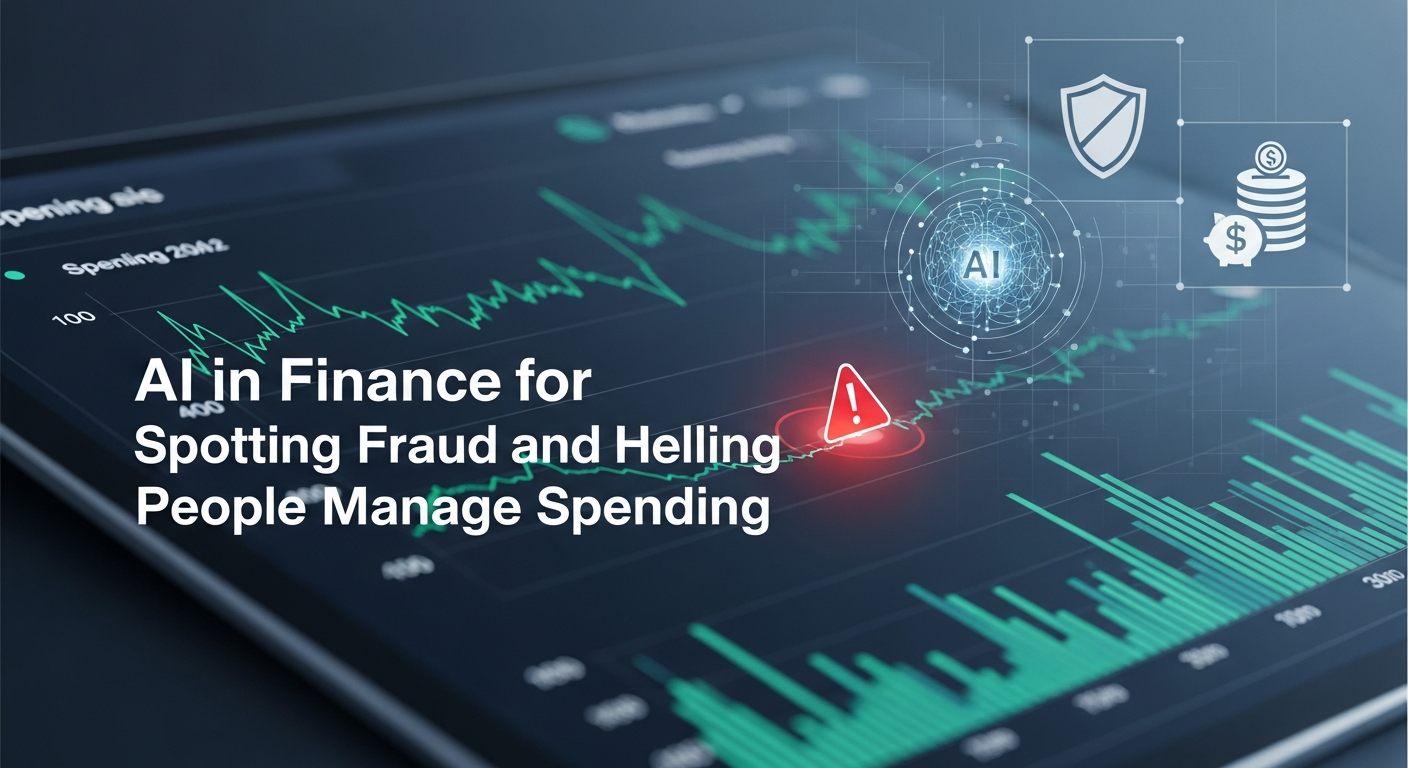
AI in finance for spotting fraud and helping people manage spending.
- November 20, 2025
- ~ 1 min read
- 122 views
- AI in Business , Everyday AI
Introduction: AI's Dual Impact on Financial Security and Personal Wealth
In an increasingly interconnected world, where billions of digital transactions occur daily, the financial landscape has never been more dynamic, yet simultaneously more vulnerable. Consider this staggering reality: global financial fraud losses are estimated to reach hundreds of billions annually, with individuals and institutions alike constantly battling ever more sophisticated schemes. Simultaneously, many individuals struggle with financial literacy and effective budgeting, yearning for tools that can simplify personal wealth management amidst rising costs and complex financial choices. This dual challenge—the relentless threat of financial crime and the persistent quest for personal financial wellness—defines our modern economic era.
The Evolving Battlefield of Modern Finance
The acceleration of digital finance transformation has opened unprecedented avenues for convenience and global commerce, yet it has also created fertile ground for new forms of risk. Traditional security measures, once adequate, are now often outpaced by the cunning of cybercriminals and the sheer volume of data involved. From identity theft to sophisticated payment scams, the threats are constant and evolving, demanding equally advanced countermeasures. On the personal front, managing finances in a cashless society, navigating investments, and adhering to a budget without the intuitive guidance of modern tools can feel overwhelming, leading to stress and missed opportunities for growth.
AI: The Game-Changer for Security and Empowerment
Enter Artificial Intelligence. Far from a futuristic concept, AI in finance is rapidly becoming an indispensable cornerstone of both institutional security and individual empowerment. It’s a transformative technology capable of sifting through colossal datasets at lightning speed, identifying anomalies that human analysts might miss, and offering personalized insights that were once unimaginable. This article embarks on a journey to demystify how this cutting-edge financial technology is being harnessed to tackle the two most pressing financial challenges of our time.
Over the course of this comprehensive guide, we will explore AI's pivotal role in bolstering defenses against illicit activities through advanced fraud detection AI, uncovering intricate patterns and predicting potential threats before they materialize. Concurrently, we will delve into how personal finance AI is revolutionizing the way individuals manage their money, offering intelligent budgeting tools, personalized spending advice, and predictive insights to foster greater financial control and resilience. Prepare to discover how AI is not just a technological advancement, but a crucial partner in securing our financial future and empowering users towards better wealth management.
Core Concepts: How AI Unlocks Financial Intelligence for Fraud and Spending
The financial world generates an unprecedented volume of data every second. To truly harness this torrent of information and transform it into actionable insights, traditional methods often fall short. This is where Artificial Intelligence (AI) steps in, providing the sophisticated tools necessary to not only keep pace but also to extract deep financial intelligence. At its heart, AI in finance is about empowering systems to learn, reason, and make predictions from complex data, mimicking human cognitive abilities but at an astronomical scale and speed.
Defining AI and Machine Learning (ML) in the Financial Context
While often used interchangeably, Artificial Intelligence is the broader field of creating intelligent machines, and Machine Learning (ML) is a core subset of AI. In the financial context, **machine learning finance** involves training algorithms on vast datasets of financial transactions, customer behaviors, and market trends. Unlike rigid, rule-based programming, ML models learn patterns and relationships directly from data, enabling them to adapt and improve over time without explicit reprogramming. This adaptive capability is what makes them so powerful for dynamically evolving scenarios like fraud or personal spending habits. These **financial AI models** are designed to see connections and deviations that would be impossible for a human, or even a team of humans, to detect manually across billions of data points.
AI's Role in Next-Gen Fraud Detection
Fraud is a constant threat in the financial industry, costing billions annually. AI revolutionizes fraud detection by shifting from reactive investigation to proactive prediction. Imagine AI as a vigilant security guard, not just watching individual doors, but simultaneously monitoring every person, every camera, and every transaction across an entire city. AI algorithms meticulously analyze vast streams of transaction data, looking for anomalies that deviate from established "normal" behavior. For instance, a sudden large purchase in a foreign country on a card typically used for local groceries, or multiple small, rapid transactions that follow a common fraudulent pattern, will immediately flag suspicion. Leveraging **predictive analytics fraud**, AI can identify complex, evolving fraud schemes faster than human analysts or static rule sets, significantly reducing financial losses and protecting customers. It doesn't just catch fraud; it learns from every attempted fraud, continuously refining its ability to spot new threats.
Empowering Personal Spending Management with AI
Beyond security, AI also acts as a personalized financial advisor, making sense of our individual spending habits. AI-powered financial apps connect to your bank accounts and credit cards, then use advanced algorithms to automatically categorize every transaction – from groceries and utilities to entertainment and travel. This continuous analysis provides a clear, real-time snapshot of where your money is going. More than just categorization, **AI spending analysis** identifies trends in your financial behavior, suggests personalized budgets based on your income and spending history, and can even offer timely advice. For example, it might alert you to recurring subscriptions you've forgotten, suggest ways to save on specific categories, or forecast your cash flow for the coming weeks. It transforms raw transaction data into meaningful insights, helping individuals make more informed financial decisions and achieve their savings goals with greater ease.
Underlying AI Techniques Driving Financial Intelligence
The magic behind these capabilities relies on several core AI techniques. Supervised learning is often used for fraud detection, where models are trained on historical data labeled as "fraudulent" or "legitimate" to learn how to classify new transactions. Unsupervised learning, on the other hand, excels at identifying unusual patterns or anomalies in data without prior labels, perfect for spotting novel fraud attempts or unexpected spending trends. Natural Language Processing (NLP) allows AI to understand and process unstructured text data, like customer feedback or market news, enriching the overall financial intelligence. Finally, predictive analytics, a cornerstone of **data-driven finance**, uses statistical algorithms and machine learning techniques to forecast future outcomes, whether it's the likelihood of a fraudulent transaction or the optimal savings strategy for an individual. Together, these techniques allow AI to transform raw financial data into invaluable intelligence for both institutions and individuals.
Real-World Impact: AI Use Cases in Financial Security and Personal Budgeting
Artificial Intelligence is no longer a futuristic concept within finance; it's a vital engine driving tangible, real-world improvements across both institutional security and individual financial well-being. This section delves into specific, compelling examples that showcase AI's practical applications, illustrating how it empowers institutions to combat sophisticated threats and enables individuals to achieve their financial goals with greater ease and intelligence.
AI in Financial Security: Stopping Fraud in its Tracks
Financial institutions face a relentless battle against increasingly sophisticated threats, from credit card fraud to complex money laundering schemes. AI offers a powerful, proactive defense, transforming reactive measures into predictive strategies.
- Credit Card Fraud Detection: Imagine Sarah, a frequent traveler. Her credit card is suddenly used for a high-value electronics purchase in a city she's never visited. Instead of waiting for a manual review or a chargeback, an AI system, leveraging sophisticated algorithms and her past spending habits, flags this anomaly instantly. Using real-time fraud detection capabilities, the system assesses the transaction's risk profile within milliseconds. A text alert is sent to Sarah, and the transaction is provisionally blocked, preventing immediate loss. This scenario epitomizes effective fraud prevention examples, significantly reducing financial institutions' exposure to illicit activities.
- Anti-Money Laundering (AML): Beyond individual transactions, AI is revolutionizing AML efforts. It sifts through colossal datasets, identifying complex patterns and hidden relationships that indicate illicit financial flows—a task virtually impossible for human analysts alone. AI can detect subtle deviations from normal behavior, flag networks of suspicious accounts, and prioritize alerts, ensuring compliance and safeguarding the integrity of the financial system. These are critical AI banking use cases that enhance systemic security.
- Insurance Claim Analysis: In the insurance sector, AI analyzes claims for discrepancies, unusual activity, and potential links to previous fraudulent claims. By processing vast amounts of historical data and applying predictive analytics, AI can flag potentially fraudulent claims with high accuracy, safeguarding billions in potential payouts and ensuring fair premiums for honest policyholders.
Empowering Individuals: AI for Personal Financial Management
AI's profound impact extends directly to consumers, offering unprecedented tools for managing their personal finances, making smart choices, and achieving financial stability.
- Smart Budgeting Apps: Consider Mark, who struggles to save consistently. An AI-powered personal finance app analyzes his income, recurring bills, and past spending history. It intelligently suggests a personalized budget, even recommending how much he can realistically save each month and automatically moving small, non-essential amounts into a savings account (often referred to as "microsavings"). This is a clear demonstration of smart budgeting tools in action, turning passive saving into an active, automated process.
- Personalized Savings Goals & Subscription Management: These AI-driven apps go further by helping users set and achieve personalized savings goals, such as a down payment for a house or a vacation. They can identify forgotten subscriptions, provide alerts before renewals, and even help negotiate better deals on recurring services. By proactively managing these aspects, AI helps individuals retain more of their hard-earned money.
- Debt Repayment Planning: For those grappling with debt, AI can craft optimized repayment plans. It prioritizes high-interest debts, suggests consolidation strategies tailored to individual cash flow, and monitors progress, accelerating the path to financial freedom and reducing interest payments over time.
Enhanced Features and Quantifiable Benefits
The core of these revolutionary applications lies in AI's ability to process, learn from, and act upon massive datasets with unparalleled speed and accuracy. Key features driving this impact include predictive analytics for anticipating risks, natural language processing (NLP) for intuitive chatbot interactions and sentiment analysis, and sophisticated anomaly detection algorithms that operate continuously in the background.
For financial institutions, the benefits are clear and quantifiable: significant reductions in fraud losses (often ranging from 20-50% in reported cases), enhanced compliance with stringent regulatory requirements, and dramatically improved operational efficiency. For individual users, AI translates into greater financial control, reduced stress, and ultimately, increased savings and wealth accumulation. The immediate protection against fraud and the long-term guidance for financial health are absolute game-changers, offering both peace of mind and measurable improvements to everyone's financial landscape.
AI's real-world applications in finance are not just about automation; they are about creating a more secure, efficient, and equitable financial ecosystem for everyone, making advanced financial management accessible and intuitive.
Beyond the Basics: Diving Deeper into AI's Technical and Ethical Dimensions
While the surface benefits of AI in finance are compelling, the true power and complexity lie beneath. This section peels back the layers, exploring the sophisticated technical underpinnings that make AI so effective, the data challenges involved, and the critical ethical and regulatory considerations that financial institutions must meticulously navigate.
Technical Deep Dive & Data Dynamics
Deploying AI for critical tasks like fraud detection and personal spending management demands a deep understanding of specialized algorithms and robust data infrastructure. For instance, in fraud detection, institutions often leverage a combination of sophisticated AI algorithms fraud models. Neural Networks, particularly deep learning architectures, excel at identifying complex, non-linear patterns in vast datasets, crucial for spotting subtle anomalies that human analysts might miss. Similarly, Random Forests offer robust performance and insights into feature importance, while Isolation Forests are specifically designed for efficient anomaly detection without requiring prior labeling of fraudulent instances.
Effective AI deployment hinges on high-quality data. The sheer volume, velocity, and variety of financial information necessitate a robust big data analytics finance strategy. Financial institutions grapple with massive transaction logs, customer profiles, market data, and more. This "big data" fuels AI, but not without challenges. Data quality is paramount – inaccurate or incomplete data can lead to biased or ineffective models. Furthermore, feature engineering, the process of transforming raw data into meaningful features for models, is an art and a science, often making the difference between a mediocre and a high-performing AI system. Real-time data processing capabilities are also critical, especially for fraud detection, where rapid analysis can prevent significant financial losses.
Ethical Imperatives and Explainability
As AI systems take on increasingly pivotal roles in financial decisions, ethical considerations become non-negotiable. One of the most significant concerns is algorithmic bias. If historical data used to train AI models contains embedded human biases (e.g., related to credit assessments or loan approvals based on demographics), the AI can perpetuate and even amplify these inequalities. This makes the pursuit of ethical AI banking a moral and business imperative, requiring careful data curation and fairness-aware model development.
Another crucial area is data privacy financial services. With stringent regulations like GDPR and CCPA, financial institutions must ensure that AI systems handle customer data with the utmost care, incorporating robust anonymization, encryption, and secure processing methods. Balancing the desire to leverage data for personalized services with the need to protect individual privacy is a delicate tightrope walk.
Perhaps most challenging is the demand for explainable AI finance (XAI). Financial decisions, whether it's approving a loan, flagging a transaction as fraudulent, or providing spending advice, often have profound impacts on individuals. Regulators, customers, and internal auditors require transparency: they need to understand why an AI system made a particular decision. Black-box models are increasingly unacceptable, driving the need for interpretability techniques that can articulate the rationale behind AI recommendations.
Navigating the Regulatory Landscape
The rapid advancement of AI presents a dynamic challenge for financial regulators worldwide. Traditional financial regulations, often designed for human decision-making and rule-based systems, are now adapting to govern autonomous AI models. Institutions face increasing scrutiny regarding their AI governance frameworks, model validation processes, and risk management strategies for AI deployments. Compliance extends beyond just data privacy, encompassing fairness, accountability, and the robustness of AI systems.
The evolving regulatory AI compliance environment means financial institutions must proactively develop internal policies, conduct regular audits of their AI models, and ensure clear oversight. This often involves creating "AI sandboxes" to test new solutions under regulatory supervision, fostering innovation while managing systemic risks. Staying abreast of these regulatory shifts is not just about avoiding penalties; it's about building trust and ensuring the sustainable, responsible adoption of AI in the financial sector.
Practical Implementation: Integrating AI for Financial Security and Personal Empowerment
The theoretical benefits of AI in finance are compelling, but their real impact hinges on effective implementation. This section provides a practical roadmap for both financial institutions and individual consumers, offering actionable advice to harness AI's power for enhanced security and smarter financial management.
Strategic Integration for Financial Institutions
For banks, credit unions, and fintech companies, a structured approach to AI adoption is crucial. Successfully implementing AI banking solutions requires more than just acquiring technology; it demands a strategic overhaul:
- Robust Data Infrastructure: AI thrives on data. Institutions must invest in modernizing their data architecture, ensuring clean, centralized, and accessible data lakes. Establishing strong data governance AI frameworks is paramount to ensure data quality, privacy, and compliance across all systems. This foundation prevents data silos and enables comprehensive analysis for fraud detection and personalized services.
- Talent Acquisition and Upskilling: The right people are as important as the right technology. Recruit data scientists, machine learning engineers, and ethical AI specialists. Simultaneously, invest in upskilling existing staff in data literacy and AI principles to foster an AI-ready culture.
- Pilot Programs and Iteration: Don't attempt a "big bang" rollout. Start with well-defined pilot programs focused on specific use cases, such as a particular fraud detection module or a personalized savings recommendation engine. Learn from these pilots, iterate on models, and gather feedback before scaling. This measured approach minimizes risk and maximizes learning.
- Scalable Solutions and API Integration: Plan for scalability from day one. AI solutions should be designed to integrate seamlessly with existing core banking systems via APIs, allowing for gradual expansion across departments and products. A clear AI adoption strategy finance blueprint guides this journey from proof-of-concept to enterprise-wide deployment.
- Ethical AI Frameworks: Implement clear guidelines for ethical AI development and deployment. This includes addressing bias, ensuring transparency, and protecting customer privacy – building trust is non-negotiable.
Empowering Individuals: Smart Choices for AI-Powered Financial Tools
As an individual, harnessing AI for personal finance means making informed choices about the tools you use. Here’s a checklist for choosing financial AI apps:
- Security First: Prioritize apps with robust encryption (e.g., 256-bit AES), multi-factor authentication, and clear data privacy policies. Read user reviews and check if the app is regulated by financial authorities or has partnerships with reputable banks. Your financial data is incredibly sensitive.
- Understand Data Usage: Carefully review how an app collects, uses, and shares your data. Opt for apps that provide transparent explanations and offer control over your personal information. Be wary of apps that seem to over-collect data without a clear purpose.
- Relevant Features and Customization: Does the app offer features that genuinely meet your needs? Whether it's advanced budgeting, subscription tracking, investment insights, or personalized savings goals, ensure the AI provides actionable advice tailored to your financial situation.
- User-Friendliness and Support: An intuitive interface and responsive customer support are key. AI tools should simplify, not complicate, your financial life. Look for easy-to-understand explanations of AI-driven insights.
Sustaining AI Effectiveness and Mitigating Risks
The implementation journey doesn't end with deployment. To ensure AI models remain effective and beneficial, ongoing vigilance is critical:
- Continuous Learning and Model Monitoring: Financial landscapes are dynamic. Fraud patterns evolve, and spending habits change. Best practices AI models include establishing mechanisms for continuous learning, where models are regularly retrained with fresh data. Implement robust model monitoring to detect performance drift, identify biases, and ensure accuracy over time.
- Human-in-the-Loop Approaches: AI is a powerful assistant, not a replacement for human judgment. For critical decisions, especially in fraud detection or complex financial advice, integrate human oversight. This "human-in-the-loop" approach allows experts to review ambiguous cases, validate AI recommendations, and provide valuable feedback for model improvement.
- Robust AI Cybersecurity: AI systems themselves can be targets. Institutions must implement stringent AI cybersecurity finance measures to protect AI models, their training data, and the insights they generate from adversarial attacks, data breaches, and manipulation. This includes secure API management, regular penetration testing, and access controls.
- Avoid Common Pitfalls: Steer clear of pitfalls like operating in data silos, which hinder AI's ability to create a holistic view. Ensure clear objectives are defined before implementation to measure ROI effectively. Finally, be cautious of over-reliance on "black-box" models where decisions are opaque. Strive for explainable AI (XAI) to foster trust and ensure accountability.
Comparative Analysis: AI vs. Traditional Methods and Future Outlook
The integration of Artificial Intelligence into finance marks a significant evolution, moving beyond established practices to offer unprecedented capabilities. This section provides a comparative analysis, highlighting AI's transformative impact while acknowledging the challenges and peering into the exciting future.
AI's Edge: Revolutionizing Fraud Detection and Spending Management
When it comes to safeguarding assets and optimizing personal finances, AI-driven solutions present a stark contrast to their predecessors.
- Fraud Detection: Historically, financial institutions relied on traditional fraud detection vs AI primarily through rule-based systems. These systems operate on predefined thresholds and known fraud patterns. While effective against familiar threats, they are inherently reactive, labor-intensive to update, and easily outsmarted by novel, evolving fraud schemes. AI, conversely, employs machine learning algorithms to analyze vast datasets in real-time, identifying subtle anomalies and complex patterns indicative of fraudulent activity that human analysts or static rules might miss. This leads to superior accuracy, significantly faster detection, and a proactive defense against zero-day threats. AI's adaptability is its most powerful asset in this ever-changing landscape.
- Spending Management: For individuals, managing finances traditionally involved manual budgeting, tracking expenses with spreadsheets, or relying on basic banking apps. These methods demand significant user input and offer generic insights. AI-powered spending management, however, provides a quantum leap in personalization, automation, and insight generation. AI algorithms can categorize transactions automatically, predict future spending based on historical data, and offer contextual, proactive advice on saving opportunities or potential overspending. This level of hyper-personalization transforms the user experience from tedious manual entry to an intuitive, intelligent financial co-pilot, empowering individuals with actionable insights tailored to their unique financial habits and goals.
Navigating the Landscape: Limitations and Challenges of AI in Finance
Despite its immense promise, the path to full AI adoption in finance is not without hurdles. Several significant AI finance challenges must be addressed for widespread and equitable implementation:
- Implementation Cost and Complexity: Deploying sophisticated AI systems requires substantial investment in cutting-edge infrastructure, specialized software, and ongoing maintenance. This can be a barrier for smaller institutions or fintech startups with limited resources.
- Talent Gap: There's a global shortage of skilled AI engineers, data scientists, and machine learning experts with deep financial domain knowledge. Attracting and retaining such talent is crucial but highly competitive.
- Data Availability and Quality: AI models are only as good as the data they're trained on. Financial institutions must contend with data silos, inconsistent data formats, and ensuring data privacy and ethical usage. The 'cold start' problem, where new products or users lack sufficient historical data, can initially limit AI's effectiveness.
- Regulatory and Ethical Considerations: Ensuring AI models are fair, transparent, and compliant with evolving financial regulations (e.g., GDPR, CCPA) is complex. Addressing algorithmic bias and providing explainability (XAI) for critical decisions are ongoing challenges that require robust governance frameworks.
While AI offers transformative potential, a clear-eyed view of its implementation challenges—from cost and talent to data and ethics—is essential for sustainable financial innovation.
The Horizon: Emerging Trends and the Future of AI in Finance
Looking ahead, the evolution of AI in finance promises even more profound shifts, driven by continuous technological advancements and increasing market demand for smarter financial tools.
- Hyper-Personalization Finance Redefined: Beyond current recommendations, the future of AI banking will involve truly predictive and prescriptive financial guidance. AI will anticipate financial needs before they arise, offering customized product recommendations, dynamic budget adjustments, and proactive risk alerts tailored to each individual's life stage and economic environment. This next level of hyper-personalization finance will feel like having a dedicated financial advisor in your pocket.
- Synthetic Data Generation: To overcome data scarcity and privacy concerns, synthetic data—artificially generated data that statistically mirrors real data without containing any sensitive personal information—will become increasingly vital. This will allow for robust model training and testing, accelerating development without compromising privacy.
- Quantum AI Applications: While still in its nascent stages, the long-term potential of quantum AI finance is immense. Quantum computing could revolutionize complex financial modeling, risk assessment, portfolio optimization, and fraud detection by solving problems currently intractable for even the most powerful classical supercomputers. This represents a frontier of financial innovation AI that could unlock unprecedented efficiencies and insights.
- AI Democratization and Financial Inclusion: As AI tools become more sophisticated and accessible, they will play a crucial role in democratizing access to advanced financial services, helping underserved populations manage their money more effectively, and fostering greater financial inclusion globally.
The journey of AI in finance is one of continuous evolution. By understanding its current advantages, diligently addressing its challenges, and strategically embracing emerging trends, we can collectively build a more secure, efficient, and personalized financial future for all.
Conclusion: Securing the Future and Empowering Financial Journeys with AI
As we draw this exploration to a close, it's clear that Artificial Intelligence is not merely a transient technological trend but a fundamental pillar supporting the next generation of financial services. Throughout this article, we’ve delved into the profound ways AI is transforming the financial sector, primarily by fortifying defenses against fraud and revolutionizing how individuals manage their personal spending. The journey has revealed a landscape where AI's analytical prowess is unmatched, promising a future of unprecedented security and personalization.
The Dual Power of AI in Finance: A Recap
Our discussion highlighted two critical areas where AI delivers immense value. Firstly, in the realm of fraud detection, AI algorithms stand as vigilant guardians, capable of sifting through colossal datasets to identify anomalous patterns and suspicious activities with remarkable speed and accuracy. This proactive approach not only prevents significant financial losses for institutions and individuals but also instills greater confidence in digital transactions. Secondly, AI's role in personal spending management is equally transformative. AI-powered tools offer predictive insights, personalized budgeting advice, and automated savings mechanisms, empowering individuals to achieve their financial goals with greater ease and understanding. These dual capabilities underscore the immense AI impact finance is experiencing today.
A New Era of Financial Security and Empowerment
The central theme resonating through our analysis is that AI represents more than just an advancement; it's a paradigm shift towards a financial ecosystem that is both more secure and deeply personalized. This technological evolution fosters robust AI financial security, protecting assets and identities in an increasingly complex digital world. Concurrently, it champions individual empowerment, placing sophisticated financial intelligence directly into the hands of consumers. This symbiotic relationship between enhanced security and personalized control is setting a new standard for service, significantly improving overall financial well-being AI capabilities for everyone involved.
Embracing the AI-Driven Financial Future: Your Next Steps
The message is clear: AI is here to stay, and its influence will only grow. For financial institutions, embracing AI solutions is no longer optional but essential for maintaining competitiveness, ensuring robust security, and delivering superior customer experiences. For individuals, we encourage you to explore the myriad AI-powered applications available, from budgeting apps to fraud alert services, to take active control of your financial destiny. Stay informed about new developments, adapt to changing technologies, and actively engage with the ongoing evolution in the future of fintech. The future of finance is intelligent, secure, and profoundly empowering – and it’s a future we are building together with AI. Continuous learning and proactive engagement will be key to harnessing its full potential.


Comments (0)
Please login or register to leave a comment.
No comments yet. Be the first to comment!