
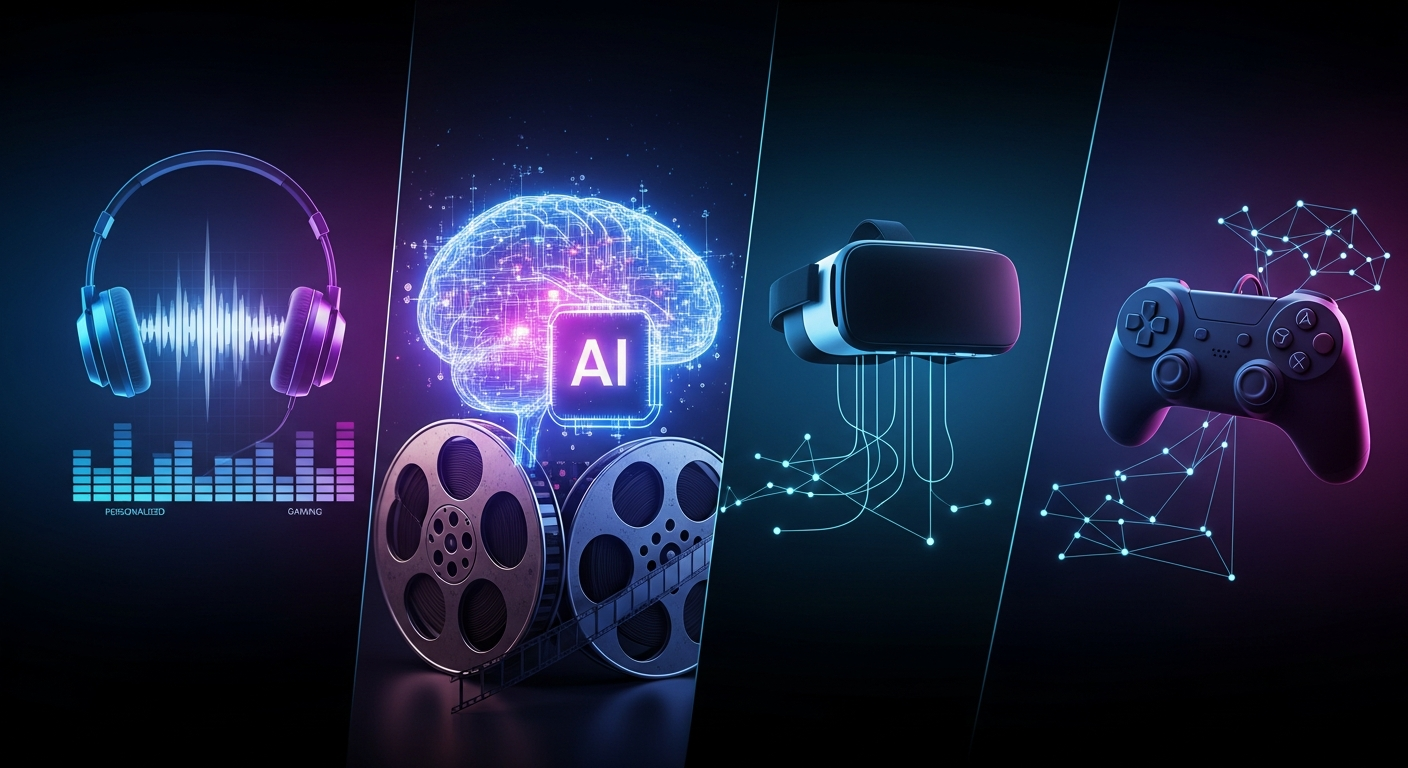
AI in entertainment: personalized movies, music playlists, and gaming.
- November 20, 2025
- ~ 1 min read
- 143 views
- Lifestyle & AI , GenAI
Introduction to AI in Entertainment
The entertainment industry is on the cusp of a revolution, driven by the rapid advancement of AI in entertainment. Artificial Intelligence (AI) is transforming the way we consume and interact with entertainment, from personalized movie recommendations to dynamic music playlists and immersive gaming experiences. With the global entertainment market projected to reach $2.6 trillion by 2025, the impact of AI on this industry cannot be overstated. As AI continues to evolve, it's essential to understand its role in shaping the future of entertainment.
The Rise of Personalized Entertainment
One of the most significant benefits of AI in entertainment is the ability to provide personalized entertainment experiences. With the help of machine learning algorithms, entertainment companies can now analyze vast amounts of user data to create tailored recommendations, increasing user engagement and satisfaction. For instance, streaming services like Netflix and Hulu use AI-powered recommendation engines to suggest content based on individual viewing habits. This level of personalization has become a key differentiator in the entertainment industry, with 72% of consumers saying they prefer personalized content recommendations.
What to Expect from AI in Entertainment
In this article, we'll delve into the world of AI in entertainment, exploring its applications, benefits, and future prospects. We'll examine how AI is being used to create immersive gaming experiences, dynamic music playlists, and personalized movie recommendations. We'll also discuss the importance of personalized entertainment and how it's changing the way we consume entertainment. Some of the key topics we'll cover include:
- The role of AI in content creation and distribution
- The impact of AI on the entertainment industry's business models
- The potential applications of AI in virtual and augmented reality entertainment
By the end of this article, readers will have a comprehensive understanding of the current state of AI in entertainment and its potential to shape the future of the industry. Whether you're a tech enthusiast, an entertainment industry professional, or simply a consumer interested in AI-powered entertainment, this article will provide valuable insights into the exciting world of AI in entertainment.
The future of entertainment is personalized, immersive, and AI-driven. As we explore the many applications of AI in entertainment, one thing is clear: the industry will never be the same.
The Role of AI in Personalized Entertainment
The integration of Artificial Intelligence (AI) in the entertainment industry has revolutionized the way content is consumed. At the heart of this revolution is personalization, which enables entertainment platforms to offer tailored experiences to individual users. This is made possible by AI algorithms that analyze vast amounts of user data to predict preferences and recommend content accordingly.
Understanding AI Algorithms for Personalization
AI algorithms used for personalization are complex systems that process user data from various sources, including viewing history, search queries, ratings, and social media interactions. These algorithms can be broadly categorized into collaborative filtering, content-based filtering, and hybrid approaches. Collaborative filtering involves analyzing the behavior of similar users to make recommendations, while content-based filtering focuses on the attributes of the content itself. Hybrid approaches combine these methods to leverage their respective strengths.
The process of analyzing user data involves several steps, including data collection, preprocessing, and modeling. Data collection involves gathering user interactions from various touchpoints, such as websites, mobile apps, and social media platforms. Data preprocessing involves cleaning, transforming, and formatting the data into a suitable format for analysis. Finally, modeling involves applying AI algorithms to the preprocessed data to generate recommendations.
Examples of AI-Powered Personalized Entertainment Platforms
Several entertainment platforms have successfully integrated AI-powered personalization into their services. For instance, Netflix uses a hybrid approach to recommend TV shows and movies based on user viewing history and ratings. Similarly, Spotify's Discover Weekly playlist uses natural language processing and collaborative filtering to curate a weekly playlist of songs tailored to individual users' tastes. Other examples include YouTube's video recommendations and Amazon's personalized product suggestions.
These platforms demonstrate the potential of AI-driven personalization in enhancing user engagement and satisfaction. By offering content that resonates with individual preferences, entertainment platforms can increase user retention, encourage discovery, and ultimately drive revenue growth.
Benefits of AI-Driven Personalization in Entertainment
The benefits of AI-driven personalization in entertainment are multifaceted. Firstly, it enables entertainment platforms to offer a more immersive experience by tailoring content to individual preferences. Secondly, it helps users discover new content that they may not have encountered otherwise. Finally, it allows entertainment platforms to differentiate themselves in a crowded market by offering a unique value proposition.
In conclusion, AI algorithms play a vital role in enabling personalization in entertainment. By analyzing user data and applying complex algorithms, entertainment platforms can offer tailored experiences that enhance user engagement and satisfaction. As the entertainment industry continues to evolve, the importance of AI-powered personalization will only continue to grow.
The future of entertainment is personalized, and AI is the key to unlocking this future. By leveraging AI algorithms and user data, entertainment platforms can create unique experiences that resonate with individual users, driving engagement, satisfaction, and revenue growth.
Real-World Applications of AI in Entertainment
The integration of AI in movies, music, and gaming has led to a significant transformation in the entertainment industry. From personalized recommendations to immersive experiences, AI is revolutionizing the way we consume entertainment. In this section, we will explore the real-world applications of AI in entertainment, highlighting successful case studies and examples of AI-powered solutions.
AI in Movie Recommendations and Music Playlists
One of the most notable applications of AI in entertainment is in movie recommendations and music playlists. Companies like Netflix and Spotify use AI algorithms to analyze user behavior and provide personalized recommendations. For instance, Netflix's recommendation engine uses a combination of natural language processing and collaborative filtering to suggest movies and TV shows based on a user's viewing history. Similarly, Spotify's Discover Weekly playlist uses AI in music to curate a weekly playlist of songs tailored to a user's listening habits. These AI-powered recommendations have significantly improved user engagement and satisfaction, making them a key component of the entertainment experience.
Other examples of AI-generated music playlists include Apple Music's "For You" section, which uses machine learning to recommend music based on a user's listening history, and Amazon Music's "Daily Mix" playlists, which use AI algorithms to curate playlists based on a user's favorite artists and genres. These AI-powered music playlists have made it easier for users to discover new music and have helped to increase user engagement and loyalty.
AI in Gaming: Enhancing Game Development and Player Experience
AI in gaming is also being used to enhance game development and player experience. Game developers are using AI to create more realistic non-player characters (NPCs), generate terrain and environments, and even create entire game levels. For example, the game "No Man's Sky" uses a procedural generation algorithm to create an almost endless variety of planets and environments, each with their own unique characteristics and features. This use of AI has enabled game developers to create more immersive and engaging games, with a higher level of realism and complexity.
In addition to game development, AI is also being used to enhance the player experience. For example, some games use machine learning algorithms to analyze player behavior and adjust the difficulty level accordingly. This ensures that the game remains challenging but not frustratingly difficult, providing a more enjoyable experience for the player. Other games use natural language processing to enable players to interact with NPCs in a more realistic and intuitive way, adding to the overall immersion and engagement of the game.
Future Potential of AI in Virtual and Augmented Reality Entertainment
The future of AI in entertainment is likely to be shaped by the growing trend of virtual reality and augmented reality experiences. As VR and AR technology becomes more advanced and affordable, we can expect to see more AI-powered experiences that blur the line between the physical and digital worlds. For example, AI could be used to create personalized VR experiences that adapt to a user's preferences and behavior, or to generate realistic virtual environments that simulate real-world locations and scenarios.
According to a recent study, the use of AI in VR and AR entertainment is expected to increase significantly in the next few years, with
80% of entertainment companies planning to invest in AI-powered VR and AR experiences by 2025. This highlights the potential of AI to transform the entertainment industry and create new and innovative experiences that were previously unimaginable.
In conclusion, the real-world applications of AI in entertainment are vast and varied, from personalized movie recommendations and music playlists to AI-powered gaming and virtual reality experiences. As AI technology continues to evolve and improve, we can expect to see even more innovative and immersive experiences that transform the way we consume entertainment. Whether you're a tech enthusiast, an entertainment industry professional, or just a consumer looking for new and exciting experiences, the future of AI in entertainment is certainly worth watching.
Advanced AI Concepts in Entertainment
The integration of Artificial Intelligence (AI) in the entertainment industry has led to the development of innovative technologies that are transforming the way we consume and interact with media. At the heart of these advancements are deep learning techniques, which enable AI systems to learn from vast amounts of data and make predictions or decisions with unprecedented accuracy. In the context of entertainment, deep learning is used to analyze user behavior, preferences, and viewing patterns to create personalized recommendations, such as customized movie trailers or music playlists.
Deep Learning and Natural Language Processing in Entertainment AI
One of the key applications of deep learning in entertainment is natural language processing (NLP), which allows AI-powered chatbots to understand and respond to user queries in a more human-like manner. NLP is used in various entertainment applications, including virtual assistants, voice-controlled interfaces, and chatbots that provide customer support or recommend content based on user preferences. For instance, AI-powered chatbots can be used to create interactive stories or games that adapt to the user's input and preferences, providing a more immersive and engaging experience. By leveraging NLP, entertainment companies can create more personalized and interactive experiences that enhance user engagement and loyalty.
Computer Vision and AI-Driven Content Creation
Computer vision is another critical component of AI in entertainment, enabling machines to interpret and understand visual data from images and videos. In the context of content creation, computer vision is used to analyze footage, detect objects, and track movements, allowing for the automation of tasks such as video editing, color correction, and visual effects. Additionally, computer vision can be used to generate synthetic content, such as CGI characters or environments, which can be used in movies, TV shows, or video games. By automating content creation tasks, entertainment companies can reduce production costs, increase efficiency, and focus on high-level creative decisions.
The use of AI in entertainment also raises important AI ethics considerations, such as the potential for bias in algorithmic decision-making, the protection of user data, and the impact of automation on jobs and creative industries. As AI continues to play a larger role in entertainment, it is essential to address these concerns and develop guidelines and regulations that ensure the responsible development and deployment of AI technologies.
The future of AI in entertainment will depend on our ability to balance innovation with responsibility, ensuring that these technologies benefit both creators and consumers alike.
Future Directions of AI Research in Entertainment Technology
Looking ahead, the future of AI in entertainment is likely to be shaped by advances in areas such as deep learning, natural language processing, and computer vision. Researchers are exploring new applications of AI in entertainment, such as the use of generative models to create synthetic content, the development of more sophisticated chatbots and virtual assistants, and the integration of AI with other technologies, such as augmented and virtual reality. By continuing to push the boundaries of AI research and development, we can unlock new creative possibilities, enhance user experiences, and transform the entertainment industry in profound ways. Some potential future directions of AI research in entertainment technology include:
- Developing more advanced NLP capabilities to enable more nuanced and human-like interactions between users and AI systems
- Exploring the use of computer vision to generate synthetic content, such as CGI characters or environments
- Investigating the potential of AI to enhance accessibility and inclusivity in entertainment, such as through the development of AI-powered tools for disabilities
Ultimately, the future of AI in entertainment will depend on our ability to harness the potential of these technologies while addressing the challenges and concerns that they raise. By working together to develop responsible AI practices and guidelines, we can ensure that these technologies benefit both creators and consumers, and that the entertainment industry continues to thrive and evolve in the years to come.
Implementing AI in Entertainment: A Practical Guide
As the entertainment industry continues to evolve, AI implementation has become a crucial aspect of providing personalized experiences for consumers. To successfully integrate AI into their businesses, entertainment industry professionals must follow a step-by-step approach that includes data collection, model training, and platform selection. In this section, we will provide a comprehensive guide on how to implement AI solutions, including best practices and common pitfalls to avoid.
Step-by-Step Guide to Implementing AI for Personalization
The first step in implementing AI for personalization is to collect and analyze
The next step is to choose the right AI tools and platforms for implementation. There are various AI tools and platforms available, each with its own strengths and weaknesses. It is crucial to select tools that are scalable and can handle large amounts of data. Some popular AI tools and platforms for entertainment include TensorFlow, PyTorch, and AWS SageMaker. These tools provide a range of features, including data preprocessing, model training, and deployment.
Best Practices for Collecting and Analyzing User Data
When collecting and analyzing user data, there are several best practices to keep in mind. Firstly, it is essential to ensure that the data is collected with user consent. This can be done by providing clear and transparent information on how the data will be used. Secondly, the data should be stored securely to prevent unauthorized access. Finally, the data should be analyzed regularly to ensure that it is accurate and up-to-date. Some common pitfalls to avoid include collecting too much data, which can lead to information overload, and failing to analyze the data regularly, which can lead to inaccurate insights.
Some additional best practices for collecting and analyzing user data include:
- Using data anonymization techniques to protect user privacy
- Implementing data quality checks to ensure accuracy
- Using data visualization tools to provide insights and trends
Tips for Training AI Models for Entertainment Applications
Training AI models for entertainment applications requires a deep understanding of the specific use case and the data being used. It is essential to ensure that the model is trained on high-quality data that is relevant to the specific application. Additionally, the model should be trained regularly to ensure that it remains accurate and up-to-date. Some tips for training AI models include:
- Starting with a small dataset and gradually increasing the size as the model becomes more accurate
- Using transfer learning to leverage pre-trained models and reduce training time
- Monitoring the model's performance regularly and making adjustments as needed
By following these steps and best practices, entertainment industry professionals can successfully implement AI implementation and provide personalized experiences for their consumers.
Remember, the key to successful AI implementation is to start small, be patient, and continuously monitor and evaluate the model's performance.
Comparison and Analysis of AI Entertainment Solutions
The integration of Artificial Intelligence (AI) in the entertainment industry has given rise to a multitude of AI-powered entertainment platforms. Each platform offers unique features, advantages, and disadvantages. In this section, we will delve into a comparison of AI solutions to understand their differences and similarities. This analysis will help readers make informed decisions about adopting AI technology in the entertainment sector.
Pros and Cons of AI-Powered Entertainment Platforms
A thorough analysis of the pros and cons of AI-powered entertainment platforms is essential to understand their potential and limitations. On the one hand, AI-powered platforms offer personalized recommendations that enhance the user experience. For instance, music streaming services like Spotify and Apple Music use AI algorithms to create customized playlists based on users' listening habits. On the other hand, the over-reliance on AI can lead to a lack of diversity in recommendations, as the algorithms may prioritize popular content over niche or emerging artists.
Some of the key advantages of AI-powered entertainment platforms include:
- Enhanced user experience through personalized recommendations
- Increased efficiency in content creation and distribution
- Improved customer engagement and retention
- Potential bias in AI algorithms
- Dependence on high-quality data for accurate recommendations
- Concerns over privacy and data protection
Trade-Offs Between Personalization and Privacy
The use of AI in entertainment raises important questions about the trade-offs between personalization and privacy. While AI algorithms can provide highly personalized recommendations, they often require access to large amounts of user data. This can be a concern for users who value their privacy and data security. To mitigate this risk, entertainment companies must implement robust data protection measures and provide transparent information about their data collection and usage practices.
A cost-benefit analysis of implementing AI solutions in entertainment is also crucial. While AI can offer significant benefits in terms of personalized recommendations and increased efficiency, it also requires significant investment in infrastructure, talent, and data management. Entertainment companies must carefully weigh the costs and benefits of AI adoption to ensure that it aligns with their business goals and strategy.
The key to successful AI adoption in entertainment is finding a balance between personalization and privacy, while also ensuring that the benefits of AI outweigh the costs.
In conclusion, the comparison and analysis of AI entertainment solutions highlight the importance of considering the pros and cons of AI adoption. By understanding the advantages and disadvantages of AI-powered entertainment platforms, entertainment companies can make informed decisions about how to leverage AI to enhance the user experience, while also addressing concerns over privacy and data protection. As the entertainment industry continues to evolve, it is likely that we will see even more innovative applications of AI in the future.
Conclusion and Future of AI in Entertainment
In conclusion, the integration of AI in entertainment has revolutionized the way we consume and interact with media. From personalized movie recommendations to dynamic music playlists and immersive gaming experiences, AI has transformed the entertainment landscape. Throughout this article, we have explored the various applications of AI in entertainment, including content creation, distribution, and consumption. We have also examined the current state of the industry and the potential challenges and opportunities that lie ahead.
Reflection on the Current State and Future Potential
As we look to the future, it is clear that AI in entertainment will continue to play a major role in shaping the industry. With advancements in machine learning and natural language processing, we can expect to see even more sophisticated and personalized entertainment experiences. The use of virtual and augmented reality will become more prevalent, allowing for immersive and interactive experiences that blur the lines between reality and fantasy. Furthermore, the rise of industry trends such as streaming services and social media will continue to drive the demand for AI-powered entertainment solutions.
Call to Action and Next Steps
As we move forward in this exciting era of AI in entertainment, it is essential that we continue to explore and learn more about the potential applications and implications of AI in the entertainment industry. We encourage readers to take a proactive approach and stay up-to-date with the latest developments and trends in AI-powered entertainment. Whether you are a tech enthusiast, an entertainment industry professional, or simply a consumer of entertainment media, there has never been a more exciting time to be a part of this rapidly evolving landscape. We invite you to join the conversation and explore the many ways in which AI in entertainment is transforming the way we experience and interact with media.
To take the next step, consider the following:
- Explore the latest AI-powered entertainment platforms and services
- Attend industry events and conferences to learn more about the latest trends and developments
- Join online communities and forums to connect with others who share your interests in AI and entertainment
By taking these steps, you can stay at the forefront of this exciting and rapidly evolving field, and be a part of shaping the future of AI in entertainment. As we look to the future, one thing is clear: the possibilities are endless, and the potential for AI in entertainment to transform and enrich our lives is vast and full of promise.
The future of entertainment is here, and it is powered by AI. Join the revolution and discover the exciting possibilities that await.

Comments (0)
Please login or register to leave a comment.
No comments yet. Be the first to comment!