
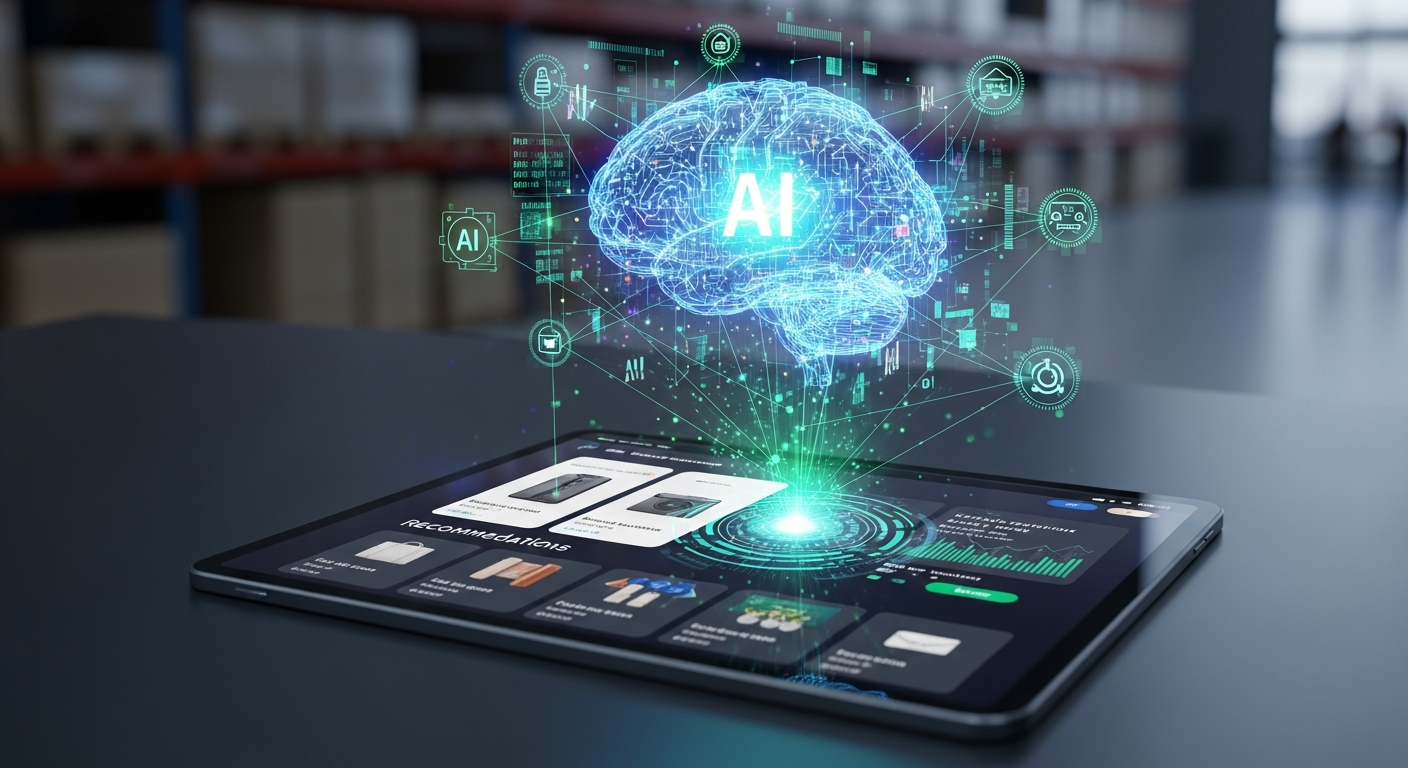
AI in e-commerce for recommending products and predicting customer needs.
- November 20, 2025
- ~ 1 min read
- 123 views
- AI in Business
Introduction to AI in E-commerce
Did you know that AI in e-commerce is expected to boost the global economy by $15.7 trillion by 2030? This staggering statistic highlights the immense potential of artificial intelligence in revolutionizing the way online businesses operate. As an e-commerce business owner, marketer, or developer, it's essential to understand the significance of AI in enhancing customer experience, driving sales, and predicting customer needs. In this article, we'll delve into the world of AI in e-commerce, exploring its definition, importance, and applications.
Defining AI in E-commerce
AI in e-commerce refers to the use of artificial intelligence technologies, such as machine learning, natural language processing, and computer vision, to optimize and automate various aspects of online retail. From product recommendation engines to customer need prediction algorithms, AI is being leveraged to create personalized shopping experiences, improve operational efficiency, and increase revenue. By analyzing vast amounts of customer data, AI-powered systems can identify patterns, preferences, and behaviors, enabling businesses to make data-driven decisions and stay ahead of the competition.
The Importance of AI in E-commerce
The importance of AI in e-commerce cannot be overstated. By implementing AI-powered solutions, businesses can enhance customer experience, increase sales, and reduce costs. For instance, AI-driven chatbots can provide 24/7 customer support, while AI-powered product recommendation engines can suggest relevant products, leading to increased average order value and customer loyalty. Moreover, AI can help businesses to predict customer needs, enabling them to proactively offer personalized promotions, discounts, and services, thereby building trust and loyalty with their customers.
Overview of AI Applications in E-commerce
AI applications in e-commerce are diverse and widespread. Some of the key areas where AI is being applied include:
- Product recommendation: AI-powered engines suggest relevant products to customers based on their browsing history, search queries, and purchase behavior.
- Customer need prediction: AI algorithms analyze customer data to predict their needs, enabling businesses to offer personalized promotions, discounts, and services.
- Chatbots and virtual assistants: AI-powered chatbots provide 24/7 customer support, helping customers with queries, returns, and refunds.
- Inventory management and supply chain optimization: AI helps businesses to optimize their inventory levels, reduce stockouts, and streamline their supply chain operations.
How AI Recommends Products and Predicts Customer Needs
Artificial Intelligence (AI) has revolutionized the e-commerce industry by enabling businesses to recommend products and predict customer needs with unprecedented accuracy. At the heart of this technology lies machine learning, a subset of AI that enables systems to learn from data and make predictions or decisions. In the context of product recommendation and customer need prediction, machine learning algorithms such as collaborative filtering and content-based filtering play a crucial role.
Machine Learning Algorithms for Product Recommendation
Collaborative filtering is a machine learning algorithm that recommends products to a user based on the preferences of similar users. This algorithm works by analyzing the purchase history and browsing behavior of users and identifying patterns and correlations. For instance, if a user has purchased a product A and B, and another user has also purchased product A, the algorithm may recommend product B to the second user. On the other hand, content-based filtering recommends products to a user based on the features of the products they have liked or purchased in the past. This algorithm works by analyzing the attributes of products, such as price, brand, and category, and recommending products with similar attributes.
Natural Language Processing for Customer Need Prediction
Natural Language Processing (NLP) is another key technology that enables AI-powered customer need prediction. NLP is a subset of AI that deals with the interaction between computers and humans in natural language. In the context of customer need prediction, NLP is used to analyze customer feedback, reviews, and social media posts to identify patterns and sentiments. Sentiment analysis is a technique used in NLP to determine the emotional tone or sentiment behind a piece of text. This technique can help businesses identify customer preferences and predict their needs. For example, if a customer has written a positive review about a product, the algorithm may recommend similar products to the customer.
Data Sources and Successful Implementations
The accuracy of AI-powered product recommendation and customer need prediction depends on the quality and quantity of data used to train the algorithms. Common data sources used in this context include customer purchase history, browsing behavior, search queries, and social media data. Businesses can also use external data sources, such as market trends and competitor analysis, to improve the accuracy of their predictions. For instance, Amazon uses a combination of collaborative filtering and content-based filtering to recommend products to its customers. The company also uses NLP to analyze customer feedback and improve its product recommendations. According to a study, Amazon's product recommendation algorithm is responsible for
about 35% of the company's sales.
Other successful implementations of AI-powered product recommendation and customer need prediction include Netflix, which uses a combination of collaborative filtering and content-based filtering to recommend movies and TV shows to its users. The company also uses NLP to analyze customer feedback and improve its recommendations. According to a study, Netflix's recommendation algorithm is responsible for
about 80% of the content watched on the platform. These examples demonstrate the power of AI in predicting customer needs and recommending products, and highlight the importance of machine learning and natural language processing in this context.
- Collaborative filtering: recommends products to a user based on the preferences of similar users
- Content-based filtering: recommends products to a user based on the features of the products they have liked or purchased in the past
- NLP: analyzes customer feedback, reviews, and social media posts to identify patterns and sentiments
By leveraging these technologies and techniques, businesses can create personalized product recommendations and predict customer needs with unprecedented accuracy, driving sales, customer satisfaction, and loyalty. As the use of AI in e-commerce continues to evolve, we can expect to see even more innovative applications of machine learning and natural language processing in the years to come.
Real-World Examples of AI in E-commerce
The integration of AI in e-commerce has revolutionized the way businesses operate and interact with their customers. Several companies have successfully implemented AI-powered solutions to enhance customer experience, improve sales, and predict customer needs. In this section, we will explore some real-world examples of AI in e-commerce, including case studies and success stories.
Case Study: Amazon's Product Recommendation Algorithm
Amazon's product recommendation algorithm is a prime example of AI-powered e-commerce in action. The algorithm uses machine learning and data analytics to suggest products to customers based on their browsing and purchasing history. This personalized approach has significantly improved sales and customer satisfaction. According to Amazon, over 35% of its sales come from product recommendations. The algorithm's success can be attributed to its ability to analyze vast amounts of customer data and provide relevant recommendations in real-time.
Predicting Customer Needs with Natural Language Processing
Netflix is another company that has successfully leveraged AI in e-commerce to predict customer needs. The company uses natural language processing (NLP) to analyze customer reviews and ratings, and provide personalized recommendations. NLP enables Netflix to understand the nuances of customer preferences and provide highly accurate recommendations. For instance, if a customer searches for "romantic comedies," Netflix's algorithm will suggest relevant movies and TV shows based on their viewing history and ratings.
Walmart's Use of AI in E-commerce
Walmart, one of the world's largest retailers, has also embraced AI-powered e-commerce to enhance customer experience and improve operational efficiency. The company uses machine learning and data analytics to optimize its supply chain, predict demand, and provide personalized recommendations to customers. Walmart's use of AI has enabled it to reduce costs and improve sales, making it a competitive player in the e-commerce market.
In addition to these examples, several other companies have successfully implemented AI in e-commerce. Some notable examples include:
- Ebay, which uses machine learning to provide personalized product recommendations
- Stitch Fix, which uses AI to provide personalized fashion recommendations
- Home Depot, which uses AI to optimize its supply chain and improve customer service
The key to success in AI-powered e-commerce is to leverage data analytics and machine learning to provide personalized recommendations and improve operational efficiency. By doing so, businesses can enhance customer experience, improve sales, and stay ahead of the competition.
Advanced Concepts in AI-Powered Product Recommendation and Customer Need Prediction
As e-commerce businesses continue to leverage Artificial Intelligence (AI) to enhance customer experiences, it's essential to delve into the advanced concepts that power product recommendation and customer need prediction. Deep learning techniques, such as neural networks and convolutional neural networks, play a crucial role in analyzing customer behavior and preferences. These techniques enable AI-powered systems to learn from vast amounts of data, identify patterns, and make accurate predictions about customer needs.
Deep Learning Techniques and Transfer Learning
In the context of product recommendation, deep learning techniques can be applied to analyze customer interactions, such as browsing history, search queries, and purchase behavior. This analysis helps AI-powered systems to identify relevant products and recommend them to customers. Furthermore, transfer learning can be used to leverage pre-trained models and fine-tune them for specific e-commerce applications. This approach enables businesses to adapt to changing customer needs and preferences, ensuring that their product recommendations remain relevant and effective.
For instance, a fashion e-commerce platform can use transfer learning to adapt a pre-trained model that recognizes clothing items and styles. By fine-tuning this model with their own customer data, the platform can provide personalized product recommendations that take into account the customer's preferred styles, colors, and sizes. This approach not only enhances the customer experience but also increases the likelihood of conversion and customer loyalty.
Edge Cases and Future Trends
Despite the advancements in AI-powered product recommendation and customer need prediction, there are still edge cases that require attention. The cold start problem, which occurs when a new customer or product is introduced, can be challenging to address. Additionally, data sparsity can limit the effectiveness of AI-powered systems, particularly when dealing with niche products or customers with limited interaction history. To overcome these challenges, businesses can use techniques such as content-based filtering, knowledge-based systems, or hybrid approaches that combine multiple methods.
In terms of future trends, AI-powered e-commerce is likely to incorporate augmented reality (AR) and virtual reality (VR) to create immersive customer experiences. These technologies can enable customers to interact with products in a more engaging and interactive way, increasing the likelihood of conversion and customer satisfaction. For example, a furniture e-commerce platform can use AR to allow customers to visualize products in their own space, reducing the likelihood of returns and improving customer satisfaction.
Other advanced AI-powered e-commerce platforms, such as Salesforce Commerce Cloud and Shopify Plus, offer a range of features and benefits, including:
- Personalized product recommendations using deep learning techniques
- Transfer learning capabilities to adapt to changing customer needs
- Integration with AR and VR technologies to create immersive customer experiences
- Advanced analytics and insights to inform business decisions
By leveraging these advanced concepts and technologies, e-commerce businesses can stay ahead of the competition, drive revenue growth, and deliver exceptional customer experiences.
Implementing AI in E-commerce: A Practical Guide
As e-commerce businesses continue to evolve, the implementation of Artificial Intelligence (AI) has become a crucial step in staying competitive. In this section, we will provide a step-by-step guide on how to implement AI-powered product recommendation and customer need prediction into your e-commerce platform. By following these best practices and tips, you can unlock the full potential of AI in e-commerce and take your business to the next level.
Step-by-Step Guide to Implementing AI-Powered Product Recommendation
The first step in implementing AI-powered product recommendation is to prepare your data. This includes collecting and processing customer interaction data, such as purchase history, browsing behavior, and search queries. Once you have your data, you can select a suitable AI model, such as collaborative filtering or content-based filtering, to generate personalized product recommendations. The following are the key steps to follow:
- Collect and process customer interaction data
- Select a suitable AI model for product recommendation
- Train and test the model using your dataset
- Integrate the model into your e-commerce platform
- Monitor and evaluate the performance of the model
By following these steps, you can create a robust AI-powered product recommendation system that drives sales and enhances customer experience. Remember to continuously monitor and update your model to ensure it remains effective and accurate.
Tips for Integrating AI-Powered Customer Need Prediction into E-commerce Platforms
Integrating AI-powered customer need prediction into your e-commerce platform can be a game-changer. It allows you to anticipate and fulfill customer needs, resulting in increased customer satisfaction and loyalty. To integrate AI-powered customer need prediction, follow these tips:
- Integrate your customer data from various sources, such as social media, customer reviews, and purchase history
- Use natural language processing (NLP) and machine learning algorithms to analyze customer data and predict their needs
- Deploy your model using a cloud-based platform or on-premise infrastructure
- Continuously monitor and update your model to ensure it remains accurate and effective
By following these tips, you can create a powerful AI-powered customer need prediction system that drives business growth and enhances customer experience. Implementation guide and step-by-step instructions are crucial in ensuring a smooth and successful integration.
Common Pitfalls to Avoid and Best Practices for AI-Powered E-commerce
When implementing AI in e-commerce, there are common pitfalls to avoid, such as data quality issues, model drift, and lack of transparency. To avoid these pitfalls, follow these best practices:
Monitor your data quality and ensure it is accurate and up-to-date. Regularly update your models to prevent drift and ensure they remain effective. Provide transparency into your AI decision-making processes to build trust with your customers.
Additionally, continuously evaluate and improve your AI-powered systems to ensure they remain aligned with your business goals and objectives. By following these best practices and avoiding common pitfalls, you can unlock the full potential of AI in e-commerce and drive business success. Step-by-step instructions and a well-planned implementation guide are essential in ensuring a successful AI-powered e-commerce strategy.
Comparison of AI-Powered E-commerce Platforms
As the e-commerce industry continues to evolve, the use of Artificial Intelligence (AI) has become a crucial aspect of online retail. With numerous AI-powered e-commerce platforms available, it's essential to conduct a comparative analysis to determine which one best suits your business needs. In this section, we'll delve into the pros and cons of popular AI-powered e-commerce platforms, discuss trade-offs, and provide tips for selecting the right platform.
Popular AI-Powered E-commerce Platforms
Some of the most popular AI-powered e-commerce platforms include Shopify, Magento, and BigCommerce. Each platform has its unique features and benefits, which are outlined below:
- Shopify: Known for its user-friendly interface and extensive app store, Shopify offers a range of AI-powered tools, including product recommendations and customer segmentation.
- Magento: A popular choice among large-scale e-commerce businesses, Magento offers advanced AI-powered features, such as predictive analytics and personalized marketing.
- BigCommerce: This platform offers a range of AI-powered tools, including product recommendations, customer segmentation, and predictive analytics, making it an excellent choice for businesses of all sizes.
Pros and Cons of Each Platform
When selecting an AI-powered e-commerce platform, it's essential to consider the pros and cons of each option. For example:
Shopify's ease of use and extensive app store make it an excellent choice for small to medium-sized businesses. However, its limited customization options may be a drawback for larger businesses. Magento, on the other hand, offers advanced customization options but can be complex to use and requires significant development expertise. BigCommerce offers a balance between ease of use and customization options, but its pricing plans can be steep for small businesses.
Ultimately, the choice of platform depends on your business needs and goals. It's crucial to weigh the pros and cons of each platform and consider factors such as scalability, customization, and cost.
Trade-Offs and Tips for Selection
When selecting an AI-powered e-commerce platform, you'll need to consider trade-offs between different factors, such as cost and complexity. Trade-offs may include:
- Cost: More advanced AI-powered features may come at a higher cost.
- Complexity: More complex platforms may require significant development expertise.
- Customization: More customizable platforms may require more development time and resources.
To select the right AI-powered e-commerce platform, consider the following tips:
- Define your business needs and goals.
- Assess your technical expertise and resources.
- Evaluate the pros and cons of each platform.
- Consider scalability and customization options.
- Compare pricing plans and calculate the total cost of ownership.
By conducting a thorough comparative analysis and considering trade-offs, you can select an AI-powered e-commerce platform that meets your business needs and drives growth and success.
In conclusion, selecting the right AI-powered e-commerce platform requires careful consideration of pros and cons, trade-offs, and business needs. By following these tips and conducting a thorough comparative analysis, you can make an informed decision and take your e-commerce business to the next level. Remember to prioritize scalability and customization when selecting a platform, and don't hesitate to seek expert advice if needed.
Conclusion and Key Takeaways
In conclusion, the integration of Artificial Intelligence (AI) in e-commerce has revolutionized the way businesses approach product recommendation and customer need prediction. Throughout this article, we have explored the various ways in which AI can be leveraged to enhance the online shopping experience, drive sales, and foster customer loyalty. The key takeaways from our discussion include the importance of personalized product recommendations, the role of machine learning in predicting customer behavior, and the need for seamless integration of AI-powered solutions into existing e-commerce platforms.
Summary of Key Points
A thorough review of the main topics covered reveals that AI-powered product recommendation engines can significantly increase conversion rates and average order value. Moreover, the use of natural language processing and machine learning algorithms enables businesses to gain a deeper understanding of their customers' preferences and behaviors. By analyzing customer data and feedback, e-commerce businesses can identify areas for improvement and implement targeted marketing strategies to drive growth and revenue.
Reinforcement of Main Takeaways
The benefits of AI in e-commerce are numerous, and businesses that fail to adopt these technologies risk being left behind. By leveraging AI-powered solutions, e-commerce businesses can enhance customer engagement, improve operational efficiency, and drive revenue growth. As we move forward in this digital age, it is essential for businesses to stay ahead of the curve and embrace the latest technologies and trends. The next steps for businesses looking to integrate AI into their e-commerce platforms include researching and selecting the right AI-powered solutions, developing a comprehensive implementation strategy, and monitoring and evaluating the effectiveness of these solutions.
Call-to-Action and Next Steps
As you consider the potential of AI to transform your e-commerce business, we encourage you to take action and start exploring the many AI-powered solutions available. Our call-to-action is simple: start by assessing your current e-commerce platform and identifying areas where AI can be integrated to drive improvement. For further learning and implementation, we recommend checking out the following resources:
- AI-powered product recommendation engines
- Machine learning and natural language processing courses
- E-commerce platform integration guides
By embracing AI and its many applications, e-commerce businesses can unlock new opportunities for growth, innovation, and customer satisfaction. The future of e-commerce is here, and it's powered by AI.

Comments (0)
Please login or register to leave a comment.
No comments yet. Be the first to comment!