
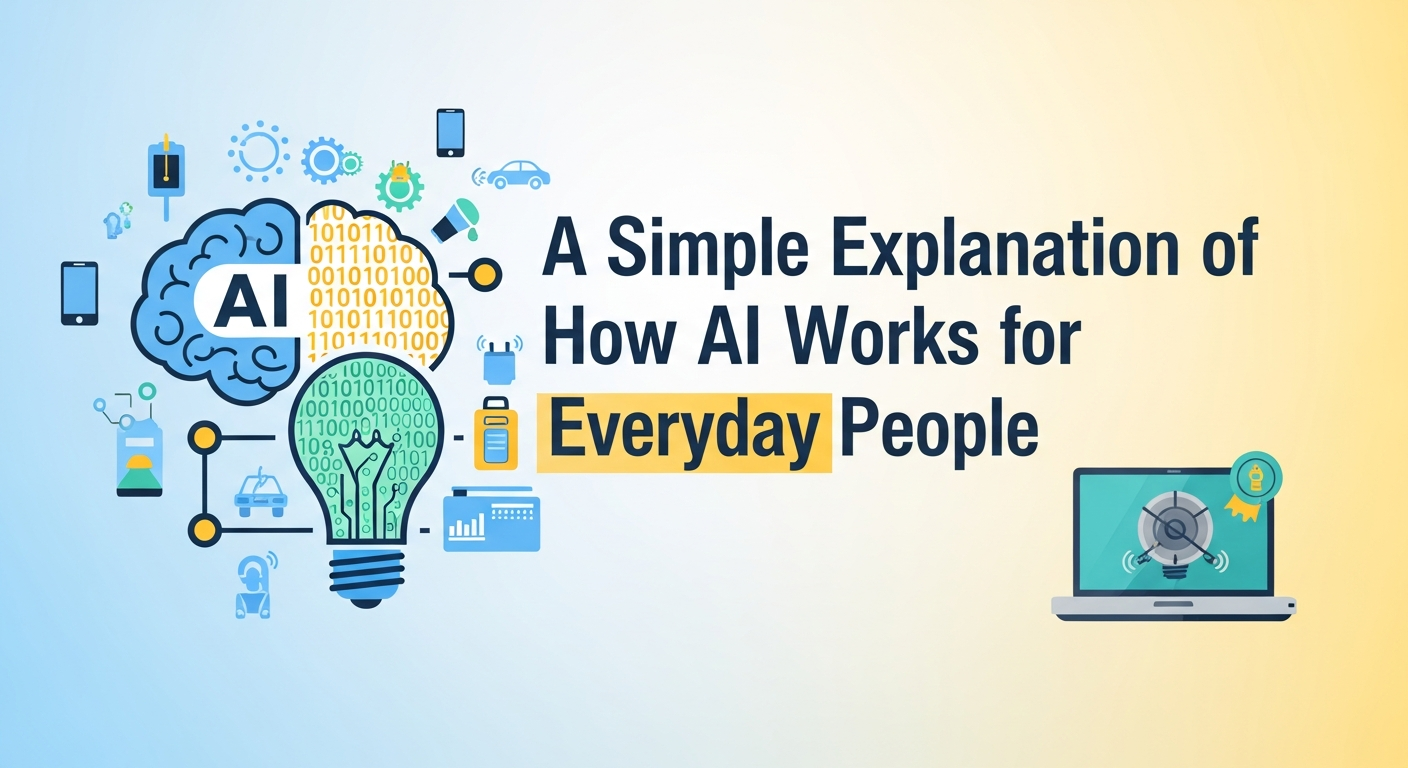
A Simple Explanation of How AI Works for Everyday People
- November 18, 2025
- ~ 1 min read
- 131 views
- GenAI
Introduction/Overview
Relatable Start: AI Around Us
Have you ever wondered how your phone recognizes your voice or why Netflix keeps suggesting shows you'll love? These aren't magic tricks—they're examples of Artificial Intelligence (AI) working behind the scenes. In fact, AI is already shaping our daily routines in ways you might not even notice. From your smart speaker answering questions to apps that filter spam emails, AI technology is quietly making our lives easier.
What is AI? A Simple Definition
Artificial Intelligence refers to computer systems designed to mimic human intelligence. At its core, AI is about creating machines that can perform tasks that typically require human intelligence, like learning, problem-solving, and decision-making. Think of it as teaching computers to "think" and "learn" from data, just like humans do.
But don't worry—this isn't about robots taking over the world. AI is about augmenting human capabilities, helping us solve complex problems and automate repetitive tasks. It's not about creating conscious machines but about building intelligent tools that can assist us in various aspects of life.
Debunking Common Myths
When it comes to AI, there are several misconceptions that often create unnecessary fear. Let's address a few common myths:
- Myth 1: AI will replace all human jobs — While AI automates certain tasks, it also creates new opportunities and roles that we haven't even imagined yet.
- Myth 2: AI is sentient and has emotions — Current AI systems don't possess consciousness or feelings; they process data and generate responses based on patterns.
- Myth 3: AI is a single technology — In reality, AI encompasses various approaches, from simple rule-based systems to complex neural networks.
Understanding these myths helps us approach AI with a clearer perspective and reduces the fear factor.
Why AI is Everywhere
The beauty of AI is that it's becoming increasingly accessible. Unlike decades ago when AI was confined to research labs, it's now integrated into everyday technology. From your smartphone's facial recognition to the shopping recommendations on Amazon, AI powers countless applications that enhance our experience.
What makes AI so prevalent? It's because computing power has become more affordable, and the amount of available data has exploded. This combination allows AI systems to learn from vast amounts of information and improve over time.
What to Expect in This Article
In this article, we're going to break down Artificial Intelligence into bite-sized, easy-to-understand concepts. We'll explore how AI works without overwhelming technical jargon. By the end of this series, you'll have a solid understanding of:
- The fundamental concepts behind AI
- How AI learns from data
- The different types of AI systems
- Real-world applications of AI
- The ethical considerations surrounding AI
Our goal is to make this complex topic approachable and relevant to everyone. Whether you're a curious beginner or someone looking to understand AI's impact on society, this guide will provide a solid foundation. We'll keep everything straightforward and actionable, so you can confidently navigate our increasingly intelligent world.
Core Concepts of AI
To truly grasp how AI works, let's break down its fundamental building blocks. Think of it like understanding how a child learns and grows – it's a process fueled by observation, experience, and guidance.
How AI Learns: The Power of Patterns and Data
At its core, intelligence, whether human or artificial, heavily relies on the ability to learn. For AI, this learning primarily happens through pattern recognition. Imagine teaching a child to identify a cat. You wouldn't give them a complex biology lecture. Instead, you'd show them dozens, perhaps hundreds, of pictures of different cats – fluffy ones, sleek ones, big ones, small ones – along with pictures of other animals. Slowly, the child's brain starts to pick up on the common features: ears, whiskers, specific eye shapes, typical body postures.
This is precisely how modern AI, specifically through a field called machine learning, operates. AI systems are fed massive collections of information, known as data sets. These data sets are the "food" or "fuel" for AI's learning process. If an AI is learning to identify spam emails, its data set would include millions of emails, some marked as spam, others as legitimate. By sifting through these examples, the AI begins to recognize the subtle cues and patterns that differentiate spam from non-spam, much like our child learned what makes a cat a cat.
Algorithms and the Learning Loop
So, if data is the fuel, then what tells the AI what to do with it? That's where algorithms come in. Think of an algorithm as a highly detailed recipe or a set of instructions. It's the step-by-step process that the AI follows to analyze the data, identify patterns, and make decisions or predictions. Different algorithms are designed for different tasks – some are great at sorting, others at predicting, and some at generating new content.
But learning isn't just about absorbing information; it's also about improving. This is where feedback mechanisms are crucial. Just as a child learns to refine their understanding of a cat when a parent corrects them ("No, that's a dog, see its floppy ears?"), AI systems also learn from their mistakes. When an AI makes an incorrect prediction or classification, it receives feedback, allowing its algorithms to adjust and improve their accuracy over time. This continuous loop of processing data, making predictions, and receiving feedback is fundamental to how AI systems evolve and get smarter.
It's also important to note that most of the AI we interact with daily is considered "Narrow AI." This means it's incredibly good at performing very specific tasks, like playing chess, recognizing faces in photos, translating languages, or recommending movies. It excels within its defined parameters. However, it lacks the broad, flexible intelligence that humans possess – the ability to learn any intellectual task. This human-like, multi-faceted intelligence is known as Artificial General Intelligence (AGI), and while it's a fascinating area of research, it's still largely a goal for the future, not something commonplace today.
Real-World AI Examples
You might think of Artificial Intelligence as something from science fiction movies, full of robots and futuristic technology. But the truth is, AI examples are already deeply integrated into our daily lives, often working silently in the background to make things easier, safer, or more convenient. From helping us find our favorite shows to keeping our inboxes clean, AI is everywhere. Let's explore some common ways AI impacts your world right now, showing just how practical and pervasive it has become.
AI That Listens and Recommends
One of the most familiar forms of AI you interact with daily is your personal voice assistant. Think about Siri on your iPhone, Alexa from Amazon, or Google Assistant. When you ask them a question or give a command, a lot of AI magic happens. First, they use complex speech recognition AI to convert your spoken words into text. Then, another layer of AI processes that text, understanding the intent behind your words – are you asking for the weather, setting a timer, or playing music? Finally, they use AI to formulate a relevant response and convert it back into spoken language. It’s like having a super-smart assistant that understands what you say and knows how to respond.
Another powerful AI at play is the recommendation system found on platforms like Netflix, Amazon, or YouTube. Have you ever wondered how Netflix always seems to suggest movies you might genuinely like, or how Amazon knows exactly what products you might be interested in? This isn't guesswork. These systems learn from your past behavior – what you've watched, bought, or clicked on – and compare it with the behavior of millions of other users. If people with similar tastes to yours enjoyed a particular item, the AI figures you probably will too. It’s constantly learning and adapting, making sure your next experience is tailored just for you, often leading to delightful discoveries.
AI That Sees and Sorts
Beyond listening and suggesting, AI also has an incredible ability to "see" and understand visual information. This is thanks to image recognition technology. You might use this without realizing it when your phone automatically organizes your photos by faces, locations, or even pets. Apps like Shazam use a form of audio recognition to identify songs simply by listening to a snippet, comparing it to a massive database. More broadly, image recognition AI helps identify objects in self-driving cars, diagnose medical conditions from scans, or even unlock your phone using facial identification. It’s about teaching computers to interpret the visual world much like humans do, but at an incredibly fast and large scale.
On the sorting front, perhaps the most unsung hero of everyday AI is the humble spam filter in your email inbox. This AI works tirelessly behind the scenes, scanning every incoming message for suspicious patterns. It looks for common characteristics of unwanted emails, such as unusual sender addresses, suspicious links, certain keywords, or even the email's structure. Over time, it learns what legitimate emails look like versus what constitutes spam, effectively sifting through hundreds of messages to ensure only the important ones land in your primary inbox. Without this AI, our inboxes would be overflowing with junk, making email practically unusable. It’s a brilliant example of AI enhancing our digital experience.
AI That Protects Your Interests
Finally, AI plays a crucial role in safeguarding your financial security through fraud detection in banking and finance. Your bank uses sophisticated AI systems to monitor your credit card and bank account activity around the clock. These systems learn your typical spending habits – where you shop, how much you usually spend, and even the types of transactions you make. If a transaction occurs that deviates significantly from your normal patterns – say, a large purchase made from a country you’ve never visited, or multiple small, rapid transactions – the AI will flag it as potentially fraudulent. This proactive approach allows banks to alert you quickly and often stop fraudulent activity before it causes significant damage, giving you peace of mind in your financial dealings.
Going Deeper: How AI Learns
Supervised Learning: Learning from Examples
Imagine you're learning to recognize cats. You wouldn't just look at random images and figure it out on your own. You'd need someone to point out, "This is a cat," and "This is not a cat." That's exactly how supervised learning works in AI. In this approach, developers provide an AI with a dataset of labeled examples—thousands of images, each tagged as "cat" or "not a cat." The AI then uses these examples to learn patterns and relationships. For instance, it might notice that cats have certain ear shapes, fur patterns, or eye structures that distinguish them from other animals. Once trained, the AI can apply this knowledge to new, unseen images, accurately classifying them as cats or not. This method is widely used for tasks like image recognition, spam filtering, and voice command systems, where the AI must make predictions based on known data.
Supervised learning relies on two key components: the input data (like images or text) and the corresponding output labels (the correct answers). The process involves feeding this data into an algorithm, which adjusts its internal parameters to minimize errors. Over time, the AI becomes more accurate, much like how you'd improve your cat-spotting skills by getting feedback on your guesses.
Unsupervised Learning: Finding Patterns on Its Own
Now, what if you were given a pile of thousands of images of animals but no labels? You'd probably group them into categories like "cats," "dogs," and "birds" yourself, based on similarities. That's the essence of unsupervised learning. In this approach, AI algorithms analyze data without any predefined answers or labels, identifying hidden patterns, structures, or groupings. Unsupervised learning is like teaching an AI to be a curious explorer—discovering insights on its own.
One common application of unsupervised learning is clustering, where data points are grouped based on similarities. For example, an AI might cluster customer data to identify distinct segments for targeted marketing. Another is dimensionality reduction, where the AI simplifies complex data by focusing on the most important features. This is crucial for tasks like analyzing large-scale scientific data or improving search engine results by understanding the underlying structure of information.
Unsupervised learning is powerful because it allows AI to uncover knowledge without human intervention, making it ideal for exploratory data analysis and scenarios where labeling data is too time-consuming or costly.
Reinforcement Learning: Learning by Doing
Ever watched a robot learn to navigate a maze or a computer program improve at playing a game like chess? This is achieved through reinforcement learning, a method where AI learns by performing actions and receiving feedback in the form of rewards or penalties. It's like teaching a pet dog—praise for a good trick and a time-out for a mistake.
In reinforcement learning, an AI agent interacts with an environment, taking actions and observing the outcomes. For example, a robot arm might reach for an object; if it succeeds, it gets a positive reward and its behavior is reinforced. If it fails, it gets a negative reward and adjusts its strategy. Over time, the AI develops a "policy"—a set of rules that guides its actions to maximize rewards and avoid punishments.
This approach is particularly effective for complex, dynamic tasks where rules are unclear, such as robotics, game-playing AI, or autonomous driving. By trial and error, reinforcement learning enables AI to master skills that are too intricate for traditional programming.
Neural Networks and the Role of Data and Computing
At the heart of many modern AI systems lies the neural network, a computational model inspired by the structure of the human brain. Neural networks consist of layers of interconnected nodes (called neurons), each processing a small piece of information. Data flows through these layers, with each neuron applying a simple transformation. The network's "learning" happens through adjustments to the connections between neurons, strengthening or weakening them based on the data, much like how neural connections in our brains grow stronger with repeated use.
The effectiveness of neural networks hinges on two critical factors: massive amounts of data and powerful computational resources
AI in Your World
AI Making Life Easier and More Efficient
You might not always realize it, but Artificial Intelligence is constantly working behind the scenes, making aspects of your life smoother, more convenient, and remarkably efficient. It's no longer a futuristic concept confined to science fiction; it's a practical helper deeply embedded in our everyday routines. From the moment you wake up to the time you go to bed, AI algorithms are processing data to offer personalized experiences and streamline complex tasks.
Think about your smart home devices – speakers that play your favorite music on command, thermostats that learn your preferred temperature, or security cameras that can differentiate between a pet and a person. These are prime examples of AI in daily life, bringing unparalleled convenience right into your living space. When you browse online stores, AI analyzes your past purchases and viewing habits to recommend products you might genuinely like, transforming endless choices into a personalized shopping experience. Similarly, streaming services use AI to suggest movies and shows, ensuring you spend less time searching and more time enjoying. These intelligent suggestions are clear demonstrations of the tangible AI benefits we now take for granted.
Beyond personal convenience, AI significantly enhances efficiency across various industries. In healthcare, AI assists doctors in analyzing complex medical images like X-rays and MRIs, often identifying subtle patterns that could indicate diseases earlier than the human eye alone. This leads to faster, more accurate diagnoses and ultimately, better patient outcomes. In logistics and transportation, AI optimizes delivery routes, reducing fuel consumption and ensuring your packages arrive quicker. Financial institutions use AI to detect fraudulent transactions, protecting your money and enhancing security. These industrial applications underscore the immense AI benefits that ripple through our economy and society, making critical services more reliable and accessible.
Understanding AI's Role and Impact
While AI brings many advantages, its growing presence also means that certain tasks can be automated. This aspect of AI automation is revolutionizing workplaces by taking over repetitive, data-intensive tasks. In manufacturing, robots perform precise assembly line work, and in customer service, AI-powered chatbots handle routine queries, freeing up human agents for more complex issues. This transformation, often referred to as the AI impact on jobs, doesn't necessarily mean fewer jobs, but rather a shift in the types of skills needed. It encourages us to adapt, learn new abilities, and focus on roles that require creativity, critical thinking, and human interaction, areas where AI currently complements rather than replaces human capabilities.
To better understand AI and its presence, start by becoming an observant user. Look for cues in the apps and services you use daily. Do you see a feature that promises "smart" suggestions or "personalized" recommendations? That’s likely AI at work. When an online chatbot provides instant answers, consider that it’s an AI trained on vast amounts of data. Pay attention to how these tools learn from your interactions – if a navigation app starts predicting your commute based on the time of day, it’s using AI to anticipate your needs. Engaging with these tools consciously helps demystify AI, turning it from an abstract concept into a practical, interactive component of your digital life. Ask yourself: "How might this tool be making decisions or suggestions for me?"
Embracing AI as a Powerful Tool
Ultimately, it’s helpful to view AI not as an intimidating force, but as an incredibly powerful and versatile tool. Like any tool, its value lies in how we use it. AI is integrated into existing systems to augment human capabilities, solve complex problems, and make our interactions with technology more intuitive and effective. It’s designed to extend our reach, simplify our lives, and make processes more efficient. By acknowledging and learning to understand AI's presence, you empower yourself to navigate a technologically advanced world with greater confidence and make the most of the innovations it offers. Embrace it as an invaluable assistant, ready to improve your convenience, boost efficiency, and tackle challenges in ways we could only dream of a few decades ago.
AI vs. Other Technologies
To truly grasp what Artificial Intelligence is, it helps to understand what it isn't, and how it differs from other technologies you might already be familiar with. While many technologies automate tasks or follow instructions, AI brings a fundamentally different approach to problem-solving. It's not just about doing what you're told; it's about learning and adapting.
AI vs. Traditional Programming and Simple Automation
Think of AI vs. programming like this: traditional programming is akin to writing a very detailed recipe. You, the programmer, anticipate every step, every ingredient, and every possible outcome, writing explicit instructions for the computer to follow. If the recipe needs to change, you have to go back and rewrite it. This approach works perfectly for tasks with clear, unchanging rules, such as calculating payroll or managing a database. The computer performs exactly what it's told, no more, no less.
Artificial Intelligence, however, is more like giving a budding chef a vast cookbook and letting them experiment. Instead of providing explicit rules for every scenario, you feed the AI massive amounts of data—examples, observations, and outcomes. The AI then learns the patterns and relationships within that data, figuring out its own "recipe" for success. This means it can adapt to situations it hasn't been specifically programmed for, making it far more flexible than traditional software that relies solely on pre-defined commands.
Similarly, comparing AI vs. automation reveals a key distinction. Simple automation is often based on rigid "if-then" logic: *if* a certain condition is met, *then* perform a specific action. For example, an automated email responder sends a pre-written reply *if* it detects specific keywords. AI, on the other hand, can go beyond these rigid rules. A modern AI-powered customer service chatbot can understand context, infer intent, and even learn from past interactions to provide more nuanced and helpful responses, rather than just firing off a canned message.
AI Pros and Cons: What AI Does Best and Where It Struggles
The learning-based nature of AI brings significant advantages, but also comes with its own set of trade-offs. Understanding these AI pros and cons helps explain why AI is so powerful in some areas, yet still presents challenges in others.
- Pros of AI:
- Adaptability and Flexibility: AI systems can adjust to new data and changing environments without requiring constant human reprogramming. This makes them ideal for dynamic tasks like self-driving cars navigating unpredictable roads or medical AI diagnosing evolving diseases.
- Handling Complexity: AI excels at sifting through enormous, complex datasets to find hidden patterns and make predictions that would be impossible for humans or traditional programs to uncover. Think of identifying fraud patterns in billions of transactions or optimizing global logistics.
- Learning from New Data: Perhaps AI's most powerful advantage is its ability to improve over time. The more data an AI system processes, the smarter and more accurate it can become, continuously refining its understanding and performance.
- Cons and AI Limitations:
- Data Hunger: AI needs vast quantities of high-quality data to learn effectively. Training sophisticated AI models can be incredibly resource-intensive, both in terms of data collection and computational power.
- The 'Black Box' Problem: Often, it's difficult to understand *why* an AI made a particular decision. The complex interplay of learned patterns can make its reasoning opaque, earning it the label of a 'black box.' This lack of explainability can be a significant concern in critical applications like healthcare or legal judgments.
- Potential Biases: Because AI learns from data, it can inadvertently pick up and amplify existing human biases present in that data. If the training data reflects historical inequalities or prejudices, the AI system will learn and perpetuate those biases, leading to unfair or discriminatory outcomes. Addressing AI bias is a critical area of ongoing research and development.
In essence, while traditional programming gives us precise control, AI offers us intelligent autonomy. The trade-off is between predictable, explicit instruction and the powerful, yet sometimes mysterious, world of learned intelligence. It's this balance that defines the unique place of AI among modern technologies.
Conclusion and Takeaways
Understanding AI: A Simple Recap
Throughout this article, we've broken down what might seem like a complex topic, proving that AI explained simply is not only possible but crucial for everyone. We started with the fundamental premise that AI, at its core, isn't magic; it's a sophisticated system designed to learn from data, identify patterns, and then make decisions or predictions. Much like a human brain learns from experience, artificial intelligence processes vast amounts of information to become smarter and more capable over time.
We've seen how these principles manifest in everyday life – from the personalized recommendations on your favorite streaming services to the voice assistant that answers your questions, and even the spam filter protecting your inbox. AI is constantly working behind the scenes, often unnoticed, making our daily lives more convenient, connected, and efficient. Our goal was to demystify the `AI basics` and provide you with a clearer picture of how these intelligent systems operate, all without requiring a computer science degree.
Your AI Journey: Next Steps and Critical Thinking
So, what are the most important takeaways from our exploration of artificial intelligence? Here’s a quick recap of the essentials:
- AI Learns from Data: Its intelligence is directly proportional to the quality and quantity of information it processes.
- AI Enhances Daily Life: It's integrated into countless services and products, often improving our experiences in subtle yet significant ways.
- AI is a Tool: Its power and impact come from its application, designed by humans to solve problems or create new possibilities.
- AI Isn't Magic, It's Logic: Built on algorithms, computation, and statistical models, it operates on a defined set of rules, however complex.
Now that you have a foundational understanding, we strongly encourage you to continue to understand AI more deeply. Pay closer attention to where AI shows up in your day-to-day life. Question how it works, consider what data it might be using, and critically evaluate how it impacts your experiences. You might also consider diving into related topics such as the future of AI, its societal implications, or the ethical considerations surrounding its development and use. These are rich areas for continued learning and contribute to a more informed public.
Embracing the Future of AI
As we conclude our AI summary, remember that artificial intelligence is an incredibly powerful tool, constantly evolving and reshaping our world at an astonishing pace. It's built on fundamental principles of learning and pattern recognition, made possible by the incredible processing power of modern computers. This technology isn't just for scientists and engineers; it’s for all of us.
By understanding its basics, you are better equipped to navigate the future, make informed decisions, and even contribute to the ongoing conversation about how AI should be developed and utilized for the greater good. Embrace this exciting era of innovation with curiosity and confidence. The more we understand AI, the more effectively we can harness its immense potential to build a better, more intelligent future for everyone.

Comments (0)
Please login or register to leave a comment.
No comments yet. Be the first to comment!