
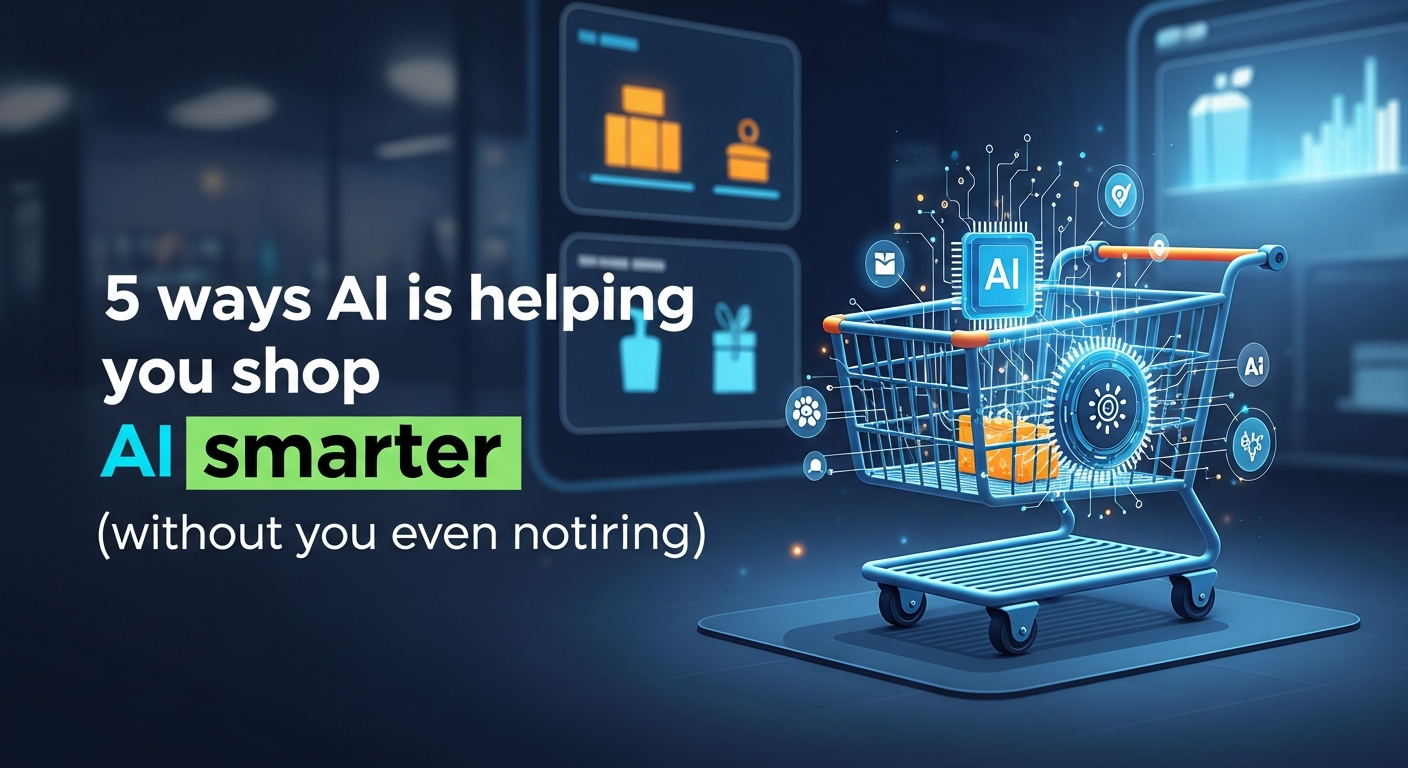
5 ways AI is helping you shop smarter (without you even noticing)
- November 20, 2025
- ~ 1 min read
- 166 views
- Lifestyle & AI , AI in Business
Introduction to AI-Powered Shopping
Did you know that AI in retail is expected to grow to a whopping $23.5 billion market by 2025? This staggering statistic highlights the significant impact artificial intelligence is having on the shopping experience. As consumers, we're no longer just browsing through physical stores or scrolling through online marketplaces; we're interacting with intelligent systems designed to make our lives easier, more convenient, and more personalized. In this article, we'll delve into the world of AI-powered shopping, exploring how AI is revolutionizing the way we discover, purchase, and interact with products.
Why Understanding AI's Role Matters
As consumer behavior continues to evolve, it's essential to understand the role AI plays in shaping our shopping experience. By grasping the concepts and applications of AI in retail, we can better appreciate the innovations that are transforming the industry. From chatbots to personalized recommendations, AI is quietly working behind the scenes to enhance our shopping journeys. Whether you're a retail professional looking to stay ahead of the curve or a consumer curious about the technology behind your favorite online stores, this article will provide you with a comprehensive overview of the practical applications of AI in shopping.
A Sneak Peek into the World of AI-Powered Shopping
In the following sections, we'll explore the top 5 ways AI is helping you shop smarter, without you even noticing. From intelligent product suggestions to streamlined checkout processes, we'll dive into the innovative ways AI is being used to enhance the shopping experience. Here's a preview of what's to come:
- How AI-powered chatbots are providing personalized customer support
- The role of machine learning in predicting consumer behavior
- How AI-driven analytics are helping retailers optimize their inventory and supply chains
- The impact of AI-powered recommendations on consumer purchasing decisions
- The future of AI in retail and what it means for shoppers and retailers alike
By the end of this article, you'll have a deeper understanding of the ways AI is transforming the shopping experience and how you can leverage these innovations to shop smarter, faster, and more efficiently.
The future of retail is not just about technology; it's about creating a seamless, personalized, and engaging shopping experience that meets the evolving needs of consumers. And AI is at the forefront of this revolution.
The 5 Ways AI is Enhancing Your Shopping Experience
Artificial intelligence (AI) is revolutionizing the way we shop, making the experience more convenient, personalized, and enjoyable. From personalization to predictive analytics, AI is being used in various ways to enhance the shopping experience. In this section, we will explore the 5 ways AI is helping shoppers, providing detailed explanations and examples of each.
Personalized Product Recommendations and Streamlined Checkout Processes
One of the most significant ways AI is enhancing the shopping experience is through personalized product recommendations. By analyzing a customer's browsing and purchase history, AI-powered systems can suggest products that are likely to be of interest to them. This not only improves the customer's experience but also increases the chances of making a sale. Additionally, AI is being used to streamline checkout processes, making it faster and more convenient for customers to complete their purchases. For example, some retailers are using AI-powered chatbots to help customers with their purchases, answering questions and providing support in real-time.
AI is also being used to improve the checkout process by reducing the number of steps required to complete a purchase. For instance, some retailers are using predictive analytics to identify customers who are likely to abandon their shopping carts, and then sending them personalized reminders and offers to complete their purchases. This approach has been shown to be highly effective in reducing cart abandonment rates and increasing sales.
Intelligent Customer Service Chatbots and Predictive Analytics
Another way AI is enhancing the shopping experience is through the use of intelligent customer service chatbots. These chatbots use natural language processing (NLP) to understand customer inquiries and provide personalized responses. They can also be used to help customers with their purchases, answering questions and providing support in real-time. For example, some retailers are using chatbots to help customers with product recommendations, sizing, and styling advice.
AI is also being used to improve inventory management through predictive analytics. By analyzing sales data and other factors, AI-powered systems can predict demand for certain products, allowing retailers to adjust their inventory levels accordingly. This approach helps to reduce waste and improve the overall efficiency of the supply chain. For instance, some retailers are using predictive analytics to identify trends and patterns in customer behavior, and then using this information to inform their inventory management decisions.
Virtual Try-on and Augmented Reality Experiences
Finally, AI is being used to create immersive shopping experiences through virtual try-on and augmented reality (AR) technologies. These technologies allow customers to try on products virtually, seeing how they would look and fit without having to physically visit a store. For example, some retailers are using AR to allow customers to see how furniture would look in their homes before making a purchase. This approach not only improves the customer experience but also reduces the number of returns and exchanges.
In addition to virtual try-on, AI is also being used to create personalized augmented reality experiences. For instance, some retailers are using AR to provide customers with personalized product recommendations, based on their browsing and purchase history. This approach helps to create a more engaging and interactive shopping experience, and can also help to increase sales and customer loyalty.
The use of AI in retail is not just about improving the customer experience, but also about creating a more efficient and effective business model. By leveraging AI technologies such as personalization, predictive analytics, and augmented reality, retailers can gain a competitive edge in the market and drive business growth.
In conclusion, AI is enhancing the shopping experience in many ways, from personalized product recommendations to virtual try-on and augmented reality experiences. By leveraging these technologies, retailers can create a more convenient, personalized, and enjoyable shopping experience for their customers, while also improving the overall efficiency and effectiveness of their business model.
Real-World Examples of AI in Retail
The integration of Artificial Intelligence (AI) in retail has transformed the way consumers shop and interact with their favorite brands. From personalized product recommendations to streamlined inventory management, AI is revolutionizing the retail landscape. In this section, we'll delve into some fascinating case studies that demonstrate the impact of AI on sales, customer satisfaction, and operational efficiency.
Personalized Shopping Experiences
One of the most notable examples of AI in retail is Amazon's use of AI-powered product recommendations. By analyzing customer browsing history, purchase behavior, and search queries, Amazon's AI algorithms suggest relevant products, increasing the likelihood of a sale. This personalized approach has contributed significantly to Amazon's success, with reportedly 35% of sales generated through recommended products. Similarly, Walmart has implemented AI-powered chatbots to provide customers with personalized support and recommendations, enhancing their overall shopping experience.
Immersive Retail Experiences
Sephora's virtual try-on experience is another exemplary use of AI in retail. Using augmented reality (AR) technology, customers can try on makeup products virtually, reducing the need for physical testers and minimizing the risk of returns. This innovative approach has not only improved customer satisfaction but also driven sales, with a significant increase in conversions reported by Sephora. By leveraging AI-powered AR technology, retailers can create immersive and engaging experiences that set them apart from competitors.
Operational Efficiency and Inventory Management
Home Depot has successfully implemented predictive analytics to optimize inventory management. By analyzing historical sales data, weather patterns, and seasonal trends, Home Depot's AI system can forecast demand and adjust inventory levels accordingly. This has resulted in reduced stockouts and overstocking, leading to significant cost savings and improved customer satisfaction. As retailers continue to adopt AI-powered inventory management systems, they can expect to see similar benefits, including reduced waste and improved operational efficiency.
- Improved demand forecasting through predictive analytics
- Optimized inventory levels to minimize stockouts and overstocking
- Enhanced customer satisfaction through improved product availability
These case studies demonstrate the tangible impact of AI on retail operations and customer experiences. As the retail landscape continues to evolve, it's essential for retailers to stay ahead of the curve by embracing AI-powered solutions that drive sales, satisfaction, and efficiency. By doing so, they can create a competitive advantage that sets them apart in a crowded market.
By leveraging AI-powered solutions, retailers can unlock new opportunities for growth, improve customer satisfaction, and drive operational efficiency. As the retail industry continues to evolve, one thing is clear: AI is here to stay, and its impact will only continue to grow.
The Technical Side of AI in Retail
The integration of Artificial Intelligence (AI) in retail has been a game-changer, transforming the way consumers shop and interact with products. Behind the scenes, advanced technologies like machine learning, natural language processing, and computer vision are working together to create a seamless and personalized shopping experience. In this section, we'll delve into the technical aspects of AI in retail, exploring the intricacies of these technologies and their applications.
Machine Learning Algorithms in Retail
Machine learning is a subset of AI that enables systems to learn from data and improve their performance over time. In retail, machine learning algorithms are used to analyze customer behavior, preferences, and purchase history to provide personalized product recommendations. For instance, online retailers use collaborative filtering algorithms to suggest products based on the browsing and purchasing habits of similar customers. These algorithms can also be used to predict customer churn, allowing retailers to proactively target high-risk customers with personalized offers and promotions.
Another application of machine learning in retail is demand forecasting. By analyzing historical sales data, weather patterns, and seasonal trends, retailers can use machine learning algorithms to predict demand for specific products and optimize their inventory management. This helps to reduce stockouts, overstocking, and waste, resulting in significant cost savings and improved customer satisfaction.
Natural Language Processing and Computer Vision
Natural Language Processing (NLP) is a technology that enables computers to understand and generate human-like language. In retail, NLP is used to power chatbots and virtual assistants that can engage with customers, answer queries, and provide support. These chatbots use intent recognition to identify the customer's intent and respond accordingly. For example, a customer may ask a chatbot "What's the return policy for this product?" and the chatbot will respond with the relevant information.
Computer vision is another technology that's being used in retail to recognize and analyze visual data. For instance, retailers are using computer vision to develop product recognition systems that can identify products and provide customers with relevant information, such as prices, reviews, and recommendations. Computer vision is also being used to analyze customer behavior in-store, tracking metrics like foot traffic, dwell time, and purchase patterns to optimize store layouts and product placements.
Data Analytics and Future Developments
Data analytics plays a critical role in retail, enabling retailers to collect, analyze, and act on large amounts of customer and product data. By leveraging data analytics, retailers can gain insights into customer behavior, preferences, and purchase patterns, and use this information to inform their marketing, merchandising, and inventory management strategies. For example, retailers can use data analytics to identify top-selling products, optimize their pricing strategies, and predict demand for new products.
Looking ahead, future developments in AI for retail include the emergence of edge AI and the Internet of Things (IoT). Edge AI refers to the deployment of AI algorithms on edge devices, such as smartphones, smart home devices, and retail kiosks. This enables real-time processing and analysis of data, reducing latency and improving the overall customer experience. The IoT, on the other hand, refers to the network of physical devices, vehicles, and other items that are embedded with sensors, software, and connectivity, allowing them to collect and exchange data. In retail, the IoT can be used to track inventory levels, monitor supply chains, and optimize logistics and fulfillment.
The integration of AI, edge AI, and IoT in retail has the potential to transform the shopping experience, enabling retailers to provide personalized, seamless, and immersive experiences that drive customer loyalty and retention.
In conclusion, the technical side of AI in retail is complex and multifaceted, involving a range of technologies and techniques that work together to create a personalized and efficient shopping experience. By understanding the how behind AI applications in retail, retailers can unlock new opportunities for growth, innovation, and customer engagement.
- Key technologies: machine learning, natural language processing, computer vision, data analytics, edge AI
- Applications: personalized product recommendations, demand forecasting, chatbots, product recognition, inventory management
- Future developments: edge AI, IoT, real-time processing and analysis
Implementing AI in Your Retail Business
As a retail professional, you're likely aware of the potential benefits of AI implementation in your business. From enhancing customer experiences to streamlining operations, AI can have a significant impact on your bottom line. However, implementing AI effectively requires careful planning and execution. In this section, we'll provide a step-by-step guide to help you get started with AI implementation in your retail business.
Assessing Your Business Needs and Goals
The first step in implementing AI is to assess your business needs and goals. This involves identifying areas where AI can have the most significant impact, such as inventory management, customer service, or supply chain optimization. Take the time to analyze your current operations, identifying pain points and opportunities for improvement. Consider the following questions:
- What are your business objectives, and how can AI help you achieve them?
- What are the biggest challenges facing your business, and can AI help address them?
- What are your customers' needs, and how can AI help you meet them?
Choosing the Right AI Technologies and Vendors
Once you've assessed your business needs and goals, it's time to choose the right AI technologies and vendors. This can be a daunting task, given the numerous options available. When evaluating vendors, consider factors such as their experience in the retail industry, the scalability of their solutions, and their ability to integrate with your existing systems. It's also essential to assess the vendor selection process carefully, ensuring that you choose a vendor that aligns with your business objectives and can provide the necessary support and training.
Some key considerations when choosing AI technologies include:
- The level of customization and flexibility offered by the solution
- The quality of customer support and training provided by the vendor
- The solution's ability to integrate with your existing systems and infrastructure
Developing a Strategic Plan and Training Staff
With your AI technologies and vendors in place, it's time to develop a retail strategy for implementation. This involves creating a comprehensive plan that outlines the steps necessary for successful AI integration, including staff training and support. Your plan should include:
- A clear timeline for implementation
- A budget for AI-related expenses
- A plan for training and supporting staff
Training and supporting staff is critical to the success of your AI implementation. Ensure that your staff understands the benefits and limitations of AI, as well as how to use AI-powered tools effectively. This may involve providing ongoing training and support, as well as encouraging a culture of continuous learning and innovation. By investing in your staff, you can ensure that your AI implementation is successful and that your business reaps the benefits of AI implementation.
Remember, successful AI implementation requires careful planning, execution, and ongoing support. By following these steps and prioritizing staff training and support, you can unlock the full potential of AI in your retail business and stay ahead of the competition.
The Future of AI in Retail: Opportunities and Challenges
The integration of Artificial Intelligence (AI) in retail is transforming the way businesses operate and interact with customers. As AI technology continues to evolve, it is essential to consider both the opportunities and challenges it presents. On one hand, AI offers numerous benefits, including increased efficiency, personalization, and enhanced customer experiences. For instance, AI-powered chatbots can provide 24/7 customer support, while machine learning algorithms can analyze customer data to offer tailored product recommendations.
Potential Benefits and Risks of AI in Retail
Some of the potential benefits of AI in retail include improved supply chain management, optimized inventory levels, and reduced costs. Additionally, AI can help retailers to better understand customer behavior and preferences, enabling them to make data-driven decisions. However, there are also potential risks and challenges associated with AI in retail, such as job displacement and data privacy concerns. As AI takes over routine and repetitive tasks, there is a risk that some jobs may become redundant, while the collection and analysis of customer data raises concerns about privacy and security.
Moreover, the use of AI in retail also raises questions about responsible AI development and deployment. As AI systems become more autonomous and decision-making, it is crucial to ensure that they are transparent, accountable, and fair. This requires retailers to prioritize ethics and accountability in their AI development and deployment strategies, ensuring that AI systems are designed and used in ways that benefit both businesses and society as a whole.
Comparing AI Technologies and Applications in Retail
Different AI technologies, such as machine learning, natural language processing, and computer vision, have various applications in retail. For example, machine learning can be used for demand forecasting and inventory optimization, while natural language processing can be used for chatbots and virtual assistants. Computer vision, on the other hand, can be used for image recognition and analysis, enabling retailers to monitor inventory levels and detect anomalies. The following are some examples of AI technologies and their applications in retail:
- Machine learning: demand forecasting, inventory optimization, and customer segmentation
- Natural language processing: chatbots, virtual assistants, and sentiment analysis
- Computer vision: image recognition, inventory monitoring, and anomaly detection
Ensuring Responsible AI Development and Deployment
To ensure that AI is developed and deployed in a responsible and ethical manner, retailers must prioritize transparency, accountability, and fairness. This requires AI benefits to be balanced with AI risks, and for retailers to consider the potential impact of AI on their customers, employees, and society as a whole. By doing so, retailers can harness the power of AI to drive business success, while also promoting a positive and sustainable future for the retail industry. As the future of retail continues to evolve, it is essential for retailers to stay ahead of the curve, embracing AI and other emerging technologies to drive innovation and growth.
The key to successful AI adoption in retail is to strike a balance between the benefits and risks, and to prioritize responsible AI development and deployment. By doing so, retailers can unlock the full potential of AI, driving business success and promoting a positive and sustainable future for the retail industry.
Conclusion: The AI-Powered Shopping Experience of the Future
In conclusion, we have explored the various ways in which AI in retail is transforming the shopping experience, making it more personalized, efficient, and enjoyable for consumers. From intelligent product recommendations to streamlined checkout processes, AI is revolutionizing the way we shop. The 5 ways AI is helping shoppers, as discussed in this article, are:
- Personalized product recommendations
- Intelligent chatbots for customer support
- Streamlined checkout processes
- Smart inventory management
- Enhanced customer experience through analytics
Reflection on the Potential Impact of AI
The potential impact of AI on the retail industry is substantial, and it is likely to change the future of retail as we know it. As AI continues to evolve and improve, we can expect to see even more innovative applications in the retail space. Retailers who embrace AI in retail will be better equipped to provide their customers with a seamless and personalized shopping experience, ultimately driving sales and revenue growth. On the other hand, those who fail to adapt may struggle to remain relevant in a rapidly changing market.
Call to Action for Retailers
So, what can retailers do to stay ahead of the curve? The first step is to explore AI implementation and understand how it can be leveraged to improve their business. This may involve investing in AI-powered technologies, such as machine learning algorithms and natural language processing, or partnering with AI solution providers to develop customized solutions. Retailers can also start by analyzing their customer data and identifying areas where AI can add value. By taking these steps, retailers can unlock the full potential of AI in retail and create a future-proof shopping experience that meets the evolving needs of their customers. As the retail industry continues to evolve, one thing is clear: AI is here to stay, and it will play a vital role in shaping the future of retail. By embracing this technology and exploring its many applications, retailers can stay ahead of the curve and thrive in a rapidly changing market.
The future of retail is AI-powered, and it's time for retailers to take notice. By leveraging the power of AI in retail, businesses can create a more personalized, efficient, and enjoyable shopping experience that drives sales and revenue growth.

Comments (0)
Please login or register to leave a comment.
No comments yet. Be the first to comment!